What Does Doubles Look Like?: Being an Over-Worked Mom

(Photo by Ketut Subiyanto, pexels.com)

When my husband was working, I remember telling him that I missed going to work and getting time away from the house. Now that the cards have turned, I would give anything to quit my jobs, drive my kids to their events, and be at the teacher-parent conferences. In a snap, all the responsibilities I had taken for granted now are my husband’s.

As a nonworking parent, it’s easy to say, “I work full time too, as a parent,” which is apprehensible. Yet, the working parent doesn’t get noticed for the long hours away from the kids, creating new working relationships with coworkers and clients that aren’t nearly as meaningful as a relationship with their children.

What does doubles look like? That’s what my girlfriend texted me today, trying to squeeze in some connecting time. Doubles to me looks like getting ready for work at 6 am. 5 days a week, I put my dreads up into a bun. I take the kids to school at 7:45 am and begin work at the schools by 8:15 am. As a substitute teacher, I’m on call, but as the winter months have come, the need for a substitute is so great that they can book me weeks in advance. Lately, I’ll have the month booked prior to the first.

So, I go teach at a school with new-to-me office personnel and principals, with new students and teacher’s aids. I do my best, which is usually appreciated, and then jump into my car at 3 pm. Lately, I’ve been working in high schools, with developmentally challenged children, and my usual K-8th. I enjoy all my jobs. I like impacting my community, even if it’s a different community every day.

Then at 3 pm I jump into my car and drive home. In between shifts, my husband can find my doubles frustrating. He might not always support me in the way that I would want him to. For example, sometimes, he wants attention instead of just giving me time with the kids. This, in turn, frustrates me and can create problems.

So I get home and spend 30-45 minutes watching TV with the kids, reading Malakai a book, and asking Halaya how school was. At 4 pm, I start getting ready to go to work. After I shower, change my clothing, and do some makeup, I put my hair back into a bun and put a net on it. I’ve noticed some intense neck pain with the dreads and having them pilled up on the top of my head, all day, but they are symbolic to me, a marking of when I became pregnant and had Malakai, similar to how my partner’s dreads mark Halaya’s conception. I leave fifteen minutes before my shift every day. I either walk and calm my mind during this time or spend ten minutes in my car in front of the restaurant playing Lily’s Garden on my phone.

So far, I’ve always been on time for work, besides once when I thought I started work at 5 and not 4 (that’s on Sundays only.) When I go to work, I begin a set routine. I always fill the chocolates that go with the receipts before I clock in. Then I walk toward the kitchen, pounding fists with the server I’m relieving and saying “Hola” to the staff in the kitchen. I clock in and begin with the bar, taking the same steps every day unless the other server gets to work before me; in that case, he will start with the bar. I get to choose the light color that lights up the liquor. The other server said he never put the light on in the past, so I got the privilege. I choose the color that matches my mood for the day, not that anyone notices. Something about this rhythm of doing things in the exact order helps me balance my full day’s worth of work. If I perform these steps, everything will be okay, and nothing will be forgotten.


When it comes to customers at Chapala’s, everyone is nice. The staff is friendly, and the customers are lovely. I am fortunate with this job. I don’t make the tips I would in San Diego, but I make enough to pay my bills and take my daughter to do something fun on the weekends. While I’m waitressing, somebody might take offense if I try to crack a joke or say anything that’s not in line with what I say to almost every table. It’s the world we live in today. Dry or dark humor is not often appreciated, so I just kind of do this step-by-step process.


Chapala always gives me a shift meal. This is my first time working at a restaurant that gives a waitperson a shift meal. I appreciate this because not being hangry is essential to me. So I always accept this meal. I feel healthy in general, eating Mexican food almost every night. I mostly get salads, but rice and beans, meat, and some sauce are better for you than people may make it out to be. So when I close Chapala, it’s never the worst day of my life, well besides when my friend died, but I asked to go home early that day, and they understood. This place is one of the best restaurants I’ve ever worked in.


So I get some days off, right? Well, I’m trying to run this small business. I need to make products and content and create a community with the business you’re reading this blog from right now. So, a lot of times, I come home, and I can’t even be present. I go down to Scotia on Fridays (I’m off from the restaurant Fridays and Saturdays) and read Tarot cards. I love reading Tarot cards. I love connecting with my community and guiding them through the cards. I’m very blessed to have this opportunity. Every other Friday, I go from my Tarot readings to the Explore Your Shadow acrylic expression class I teach at the Children’s Cottage. Most Saturdays and Sundays, I vend. I vend all over Humboldt County, and Little Lost Forest is growing in its presence in the community. But to answer the question I do get holidays off, off from the restauarant and from the schools. These days are not meant for cooking.


So when is enough, enough? Well, the more people I talk to, the more I hear, “I worked doubles and triples in my thirties.” I guess, this is the grind yet here I am having dreams where I’m screaming “I quit!” I envision myself leaving the restaurant in January. This will be a hard pull because restaurant money is quick money, and umbrellas the funding for my small business and pays the bills. I foresee Orion and I traveling to Renaissance Festivals next year to do the wand workshop and sell witchcraft goods. I envision myself attending grad school for writing, influenced by history and art. I would love to get a remote job where I work from home as a personal assistant. I can take substitute teaching jobs as I wish. Orion and I also make baked goods, which I sell at the Children’s Cottage. I dream of marketing this better online.


Next year, I foresee myself going to Germany to see my grandfather’s grave. A loss that I took hard over the summer. And most of all, I see myself spending more time with my kids next year. Without the restaurant job, I will get afternoons with my kids. Teaching occasionally instead of five days a week will allow me to grow my business. The new year is right around the corner. I’m going to keep my head down and grind it out, knowing that nothing is forever.
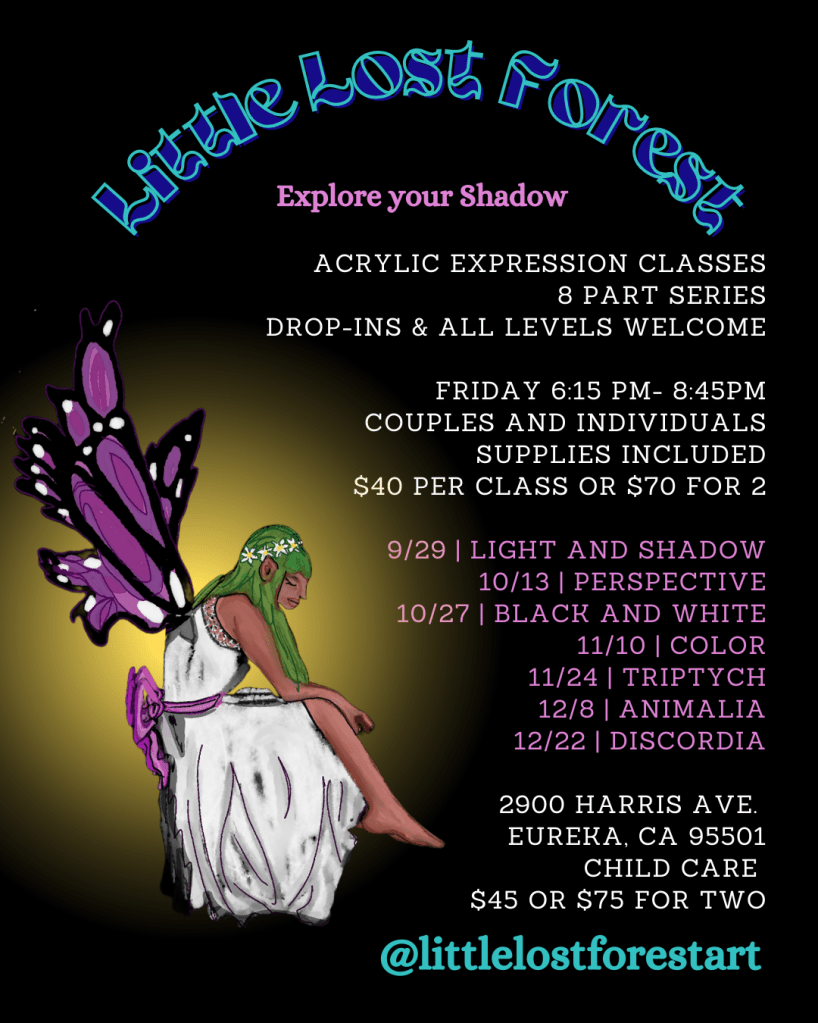
Therapeutic Art Class: Perspective 2/8

YouTube Link

Introduction.

Today we will discuss perspective, perspective in art, and cosmic perspective.

Tarot Card: Choose a card and tell me how the card relates to you today.

Quick warm-up; neckrolls, touch toes, etc.

Breath in 12345, Hold 12345, Slowly Release 12345

Breath in 12345, Hold 12345, Slowly Release 12345

Breath in 12345, Hold 12345, Slowly Release 12345

Breath in 12345, Hold 12345, Slowly Release 12345

Breath in 12345, Hold 12345, Slowly Release 12345

Thank the elementals of the North, in your mind’s eye picture elements of the earth.

Thank the elementals of the East; in your mind’s eyes picture elements of air.

Thank the elementals of the South; in your mind’s eye picture elements of fire.

Thank you elementals of the West; in your mind’s eye picture elements of water.

Thank Pachamama, the earth and ground we sit on,

Thank the cosmos above,

Thank yourself for showing up here today. Sit with the bright light that fuels your soul, the same bright light that fires the sun.

Thank the sun,

thank yourself,

acknowledge your light.

Imagine you are in a dark cosmic space,

In a rush, like a rapid river, you come into the earth, as if out of a womb, to the light.

Where are you?

Notice your surroundings, rather it be inside or outside,

picture the town you are in,

the state that town resides in,

the continent that holds that state.

Now imagine the planet that, that continent calls home.

And the galaxy on the planet lives.

Bring your mind’s eye higher to the Universe that the galaxy is a part of.

Take a deep breath and look around you.

You are never alone.

Say it out loud; I am never alone.

Okay, thank you for allowing me to guide you to this place. Sit here for a second, look around you. What do you see?

This is inside you, and every one of us.

Acknowledge the vastness, that exists within you and within me.

The complexity of that cycle is infinite and continues to exist, exist in you and in me.

Now lift yourself into a flying position, and travel back to your planet, where you came out of the darkness and into space. This is your safe space. Do you remember it?

What is around you? Are there people?

Are you in a city? Are you on a mountain? Near a Lake?

Are you around people? What are the people doing?

Are you around animals? What are the animals doing?

We’re going to paint this space, so sit with you for as long as you are comfortable. Explore the details of this space.

Now while you are in this safe space, take a mirror, and look into the mirror. In the mirror is a problem. A problem that has been bothering you for a very long time.

How do you respond in your day-to-day life to this problem?

Do you scream at it?

Throw objects because of it?

Do you experience hate for others because of this problem?

Self-hate because of this problem?

Self-doubt?

Do you feel unrest because of this problem?

Has it kept you up at night?

Today we’re going to accept this problem for what it is. You can’t hate a problem you accept. You can only move forward once you’ve accepted a problem.

After you have chosen to accept this problem, we are going to explore ourselves by using this problem.

Looking at this problem in this mirror, talk to the problem. Have a conversation with this problem. Ask it questions, express your thoughts, and listen to the answers.

We are going to sit in silence for approximately five minutes.

When you feel satisfied with the conversation, we have had with the problem take a pair of scissors and cut any strings that attach you to this problem This problem is no longer serving you are you are ready to move on. After you have cut the cords, say goodbye to the problem and wish it a safe travel into the light.

Place down the mirror and look at the space you are in. Is anything different?

Do you notice more in the space?

What details stand out to you?

Please hold onto this imagery as you open your eyes.

When we experience uncontrollable rage, we view it from the perspective of the self rather than the global consciousness. This doesn’t devalue your rage. Your rage may or may not be valued. But even great leaders have not solved their problems by running into battle, but rather by placing their pieces deliberately and playing their cards strategically.

Now let’s get into perspective in art:

To understand perspective in art we start with the viewer,

The viewer sees infinitely far away, this is the horizon line. On the horizon line is a vanishing point. A single vanishing point is called one one-point perspective.

Now let’s add a second vanishing point, in most cases the vanishing points are slightly off the frame.

Now lower the horizon line, now the viewer is looking up. Add a third vanishing point above off frame. This is called a three-point perspective. We can also take the horizon line and move it up, now we are looking down.

Now take an object and put it far in the distance, the object will become smaller. Bring that object closer and it will be larger.

Take note that there is a relationship between size/ distance and eye level.

Now imagine a river or a car going from angle to another, you see the slope?

Now put that same river, or that same angle into the distance, the line is going to look horizontal. Distance forces horizontal lines.

Distance forces horizontal

Now quickly let’s talk about light and shadow. We discussed this in detail in our last class.

We have the foreground which is closest to the viewer, then the midground, and the background. In the foreground, we can see the shadow of the sun easily. As well progress into the background the shadow will be less. In the foreground, there is a variety of color and values in the shadow. In the midground, the depth of colors are brought to the cyan-blue colors. In the background, there are simple changes in colors. The sky does not go from yellow to blue but rather the yellow influences the blue and the blue fades into yellow. Color happens due to light, so the light family reserves its colors more than the shadow family. Yellows get filtered out because of the atmosphere.

Take your notebook and start sketching your scene. Remember we are focusing on perspective. This will not be a portrait but rather a landscape.

Where are you looking toward the horizon line? Up, down?

Place your horizon line onto the paper.

Are you looking toward the left? the right? the center? Plot your vanishing point. If the vanishing point is a three-point perspective than plot your vanishing points off the frame. Now draw your chart lines.

Where do the buildings, trees, and objects fall on the horizon line?

What objects overlap? Buildings overlapping other buildings? People overlapping the ground? Boats overlapping walls of trees? Not overlapping shapes take away from your scene. Populate your painting. Put basics down, this is a tree, this is a person, etc., and fill the space. We will audit later. Tweak the lines to lead to the vanishing point.

Paint 1.5 hours.

In closing, talk about your painting.