McNamara, Miriam. The Unbinding of Mary Reade. Reprint ed., Sky Pony Press, 2019.
The Unbinding of Mary Reade is a historical fiction novel about a transgender pirate named Mary, who lives as Mark and joins a crew led by Captain Jack. Jack’s female companion, Anne, takes a romantic interest in Mark, and their evolving relationship becomes the heart of the story.
Mary’s life of disguise begins when her mother forces her to live as a boy in order to secure her grandmother’s inheritance, binding her chest with a sheet to conceal her gender. Over time, Mary becomes accustomed to being perceived as a man and develops fluid attraction, forming a close relationship with a servant named Beth. When Beth exposes Mary’s secret, Mary is forced to flee and eventually takes to the sea. Living as Mark the pirate, she earns respect among the crew—but her growing affection for Anne threatens to expose her again. When Anne learns the truth, she expresses a desire to bind herself and live as a man as well. Mary warns her of the hardships that come with this life, but Anne insists that being a woman in the 1700s is far worse.
In this annotation, I explore some of the controversial and allegorical themes McNamara weaves into her narrative—many of which still reflect social struggles in our world today. The novel uses historical fiction to examine class systems, gender identity, and freedom through a lens of political allegory.
One passage captures the novel’s commentary on class inequality:
“If only everything worked that way.” If only Granny had just double what Mum did. If only Baas had double what his sailors did. “Imagine if the king himself could only have twice as much as the poorest beggar. That world would be a different place.” (75)
Here, McNamara critiques the imbalance of wealth and power by imagining a world where those in authority could earn no more than double their subordinates. This reflection feels remarkably relevant in today’s world, where similar inequalities persist across class lines.
Later, a heartfelt conversation between Mary and Anne highlights the struggle for autonomy and freedom, particularly for women and those living under oppressive rule:
“You’re never free, so long as you’re subject to someone—to a captain, or the crown, or whatever good-for-nothing man decides to lord over you.” (82)
This line resonates deeply with the current political climate. Though America was founded as “the land of the free,” modern politics challenge that promise. During Donald Trump’s presidency, many saw the erosion of democratic norms—the undermining of separation of powers, the targeting of free speech, and the questioning of birthright citizenship. McNamara’s words remind us that freedom must be continuously protected, and that systems of control—whether monarchies or modern governments—can threaten that ideal.
As a writer, I am inspired by McNamara’s ability to weave political allegory into personal narrative. I aim to do the same in my own work—addressing tyranny within communities, advocating for women’s rights, championing LGBTQ+ acceptance, and encouraging open dialogue across divisions. In my fiction, I want to support characters who use zie/zir/zirs pronouns, model resistance against unjust authority even at great personal risk, and portray diverse people working together to rebuild communal, earth-centered lives.
Through The Unbinding of Mary Reade, McNamara demonstrates how storytelling can both preserve history and challenge it—reminding us that identity, justice, and freedom are battles that transcend time.
On November twentieth, around nine in the morning, Natascha and her family friend, Sam P, met with Satya at Ramone’s Bakery and Coffee in Eureka. Their conversation became a deep dive into Satya’s history in the healing arts and the many ways she serves the community as a facilitator of sound baths, microdose offerings, yoga, reiki, and tuning fork sessions. Satya has brought peace of mind to many by offering a safe space to release, recover, nurture, and learn how to move through life’s challenges with greater ease.
As we enter the winter season, we invite you to explore the power of sound healing and discover how giving this practice a chance can enhance your life in the most positive way.
Natascha: Good morning Satya. Thank you so much for joining me today. At Little Lost Forest we’re always honored to highlight local healers, artists and visionaries. And today we’re in for a special treat. Humboldt County sound healing artist Satya Earth, founder of Satya Healing, is here to share her journey, her craft and the heart centered intention behind her work. I first discovered Satya during one of her sound healings and mushroom microdose sits. Over the course of about 90 minutes, a small mushroom microdose, gentle yoga and closed eyes opened the door to a vivid inner landscape. The soundscape she and her collaborators created carried me from the depths of the ocean to a fairy lantern forest, and eventually into the far reaches of space. The magic she facilitates comes not only from the instruments she uses, but from a deep well of knowledge, intuition, and care. Today we dive into that magic, its origins, its purpose, and the person behind it. Can you tell us a little bit about yourself?
Satya:Thank you for having me here. It’s really great to see you. A little bit about myself. I’m a mama of two little ones. They are my whole world and have been a driving force for my evolution in the landscape of sound healing, energy work and working with medicine. My background comes from psychology. I majored in psychology and got my bachelor’s in 2014, and from there I decided to branch out and study different forms of holistic healing. I studied yoga and herbalism, energy work, and sound healing, and have now branched out into the realm of working with psilocybin.
Natascha: Yay! Thank you for sharing. When did your journey with sound healing begin?
Satya: I attended my first sound bath with Jen Madrone back in 2017, and that was an initiation into the world of sound healing and experiencing. Noticing where I was in my life at that time.
Sound healing can stir up a lot of things for us, especially if we’re just beginning the journey. Throughout the years, I’ve gathered tools to support integrating the experiences and emotions that arise when receiving sound healing. This has helped to make it easier to understand and navigate the things that come up. It can really bring up a lot of stuff. Like old stories and thought patterns. Bringing them forward to be acknowledged and felt. It was a beautiful introduction to getting to know myself. The stories that I hold and how to how to work with them and how to transform them. In 2021 was when I bought my first gong and that was inspired through the birth of my second daughter. I had a very challenging experience with postpartum depression. In a place of desperation to not return to pharmaceuticals, I searched online things that could help my nervous system and help with depression and anxiety. Sound healing was the first thing that popped up. I was reminded of my experiences with Jen and decided to take the leap to purchase my first gong.
Natascha: That’s beautiful. I really love how you worked against the postpartum and found natural ways to heal instead of falling into it. Did you have any mentors or influential teachers along the way?
Satya: Absolutely. My number one mentor, her name is Josie Bravo. I met her when I was when I was in a hospital. I had a really hard adolescence; childhood. She met me at some of the hardest times in my life. I’ve known her for 29 years now. She has been a guiding light and I wouldn’t be where I am today without her support.
Natascha: Wow.
Satya: She’s been a really big influence. Like a guardian angel for me along this path. My other mentors are Jen Madrone. She’s an incredible being, here in Humboldt County. I’ve studied Reiki II and my Master Reiki course with her. A couple other influential teachers are Eileen McKusick. She’s the woman that discovered tuning the human biofield. I love blending my own interpretation of her teachings into my sessions. I scan the field with a tuning fork and listen for different sounds and that resonate from the tuning forks to let me know where there is perhaps some stuck energy that can be brought into coherent energy. Another incredible teacher that I haven’t had the opportunity to learn from yet, but I’ve heard great things of his name is Mike Tamburo and he will be here in Humboldt County in March 2026.
Natascha: What will Mike be teaching you or working with you?
Satya: He’s a gong master. He’ll be doing three day long class for a few days. And we’ll be learning different techniques and styles of how to work with sacred healing instruments, mainly gongs.
Natascha: During your sessions, there’s usually other people in the room that are playing the instruments along with you or offering the mushroom micro-doses. Who do you choose to collaborate with for your sound healing sessions?
Satya: I just collaborated with Fallon Orr. We had a beautiful offering where we offered microdosing, yoga nidra and sound healing. It was a different space from the class that that you attended. More stillness and opportunity to reflect in that stillness. It was very supportive for rest.
I just received my certification as a psychedelic facilitator through Emerald Valley Institute. After sharing medicine in the community for nearly 4 years, I decided I wanted to learn more about the history, culture and varying approaches to holding ceremony in psychedelic spaces. Another person I have worked with is Michiah Tobin. She’s an acupuncturist based out of Fortuna. I love blending multiple modalities together for a transformative intentional experience.
Natascha: Well thank you. How do these sounds and frequencies impact your participants?
Satya: That’s a great question. Each person and how they experience sound is very unique. And each session is very unique. Some of the things that I have noticed participants experience would be emotional clearing and release. I’ve heard some really good feedback on how people will come into a session feeling highly stressed and overwhelmed with life and would leave with a new state of grounded clarity. The beautiful thing about sound healing is that it creates neural plasticity and neurogenesis. By approaching your session with an intention this offers us an opportunity to see, feel and think differently about the things that we’re experiencing in life. And like you said, when we’re in this space there are visuals, there’s feelings of floating. It can be a psychedelic experience without the medicine, with the things that we see and that we feel. It offers a place of deep rest for the nervous system.
Natascha: Absolutely. I definitely found a release for my anxiety when I go to your sound healings and I feel really well going back into the world, more prepared. Your vocal work is especially moving where you learn to sing? What language or tradition are you drawing from?
Satya: I’ve been singing since I was three. Song has been a part of my whole life. I was in choir for eight years, and I was in a band for a couple years. Interestingly, I always felt nervous. And to this day, I still feel some nerves before I sing. But, after I traveled to India back in 2014, I was studying yoga there and we learned a lot of mantras and Sanskrit prayers. It is in this place of prayer that the anxiety dissolves and my intention of sharing song expands. I sing in Sanskrit, and the songs that you’ve probably heard are called the beginning prayer, the ending prayer and the Anahata prayer.
Our voices are our most powerful instrument, and it’s my mission to continue sharing this instrument, along with these other instruments and empowering other people to come into a place of comfort in their own body and their voice. I encourage people when I’m singing, when the sounds are going; we can hum, we can sing too, and start to vocalize because that’s how we can move energy throughout our body.
Natascha: Yeah, that’s some of my favorite moments. I really enjoy your singing, and I like that you pushed me to sing and your participants to sing, because oftentimes I don’t use my voice. It does resonate with me, and it does bring something positive out. So thank you for doing that. What dreams and aspirations do you have for such a healing moving forward?
Satya: I love this question.
Natascha: What’s next?
Satya: Yes I am so excited about what’s next.
I am creating some packages to make these experiences more accessible. After going through my psychedelic facilitator training, I really want to work with marginalized communities. Whether that means I look into what it would be to become a nonprofit or I look into fiscal sponsorship. I really believe that this type of medicine is something that everybody needs.
Natascha: Cool. I can’t wait to see where you go with it. Was there anyone who inspired the evolution of your art or an event? Possibly.
Satya: Absolutely. I had some moments to reflect on this, and the evolution of my art truthfully, has come from a place of pain and suffering and knowing that these wounds can be transformed. And I’m speaking from a mother wound that without that experience and without those wounds, I wouldn’t be where I’m at today. Having a troubled relationship inspired me to ask: how can I best show up for myself and how can I best show up for my children and for my community? How can I create this space of safety and trust within myself and within my community?
I’ve been learning different communication styles, like compassionate communication, paraphrasing and reflecting. These are all practices that I’m in a space of learning right now and eager to implement into how I parent my children and how I speak to myself, how I speak to my community and to my clients, and I’m really encouraging all of us to become more curious about how are we communicating with ourselves? How are we communicating with our loved ones? Because this is where we can we can really come together and come together in a space of safety and trust.
Natascha: I think you’re really advocating for people that are struggling, that there’s a light on the end of the tunnel. As a mother, too, there’s a lot of stress in motherhood and seeing you blossom and bloom that shows that we don’t have to be the pain of our families, but that we could create our own positive walk of life and the way that you impact your community. It loudly speaks that you walk the walk that you’re not just talk. So thank you for doing all the all the work you do with us here in Humboldt. What are your thoughts on human consciousness?
Satya: Another fabulous question, Natascha. My thoughts on human consciousness; human consciousness to me, is a state of being. I come from a spiritual and perhaps Buddhist approach where I believe that all living sentient beings from our animals to the trees to the rocks, to the dirt, to the insects. We all have a consciousness. We are all here coexisting as one on this cell of Earth. And when we can come into that place of connection, we can really start to come together in this collective ecosystem.
Natascha: That’s beautiful. How does that deconstruct the ego when you come into a mindset of a universal consciousness?
Satya: Mmm, yeah. We’re definitely deconstructing the ego and perhaps deconstructing the hierarchy of humans being at the top and everything else being below us. I know that there is definitely some advancement in technology where we are now having the opportunity to communicate with our animal friends. And it is deconstructing how we view our existence and how we view the existence of other beings in this world. It’s really powerful. We can come into this from a wholehearted space, or we can, you know, use it for power. So it’s really up to the individual and how we approach this type of technology. Language is technology too. You know, it’s like these things are always advancing. And so it’s like, who is behind this and what are our intentions behind it? And it’s how we show up and how we reflect that into our circles and into our community. And that’s when we really have that opportunity again, to come together into this collective space of awareness, which is kind of linking to that state of consciousness, the consciousness and the awareness, how we show up, how we reflect, how we have awareness of our energy and how we impact the environment around us. I feel like I could go on forever.
Natascha: I love this, I just want to dig a little deeper into it. You mentioned animals briefly. Is there a connection between your sound healing and nature? Maybe you play your music outside, or you feel a deeper connection to the earth and to the animals when you perform sound healing?
Satya: Absolutely. I have a very deep connection with the elements and with nature. When I take my gong out and I play next to that maple tree and Cheatham Grove, I’m playing for that tree and I’m playing for the land. And I just imagine this time lapse of this tree living there and all the things that have surrounded it. And for me, I just, I want to be with that tree for that moment and play the sounds. And when I play my infinity disc, that sounds like the ocean, I’m like, man, this tree won’t ever have that opportunity to be by the ocean. So maybe I could bring the ocean to the tree.
Natascha: Cool and lastly, what are your beliefs or reflections on the afterlife?
Satya: Reflections on the afterlife. I do believe that we are reincarnated. I do believe in karma. I believe that the things that we’re experiencing in this life are perhaps a reflection of the life we’ve led before. I also go between this, you know, when we die, we go into the void. We go into emptiness. No one knows. And we have access to so much information that we can decide what we want to believe. But we truly just don’t ever know. So when I think about what the afterlife is, I like to consider a lot of things. But I also don’t have a concrete belief because nobody truly knows.
Natascha: Absolutely.Do you have any advice for someone that might be depressed, anxious, or struggling in their life? How to get out of that negative spiral?
Satya: Well, there are many approaches to helping ourselves through these stagnant, dark places. The first approach that I like to suggest is, depending on the severity of it, is having a counselor or a therapist. Somebody to offer an objective perspective, somebody who will support us in our stories that we share and perhaps guide us into healthier states of thinking. Also bringing in the element of what are we putting in and on our body. And that’s not just food, that’s not just cosmetics. That includes the things that we watch, that includes the people that we surround ourselves with. That includes supplements that we’re taking. So it’s really a whole approach when we start getting into this world of depression and anxiety. I mean, we can look at our gut microbiome that’s definitely linked to anxiety. Parasites are linked to anxiety. And then when we start to go in a little bit deeper outside of the the physical being of depression and anxiety, we can start to go into like the emotional body and the ethereal body, and that’s where we can bring in these alternative modalities to help us. That could be energy work, that could be sound healing and microdosing. But then again, drawing it back into the self, it’s really about our perspective, how we speak to ourself. So again, coming into that tug of war that we experience when we’re going into this place of depression and anxiety: The stories that we tell ourselves, how we talk to ourselves. And a lot of this is linked to how we were raised and how we were talked to and how we were taught to manage these things.
Satya: In my psychedelic facilitator training, we learned about this thing called the default mode network. And when we’re born, up until we’re about four, this network in our mind is very malleable. But around the age four, we are now learning to exist in the world through the way that we are talked to by our family members and the authority around us. And those pathways start to get very rigid. And so then we start existing in that story. So when we are working with psilocybin in larger doses, we have the opportunity to do what is called a reset dose, where the default mode network gets shut down. And this is where we have access to new pathways, new ways of thinking and feeling existing, perceiving and we want to be slow with this. Whenever we’re in this place of depression and anxiety, how long did it take us to get here? How long have we been in that place? And just know that there’s no one pill. There’s no one experience that’s going to shift things. This is a practice that we have to implement and be dedicated to daily. The most important facet of that is who are we surrounding ourselves with? Who is our support system, our community, the classes we attend, the people we talk to. These are all factors to consider when we’re starting to address these symptoms of depression and anxiety.
Natascha: Coming into the winter, is there are certain practices that you do seasonally; more winter style forms of healing?
Satya: When we come into the winter. I personally think about darkness. I think about going into a place of hibernation. I think about what is nature doing? And I do my best as a single mother, to slow down. Some practices that we can do is look at how we can slow down. How we can create spaciousness and just noticing when we are overdoing. When we are doing too much and just taking a moment to step back, reflect and say “hey, I need to cancel.”
Satya: One practice that I learned recently that’s been so helpful, is tuning into our breath and tuning into what it means to clear our energetic field. When we are starting to experience that tightness in the body, or we notice we’re getting really overwhelmed and feeling frantic. Come back into the breath. Breathe through the souls at the feet.
Satya: And as we’re exhaling, we’re releasing this energy out through the crown of the head. And this is the cycle. Breathing in through the feet, coming through the center of the body, breathing out through the crown. And as we continue this breath, we’re starting to think about, I’m breathing in calm and I am letting go of any tension. I’m letting go of any chaos that I’m holding in my belly, that I’m holding in my heart. I’m holding in my brain. I’m letting that go. I’m returning it to sender. I’m returning it to the universe. And I love this practice, especially for people who are highly sensitive or for highly empathic people. People who tend to absorb energies easily. This is an amazing breath practice, because then we get to tune into not only our breath and clearing our fields, but we’re starting to acknowledge what is mine and what is not mine. What am I holding on to? Maybe I’m holding on to something that I experienced yesterday, and now it’s time to let that go. And it’s time to bring in that clearing and that self-forgiveness, so that we can have a clear field and show up for our friends and our family in a more balanced state.
Natascha: As we move into the winter, sound healing offers a powerful way to calm the nervous system, reconnect with the heart, and bring clarity to the mind. Satya, thank you so much for your time and for sharing your wisdom with our Little Lost Forest community.
Satya: Thank you so much. I appreciate you. Thank you for calling me in and sharing these moments together. Blessings.
I am looking forward to the Super Winter Moon—also known as the Cold Moon—on December 4th at 3:14 p.m. PST.
The Cold Moon is traditionally understood as the final full moon of the year and has been associated with stillness, endurance, and introspection. The name “Cold Moon” appears in the traditional lunar calendars of several Indigenous peoples of the Northeastern United States, including the Mohawk, who used the term to describe the deepening cold and the natural slowing of the world. Other cultures—such as early European agrarian communities—also recognized this moon as a marker of winter’s threshold, a time of rooting inward and preparing for spiritual renewal.
I will be offering a Grounding Ceremony at the Grove of Hecate on Saturday, December 6th, where we will honor the season by calling the Cailleach—the ancient winter goddess of Scotland and Ireland—into our practice. The meditation below is one I created specifically for this ceremony to support grounding, clarity, and connection during the Winter Moon.
If the meditation aligns with you, please feel free to use it in your own practice, or join us in person on Saturday. May this season bring deep rest, insight, and renewal.
🧊 Who Is the Cailleach?
Pronunciation:KY-lakh (the “kh” like a soft clearing of the throat) Origins: Scotland, Ireland, and the Isle of Man Domains:
Winter, storms, and the fierce cleansing cold
Ancestors, the ancient ones
Transformation, endings, thresholds
Bones, stone, mountain magic
Sovereignty, the wisdom of age
Renewal through stillness
Her imagery: An ancient blue-faced crone, tall as a mountain, with white hair streaming like winter waterfalls. She carries a staff or hammer that freezes the land. She shapes cliffs and valleys, raises storms, and guards the thresholds between seasons.
Her teaching: The Cailleach is not a “gentle” goddess—she is honest, raw, clarifying. She strips away illusion, clears what must die, and makes space for new cycles. Winter is not absence—it’s gestation, the deep dreaming that precedes rebirth.
Invoking her means:
Honoring endings
Honoring ancestors
Honoring the deepest inner knowing
Stepping into personal sovereignty
Allowing the cold to purify and sharpen intuition
She is perfect for cord-cutting, deep release, and intuitive messages.
🌬️ Grounding + Centering Ritual Script
Opening & Smoke Cleansing
(Light the sage) “Sacred smoke, we welcome you. Carry away what clings, what obscures, what weighs upon spirit or breath. Leave only clarity, presence, and the soft hum of truth.”
(Pause and let the smoke pass)
Settling Into the Body
“Please find a comfortable seat. Let your spine lengthen softly, as if a thread of moonlight is drawing the crown upward. Let your shoulders melt down your back. Let the jaw unclench. Allow the belly to soften.”
“Close your eyes if you wish, and bring your awareness to the sacrum—the root of the spine— the ancient bone where instinct, memory, and ancestry live.”
🌱 Rooting Into Gaia
“Imagine roots unfurling from your sacrum, spiraling down through the floor, through soil and stone, reaching deep into the warm heart of Gaia.
With each inhale, feel those roots thicken. With each exhale, feel the Earth rise to meet you.”
“Call in your ancestors—those of your blood, your spirit, and your path. Feel them settle behind you like a warm cloak.”
🫁 Breath Through the Chakras (Guided Visualization)
“And now that we are rooted, we come into the breath.
We will be breathing in through the nose, slowly and intentionally, inhaling for a count of four… holding the breath for a count of four… and then exhaling through the mouth for a count of six.
The longer exhale signals to the body and spirit that it is safe to soften, safe to open, safe to release.
We will use this breath as we move through the chakras — taking a few breaths in each chakra, first bringing our awareness to the energy center itself, and then breathing life into it.”
(Pause)
“Let’s practice three rounds together before we begin our ascent.”
Breath Practice “Inhale through the nose for 1…2…3…4… Hold for 1…2…3…4… Exhale through the mouth for 1…2…3…4…5…6…
Again — Inhale…2…3…4… Hold…2…3…4… Exhale…2…3…4…5…6…
One more — Inhale…2…3…4… Hold…2…3…4… Exhale…2…3…4…5…6…”
(Pause, let the energy settle)
“When we move through each chakra, you will take several breaths just like this — first feeling into the energy of the center, and then letting the breath illuminate it.”
“Now we begin our ascent.”
1. Root
“Inhale into the base of the spine. A deep red glow forms—steady, grounding, anchoring.”
Take a slow inhale through the nose, feeling the pelvic floor gently expand downward. Exhale through the mouth, imagining heaviness draining into the Earth. Feel warmth gather in the hips like glowing coals.
2. Sacral
“Let the breath rise to the pelvis. A warm orange tide moves through you, igniting creativity, flow, and sensual presence.”
Let the lower belly swell softly on the inhale like a rising wave. Exhale and imagine the water smoothing your emotions from the inside. Feel a gentle sway or natural rocking in the hips
3. Solar Plexus
“Breathe into the belly. A golden ember brightens—your power, your autonomy. Let it expand with your inhale, and soften with the exhale.”
Inhale and feel the diaphragm press outward in all directions. Exhale with intention, softening the stomach. Feel heat spreading across the ribs like sunlight breaking through clouds.
4. Heart
“Draw breath into the chest. A green flame unfurls and opens like a blooming rose. With the exhale, release anything gripping the heart— old stories, old hurts, old armor.”
If comfortable, place a hand over the sternum. Inhale as though your breath widens the collarbones. Exhale and let your shoulders melt. Imagine a breeze traveling through the lungs, clearing space.
5. Throat
“Inhale into the throat. A blue ring of truth begins to spin, clearing space for your authentic voice.”
Inhale slowly, cooling the back of the throat. Exhale with a soft sigh, releasing tension in the jaw and neck. Feel a subtle vibration at the throat—your inner tuning fork.
6. Third Eye
“Bring breath to the space between the brows. An indigo star brightens, opening intuition, insight, and inner sight.”
Inhale and imagine breath traveling upward behind the eyes. Exhale slowly, smoothing the forehead. Sense a slight pulsing at the brow, like an inner lantern igniting.
7. Crown
“And finally, inhale to the crown of the head. A white-gold pillar ignites, shooting upward into the night sky, connecting you to your higher self— the luminous, timeless version of you that has always known your way.”
Inhale and feel the top of your head gently lift. Exhale gently, letting light rain down through the scalp and spine. Feel yourself become a conduit—open, luminous, receptive.
👁️ Receiving a Message From the Higher Self
“Allow that light to pour down into you. Ask silently: What do I need in this moment? What truth wants to come forward?
Maybe your higher self cradles the inner child in the soft cavern of the belly. Maybe forgiveness rises like thawing snow. Maybe a manifestation shimmers on the horizon. Maybe a cord appears—thin, frayed, ready to be released.”
✂️ Cord-Cutting / Release
“If there is something pulling at you— a fear, an expectation, a sorrow, a person, a pattern— see it now as a strand of shadow.
With your next exhale, imagine the strand dissolving into frost and blowing away on a winter wind.”
“Feel the space that opens. Feel the light that replaces it.”
❄️ Inviting the Cailleach
“And now, we invite the Cailleach, Ancient Mother of Winter, Shaper of mountains, Keeper of endings, To stand at the edge of our circle.”
“Feel her presence like crisp winter air— sharp, honest, clarifying. Her blue gaze sees truth without fear. Her cold wind sweeps away what is dead, leaving room for what is becoming.”
“Cailleach, grandmother of storms, we honor you. Cleanse us. Strengthen us. Guide our steps through winter’s threshold.”
(Pause to let the energy settle)
🌕 Closing Gratitude + Three OMs
“Thank you, higher self. Thank you, beloved ancestors. Thank you, Gaia, for holding us. Thank you, Cailleach, for standing guard over this sacred space.”
“When you are ready, place your hands at your heart.”
Instructions for Leading Three OMs
Speak calmly:
“We will close with three OMs. Each OM is one long breath— Inhale fully, then let the sound roll out in three parts:
Aaaah… Uuuuuh… Mmmmmm…
Let the M vibrate in the skull, as if you are ringing a bell inside the body.”
“First OM— Inhale deeply… OMMMMMMMMM…”
(Let the sound fade completely before speaking again)
“Second OM— Inhale… OMMMMMMMMM…”
(Pause)
“Final OM— Inhale… OMMMMMMMMM…”
Let silence hold for a moment, then:
“Blessed be. The circle is grounded, the work is done.”
The Fifth Season: Every Age Must Come to an End by N.K. Jemisin
The Fifth Season is a science fiction novel set on a supercontinent called the Stillness. The narrative alternates between two third-person perspectives—Damaya and Syenite—and one second-person perspective, Essun. Syenite travels with her assigned mentor, Alabaster, and their relationship begins in hostility but evolves into mutual understanding and respect. Meanwhile, Essun journeys with Hoa and Tonkee in search of her daughter, Nassun. Through her grief and drive for revenge, Essun gradually rekindles her hope in others, even those of a race that once shattered her past. Damaya’s story, told from childhood, introduces the world of the Fulcrum and the deceit of the Guardians, which shapes the novel’s class system. In the end, all three main characters—Damaya, Syenite, and Essun—are revealed to be the same person, leaving readers eager to continue the trilogy in search of an answer to the haunting question: Where is Nassun?
In this essay, I closely examine Syenite’s relationship with Alabaster, focusing on the literary device of the relationship arc, and tracing the development of their connection over time. I also explore how this arc reflects Syenite’s relationship to herself across her three identities.
Syenite faces a social obligation to maintain a sexual partnership with her mentor, Alabaster. As an orogene, the Guardians have trained her to obey. Because of her strength, she is expected to breed with Alabaster as part of their mission:
“If Syen isn’t careful, if she pisses off the wrong people, if she lets herself get labeled difficult, they will kill her career and assign her permanently to the Fulcrum, leaving her nothing to do but lie on her back and turn men’s grunting and farting into babies” (71).
Alabaster’s response to this forced intimacy defines the tension in their dynamic:
“Because that’s hate in his face” (72).
From their first interactions, the reader senses an unjust world—one that both characters resist in their own ways. After their first encounter, Syenite feels ashamed, while Alabaster remains emotionally distant. Their sex continues, mandated by the Fulcrum’s breeding program, and Alabaster observes:
“I think you hate me because… I’m someone you can hate. I’m here, I’m handy. But what you really hate is the world” (149).
Alabaster knows that any child they conceive will be enslaved to power a node, “chained to a wire seat and drained.” Though the Guardians paired them for power and procreation, Alabaster instead mentors Syenite to question authority and imagine freedom. When they reach the island of Meov, he remarks,
“They don’t kill their roggas [slur for orogene] here. They put them in charge” (296).
Later, their relationship deepens when they take on a third lover, Innon. This is the turning point—their intimacy becomes mutual, and the idea of a child shifts from duty to love.
“It’s just been so long, Syen… Not since he’s had a lover he wanted” (354). This love trio embodies a sense of hope and agency: “‘Baster doesn’t want her that way, nor she him. And yet it’s unbelievably arousing for her to watch Innon drive him to moaning and begging…” (372).
Syenite’s relationship arc with herself mirrors the world’s cyclical “seasons” of disaster and calm. As Damaya, her relationship with her parents is dark:
“…and hates herself, because of course Mother and Father are selling Damaya if she can think such thoughts” (27). When she is handed over to Schaffa, her Guardian, he breaks her hand to enforce obedience, saying, “Never say no to me… I am your Guardian. I love you” (99). Her belief that “the Guardians are the closest thing to safety a rogga will ever have” (329) exposes the depth of her conditioning. We see this again in Syenite’s awareness: “…that she is a slave, that all roggas are slaves, that the security and sense of self-worth the Fulcrum offers is wrapped in the chain of her right to live and the right to control her own body” (348).
When Syenite later faces Schaffa again, she must finally say no—to end the cycle of control. Through this, the reader understands the whole arc of resistance and self-realization across her identities.
The novel’s structure allows us to recognize how Syenite’s history shapes Essun’s present. “Once you lived surrounded by the walls he built for you, in a home you made together, in a community that actually chose to take you in” (407). The rise and fall of peace between “seasons” parallels Essun’s struggle for survival. When Alabaster is taken by a stone eater and Syenite is left alone to protect their son, Coru, the irony deepens when we later discover that Hoa—also a stone eater—genuinely cares for Essun.
“But I wanted to travel with you… I like you” (396).
Relationships are central to both my storytelling and personal philosophy. Self-discovery often begins through connection with others—through those who choose to invest their time and care. This truth is mirrored in Syenite and Alabaster’s relationship: although it began as an obligation, they ultimately choose one another. Alabaster gives Syenite a glimpse of happiness and freedom she has never known—from her family, the Guardians, or herself. The relationship among the three versions of Syenite reflects the many selves that exist within every human life and how our past continually shapes our present. This lesson inspires me to write deeper, more honest relationship arcs in my own characters and to embrace how lived experience can transform the people we become.
Work Cited Jemisin, N.K. The Fifth Season. Orbit, 2015.
Febos, Melissa. Body Work: The Radical Power of Personal Narrative. Catapult, 2022.
In Body Work, Melissa Febos writes from her own experience as a former dominatrix struggling with addiction, and through the act of writing, she takes control of her narrative. Her memoir functions as both craft guide and manifesto, asserting that writing one’s truth—particularly for women, queer writers, and other marginalized voices—is an act of resistance. Febos argues that telling our stories is not self-indulgent but revolutionary; to write from lived experience is to fight against oppression and reclaim authorship over the self.
Though personal narrative is inherently subjective, Febos reframes this “bias” as authenticity. Writing from memory becomes a way to unearth silenced voices and heal from trauma. She states that even though writing may seem self-focused, it offers transformation both for writer and reader, allowing the veil of secrecy and shame to be lifted.
Febos confronts the cultural fear of what she calls “navel-gazing”—the critique that memoir writing is narcissistic. She quotes William H. Gass:
“To have written an autobiography is already to have made yourself a monster” (17).
The notion carries a sting of truth: society often punishes those—especially women and queer people—who dare to name their wounds. Febos insists that writing is not an act of vanity, but of courage. To face one’s own history, to process pain through language, is to step into transformation. For those who have been silenced or made invisible, writing becomes a form of survival.
Febos notes that writing has long been undervalued as a healing tool, particularly in patriarchal cultures that discourage emotional expression. She points out how journaling or personal writing is often mocked as feminine or “unserious,” yet it serves as a deeply therapeutic practice that supports both individual and collective healing. Febos celebrates the bravery of women, BIPOC, and LGBTQ+ writers who risk their reputations to speak truths that society prefers to ignore:
“Native women’s personal narratives explored the racialized, gendered, and sexual nature of their colonization” (15).
She continues, addressing the silencing of trauma narratives:
“Still, the dominant culture tells us that we shouldn’t write about our wounds and their healing because people are fatigued by stories about trauma? No. We have been discouraged from writing about it because it makes people uncomfortable. Because a patriarchal society wants its victims to be silent. Because shame is an effective method of silencing” (19).
Through this, Febos identifies writing as a radical counteraction to shame. She makes clear that those who write about sexual abuse, addiction, or marginalization do so not to shock but to reclaim their dignity and voice.
The memoir intertwines themes of feminism, oppression, sex, religion, and repentance. Febos reflects on her past as a dominatrix and the spiritual implications of both power and submission. In doing so, she destabilizes cultural taboos around sex and morality, positioning confession and writing as parallel acts of liberation. She writes:
“Not because it’s important to make them squirm [straight readers] but so the rest of us know that it’s possible to make a white man your bitch or get spat on without shame…” (34).
She also quotes essayist Nancy Mairs:
“That is, there is no shameless man as there is a shameless woman…” (24).
These reflections link sexual power and writing as shared acts of truth-telling and autonomy. Febos suggests that healing begins when we speak the unspeakable and strip shame from our stories.
By the end of Body Work, Febos invokes the language of recovery, aligning the act of writing with the Twelve Steps:
“Only by recognizing my deed as my own can I hope to know myself as the author of my own misdeeds” (60).
Confession becomes redemption; to write one’s truth is to acknowledge the past without being imprisoned by it. Through her interweaving of sex work, religion, and feminist theory, Febos asserts that our experiences do not define us—our willingness to understand them does.
Body Work is both a craft book and a spiritual guide—an invitation to write the stories we fear most. Febos’s work has inspired me to approach my own writing as an act of self-realization and collective healing. Like her, I want to draw from my background, my fears, and my encounters with both darkness and light to create work that reflects not only my personal truth but also the cultural and social moment I live in.
Febos offers more than instruction—she offers permission. To write the “bare truth,” no matter how uncomfortable it makes others, is to reclaim one’s humanity. Through her book, Febos grants writers like me—and all readers—the right to tell our stories unapologetically.
By Natascha Pearson Jones, Stephen Graham. The Buffalo Hunter Hunter. First Saga Press hardcover edition, Saga Press, 2025.
Stephen Graham Jones’s Buffalo Hunter Hunter is a historical horror novel that blurs the boundaries between myth, memory, and morality. Set across multiple timelines, it follows Pastor Arthur Beaucarne, who in 1912 records the confession of Good Stab, a Blackfoot vampire recounting his experience during the 1870 massacre of the Blackfoot people. As settlers destroy both Native lives and the buffalo that sustain them, Good Stab becomes a living symbol of survival, guilt, and decay.
Generations later, Etsy, Beaucarne’s great-great-great-granddaughter, discovers his logbook and, as a journalist, seeks to understand the past that haunts her family. Her search culminates in a confrontation with Good Stab himself—a scene that serves as both a power shift and a moral reckoning. With Good Stab’s identity and survival in her hands, Etsy must decide whether to end his life or allow him to continue feeding. Her choice becomes an allegory for agency, accountability, and inherited trauma.
The novel’s tone is brutal yet strangely meditative, combining the grotesque intimacy of horror with the restrained rhythm of oral storytelling. Jones describes the settlers’ violence toward the Blackfoot people and the buffalo with chilling precision, but Good Stab’s narration delivers these horrors with such calm that the reader feels both repelled and mesmerized. His storytelling maintains a balance between intimacy and distance, as if ritualizing pain into memory.
Good Stab’s voice grounds the story in Indigenous experience and language. Phrases such as
“Beaver Medicine wasn’t for me anymore” (115) and “…and my eyes are slitted down like this because I’m already looking ahead…” (41) root the narrative in Blackfoot cadence and worldview. Even when recounting unspeakable acts, the tone remains measured, spiritual, and deliberate—echoing the endurance of a people who have seen everything taken from them and still continue.
Good Stab’s recurring reference to Pastor Beaucarne as “Three Persons—Father, Son, Creator” (28) interweaves Christianity and Indigenous spirituality, merging sacred language with horror. Jones collapses faith and flesh, the cross and the fang, into a single mythology. The calm precision of his prose heightens the horror:
“The hide-hunters pulled the boy’s pants down and bent him over one of their knees, and the other one dropped down behind him, was untying his pants that were sticky with blackhorn blood” (211).
The violence is shocking, yet the narration remains detached, forcing the reader to inhabit the same emotional distance the traumatized narrator does.
In classic Western stories, settlers are often the heroes, but Jones subverts this entirely. Here, the Native vampire—traditionally cast as the monster—becomes the moral center. The reader roots for Good Stab even as he drinks blood, because his existence reclaims power from the colonizers who destroyed his people. We come to trust him, even during the most brutal moments, as a vessel of justice and remembrance.
Jones also threads a powerful commentary on religion, assimilation, and identity. The vampire becomes an apt metaphor for colonization—feeding on the living, erasing culture, and leaving behind bodies stripped of spirit. After the massacres, Native survivors are forced into Christianity, captured in images of children dressed in Western clothes, their hair cut, their heritage erased. The transformation from free people to “civilized” captives mirrors Good Stab’s own curse—immortality as a form of damnation.
As a writer, I’m deeply inspired by Jones’s craft, particularly the way he merges historical realism with supernatural horror. In Discordia, I aim to draw from similar techniques—using rhythm, diction, and cultural voice to create immersive worlds that echo the truths of history. Jones’s prose captures the daily life, geography, and humor of the Blackfoot people in brief but powerful glimpses:
“This is how we’re born into the world, and this was what was happening to me, I was being born again, but not like the Black Robe said when he baptized all the Pikuni in Big River, when I was throwing up Whitehorn milk and Wolf Calf was patting me on the back and smoking his short pipe and chuckling” (95).
In just a few lines, he conveys rebirth, cultural duality, and embodied experience. His language carries both the sacred and the horrific, allowing the past to haunt the present without losing its humanity.
By drawing from Jones’s approach—merging brutality with stillness, history with myth—I hope to create worlds where horror and hope coexist, and where the act of storytelling itself becomes a form of survival.
Perhaps you’ve read Beloved by Toni Morrison and seen Sethe as a cold-blooded killer who abandons her parenting to her daughter, Denver, and gradually loses her sanity after escaping slavery. However, I believe the brutal hardships of slavery deeply shaped Sethe’s motives- her act of killing came from a desperate desire to protect her child from a life of bondage. You might also think Paul D left because he couldn’t handle Sethe’s trauma, but I’m convinced he walked away not from her pain, but from his own inability to confront the constant threat and trauma that came with being Black in that time. Before judging Sethe, I recommend watching this video, which offers a perspective on how societal oppression affects individuals and connects these historical injustices to modern issues such as abortion laws and ICE policies.
This is a seven-week series of book annotations. Please read the books and join the discussion.
Natascha: This is Natascha with the Little Lost Forest blog. Today I will be interviewing Noelle Cox, a local Eureka legend who specializes in oil paints, gold leaf, and customized frames. Noel Cox showcased her exhibit Underneath the Surface at Morris Graves in January 2024. Noel takes a surreal and abstract approach to local animals. Fantasized creatures, glorified bugs, and self-portraits. In her sci-fi paintings, a dark humor lingers in the foreground as each piece is staged with class and elegance. It’s September 7th, around 5:00, and we’re sitting down together in her home studio.
Natascha: Hi, Noel. How are you doing today?
Noelle: I’m okay. I’m good. It’s good to have you.
Natascha: Thanks for having me.
Noelle: Thank you for having an interview with me.
Natascha: I was very excited all the way up to this point. So thank you so much for sitting with me.
How old were you when you started seeing yourself as an artist?
Noelle: Well, I think it was kind of gradual, but I think that I really got serious when I was about 16. I painted my first oil painting. Yeah, but I would draw, you know, I took it very seriously, actually. It was something I could do by myself that I could feel sacred about.
Natascha: And what was the oil painting of?
Noelle: It was kind of dark. It was a dead lady. With strings attached to it in the night sky.
Natascha: And how did it make you feel when you saw the finished piece?
Noelle: I wasn’t quite, you know, what do you call it? Satisfied with it. But when I look at it/ when I looked at it, I was like, wow, okay, This is kind of how I feel, you know?
Natascha: From what I understood, your father just passed.
Noelle: Yeah.
Natascha: I’d like to take a moment of silence in remembrance of him. What was his name?
Noelle: David Dinkfeld.
[Pause]
Natascha: I wanted to know, how has your father influenced your art?
Noelle: Yeah, that’s still something I’m trying to figure out. But I know that my dad was a very intense person, and he, you know, he had the sort of the mentality of that if your second place thats the first loser. And I was a swimmer before. He wanted me to win. Win, win.
Natascha: Yeah.
Noelle: Yeah. I think that when I pushed, you know, when I stepped back from that, because I had to. Because it was too much pressure. That was kind of a time when I retreated back into art. That was something that I could hold for myself. I would lock myself in my room and do art. I think.
Noelle Cox, Mr.Sadie
Natascha: Did you ever have any professional training?
Noelle: No, I mean. I went to; when I was seven, I went to watercolor classes that my dad took me to- my mom, my parents. I learned how to do a little bit of art. But no, I have- I tried to take a class in junior college but I’m so stubborn. I don’t want to be told how to paint, so.
Natascha: Wow. The work that you’re putting out looks like it has gone through many courses.
Noelle: Well, it takes a long time to do too. Yeah.
Natascha: How long did it take you to look at a finished piece of yours and think, this is good quality work? I’m really feeling proud of the standard of work I’m putting out.
Noelle: I think it’s more of a feeling that it gives me when I see it. But no work is really ever finished. I think mostly it’s about, for me: When I look at it, I’m just done with it. And it’s also combined with, that the image sort of disappears for me and then it doesn’t have anything else that I can add. Like disappears in the sense of not like not seeing it, but there’s nothing left.
Natascha: I love the way you phrased that. What are your favorite things to paint?
Noelle: Anything that means a lot to me. Yeah. The feeling it has to have some sort of meaning to me and something to say. Those are my favorite.
Natascha: You mentioned that you use oil. Can you expand on the mediums you use and where you source your mediums?
Noelle: I buy my oil paints from Blick and I get the Winsor and Newton. I mean, they’re not the greatest, but they’re affordable.
Natascha: Okay.
Noelle: I mean, it depends on which ones. There’s the higher end and then there’s the lower end, and I usually get the lower end.
Natascha: And then you have to use a thinner with it, correct?
Noelle: I just use the refined linseed oil.
Natascha: Interesting. Thank you. What events in your life have influenced your work as a painter?
Noelle: So many things. Being a mom, being a woman, you know, in this weird capitalistic, patriarchal culture that it seems like you can’t- it’s almost like we see ourselves as women through, like the patriarchal eye. And I think that it can be very confusing.Yeah, it’s bizarre.
Noelle Cox, I love you Zed
Natascha: Your gallery work is different than your commissioned work. Next to you is a commission of my dog Zed, who passed a year ago. While your gallery work really encompasses these fantasized creatures and the animals and bugs. How has becoming a commissioned artist impacted the way you paint?
Noelle Cox, The Fly on the Wall
Noelle: I think that what it does is it puts less- I think about myself less and I think about what other people want from me more. That’s the difference. My personal work is about my voice, about saying what I want to say. And then when you have the commission work, it’s- you’re trying to telepathically sort of connect with what another person wants out of your work, you know?
Natascha: Yeah, there’s definitely a connection there.
Natascha: What was the timeline and process like through the transition of painting for yourself and painting for others? When did you start opening yourself up to commission work?
Noelle: So that was when the pop market died. It’s not just one time. It was a gradual thing, but it happened pretty quickly.
Natascha: Yes.
Noelle: And. You know, my husband and I we grew pot and that was how we made a living. And that was how I had the time and the money to be able to do art. I think that once we lost the farm I was like, what? What am I going to do? You know what everybody says is like, well, I shouldn’t say what everybody says, but what a lot of people say is, do what you love and make money at that. And so I tried. And I don’t regret it at all. But art is a tricky thing to make money on. It’s, you know, and especially in an economy, I think the economy globally is having a rough time right now. And on top of that our area here in Humboldt is having an even worse time because of that. There’s not as much money.
Natascha: Agreed.
Noelle: Yeah.
Natascha: Has art played a healing role in your life?
Noelle: Oh, yeah. Oh, yeah. If I didn’t have it, I don’t know where I would be. It gives me stability and a voice. I would probably be an addict, honestly.
Natascha: Go art.
Noelle: Seriously, yeah. Because I’m so determined to do it and to keep doing it that I want to have the right state of mind for it. I don’t want to waste my life. I want to be able to do the best I can with what I have.
Natascha: I think you’re speaking loudly to this community. And a lot of people could gain a lot of inspiration just from the words that you’re saying now. Thank you.
I did have a chance to glance at your bio on the Morris grave site, and you mentioned that your move from SoCal to NorCal, was a culture shock that was both healing and dark. Would you say that your paintings now express your impression and self-expression of Humboldt?
Noelle: Oh, yeah. But I don’t think it’s like- I think it’s more subliminal. The culture here in Humboldt is, in my opinion, way better than down in Southern California. Southern California is very, you know, it’s about money and looks, itemizing your body and it’s very Capitalistic, cultural, patriarchal. I don’t know, it’s very destructive.
Natascha: Okay
Noelle Cox
Noelle: And up here, there’s more of- at least in the social ring that I was in, there’s more of an awareness of the goddess and more of the feminine- the feminine power, rather than down in Southern California. It’s more like you’re an object for making money and stuff, and there’s not really any power besides how you are sexualized or whatever that is. This place is a very healthy place, compared to down there.
Natascha: That really makes me wonder. Can you tell me a little bit more about your experience in Los Angeles and how perceptions of body image may have influenced your process as a painter, and what you paint?
Noelle: Yeah, there’s a lot of pain in self-image when you grow up on movies and TV and plastic surgery and all this stuff. You start to learn what you’re valued as. I think that a lot of my self-portraits are a quest to accept myself as a human being, for being beautiful the way that I am and not an item.
Natascha: Thank you.
Noelle: Yeah.
Natascha: What impact on your community do you want to convey with the message in your work?
Noelle: I think that I want people to question why. Why things are the way they are. Don’t just go with what people say. Question it. You know, we need to reevaluate our perception and our way forward.
Natascha: How does politics, governing, and even corruption play a part in your art?
Noelle: Oh, politics is greatly corrupted no matter where you go. I’m sure that it has a lot of influence in subtle ways, but I try not to concentrate too much on it because I don’t really have a lot of faith in politics. And because I’ve understood that when you’re someone who wants to be in power, a politician. Those are the people that you don’t want to have in power. And I’m not really sure how to solve that in this system.
Natascha: I think talking about is a great first step.
Noelle: Yeah.
Natascha: How does fun and play interact with your art and processing?
Noelle: I used to have more fun. I think the trick is to not be married to your ideas so tightly and to try to let loose. When you get an image done, to not hold so tightly to it. If it’s not working, let it have room, and that’s the play. But it does take discipline too. And then sometimes I have good days where I’m painting and I’m just like, yeah, this is great, you know, and I do like a little jig or whatever.
Natascha: And then others, you don’t.
Noelle: Yes.
Natascha: Every time you see people painting on social media, they look so happy. And sometimes when I paint, it’s like, fuck, shit.
Noelle: Oh, yeah.
Noelle Cox
Noelle: Well, I mean, that’s like at least half of it. You know, it’s a lot of frustration and it’s a lot of work. And I think that one of the things that a lot of people who don’t paint don’t realize is- that I think a lot of people think that painting is just like this happy go lucky. You know, you just poop out of product without any like, you know, effort. But it takes a lot of effort and a lot of commitment and a lot of times, a lot of times it is very consuming and frustrating. And it’s a lifestyle, really.
Natascha: Wow.
Noelle: Yeah.
Natascha: How long does it take you to paint a painting?
Noelle: Well, I think it depends, but for this one, it takes. I think it took about 25 days of full, full 25 days. Not including building the frame and working the image, like going, okay. I’m going to work with this image and then you dream on it and you think about it and you kind of formulate it. And that takes time too. It’s more just like a subconscious time. But yeah, it consumes you, you know? It’s the way that I live.
Natascha: You’re very generous with the way you value your art, the way that you offer to others. Thank you. Thank you for putting all your time and effort into it.
Noelle: Yeah. You’re welcome, very much.
Natascha: How do you know when the painting is done?
Noelle: When I’m just done, [laughter] I mean, I don’t know. Yeah. That’s a hard question. I mean, when it sometimes a painting will start to become invisible to me, as in, not like I can see it, but it’s not- I’m not feeling it anymore. And I think that’s kind of when it becomes done is there’s nothing else I can add.
Natascha: What motivates your color palette?
Noelle: I love warm colors. Um, you know, but blues are not my favorite. Um, but I love the sky. You know, the sky blues are- When you’re painting a sky, you got to use blue but I, you know, my favorite colors are red, black and gold.
Natascha: Cool. Who are some of your favorite artists?
Noelle: You know, I don’t really look at a lot of art, honestly. I think that a lot of people are artists that don’t create art. I’ve gone through my different, like, I like Klimt. But lately, the artists that I’ve been really inspired by are people who have been doing research and, you know, creating ideas of a reality that we don’t see in what we’re taught in our culture. You know, like Marija Gimbutas and Vicki Noble and people who are visioning a different reality, a different future for us. That’s important. It’s very important.
Natascha: What work of art that you’ve made are you the proudest of? And can you tell me in depth details about your processing?
Noelle: I think- I’m not sure about proud, but I guess, I don’t know, probably Beneath The Veil. The cross one. That was the most- it took a while, and it was the most involved. It took a lot of [pause] looking inside about how I’m feeling about all this and what it means. How I’m feeling about the signals I’m getting from- throughout my life. With that one, because I used to have, like, sort of a vague image that would come to me and then I would create a frame around it. But with that one- I had to make that cross frame. And it had sit in storage for a good year or two until I finally formulated what needed to be on it. And that’s usually what I do now, is that I create different shapes.
Noelle Cox
[Recording got interrupted.]
Noelle: Yeah, the actual frame. Because I like to create frames that are different sizes or different shapes and stuff because I get tired of painting in squares and rectangles. The different shapes actually conjure different feelings for me. And so that’s an avenue that I can work with.
Noelle: That one was in storage for a while and it took a little bit. Well, a little bit, it took probably about a year to actually really be… Honest with how I’m feeling. I mean, I’m really good at being honest about things, but you have to let things, solidify and coagulate and then you start working with the image and drawing it on a piece of paper and kind of working through the different symbolism and what it means to me and how people might interpret it. So, there’s a lot of cerebral stuff. You have to kind of be in touch with your subconscious. I’ve been learning more about the things that I didn’t learn in public school or just the culture in general, is that there’s quite a bit of subconscious stuff going on for everybody. And I try to, you know, use my intuition and to go into that route of subconscious.
Natascha: Would you say it’s a joint subconscious? Is this something that you feel on a communal level?
Noelle: I think.
Noelle: The older I get, the more I realize that it’s possible that I have sort of empathic, or I don’t really know what that is, but there’s signals and it’s hard to- it’s hard to know. What it is. But I think that there’s communication and there’s like, I just have to say what I’m feeling, I’m still trying to figure this out [head scratch.]
Natascha: Sometimes I like to think that it bubbles out. It comes up to the surface and-
Noelle: Just.
Natascha: Comes out.
Noelle: And that’s the way that I can- or that I feel like I can. That’s my voice. I feel most confident being able to communicate through painting, through imagery.
Natascha: Lovely.
Noelle Cox
Natascha: If you had a message you wanted to share with emerging artists, what would it be?
Noelle: I think it depends on what kind of artist you are.
Natascha: Okay.
Noelle: People want, you know, neutral, beautiful images, and they’ll buy them. But there’s not a lot of money right now. I think that part of an artist’s job, if you want to make money at it, because I don’t, you know, I make a little bit here and there but it’s connections. You have to be social. You have to socialize in a group that has a lot of money. But at the same time, a lot of people who have a lot of money. And I’m not saying everybody, but a lot of people who have a lot of money, they’re not going to- You’re kind of a toy. You’re something to play with. And I mean, not saying that with everybody, but they launder money through it and, you know, it’s a whole game. But yeah, it’s not. Anyways my advice is to be careful and to listen to yourself, your inner self and what it is that you want out of it. Because this world is full of givers and takers, and there’s a lot of takers. And you have to be careful and to not don’t dishonor yourself. Yeah.
Natascha: What upcoming pieces or exhibits can we look forward to see from you in the future?
Noelle: I don’t have any personal work shows coming up, but I do have the mounted prints that I make. They’re going to be shown at the Humboldt Herbs Herbals this November and December and then in Arcata, at the A to Z, I care. Yeah.
Natascha: The same pieces?
Noelle: I’m making a whole stack of mounted prints.
Natascha: Well, thank you so much for your time today. I’m happy to take home our commission piece. I love you, Zed. My family’s 12-year-old terrier passed away in the summer of 2024. Below is Noelle Cox’s oil on canvas painting and Zed’s obituary. Thank you so much.
Noelle: Thank you so much. So much.
Noelle Cox
Zed’s Obituary
I met Zed in February 2016, the first night I stayed with Jeremy in the Tarzan house in Oceanside. We watched Courage the Cowardly Dog, and Zed had his precious tennis ball. Jeremy drew his pointer finger along the horizon, and Zed nudged the ball with his nose, following Jeremy’s line. I remember Jeremy having a profound connection with his dog, and I thought if this guy is that good to his dog, he will be that good to his woman. Zed always loved to lick face and bark at squirrels. On long car rides, he would get excited over the cows. No matter where we went, Zed was always a good guard dog, friendly to cats, a cuddler, and licker. When it was just Jeremy, Zed, and me living in the tent, Zed would sleep curled against my belly, and I imagined him as my baby.
When I moved in with Tallulah in her LB apartment, Jeremy followed shortly after, and Tallulah was nervous to host Zed with her two cats. But Zed was really good with the cats, and she grew to love Zed. On our wedding day Zed walked with Orion and I down the aisle. Everyone thought it was rehearsed, but Zed just knew, knew that the day was something special, and when we got down to the stand, he stood post at Jeremy’s side. I cannot imagine the sense of loss Jeremy has; their bond was unbreakable. Every day with Zed was absolutely beautiful, full of love and care. He was an emotional support dog for me and kept me calm and supported while I went through hard times. He was an emotional support dog to Halaya as she transitioned into a new home with a new mother figure, and he was by Malakai’s side from the moment of birth. Zed went on lots of walks, he ate lots of good meat, and slept in our bed every night. I got to spend his last night with him against my belly; after we’ve gotten so far together, into a home, a family, our babies. Jeremy got to spend Zed’s last moments with him, watching the sunrise. I wish I could spend a million more nights with Zed, a million more walks, a million more face licks, but he’s in a better place, and I am grateful for the memories we had. I love you, Zed.
As Malakai gets older, more boundaries are set on how motherly I can be. From both of us. His constant reminders that he is not a baby while I’m trying to get him to sleep in his bed. The need to nurture and the reality that he can’t get everything he wants the moment he asks for it. In a way, things were easier when he was a baby. A time when he used to crawl around, take naps, and sleep wherever we put him. It’s silly, but our relationship is a catch-22, Malakai and I both want him to grow up and not be babied, while both of us are stuck from breaking away from the babying habits.
This year, we had a SpongeBob birthday. Krabby Patti wall streamer, featuring little paper and plastic jellyfish. The temporality of it all irks me. We would all have SpongeBob Birthdays after this if only the plastic decorations lasted more than one go. (Next time, I’ll get more sustainable decorations and switch my Tupperware from plastic to glass. I know these are the changes I need to make.) Water-themed tablecloth, with a net table runner. The fake tattoos and lollipops, all SpongeBob themed. It’s not that Malakai watches SpongeBob much, even though I’m sure he’s seen it before. We are just settling back from a family trip to Hawaii with my husband’s parents, so the theme of the ocean seemed to match.
Malakai went through his presents on his own time while waking up. He was less interested in the presents and more interested in relaxing on his day home from school. Each grandparent called him throughout the morning, and as he answered, they tried to tempt him to open their present sent in the mail, some in rectangular gift bags, others in Amazon sacks. Getting his attention wasn’t easy, but one grandma managed to coax him into opening her present. Malakai received Nerf guns, Legos, a Monster Truck, and some nice clothes. He played for a while before resorting to a screen.
At least until his best friend came over. It wasn’t an immediate excitement, like I’d like to type out. It started with him hiding, and then rejecting, and then finally wanting to show off all his toys and play. She announced, “He is Mountain Love! And I am Dennis.” I’m going to refer to her as Dennis. They ran around with the bug catcher and built their terrarium. Malakai was satisfied with just bugs, but Dennis decorated it with grass, leaves, and flowers. They jumped on the trampoline and practiced slamming down on their butts, running from soccer balls that dipped to them when they jumped, and crack-the-egg to see whose jump was stronger. We sat down at the table and enjoyed SpongeBob Pineapple sodas, along with brisket and chicken. Malakai’s dad came home right in time to sing Malakai Happy Birthday, and Malakai blew out the candles- all four.
The next morning, Malakai fought us to go to school. This is a regular morning routine where he doesn’t enjoy getting up and going to his daycare. Once he’s there, he always has fun, and when I pick him up, he is often very happy. I feel safe at the school he’s at, and I worry about the next step. I’m worried that he will fight even harder at a new school, which will make it harder for me to drop him off. When he fights me about going to school, I think of all the ways I can keep him home. What kind of work can I do while still giving him all the benefits of going to a school? In the long run, I’m going to have to let go, and again, the push and pull of not wanting him to grow up, and also being ready for him to grow up. The beautiful fours.
Natascha: This is Natascha with the Little Lost Forest blog, and I’m thrilled to be here today with abstract mixed media artist Sam Pedisich, who is currently showcasing his work at Gallery Cor in Asheville, North Carolina. Fun fact Gallery Cor takes its name from the Latin root “cor”, meaning heart and courage, which feels like a perfect reflection of Sam’s work and artistic spirit. Sam and I are connecting over Zoom today. He’s at his home in North Asheville, North Carolina. It’s 130 in the afternoon, and I’m here in Eureka, California. And it’s 10:30 in the morning. Sam is not only an incredible artist, but also a former middle school teacher of mine from the Environmental Resources Academy. We call the ERA at Guajome Park Academy. He’s been a close family friend of mine ever since. Hi, Sam. How are you doing today?
Sam: I’m great. Thank you. Natascha.
Natascha: Alright, let’s jump into it. I read in your bio on Gallery Cor’s website that you have an avid history as a motorcycle rider, teacher, having served a jail sentence, a youth boat builder, instructor, and so much more. Can you please touch on some points of your expansive history?
Sam: Wow. I think a common thread is being outside, and it was important to me that that when we were working together at Guajome Park Academy, I think you were in the seventh and eighth grade, that that it was outside and we, we experienced the elements and I’ve always tried to look for that. So, my current job enables me to, to see all of what nature is doing now that I’m working on tugboats for the last 12 years. I think the key point with everything about my career path is that I’ve always tried to be outside and encourage other people to be outside.
Sam Pedisich Mixed Media
Natascha: That’s lovely. I know I’ve enjoyed the hard lessons we endured in middle school, up on the hill in the sun. I don’t remember too many times in the rain, but definitely there might have been a couple of camping trips we’ve done and diverse weather. How old were you when you started seeing yourself as an artist?
Sam: I made a pretty firm commitment when I was probably about eight, that I wanted to do what I saw in the Chrysler Museum in Norfolk, and I was most attracted by, um, highly textured, probably what might have been the 50s abstract expressionist movement that was going on. And I managed to get in that museum about once a month, it seemed, because it was free, and it still is. And not that big, but global, important pieces in there worldwide throughout history. But the modern American stuff really fascinated me. And I noted that acrylic, which I’d never heard of, of course, was what the paintings were made with. And they sold those paints in the museum gift shop. And the more I think about this, the more important I realize my mother was and how she raised her four kids. I asked for some paints, and she bought some acrylic paints from the museum gift shop, which probably was four times more than it could have been. But over the years, the two of us figured out what kind of bulk we should buy. And like, I needed a lot more white and black and that I could mix colors so we didn’t need to buy a 36 color set. But she would respond pretty quickly if I told her I needed a canvas. I was typically painting like, you know, ten by 20 was big to me.
Like, I remember being 13 or 14 when I painted maybe a, a 24 by 30. And I thought that was huge. And I actually just sold that last year. It was a puma that I painted between my eighth and ninth grade in 1977. And that was oils and oil paints expensive. And, um, you know, I would use a tube of, of any given color for one painting. And it’s just remarkable that my mother figured out how to keep me in, in supplies. So, when I think I was in the early fifth grade, beginning of fifth grade, we moved and at that point I told my mother I needed art lessons. And the art at school was- was essentially playtime. And later on in high school, I was fascinated by my fellow students who were in legitimate art classes. But I was very I was interested in electives like band and music and sports. So, I didn’t I didn’t take any academic, public school or even private school, um, art classes or in college either. So that’s why Gallery Core owner, Leslie Rowland, calls me an outside, outsider artist. But that doesn’t mean I’m not. I’m not attuned to the academic traditions. My wife Erin jokes that I’m an outsider artist because when I’m painting something big in the house, she says. Can you take that shit outside? So, I knew when I was eight that I was going to paint.
And when we showed up in North Florida in the boonies, I don’t know how she did it, but my mom found a painter that was just a couple of miles from the house that, had lessons and a small studio that he had. It was a busy little hub for the county for all kinds of artists. And I can remember one named Brita, Brita Hobbs, who was, quite, quite, quite effective in what her vision was. She painted the realistic scenes of the rural South, but also some African animals. And she had she had a predilection for how to present an animal in a way that you wanted to hang it on the wall. And my, my mentor teacher was Jean Barber, and I, I know that he charged $5 every Wednesday, and I was probably there for anywhere between 2 and 3 hours once a week until, let’s see, that would have been fifth, sixth, seventh, eighth, ninth grade and then 10th grade. I went to Catholic school for a couple of years and missed him. Then I went to college in Jacksonville, not far from where Gene Barber Studio was. But he would come out to Jacksonville once in a while because he had some studio friends and some collectors closer to where I was going to college. So maybe once a month I would get on my motorcycle and have a rolled canvas or something, or I’d get one from his, whatever art store he was giving a lesson in, and I would show ad hoc, show up and enjoy his company, and have him coach me with whatever I was working on.
I can remember how he introduced me to palette knives, and I thought that at that point that I was a demigod because I could swing paint around on the canvas. And I like looking back. And I can honestly, truly, totally remember some of those palette strokes that I’ve made when I see some of those works from now. And I actually have a bodily central nervous system memory of those swipes.
So, I don’t I don’t know if you decide that you’re an artist or creator. I just think that, um, this term neurodivergent, I don’t I don’t think that has a whole lot of meaning. I think every single human being is so unique that, um, as an educator, when I figured that out, I was in about my sixth year, and that changed everything. So, when I to answer the question succinctly, when did I decide I was an artist? I mean, I was born to put color on a canvas because that’s all I did. And I, I love doing it. When I was three, I would draw a circle and put some shit in it to make it look like what I thought a face would look like and then two sticks hanging down and you know, my mom would glue that onto a piece of wood, and she probably has it in the attic now, and it’d be hilarious to look at it, because I just love it when- There’s a, there’s a term going around like, um, well, my four year old could do that. I’m like, yes, of course they can. That’s what’s so wonderful about being a person who wants to share, like, yeah, what’s wrong with that? Like, I bet your four-year-old can sing and dance too. And, you know, I just met a man today at physical therapy, and he had to pass some time away doing a certain exercise. And his coach was giving him different ways to account for the time. And I said you could just sing a song. And he goes, I can’t sing. I’m like, I wish somebody would tell me that. So, uh. Yeah. How long have you known you were a singer? Um, I’m not a singer. That doesn’t mean I’m not going to sing. That enough? [funny/sarcastic] I looked at the questions that you’re going to ask me, and some of them I’m going to have, like three words for. So, I’m not going to take four hours doing this interview.
Natascha: I love asking this question, actually. I love hearing the timeline of people’s art history. When they kind of figured that they were an artist and coming into themselves because you see pieces of everything you’ve mentioned in the art you do now, if that’s your passion for history, to using the palette knife, the animals that you saw, it all shows in the artwork that you create now. So, it’s actually, I know it might be a commonsense thing that, “Oh, I’ve always been an artist,” but hearing people explain when and how that evolved for them is a lot of fun for me. So, thank you for explaining thoroughly.
Sam Pedisich
Sam: I’d like to give a couple of milestones that are opportunities for parents and educators to really blow it on this. My family, the older generations owned a wallpaper factory, so we were frequently putting up new wallpaper in our house. And then it occurred to me that that some of the prints were essentially what would look like if you had used a brush. So, there was a commercial for a life saver commercial candy, where there was a monster with a long tongue, and he was catching the Life savers as they fell through the sky. And I was fascinated by that when I was about 11. So, I asked my mom, I just want, I want to paint that on my wall with- and I had a crazy uncle that just died recently- And he was he was very supportive of my art, and he would dabble in everything. He was he was a radio DJ. He gave me a lot of music and he had some Day-Glo stuff in his house. So, I got a bunch of Day-Glo paint which will ruin a wall. You can’t paint over it with latex paint. It will keep bleeding through. But my mother let me paint the lifesaver monster with Day-Glo paint, knowing that no matter what happened, she would just put another coat of wallpaper on it. So, um, so much happened to me from being able to paint my own bedroom walls over and over again. So, I had, you know, a ten foot by eight foot canvas perpetually. And when I got tired of whatever the mural I had, which would sometimes only last a couple of weeks, I’d either put clear coat, clear color wallpaper on it or paint over it and do something different. And in terms of encouragement, it’s just so easy to tell somebody that, “Well, we don’t have time for that” or “that costs money and, or, you know, you can’t paint that wall or we just limit people so much.
And then even with technology. The other issue is you got a ten-year-old, he’s not going- he or she is not going to produce anything of commercial value for years. And this idea, okay, you got talent. That’s meaningless. Nobody has talent. They have practice. It’s the same as walking. Look how long it takes a kid to learn how to walk. Like, I don’t know, a year. But we won’t give them a year to dabble with watercolors. We’ll just find a watercolor set, and then they lose it, and that’s the end of it.
I was never encouraged. I just was never discouraged. And then in middle school, you know, the kids noticed, your classmates noticed that, that you’ve got a tiger painted on the back of your jacket, and they’re like, how’d you do that? I’m like, you know, I’ve been learning how to do this for years. And they go, I want one. I’m like, yeah, you’re going to give me $10. So, I was charging ten bucks and there were several kids walking around in my eighth grade who had various jungle animals on- which was popular back then to have your denim jacket with shit on it, you know? Embroidery and stuff like that. But it takes acrylic paint really well. And the point I’m trying to make is that we act like we respect stuff as a community and as a culture, but we don’t support it in some of the most simplest ways. Make sense?
The Elephant She Knows, Sam Pedisich, Mixed Media
Natascha: Yeah. All right. Have you had any other professional training besides the training that you’ve mentioned? Any other classes?
Sam: I was, I was impoverished and I had a broken leg that wasn’t healing correctly, and I really needed money. And this was in 90 or 89, 89, 90. And I saw an ad for a German club wanted, wanted some murals done. So, they were about an hour away. I managed to get to their clubhouse near Pensacola, and they had these photos They had photographs of people in the club, and they wanted them in, in four foot by four foot, scenes that they could spread around their hall. And I said, okay. It’s going to take me thinking to myself, it’s going to take me a couple of hours to do an impressionistic reasonable cartoon of what they were looking for. And they had about ten of them. So, I charged 35 bucks each for a four foot by four foot, basically portraits of members of the club doing traditional German activities. And they really liked it. And I thought I was rich.
And then I saw an ad in the paper when they used to do that, and there was a sign company that just said painters needed signs. So, I showed up. And I had no idea how to… I knew how to do layout because my father had had had been a poster maker in college. And he had taught us how to space out letters in order to win um elementary school council elections. Like whoever has the best posters wins. Yeah. I showed up at the sign shop that was hand painting signs back before everything was vinyl and technical. I said I don’t have a lot of lettering experience, but I know how to do layout and, you know, I showed him a couple of pictures of some of the murals I’d been doing, and he hired me, and I think that was because I had rowed in college and he had been a coxswain. And so anybody who rowed in college can do anything. And he knew that, and I got to go out on site climbing up ladders to literally hand paint some of the billboards that needed small changes on them. But basically, we would take the billboards in 11 pieces and hang them up in the warehouse and turn the lights off and shoot a projector. So, it was pretty much paint by number kind of shit. But I got to do some portraits of- I did a portrait of Pancho Villa on a billboard by hand, and that took me a day, and I learned how to paint really fast and especially under circumstances where there’s not going to be any up close scrutiny, but it’s, you know, it’s going to be looked at from 100 yards away on the highway. So, you have to know how to work with where the viewer’s eye is going to be so that early 1990 is when I realized that I was set up to be a commercial artist.
Sam Pedisich, Mixed Media
Natascha: Now, were you using stencils for that, or was that all freeform?
Sam: Um, both. It depended on what the pictorial was. Later on in San Diego I was doing, they would just say, we need a palm tree and they’d have an eight and a half by 11 image that they’d taken. They didn’t really care how I got that onto the four foot by eight foot sign up in the corner. So sometimes I would just freehand it. I’m happy with free forming anything that’s not much bigger than me, but I have to get way back. I’ll graph it out. And I learned how to do that from a high school Renaissance class about how the cathedral painters cut, literally cut their… they graph their stuff out just like anybody would, you know, so that AA1, a one inch by one inch piece of paper in your hand equates to one foot by one foot on the cathedral ceiling. And then at that sign painting, the first sign painting job I had, I learned how to make a pounce pattern, which is when you draw the life size thing on a big roll of paper, and you put cardboard underneath it and you take a sewing wheel that puts little holes in it where, where you’re going to put your thread, but instead of sewing thread, you just put the whole piece of paper up on the billboard and then beat on it with a sock full of chalk. Take the paper off and you can see the dotted lines. So that’s how, that’s how, brick wall mural painters often work. Does that answer your question, or did I stray from that too much?
Natascha: I absolutely love that idea. I like thinking of big murals, and I always wonder sometimes how they do things at that big of a scale. So, I’ve never heard the chalk.
Speaker5: Um, it’s called a pounce pattern.
Sam: I mean, you can go online and find some really cute ones. There in these beautiful cedar boxes with, you know, this real soft thing. And it’s actually a little hole you open up and you pour the chalk in there, and then you take that wooden block, and you beat it on the wall and you go, oh, the chalk is coming out. It’s kind of nice- pounce patterns.
Sam Pedisich, Mixed Media
Natascha: So how has art played a healing role in your life?
Sam: I don’t usually prefer to spend time alone. I’m so insecure and neurotic that I like to surround myself by a lot of stimulation. And one of the I have a terrible, terrible short attention span. So it works in my benefit to be working on a painting, because then I’ll spend three, 4 or 5, eight hours by myself happy. AndI think that’s really good for my brain. And I’ll listen to music, but I’m not listening to podcasts where I have to think. I’ll just listen to one single song for 24 straight hours, and then I’ll end up naming the painting after that. And I mean, there’s no way that that cannot be healing, especially if it’s a good song.
Natascha: I think you sent me one of your songs or some inspiration before.
Sam: And you listen to it. You’re like, I don’t know where it’s got to do with the painting, but, I mean, I have a painting of an elephant, you know, two elephants, an uncle and his nephew. And the title is, uh, “they were red violins playing in my dreams.” And, you know, I actually wrote it around the border in pretty sloppy lettering. It’s like, critical to the painting.
Natascha: I like words on paintings. I think that’s fun.
Speaker6: Yeah. Yeah.
Natascha: What is your relationship with Gallery Cor?
Sam: The owner, I met Leslie in our rowing club back maybe over ten years ago. And I don’t know how she found out that I painted. Somebody must have told her. But she had a studio gallery called the London Studio that was located in- it was well placed in the city of Asheville. And it was like an October or something. She said, Sam, I think your stuff’s pretty good, do you want to you want to do a show? And I was like, hell yeah. And then I go like what? And she told me the wall space, she goes, do you have enough? And I said, I mean, I could gather ten paintings, but I don’t feel right about doing that. If I’m going to do a show, they’re going to be the last ten paintings I’ve done. I’m not dredging. It’s not consistent because it doesn’t fit my growth. And, what? I give a shit about my paintings [enough] to be throwing stuff up from five years ago. It’s kind of funny because my (this will tell you that) daughter at the time was about ten and I consider her an artist ever since she was young. So, I came home from that meeting with Leslie and I said, you know, Leslie, I’m working on a tugboat.I don’t have a lot of time to produce, but I can have a series of ten paintings in the beginning of February, which would mean I’d have to paint, uh, 1 or 2 paintings every piece of the six days that I’m home. Which is a pretty good schedule for me if I’m intense. So, actually, I might have been home a week or two at a time then. And so I said, yeah, I can have ten paintings for you in February. She said, great, I’ll give you the month of February and you can have the whole studio. I was like, oh hell yeah. Previous to that, I’d only shown at the little sidewalk thing, you know, every six months in some small town, and I’d sell 3 or 4 paintings of a monkey hanging from a tree or something. I had a gallery in Jacksonville that I was showing stuff in regularly when I was a teenager, young teenager, that, pretty much whatever I painted, it would sell because I was charging like 30, 35 bucks for, you know, an 18 by 24 that was functional. So, Leslie gave me that show, and I think I might have sold 5 or 6 paintings out of there and paid her rent for the month, and she’s pretty happy about that.
[We] had a big party there, and I just I just felt incredibly awesome. That was 2016. And, she’s been keeping track of my stuff on Facebook and around town and occasionally she visits my home, and we’re friends, and we rowed a lot together. We spent a whole much more time rowing together in the old fart rowing Club than having anything to do with art. But I, um, a huge, huge, huge turning point happened last spring when the owner of a big antique barn, who I don’t know, she’s a friend of my son. Oh, let me tell you what Marlene said. When I came home and told my family that, “Hey, Leslie’s going to give me a month. She’s going to give me a show in February. I’m going to have-” and this was like, in October- And I said, “yeah, I’ve got an idea for ten paintings that’s going to be on all one theme. And matter of fact, that’s one behind me right there my mom bought. It’s a portrait of her. She wanted it to stay in the family. I said, well, you’re gonna have to buy it.
Natascha: Right on.
Sam: So, I said my wife is not that in tune with how artists think and what their work is like. But when I said, yeah, I’ve got some ideas start to finish. I’ve already got them sort of sketched out to have ten paintings ready by February. And my daughter just was like, “Dad, you have work to do.”
Natascha: Yeah. Go do it.
Sam: My son had a friend in the house, and she saw- She saw a heron and the elephants that I had. And she said,”Oh my gosh, Elan, you gotta, you gotta- Whose paintings are these? Where did you get these? What’s going on with this?” And he goes, “That’s my dad. He’s a painter.” She goes, “We need to talk, man, because I want him to do a show at the Antique Tobacco Barn because we need to diversify there. And we’ve got this whole outdoor area that maybe it would work.” So I linked up with her in the spring of last year and she has so much room that I was painting six foot by eight foot portable pieces that that were boxed that you could hang anywhere you wanted and you could just lean them up on the wall from the floor. So we arranged. I wanted to have, like, a blowout show where my son, who’s a chef, could smoke a hog and we’d get a band to play, and I’d have about 15, 16 paintings up, which I ended up having 16 paintings up, and I sold ten of them. So, I made enough money to pay a reasonable amount to a rock band that I really like called Hello, June that came down from West Virginia. They stayed at the house. It was one of the best parties in the world. And I mean that stimulated me to start taking shit really seriously. And that show had some much more developed confidence. And that was more expressionistic, realistic stuff. And I wasn’t doing too much abstract back then.
Sam Pedisich, Mixed Media
I’m I’ve only really become confident with straight up abstracts. And in the past year where I’ll start a painting and just go, this is, this is it. It doesn’t need anything else. I’m just going to keep it. What I’m trying to get out is already there and has nothing to do with speed or intention. It’s like you dig a hole and it’s deep enough to lie down in and cover yourself up. Why would you dig it deeper? You know? After that August 2nd show last year, as Lesley was paying attention, and she said she used different words to describe my work that were much more positive. So, I don’t want to sound grandiose, but it was a lot better than “Sam your shits okay.” She’s highly respectful and encouraging and impressed by what I’m up to now. She’s Gallery Cor.
She goes, you’re going to do well in Gallery Cor and we’re going to price these things what you should be charging rather than the ridiculously insane, pathologically low prices that you’re charging right now. And she just rolls her eyes and goes, I can’t believe you sold that for that, because I could have got you, like, a way different number. And I’m like, I’m not doing this for the money because I make a good living. But she’s like, you got to be part of the artist community and you have to, you know you don’t have to but it’s really good for the artist community to keep the price points in a location in a spectrum that can allow artists to survive if they’re good.
Natascha: Well, I like what you said earlier about when you were younger, and you priced everything at $35 and it fly off the shelves. You know, I think there’s a good balance and it’s nice to see the progression and the respect. Your art’s amazing. It definitely deserves recognition.
Sam: Thank you.
Natascha: Yeah. Of course. So you do use mixed media and we’ve talked a little bit in the past about where you source your media. Do you mind telling us what media you use and where you source it from?
Sam: I use any kind of paint I can find. I don’t give a shit what. I don’t care how much is in the can. I’ll go to the hardware store and go “Let me see your bad mixes and your samples and shit.” I’ll go, “Look, nobody’s buying that. I’ll give you ten bucks for those four sample cans.” And you know, what are you going to do? You’re cabinet of bad mixes is full. Here’s 20 bucks. Let me have those six quarts right there because I use a lot of paint. And I mean, I don’t know if you’ve checked lately, but it’s not hard for me to put a quart of paint on a six by eight, and that’s $22. Like, not that I don’t want to spend money on the paintings, but the shit is not free. So, I’m not buying paint at an art store. And I don’t judge people who do that. They can. They can live their life any way they want. And I’m seriously, truly not judging people who paint with expensive oils because they’re painting. They’re doing something different than what I’m doing. I’m a sign painter. And I’m, you know, I like having the label of being an outside artist because then I can do whatever I want, and I don’t have- I mean, I have clients who like my work who have bought more than two of my paintings. And I know that every several months they’ll have an idea and they want me to produce it for them, and I’ll just knock it out and immediately, even if it’s not the style I’m happy with. And I may buy some kind of outdoor epoxy if I know they’re going to have it outside. But to answer your question, I use whatever I can get a hold of.
Natascha: Yeah. Besides paint, what else do you use? Uh, if you don’t use anything else, it’s fine.
Sam: I use a lot of fabric, and I’ll find out what I want to what the image is going to be after I’ve dug through the bins. I mean, I have one of my favorite paintings I think is the best I’ve done called Little Things. The inspiration for that was this velvety printed, flowery little blue jacket vest that must have belonged to, like a 7 or 8 year old girl that I found on the street downtown during Hurricane Helene recovery. I don’t know that jacket was in the street because of the hurricane, but it just happened to be there, and I said, oh my God, I love that blue. And I love that print on it. So, then I knew that I was going to paint this this row of monkeys, snow monkeys in a pool. And, you know, I wanted a lot of different cool colors and hot colors so that blue really helped. This last painting I did, I had a collection of about five different earthy, warm, soft, gauzy, you know, pinks and oranges and pale tangerine colors. Things that I thought really went well together. And lately I’ve been covering the entire substrate with fabric, up to maybe ten layers. And some of those fabrics are lace or gauze that you can see through. It provides a lot of depth in the painting. So, besides paint, I’ll use fabric. I’m not trying to put like a bunch of collage and crazy shit on a painting, but I did the monkeys that I was speaking of that had the blue jacket. That frame was carefully constructed, intentional, charcoaled, that a wood frame that had been burnt consistently. You had the sense that there had been a fire, but you can also see that it was a very intentional piece that the artist had created that, that that wasn’t just finding firewood, you know.
Sam Pedisich, Mixed Media
Natascha: Is there reoccurring themes and symbols in your art? What would you say is the best example of those?
Sam: Oh gosh, I don’t I don’t even really give a whole lot of attention to what’s reoccurring. I think what usually if there’s a figure they’re looking at the viewer. That might be a recurring theme. Lately there might be a recurring theme of some sort of audacity where the narrative, the thematic narrative is not classic. It’s usually eventful. That’s a tough question. I don’t know. Uh, one of the recurring themes is I’ll have a totally ungrounded figure, like I did a painting of a Fennec fox. Where, I mean, he’s just floating in space. I mean, I’m not really concerned about scenery.
Natascha: In your pieces, I see faces of your community. How do you channel community and individuals in your work?
Sam: I paint people that have changed the way I think about people in general. Like, I choose to paint people who have awakened me in some way. That’s all I can tell you.
Natascha: That’s beautiful. What else inspires your art?
Sam: I went through fabric, um, textures.
Natascha: Maybe events, life events that may influence your art.
Sam: No I don’t. That doesn’t- usually it’s music. The feelings that music gives me. Where I’m feeling something that I want to get out.
Natascha: Does politics governing or even corruption ever play a part in your art?
Sam: I think that we’re experiencing complacency and focusing on minutia. Now, give me an example. Like, you can bring up some really big theme, like human rights where it’s like, let’s discuss what a human right is. A human right means it’s a fucking human right, that there can be no discussion about it, it can’t be parsed. So, it can’t be broken into pieces and turned into some parliamentary procedural thing, because either I have a right or I don’t, and it doesn’t matter if it belongs to the states, the community, the electorate or the executive department. It’s my right. And without getting into any, you know, political discussion about what my human rights are, we don’t need to have a political discussion about what my human rights are, because we know what a human right is. I have control over. Right. So, I don’t want to waste my time with a political discussion. So lately I have been choosing subjects that are audacious or bereft of hope. Like the fox that I painted. He’s on one side of the canvas and he’s not going anywhere. It’s a ten foot long canvas, and from one end of it to the other, it was just an abyss. And there’s nothing on the other side. He’s not looking at it. He’s where he is. All he has is his own self-awareness. And, um, it’s philosophically complicated, but I think you can understand it.
It’s easy to say that we have to be in charge of our own consciousness and our own visions, and I try to paint like that.
Natascha: So yes.
Sam: Yes.
Natascha: Yes, yes, yes.
Sam: I’m not going to paint a pastoral scene because somebody needs/ somebody wants to have a beautiful painting of a wooden barn on their house. I’m so disinterested in that. But I know a painter named Bonnie Mackenzie. She can paint that subject, and it will stir your psychological, philosophical soul. Because she’s that good.
Natascha: Yes.
Sam: And she’s in rifle, Colorado. I’ve been really close with her since 89, I guess. She was a good inspiration for me when I look at what she’s doing today. It just blows my mind. Her command of the medium and her consistency. She’s right up there with Georgia O’Keeffe as far as I’m concerned, even though she paints in a completely different style. This is the last thing that she painted that I saw of her. She’s just full board. I could just see the maelstrom. And we’re looking at scene in the high. You’re not in the mountains, but in rifle, Colorado. It’s not real high mountain. So, you’re not looking at the range of the Rockies or anything. And it’s just it’s you can see the sky swirling and the activity of the wood and the architect of a decaying couple of barns and the way the foliage and the landscape works. It’s just astounding. Now, if I could do that, I would maybe do more of it. I’m not trying not to paint like that. I’m just not attracted to painting, barns and cows. And I remember being at a county fair in Texas, in rural Texas, and being initially very disappointed that all the high school art was paintings of the noses of cows and chickens and people holding eggs and stuff like that.
And it was like, you know, 10% of the artwork was provocative and challenging and risk taking, you know. And I calmed down a bit and I was like, okay, these are 14, 15, 16 year old kids. They’re painting what they love. I mean, they chose those subjects because that’s what they that’s what they’re immersed in. And they want they’re bonded. So, they’re incredible witnesses. And I matured. This was about five years ago. I matured, and I realized that it’s not my job to tell people what they could paint or not even just tell them, but even judge it personally. It’s got nothing to do with me. They’re struggling and they’re trying to figure out what they want to care about and how they want to honor it, and whether it’s a ritual of technique which is prayerful. They’re paying homage to the life around them. The best way they know how. And that’s what I do. So there you go.
North Dartmouth Smoked Your Travel Team
Natascha: I love it. How does fun and play interact with your art?
Sam: If I’m not having fun, I’m not doing it, man. I’ll go get drunk. I mean, I’m ecstatic when I’m painting. And I’ll be celebratory when I’m done. I’ll be like, “God damn, honey, did you see that? Holy shit. I’m so happy with this.” And she’ll go “Do all artists talk about their work like that?” And I’ll go. “The good ones do.”
Natascha: Yeah. Your processing seems very positive. Mine might not always be that way.
Sam: The next day, I always have to make some repairs and fix some things that I didn’t notice when I was in my frenzy the day before. So yeah, I’ll walk slowly into the work and then I’ll, and then there’s a crescendo and then like I’m getting frenzied and then I kind of just call it quits and I’ll leave an incredible mess out and then get a few hours of sleep and wake up and take a look at it and go, oh my God, that red stripe over there just does not work, you know, or something.
Natascha: So, you work on barge boats, and you spend long periods away from your family and home. You talked about how you find time to paint. By scheduling these very disciplined few days when you’re home that you work hard on your paintings. If that’s the case, then is there any times that you maybe take breaks where you feel like you need to step back from your discipline to recuperate or how else does your scheduling tend to fluctuate?
Sam: I don’t put a premium on my painting time. That’s like one of my fifth priorities. If somebody invites me to go hiking in the woods, I’m going hiking in the woods and- I never, ever have tension or any sort of discipline with the schedule. The actions of my painting are disciplined, even though they might not look like it.
I mean, there’s a way to splash in the water intentionally with control. Just because it’s splashing doesn’t mean its pure chaos. I had a young artist friend tell me that they see me, like exploring the edge of chaos. So, I do not prioritize my painting time. There have been a few times when it’s been like two days before a show, and I had a show that I really wanted six paintings in, and it just didn’t seem right. I had a composition/ I had a layout that I really was looking for and like two days before the show, this was in December of last year. I was like, I’m going to do this portrait of Clara. I have to. I’m just not going to leave it in my back pocket anymore. And that took a push, and it turned out to be a powerful piece that actually sold immediately. And I was astounded. Well, you never know. But to answer your question more directly, I don’t push things aside because I want to paint. Painting is not the priority, and that’s why I always just have fun doing it.
Natascha: I think that’s an important point because we’re told that we must work our whole lives and to push, push, push. There’s something about art where, you know, if it if it’s flowing, it’s flowing, and if it’s not, there’s no reason to push it. So, I’m glad that you you clarified that.
Sam: Yeah. I agree with what you just said. I could have said that. Yes, I agree totally.
Natascha: How long does it take you to paint a painting on average?
Sam: Oh, the average would probably be 15 to 20 hours from, well, you got to count starting to build the substrate. You know, I boxed the plywood and that takes an hour and a half to two hours. And then I prime it, and then I’ll glue some fabric here and there and get my color forms down. And I’ll it takes a couple hours to get the basic feel for the fields. You know what I mean by fields of color. Like, okay, it’s going to be a huge big piece of velvet blue over here. And then I’m going to have this kind of intricate shit with a bunch of layers. So oftentimes I don’t even start putting the image on there for about 3 or 4 hours. So, it’ll take me a day or a good session to just prepare the substrate, and then I’ll do a 5 or 6 hour session until I run out of energy. And then oftentimes I’ll paint in one session and it’s typically at night, like after dinner, you know, I’ll get going about 8:00 and I might not finish until 4:00 in the morning, and then I’ll be exhausted and then I’ll fix it. I’ll put another couple hours into it. So, I think it’s fair to say somewhere between 15 and 20 hours typically.
Natascha: Cool. And how do you know when the painting is done? Are there any times when you keep adding and keep adding and keep adding.
Sam: You know, I never really had a problem with that.
Natascha: Okay.
Sam: I always, I always kind of knew when it was done. Usually it’s done sooner than I think.
Natascha: Yeah.
Sam: I’m not trying to be cocky about it, but it’s like, okay, that’s what I was feeling, and we’re good.
Natascha: Uh, what motivates your color palette?
Sam: The fabric that I find that I’m stimulated by. So, I don’t usually have a preconceived notion about how that’s going to happen until I see it. I can tell you, I’m certainly not trying to make it look like what you think the natural world looks like. I don’t really care about that at all. Like, I’m not going to paint a tree with purple leaves. I’m not a visionary or a fantasy illustrator. Right. And that’s left over from Gene Barber when I was a kid. When I painted raccoons and ponds and I was hilariously afraid of painting people because, you know, immature, ignorant viewers, all they care about is what you painted looks like, what they think that thing’s supposed to look like, which is ridiculous. So, it took me. It took me until I was in my 20s to give that up. And it turns out it’s not that hard to paint something that looks like what people think that thing looks like. So color. I don’t really try to make it be realistic. And I usually make the colors more prevalent. And I think maybe you’ve seen have you seen that blue lake with the lake swimmers in it?
Lake Jones State Park, Sam Pedisich, Mixed Media
Natascha: No, it doesn’t ring a bell.
Sam: A lot of those colors are natural colors? But that scene wouldn’t have had the vividness of those colors. I’ll send it to you when we’re done. When we’re done?
Natascha: Yeah, I want to see it.
Sam: I’m really happy with those colors.
Natascha: When I think of your art, I think of earthy tones and bright reds. Blacks and whites. Like a big, major grayscale. I would like to see the lake one with the vibrant colors.
Sam: Have you seen these two sisters called Sisters? They’re armed guerrilla rebel fighters from Eritrea. That’s very, very abstract. Expressionistic. And it’s all black and white, except for the green and red of their uniforms and the wedding dress that I cut up with these yellow flowers on it that I painted yellow. Um, so it’s basically a black painting with overly vivid- what’s the word when there’s a whole… saturation, saturated colors.
Natascha: That’s amazing.
Sam: I’ll send you that.
Natascha: Yeah, I’ll definitely post it in the interview. That sounds great.
Sam: Cool. Yeah, that’s a good example.
Natascha: I know you said that there’s not many events [ that influensed you] and this questions on traveling. Has travel influenced your art? Have you learned new skill sets when you traveled or has travel at all influenced, if anything the theme of your art? Or the way you paint?
Sam: No, traveling just allows me to see more art, and that’s inspiring. I would say reading and understanding different cultures through my avid reading. Like, I learned a lot about composition from reading Joseph Campbell describing the difference between an eastern painter and a Western painter. And then I was fascinated by this book, Orhan Pamuk about the Muslim and the Renaissance painters who were figuring out that you could paint an actual likeness of somebody and maybe not go to hell. Because the Islamic, the Islam art history is, is that it’s um, it’s just not appropriate when in their religious beliefs. At least in what very importantly, in the 1400s, that it was inappropriate to paint someone’s likeness. And it was done surreptitiously because they were imitating the Venetian artists who were doing these gloriously beautiful portraits with oils and stuff. And Joseph, I had a painting that I stole the image from a magazine. The Christian Science Monitor had a photo of two kids, and I think they were in China and they’re squatting down- their asses are almost sitting on the road- and they’ve got this bowl of water between the two of them, and each of them has a wash rag up to their face and they’re facing each other.
So it’s just totally balanced, totally mathematically set up. I was inspired to recreate that because it’s such an eastern motif where it’s a very balanced pattern of equilibrium on both sides. And I think that that is a challenging composition in contemporary art, to have something that’s both sides of the camera are exactly the focus point is in the middle, and you know that each figure is a mirror of itself. And so, I was you know, I may be an outside outsider artist, but that doesn’t mean I haven’t read 75ft on shelves worth of art history and theory and things like that. I know what happens to the eye when it looks at it. When it looks at something. Inspiration has not been traveled. It’s just been learning.
Natascha: I love that, thank you. Thanks for sharing. Is there a few of your favorite artists maybe that you haven’t mentioned yet that you would like to share with us?
Sam: I was heavily influenced by Picasso for 20 years, and one of my favorite paintings is Three Musicians. It’s different. He came up with a new language and he almost be like discovering a new instrument. And I, I have carried those images around, from that painting, forever. And I’m only like in the past decade or so, kind of released the film that’s always going on, the “Imax theater” inside my skull, has that image of that painting gone away. I have recently been very attuned with Soutine. He’s a Jewish French post-war painter who, Leslie of Gallery Cor, turned me on to a few years ago, and it was very complimentary that she said, I think you would like this guy because it reminds me of how you paint. I was like, Jesus Christ, this guy’s amazing. And I like Chagall a lot because he puts stuff untethered. And his stuff is not aloof. It’s not. You don’t have to work your ass off to find out what he’s trying to tell you. I like the fact that it’s memory and it’s fantasy going on, but he doesn’t really care whether or not everything is anatomically perfect other than Scheille. Scheille is one of my favorites because of his audacity and his confidence. He just does not fuss around. He fascinates me because there’s no telling what would happen to him. He died at 27 of the Spanish flu in the same room that his girlfriend had died.
Was a terrible judge of that. So he interests me. And he was the darling of Klimt. Klimt I like, even though his shit is so prevalent. Um. But then. Then there’s. I forget their names. Forgive me this, but the crass Krasner, I think. Or Krasinski. Uh, I’m feeling like an asshole right now, but, um. Um. Oh, shit. Who’s the guy who was slinging paint that everybody was like, uh, you’re painting? Who’s that? God damn it. I can’t think of his name. Oh, but his wife was better than him because you could tell that that she had, um…
Natascha: Jackson Pollock.
Sam: Yeah. Pollock’s wife (Lee Krasner). He’s a super pain in the ass dude. He was a terrible, terrible person to live with. And it’s amazing that she was even able to survive and put up with him. He’s just a total drunk. Like, way worse than Hemingway. And she’s good. You would look at her stuff and you go, he was doing her poorly. I mean, he was a shitty rendition of what she could come up with. And there’s also another male famous 50s American abstract expressionist. And I think his last name begins with an R (Willem de Kooning), but I’m old. I forget all kinds of shit. His wife (Elaine de Kooning) was badass, and, uh, I think I meant to have it written down in front of me because I knew you would ask me this, but, um, it’s interesting to go back to the 50s because there’s so many women who were badass painters that nobody gave a shit about because it was so patriarchal.
Natascha: Yeah.
Sam: And there’s a lot, a lot of good discoveries still to be made.
Natascha: Yeah.
Sam: What else you got?
Natascha: How does your art align with Gallery Cor mission to make the world a better place?
Sam: They are trying to get people to see- to give more opportunity to get out of, to get out of the boundaries of what you think needs to go up on your living room wall. The clients at Gallery Cor are acquisitive in a positive way. They are wanting to get a hold of something that has value in the realm of the humanities. So, they’re really very respectful of the creative process that helps us understand our senses and our sociology and for example, just beautiful sculptures that make beautiful noise. There’s a sculptor there. His first name is John. I forget his last name, but he takes cast-off metal pieces and makes these gorgeous Japanese style looking things. They’re highly balanced and sort of like a good flower arrangement where it’s just not -everything’s not in perfect arrangement. But yet, if you strike this bell with one of the pieces of metal that are appropriated into the sculpture, it’s just beautiful. So, you know, John the sculptor is asking you to participate in the creation. This is not a new idea in museums of contemporary art to have had interactive exhibits, since probably the 60s.
Natascha: Yeah.
Sam: I’ve been to some very interesting ones that still resonate with me. So Gallery Cor is trying to- It sounds preposterous or like excessive- but I hate to use the word, but I can’t think of a better word. They’re trying to redefine the relationship between the viewer and the painting. A lot of the artwork in there, it’s clear what the engagement of the body of the artist was. You can visualize the process. That brush was drug from the top to the bottom. And over there it was drug from the bottom to the top. And it’s evident. And so, to make the world a better place, they’re choosing subjects that that are not necessarily that popular in the fine art museums.
Natascha: Nice.
Sam: If you look at their website, it’s pretty evident.
Natascha: That’s cool. It’s radical. Were you living in North Carolina during Hurricane Helena, and how did it affect your community and your daily life?
Sam:
It inspired me to do. I painted every night during the recovery, and it was, it was blood and guts. I’ve done a lot of difficult things, and I’ve, I’ve been traumatized in various different ways. I can tell you that Helene fucked this city up, and we’re fucked up, and we’re not- We’re not good to go. We’re damaged. Heart, body, soul. Terrain. The Asheville, the city of Asheville is fucked up.
And it affected everybody. I did a portrait towards the end of the- We didn’t have drinking water for 53 days. Think about it. We’re not a town. We have apartment buildings that are socially subsidized, that have residents on the 11th floor who are not ambulatory. They can’t go up and down stairs. We didn’t have electricity for weeks, so people had to carry five-gallon buckets upstairs, me, to flush toilets for people who hadn’t had their toilet flushed for over a week. So that’s just one concrete image that you can multiply by 100 to figure out what we were going through. So how are you going to eat when there’s no ATM and there’s no grocery store open because, HELLO, there is no electricity?
So, it didn’t look like dystopia, it was dystopian and it didn’t look like a movie. It was real. And so, you had to just walk down the street to figure out where you were going to eat, and there’d be somebody with a fire cooking food. And that was going on for weeks. It was unbelievable. [Deep Breath] So back to that. I painted a portrait of a young woman who I identified in my own heart as like, the hardest working person in recovery. Everywhere I went, I saw her doing something. She was hooking a trailer up or unloading/ hauling water or organize and or telling people what was still left to be done at a certain site that had been had been cleared out. She was amazing. The painting is called Clara, and the woman who bought that painting didn’t even know why, why that portrait was done at all. And when she found out, she was even more, more pleased, than understood why she was attracted to it. Because I think it comes across in the painting.
Natascha: Was she able to see the painting?
Sam: Oh, yeah. Yeah, she was appreciative of it. She was endeared to it.
Natascha: Well, I’m so sorry you guys had to go through that. That’s tragic. And I hope that the recovery is continuing and that you guys are getting some support.
Sam: We’re improving. We’re improving. Nobody gave up. Nobody’s in despair.
Natascha: Yeah. What work of art is your favorite? And can you tell us some details about the processing of that painting?
Sam: You mean my own personal work?
Natascha: Yeah.
Sam: I think this fennec fox that I spoke about. This fox is aligned with the writings of Antoine de Saint Exupéry, who wrote The Little Prince. There’s a fox in that story. And it turns out Antoine de Saint-Exupéry was a pilot for decades. And he was a shitty pilot because he crashed a lot, and he was flying his airplane in the 20s across Africa and shit. And he’d end up in the desert. And he had like three near-death experiences and so did I, and not three, but a couple. It’s hard to, it’s hard to really tell when, what, they are, you know? But I definitely had 1 in 2020 where I was in the abyss and there were no lights and nobody was wearing robes and nobody was assigning me a harp. I didn’t know how I could speak about that, and I, I actually figured out how to paint it. And it’s the ten foot long by three feet wide of a fox coming out of/ from behind some burlap that looks like it could be either a building or a tree or something. So, the fabric is suggestive of damaged trees. And this I painted at the end of the first week in recovery. And it took me a good 20 or 30 hours, of a couple hours every night, several hours every night.
Because when it got dark, it was hard to do any more recovery work. And we were moving trees out of people’s driveways or figuring out how to keep a roof from leaking. Thank God it didn’t rain after that. But people’s roofs were caved in all over the place, from trees falling and wind ripping the roofs off. So, there was a huge scramble to try to get as much as we could get done as quickly as possible. And so, I was exhausted.
These paintings that I did, I did six of them and hung them at a gallery on December 7th. And that hurricane hit the last weekend of September. So those eight weeks were still recovery. I took a break for about a week and a half. I rode my motorcycle down to Jacksonville and took a breather. I just could not believe how affected I was by that hurricane. But this painting that I spoke about before with this fennec fox, Antoine de Saint-Exupéry, was fascinated by how little, little they need. They survive on no water, no food. And they’re just really compact. And they’re cute as fuck. They have these big old long ears. And everybody loves them. And it was interesting because this thing was hanging up across the alley outside of the gallery, because it was too big to fit with the rest of my other five paintings in there. And across the alley was a Christmas, crafts warehouse pop-up gallery with maybe 200 vendors. And I felt like my painting was the perfected antithesis of the Christian myth. And one of my Christian friends says, “Well, I see some hope in this painting.” I said, “Identify because I’m going to tell you, there’s no hope in this painting. The fox doesn’t even have any eyes. He’s just his eyes are black. There’s nothing for him to see, and his body’s position where he’s not moving anymore. He’s stopped and he’s just floating. It’s he is noticing. That’s all he’s doing.” I actually named it after a friend of mine named Byron, and I asked him ahead of time if I could do this, and he said, “Yes, that’d be. I want you to name a painting after me if you feel like you want to.” And it’s called Byron Notices Joy. The joy is that he knows. He’s noticing he’s got nothing, nothing, nothing but his ability to be aware. And that’s the best painting and the most important painting I’ve ever done.
Natascha: I love that. Thank you for sharing. Um, okay, so we had if you had a message you wanted to share with emerging artists, what would it be?
Sam: It’s it’s going to be hard to get critique because everybody loves you and they want you to create. So, you have to listen to what they like and you can ask them questions instead of saying, hey, would you like to hang this on your wall? You say, what part of this do you find compelling? Or they’ll go, oh, I just love the way you did the grass. And hold that. Hold what they say.They mean your loved ones because it’s your family that’s going to tolerate you first and then. So, my advice is to listen and stop thinking that you’re doing some sort of personal expression.None of this shit that I just told you about this fox has anything to do with me. It’s not my self-expression. It’s Antoine de Saint-Exupéry. It’s the fox. It’s the abyss. It’s. It’s like people who go to go find themselves. There’s no self to find. You already are yourself. You’re sitting with yourself, so there’s no looking you can learn. Instead of going, oh, I want to go find myself. What you might mean is I want to pour some more shit into my brain. In my heart. But you’re still going to be yourself. You’re still going to be that fox with nowhere to go. That’s not really advice. That’s just philosophy.
I don’t know what to tell somebody who wants to paint if just paint or create or you know, and it doesn’t, it does. Nothing matters if it’s- you’re going to die anyway.Nobody gives a shit about your art. You just do what you want to do, you know? And don’t take advice either. My dad gave me the best advice in the world. He said, the reason you shouldn’t take advice from anybody, they’re not you. How’s that?
Natascha: I think you’re going to create emerging artist rebels. A coming explosion. But I love that. What upcoming pieces or exhibits can we look forward to of yours in the future at Gallery Cor or elsewhere?
Sam: I’m loyal to Gallery Cor. I’m thinking that when I get back from Alaska I’ll speak with Gallery Cor about approving or encouraging me to do a series that would show up maybe in early March of 2026. Where Hello, June would play again. It would be more of a multi- what’s it called? You know, like a festival. You’d have music and you’d have some art and there’s a farm not far from downtown Asheville called Rare Bird. And it’s a good venue for something like that because they have a big giant cabin, they can put a band up. They have beautiful, lush grass, and they have a wonderful, wonderful barn performance space where it’s just idyllic. So, I’m going to be in Alaska for seven months. I’m going to take a break from art. I might do some charcoal or some pencil portrait work or to try to hone my skills about some stuff like that. But I’m going to be busy in Alaska. I’m certainly not going to be painting large canvases and stuff until November of this year when I get back, so it remains to be seen. But I do dream of having another festival that I might bring another couple of artists into, but that’s about a year from now.
Natascha: What would you name your festival?
Sam: Oh God. That’s interesting. Oh, I don’t even know yet. I’m going to think of something. That’s a good idea.
Natascha: Um, would you live to paint at your festival?
Sam: I’m starting to see that that would be a good idea, because the owner of the tobacco barn that gave me that show in August of last year. She is keen on having some live painting going on. I saw a live artist at a New Orleans style, jazz horn and saxophone band that we all love in Asheville. And, a dude was doing a wonderful, wonderful piece off to the side. It was inspiring. That seems like something that people are interested in. Anybody who I talk to, I mean, dozens of people I brought that up with have always been enthusiastic about the concept. I’m totally happy with somebody seeing how I start to finish the painting.
Natascha: Yeah. If you have the canvas or the wood block made already, I can imagine you almost finishing or, you know, getting a good, a good start on it.
Sam: Yeah. If I start, if I had everything primed and all my fabric in a pile, I mean, I could have something feasible that three feet by five feet in the course of 3 or 4 hours.
Natascha: Well, that’s really exciting. That is something to look forward to.
Sam: Right on.
Natascha: Well, thank you so much, Sam, for your time today.
Sam: It’s been a wonderful break from acting like I’ve got important shit to do.

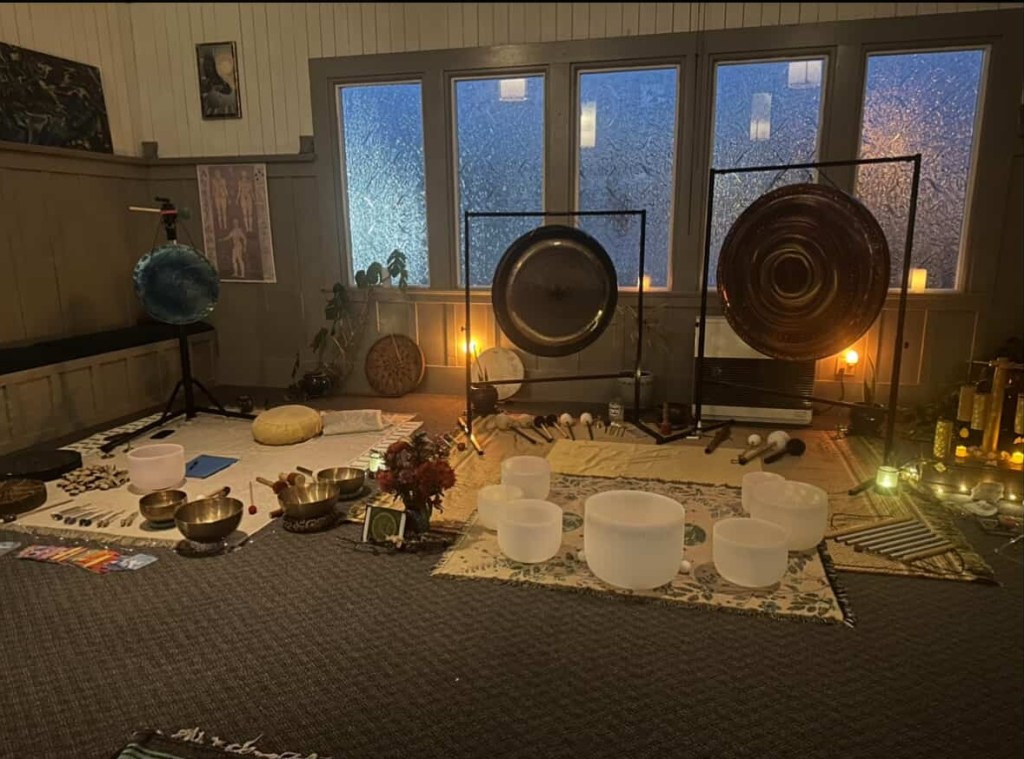
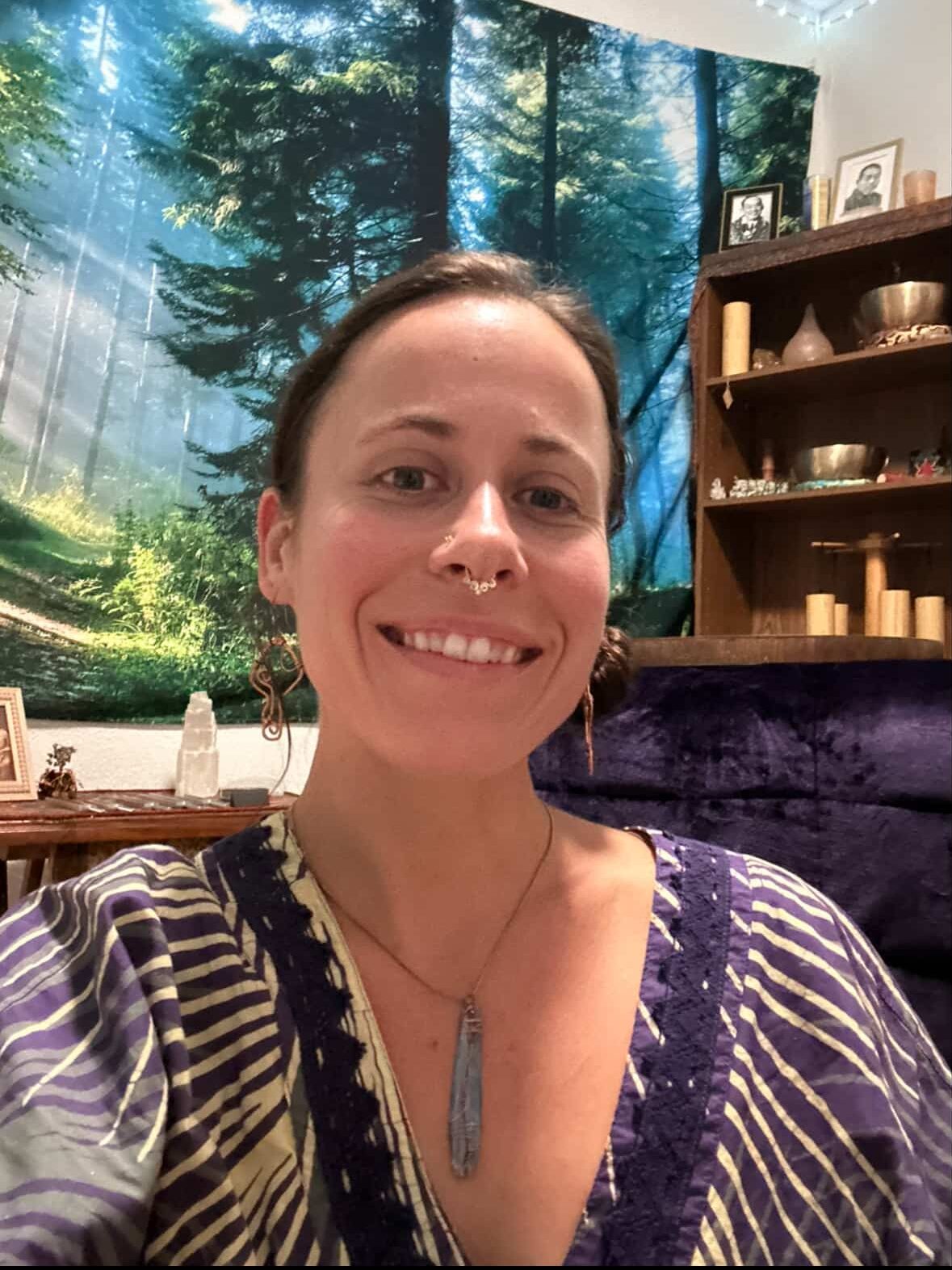


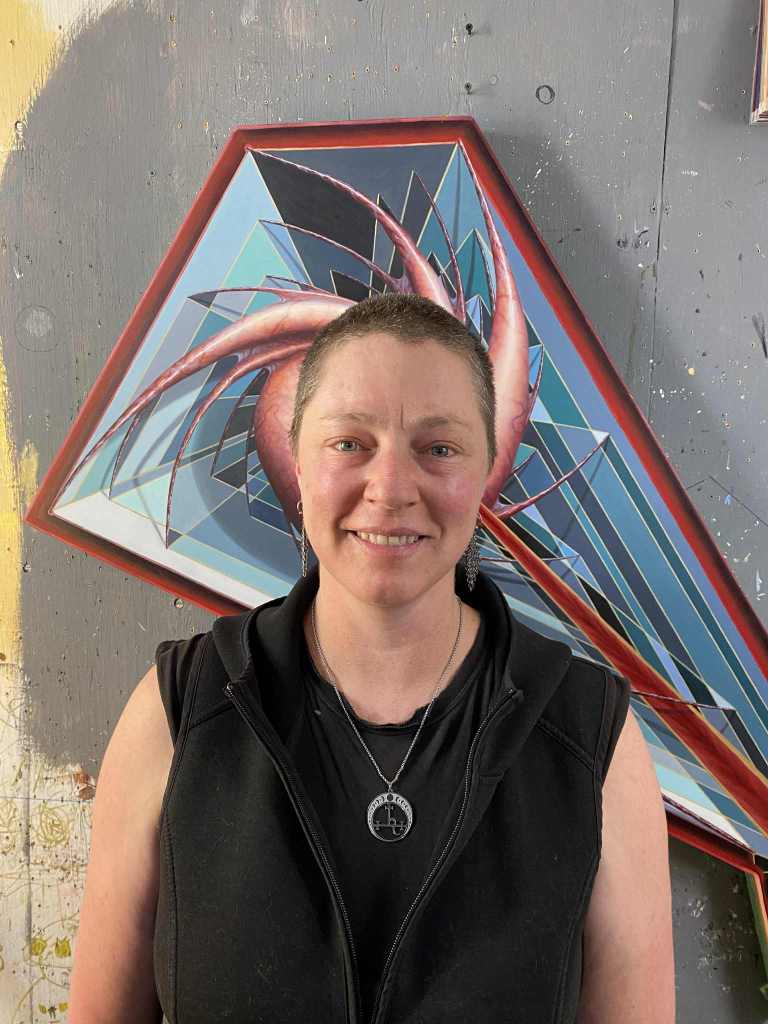

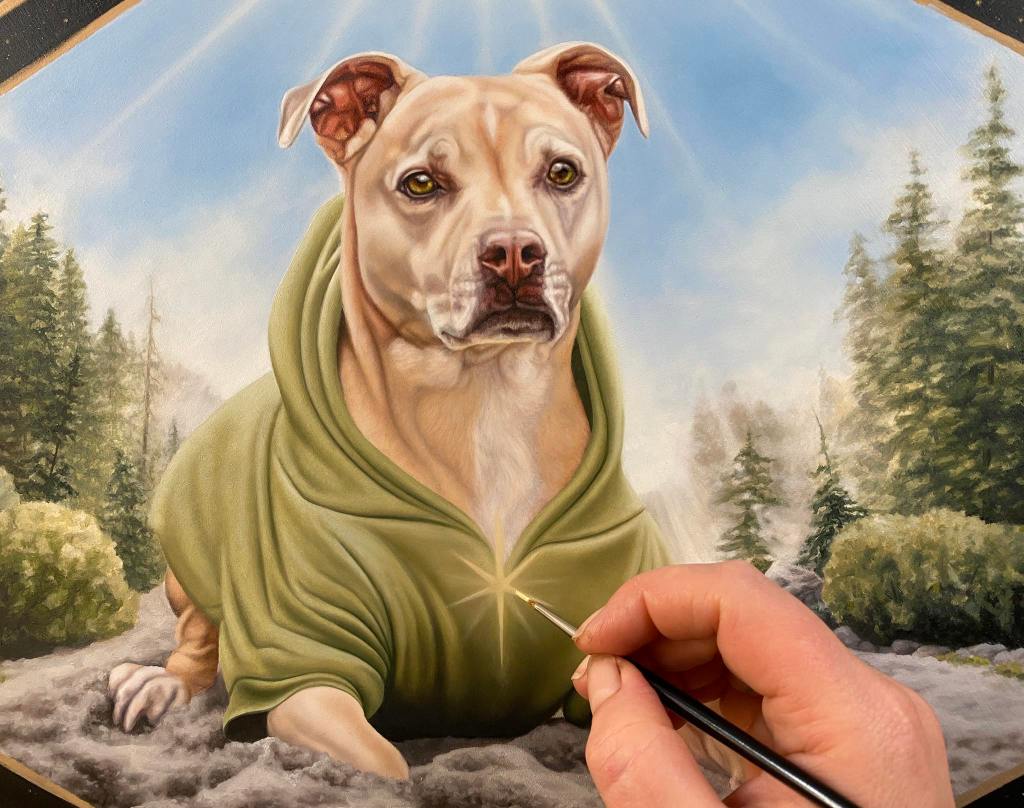


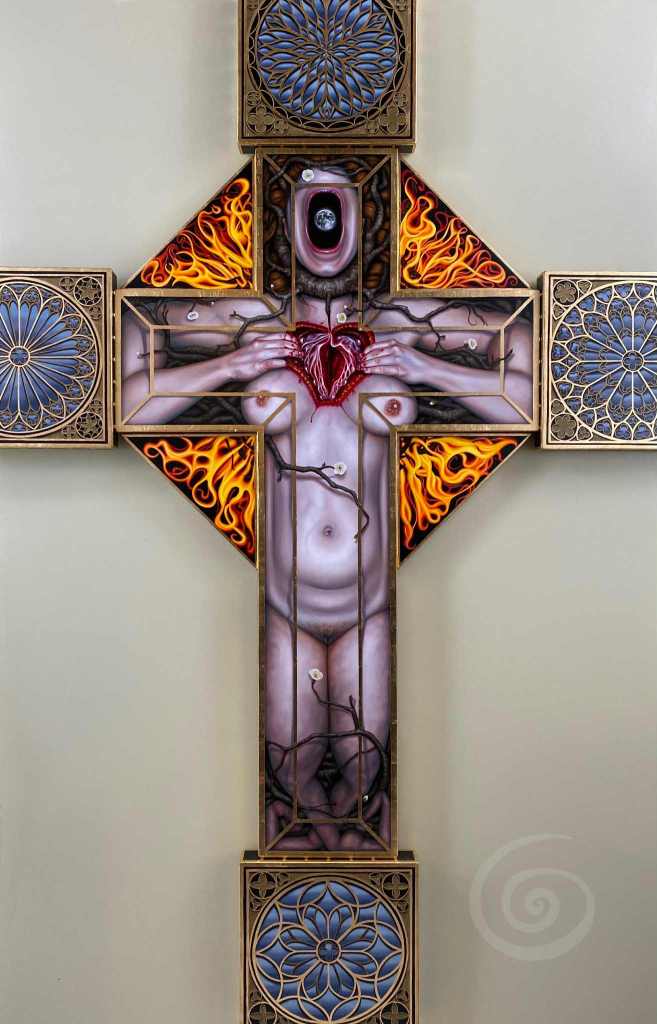
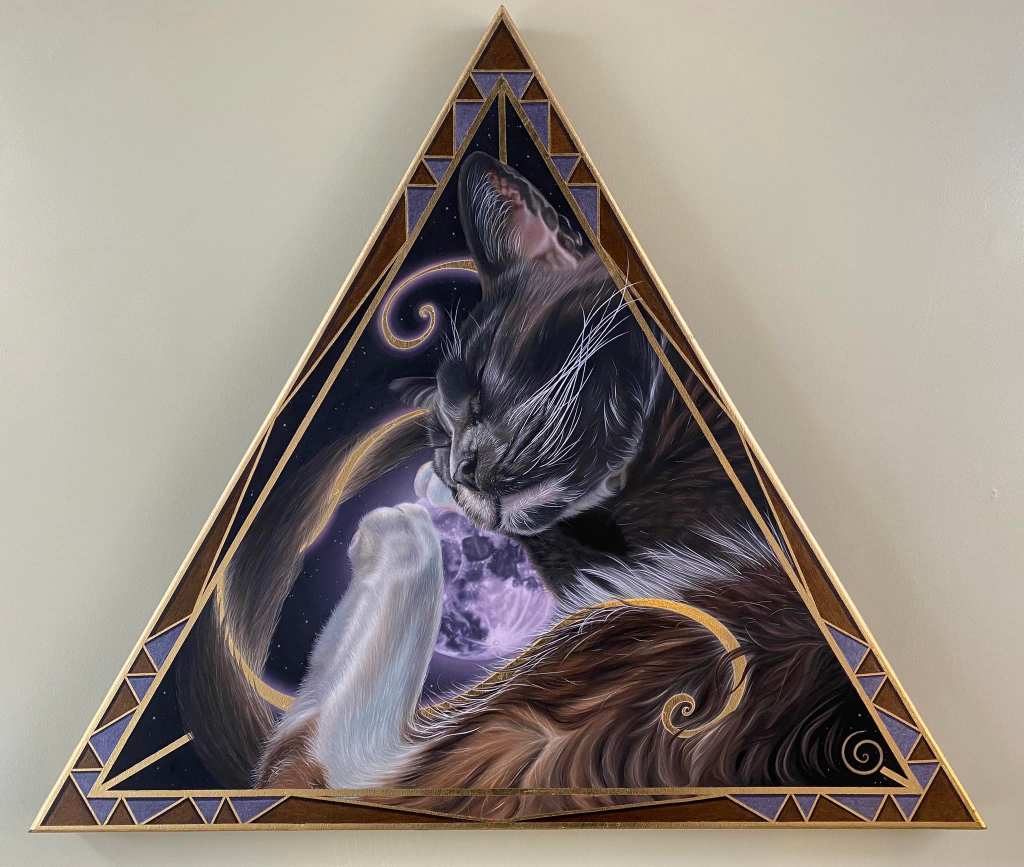

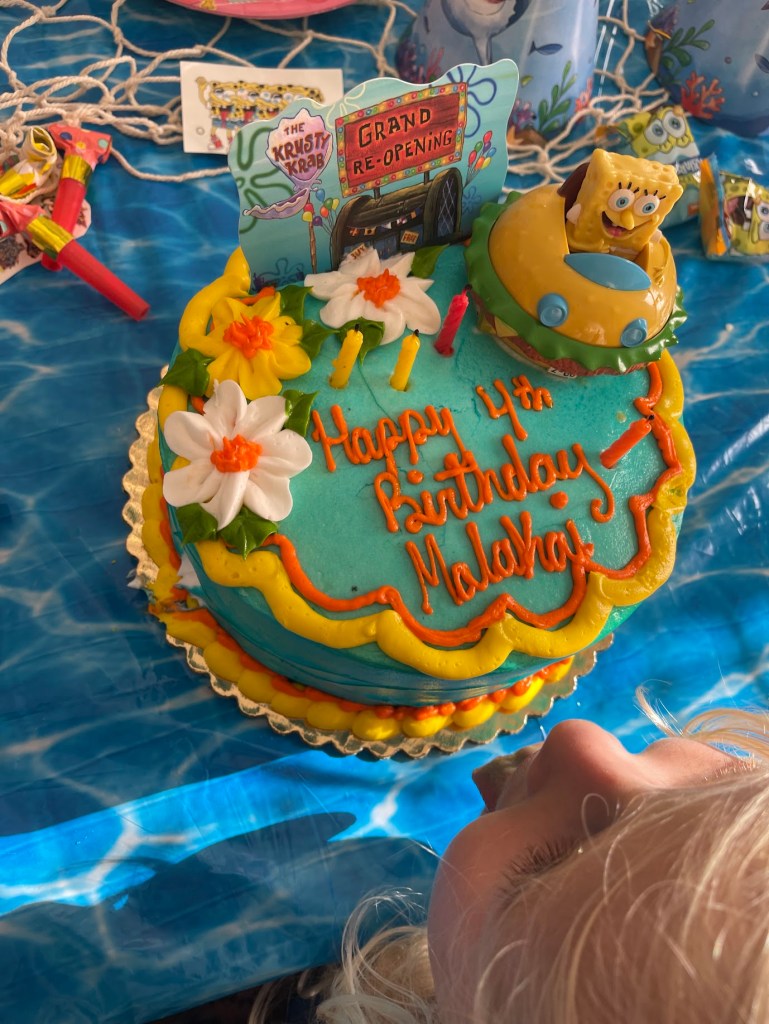
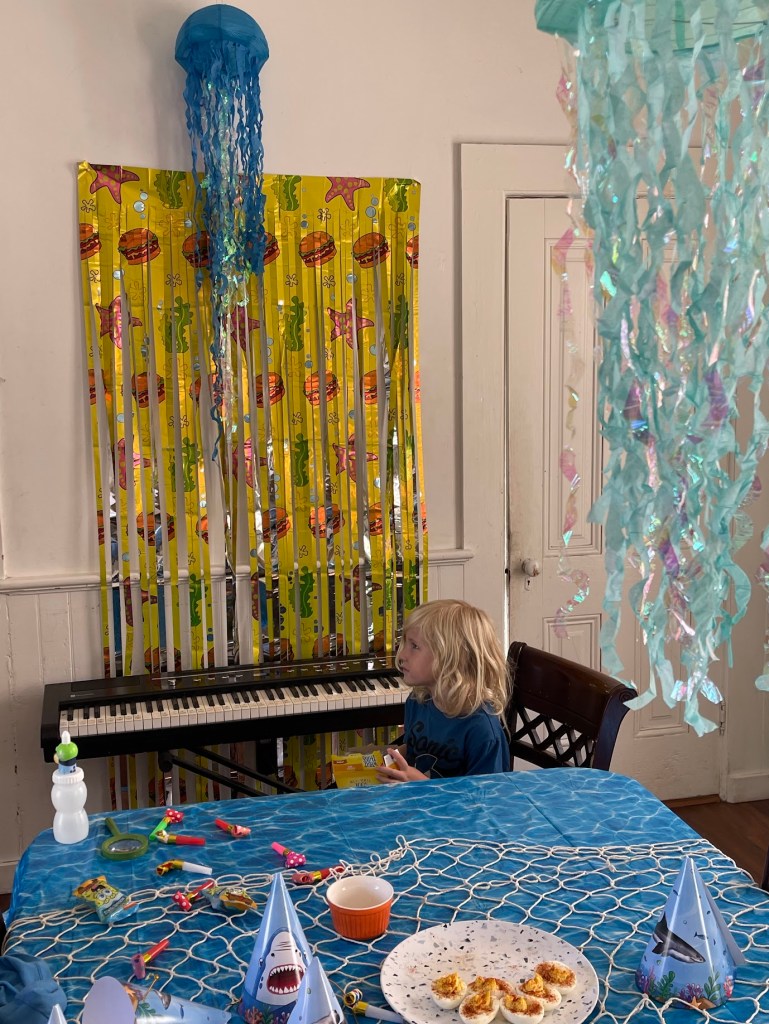
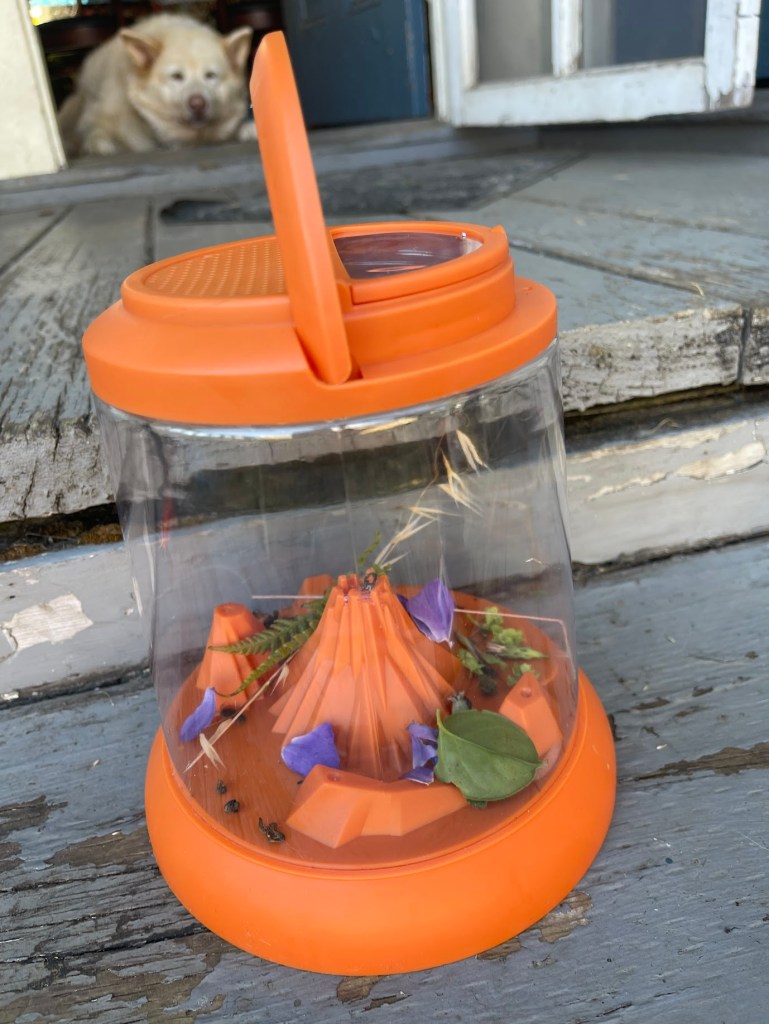


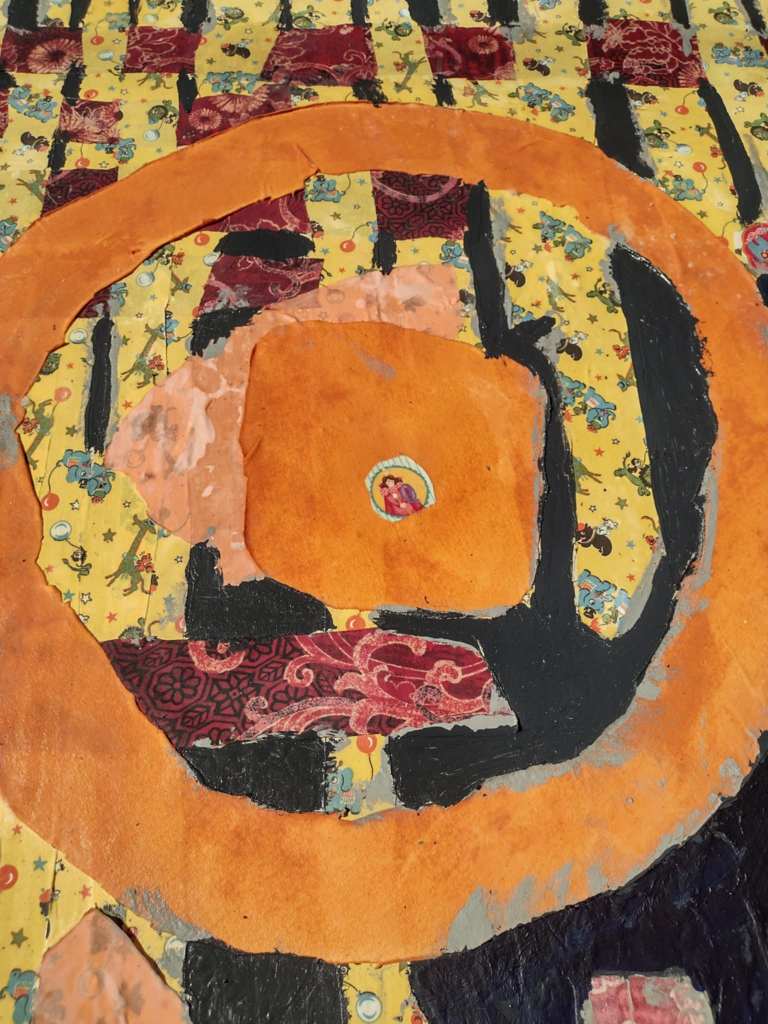
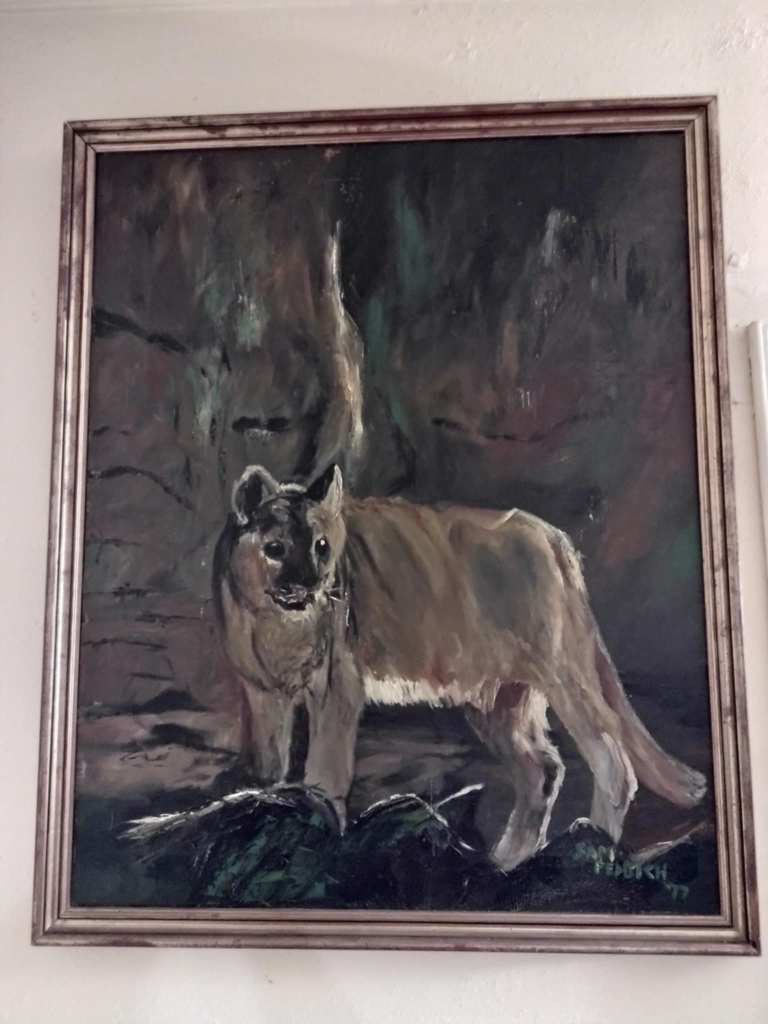
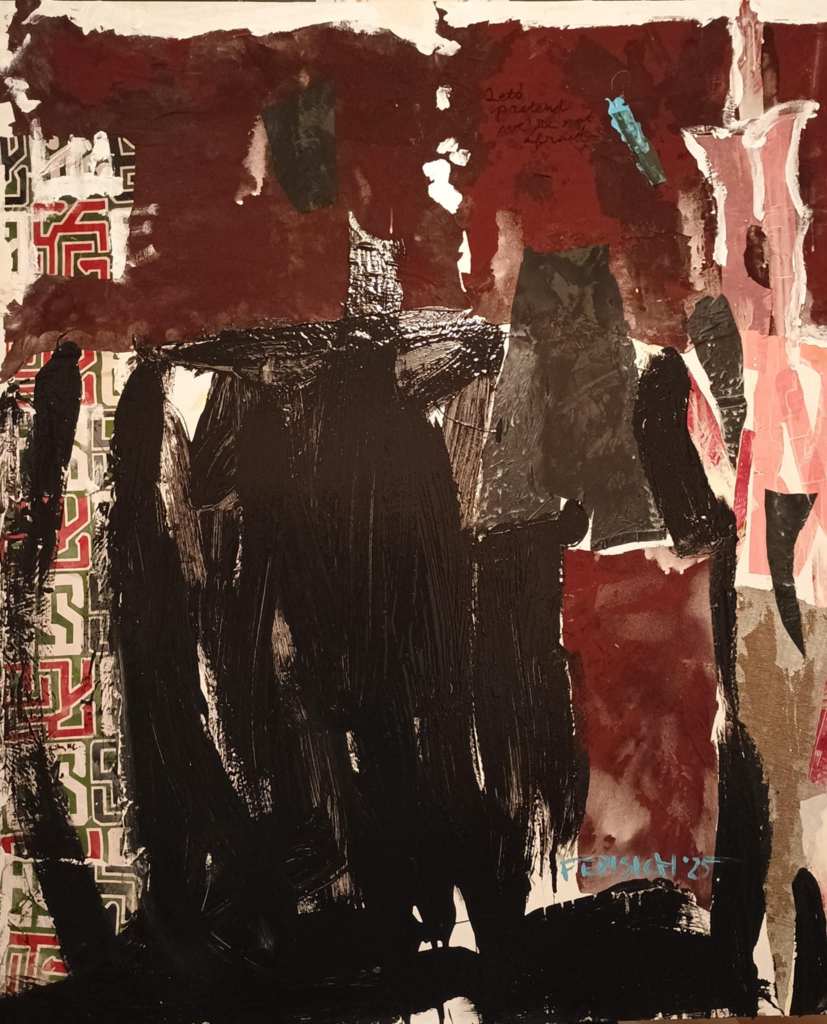


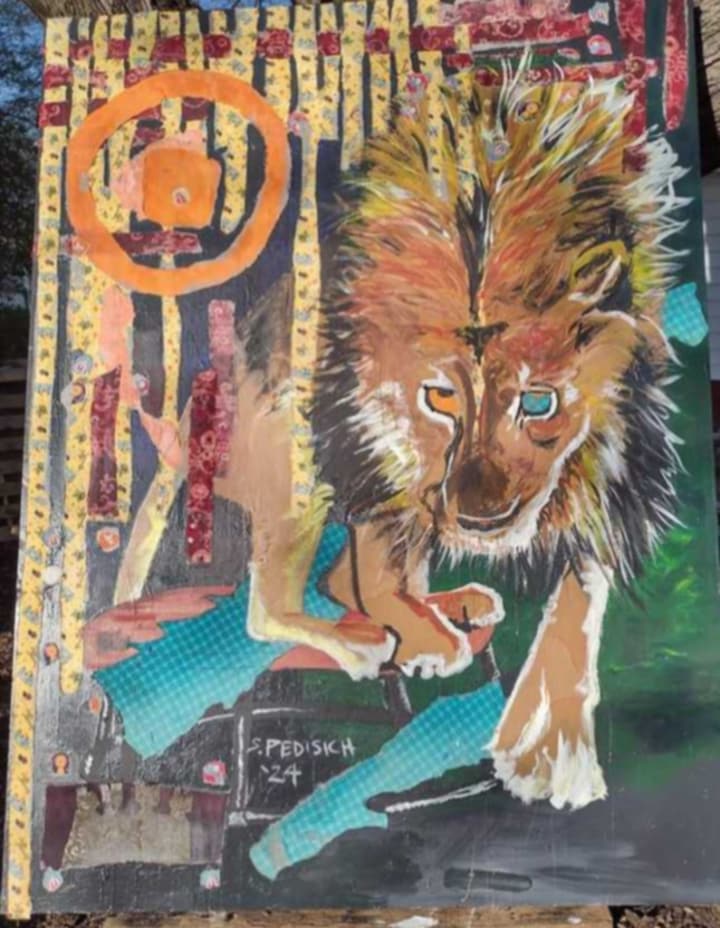


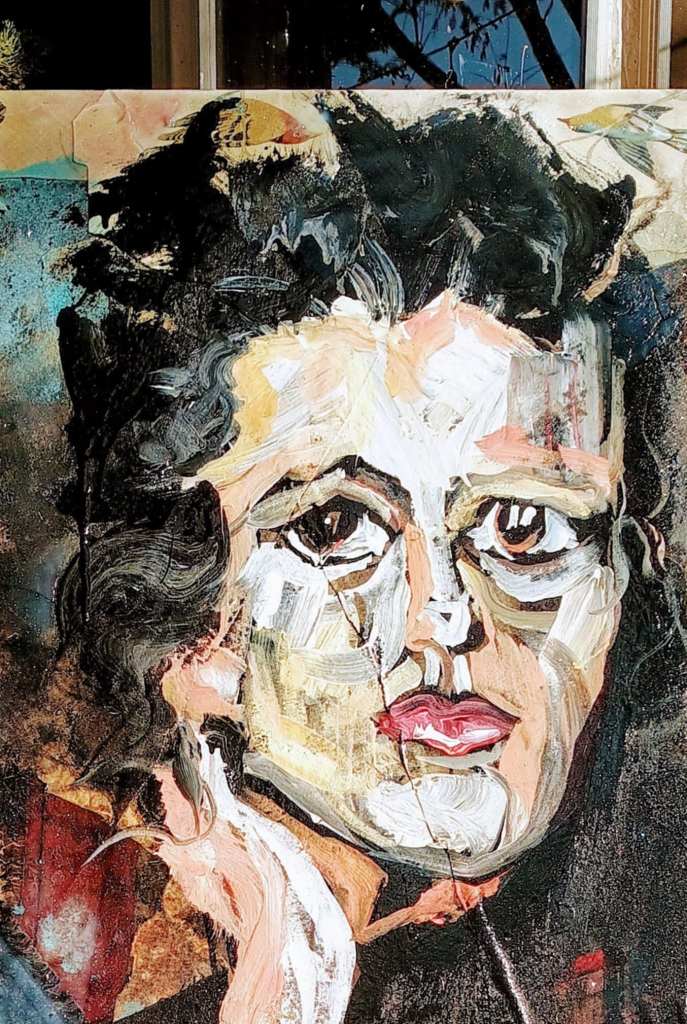


 Little Lost Forest