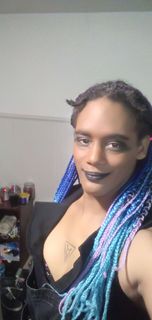
Interview with Interdimensional Artist Synchro Mystic

Find the full interview on YouTube Here.

Natascha: I’m here at Azila’ Cauldron in Eureka with Roman, a visionary artist and OG creative force of Humboldt County. My name is Natascha, and I want to thank you for tuning into the Little Lost Forest blog. I’m beyond excited to dive into the art, theory, history, and creative journey of Roman a.k.a Synchro Mystic. How are you doing?

Roman: Doing pretty good. Thank you.

Natascha: Awesome. Roman, where are you from?

Roman: Mind, body or spirit?

Natascha: All. All of the above.

Roman: I typically say that that way because my body is from Mexico. My spirit is universal, and my mind is global. My mind knows and exists and is part of a global reality that we’re perceiving together. And that definitely is who I am. But also, my physical body is a certain part of who I am, and my spirit is definitely on this mission. That is who I am as well. And those three are distinctly different things in a certain way, and my job is to try and align those together, that’s why.

Natascha: Your universal consciousness has landed you here.

Roman: Yes, but so many dimensions we can talk about that from. And that’s why I like to do art.

Natascha: Wonderful. Well during these interviews, feel free to dive into rabbit holes. We’re all really interested to see what inspires this beautiful art you make.

Roman: Thank you.

Natascha: How old were you when you first started drawing and creating?

Roman: I called myself, and this is, like, one of the most profound and silly, experiences in my life. I called myself an artist at three years old, and I specifically remember this experience that did that. And one of my older sisters came home from school with this big pad of paper, and it looked huge. But then again, I was a little kid, so it might have been a normal sized pad of paper. [Natascha’s Laughter] But then she puts it down, and then she shows me her drawings and I’m like before this moment, I considered myself a magician. And I was like, always pretending to make things disappear out of handkerchiefs and silly things that I saw. And I thought, I’m a magician. So, there’s first, there’s that. And I think that’s very symbolic because I think art is very magical. But anyway, I saw this sketchbook that my sister had, and one there was a crocodile she drew, and I could see a crocodile on this paper with lines drawn on a two-dimensional flat piece of paper, and I could see the three-dimensional crocodile that it was. And I was like, wow, that’s cool. And then the next one was a girl in a bikini. And I was like, that’s a girl in a bikini. I know exactly what it is. And it’s just a few simple lines on a flat piece of paper. And I was like, that’s magical. [Natascha: Mhm.] So, from that moment onward, I instantly call myself an artist, even though I didn’t know how to draw or whatever, because, uh, because at first, I was a magician. So, what did you have to learn?

Natascha: Would you say at a young age you related magic to art.

Roman: Instantly at three years old.
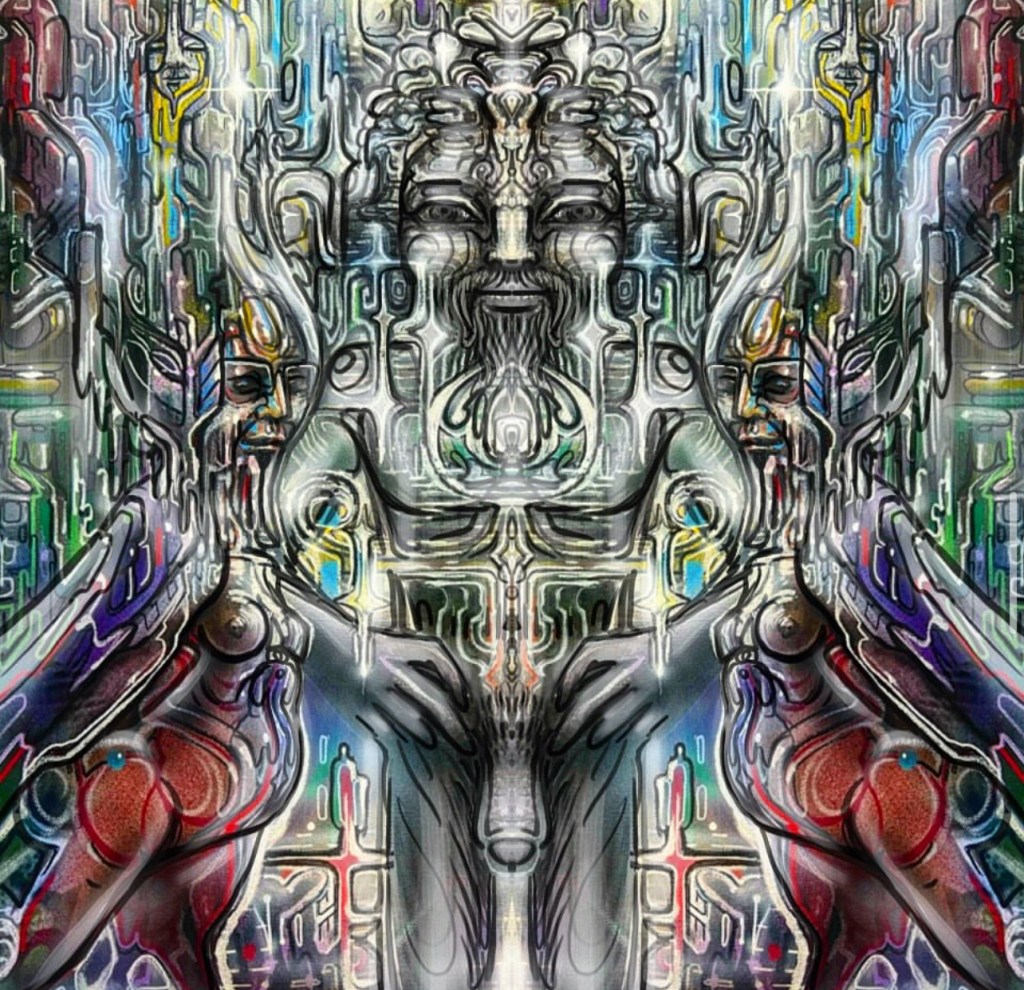
Natascha: That’s wonderful. I think you kind of answered this question, but what initially inspired you? Maybe outside of your sister’s drawing, what were some of the inspirations that have ended up fueling your creativity now?

Roman: Oh, man, I could have countless and countless stories, but I guess one fundamental, um, experience was, uh, being in Seattle during a very critical time in history, and I mean that in many different ways. The music scene and then the technological explosion that was coming from Microsoft at that time, an era when the very beginning and I tried LSD and, something I was never really too proud to boast about. But I also think that it’s a very important thing to express, that there’s these moments of that we can utilize as tools to activate something. Because on my psychedelic awakening, I definitely had so many things come together. And it isn’t all based on the psychedelic awakening. The Psychedelic Awakening gave me a view into the things that were already happening in my life. Like, calling myself a artist/ magician at three years old and a lot of mystical experiences that I never really understood growing up. That happened throughout my life. But for some reason, having a reflection like psychedelics or something external outside of us, like aliens or whatever, if you’re blessed enough to see that. But these external reflections allow us to look back at ourselves to witness these things from a third point perspective. And that helps us wake up, you know, like, oh, yeah, I notice these patterns throughout my life, I’ve never really realized how to deal with those experiences. And sometimes when you have like a psychedelic awakening, it gives you an angle to look at those things through.

Natascha: Wonderful. How would you define visionary art?

Roman: Well, visionary art to me means a lot of things. It leads me to the next thing I’m going to talk about. But just to answer your question first is, you know, at first when I got introduced to visionary Art, it was, outsider art. That was because I looked at a visionary art, magazine when I was really young, and I remembered i. It was more from people that I didn’t go to school to do art. For some reason, it was like, they call them outsider art. I thought that was interesting because there’s a visionary art museum with, uh, all these artists in there before the psychedelic visionary art movement. So then when they called the visionary art movement visionary art movement, it kind of like, wasn’t sure about that. And also, to me, vision means of our vision. But I don’t know what other art isn’t from our vision as much. (Natascha: Okay.) But don’t get me wrong, I still use that title to express our movement of artists because it’s something that people recognize right now within our circles of people, which is very powerful.

Natascha: Mhm.
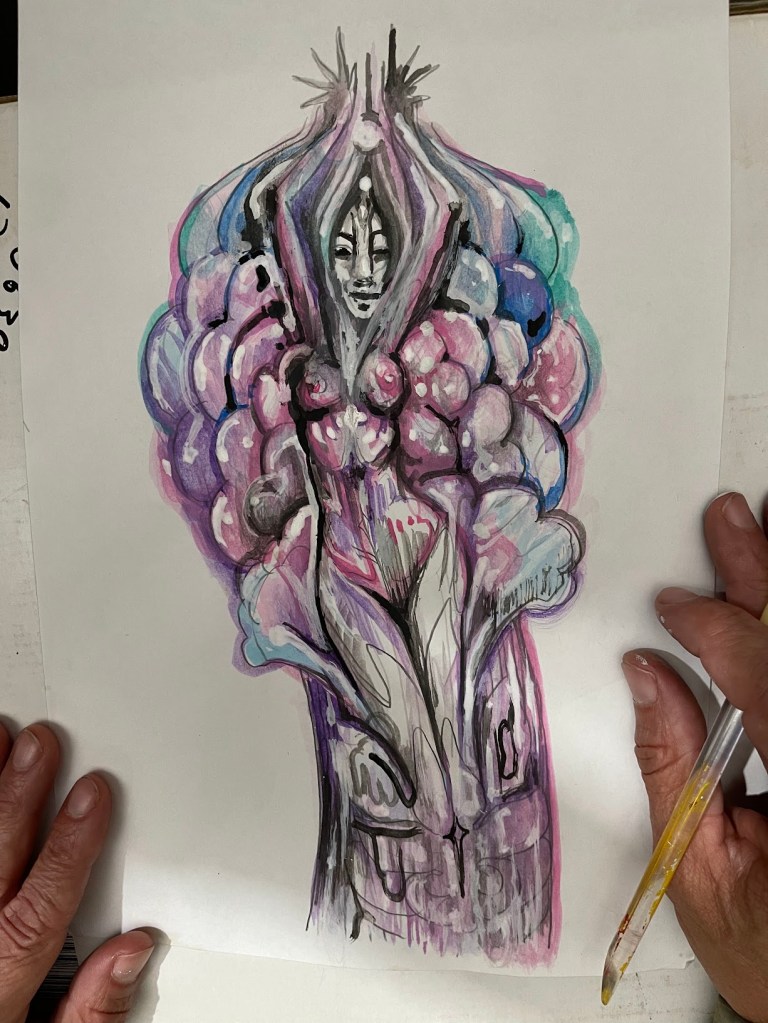
Roman: However, I don’t think that it specifically talks about the movement that I’m a part of which I feel like the people of artists that you recognize yourself liking to are not a part of necessarily only. I created an art movement called the Interdimensional Art movement. (Natascha: Lovely.) And I even told Alex Gray about these things before we named the thing visionary art movement. And this was a long time ago. And he never even heard of that. And he really was vibrating with that idea, too. Which is really cool to always be able to share your ideas with other people and get reflection. And the Interdimensional art movement the acronym is I.M. (Natascha: Nice.) It’s based on the finite of yourself, your personality, your ego or whatever it is you’re that you’re wanting to express. And then the full title, Interdimensional Art movement has no limits. I think that’s more true to the what the visionary art movement that we synchronize with at the moment.

Natascha: Interdimensional Art Movement.Got it. Can you share a bit about your history as a visionary artist?

Roman: To simplify things, psychedelic awakening in Seattle. Recognizing everything at once and wanting to be part of an art movement. Because as an artist, you always look back at art movements and you relate to certain groups like the Surrealists, the Pre-Raphaelites, or like any segment throughout history, which is really inspired in certain ones inspired us more than others. Art Nouveau or whatever. I couldn’t deny that I didn’t want- I wanted to be part of a group like that, but there was no real group to that I could associate myself to at that moment. Plus, I wasn’t that advanced. But these ideas were coming. These desires were coming to me. But then I started paying attention to what kind of art movement would I want to be a part of? And then that’s when a lot of answers started coming, and that’s when I recognized, oh, those art movements. And we’re answering these questions that they ask themselves. And that’s why they became art movements, because they were answering a question of defining who we are as a culture. And that’s what creates a movement. And we attract each other that are representing this, this reality together. And then, um, that harmonizes us as a collective.

Natascha: That’s beautiful. Who are some of your colleagues in the visionary art community?

Roman: To me, I love the way you ask because there’s a seriousness to it. And then that kind of makes me laugh because I’m also a space cadet artist. But my colleagues. I’ve been blessed enough to have colleagues of all different sorts. Like, my Seattle experience was pretty profound because, when I was having this psychedelic awakening, and I was reinterpreting reality. And then I was like, I want to hang out with the Beatles. But the Beatles already happened many years before me. So, like, put the vibration I was getting the LSD vibe or whatever, you know, and I was like, wait a minute, I’m in Seattle. [Natascha laughs.] Just to bring that into perspective and for a few many years I would keep on running into people like Nirvana, Soundgarden, Alice in Chains. And this is my canvas. And I played in this dimension for a few years of running into these people all the time, getting to know these people from different perspectives. Like, I have so many memories to even remember at the moment, but one of them that’s on my mind right now is, uh, Soundgarden when they were recording BadMotorFinger. They had my paintings in the studio while they were recording a little bit of that album and stuff like that.
Roman: I remember going in there and picking up my artwork and them being all, like, polite and kind and gentle, but they’re like, really, they’re all really tall, like over six feet, you know? For me, that’s tall. Just having those memories ingrained in my brain and seeing how influential these people were, it was pretty intense. So there’s colleagues like that, but more precisely, to the art world is like, from Alex Grey. I don’t know. It’s hard to tell because the way that I learned about my colleagues is through a party that we started. That’s why it’s really hard to answer that question, because I have to, like, share the story of why I know these people. Because if I say Alex Grey, who might be the most famous and people recognize him, but there’s. I don’t want to skew the vibe just by that attention when there’s so many other beautiful and amazing artists and they all were attracted from this interdimensional art show we threw up in Seattle. And this was the beginning of before where? Before what we were doing. There was hardly ever, like, a live artist and galleries at events. That’s like something that was, I wouldn’t want to say that we started it, but we definitely made it a ritual.

Roman: And it brought together all these artists that some are now famous visionary artists from Luke Brown, Carrie Thompson. It’s like really challenging to even start naming them because there’s so many that I can’t even name. A lot of them, I’m sure that you would recognize. For instance, like Carrie Thompson came to make the most beautiful stages of electronic events throughout the world. You would recognize them because they’re super beautiful and Alex Gray and Mark Henson. I don’t know if you know Mark Henson, but he’s an amazing artist from not that far from here, from Lake County. And if I showed you his art, you would obviously recognize him.

But the reason why I really enjoy these people is because it was a family calling that brought us together, like these shows that we used to throw up in Seattle. Were exactly that. It really bonded a large group of artists together that never recognized themselves before. Now it’s easy to see. It’s all easily recognizable. But before then, we didn’t have anybody. This was like the beginning of us recognizing each other, which was really amazing.

-Roman

Natascha: Wonderful. At that time, were you part of a community? You say we.

Roman: I would say we because I can’t. I don’t ever want to feel like I’m taking responsibility for it. That’s one aspect which is still egotistical, but I am an ego, [laughter] and it’s very influential to where my idea is coming from. But at the same time, it is a collective thing that I’m just being aware of and I’m wanting to share that with people. So, I say we because, you know, I might have been inspiring certain ideas, but it came to be through a network of different people.

Natascha: Awesome. Okay. So, in your art, you use mixed media in your paintings on canvas, and they’re all very incredible and beautiful. We’ve discussed acrylic paint, pencil and paint pens in the past. Are there other mediums you’d love to work with?

Roman: Did you say airbrush?

Natascha: No.

Roman: That’s probably one of my favorite things, even though my relationship hasn’t been too intense with it yet lately. Definitely airbrush. Cool pencil for sure. Yeah.

Natascha: That leads us to our next question. What role does pencil play in your paintings beyond sketching the initial image?

Roman: Well, lately it’s been like taking a central role and I’ve allowed myself to draw more. Then I keep on realizing why I didn’t allow myself to do that more often. Because it really brings my vision together. Because I really love to draw with a pencil, and it really flows. And it’s a relationship between the lead and the and whatever the paper or canvas or whatever. It allows me to put a lot of detail as soon as I start painting, it becomes an emotional thing and I start relating to the canvas with emotions. And then oftentimes I’m I get lost in the emotions of it. When drawing with a pencil, it’s more mental, more ideas. That helps me like navigate because I’m an idea person. I can constantly be channeling my ideas, but then I bring in the emotions of color, and that’s when it starts to get the feeling. But it’s not as controllable for me.

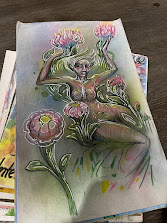
Natascha: Can we take a second and look at this painting over to your left. Is there a pencil in that painting right there?

Roman: Yeah, this one is one of like I said recently, it’s been taking main stage. This is one of the paintings that I did as a live painting. Mhm. And I just allowed myself to just feel the music and vibe and not care about painting and just draw. So I drew pretty much the whole thing with pencil. And then I loosely started airbrushing and painting on top of it, but without covering the pencil. Of course it’s very raw and very loose. But there’s something I like about it. There’s something metallic about it that I really like.

Natascha: How do you select your color palette? You have a very nice rainbow assortment of colors in a lot of your paintings.

Roman: Yeah, definitely spectral for sure, because that’s the reality that I’ve seen. You know, a lot of my art was inspired by me walking around a lot. So, whatever I could bring with me, because that’s the way I’ve explored my reality. But also, with what I have and what I had for a while was black India ink and with airbrush, and that was it, a big bottle of it. And then I started wanting to paint with color. And then you realize you want the least amount of colors, or that was my experience. And then that led me to like, oh, the spectrum, the southern colors. From here I can do different shades of shades of whatever. That was if I look at it from the physical aspect. Like I said, you asked me who I am or, you know, uh, that’s physical. There’s also the mental and the mental is, it’s more chakra style. I use the rainbow colors because I feel like there are these seven dimensions. Those are perceiving reality. So, to me, when I learned about the chakras, it started making sense.

And being a psychedelic artist, I like to travel to different dimensions, so to speak. And the chakra system seems to be a way to understand that because each of the colors are a vibration and each vibration has a negative and a positive polarity. And if you start understanding how they interact with each other, then you can travel consciousness in that manner.

-Roman

Roman: And that’s the primary reason I use the rainbow color palette.

Natascha: Oh. That’s lovely. I hear a lot of entombment in your body when you paint and meditation as you’re painting and choosing your color palette is very interesting. Can you tell us more about the reoccurring themes in your work, what those might look like?

Roman: Definitely a lot of meditating beings, and sometimes I question myself on that. But like, I’ve had visions of tapping higher states of consciousness and feeling that. And there’s always people in the meditating pose and really high vibration. Maybe it’s just me, but I’ve heard this from other people, too that these beings come in from other or we tap into a vibration or dimension that they are meditating in. When I experience that, it makes so much sense why I would be so infatuated with painting that because I’m not necessarily Buddhist, but I definitely visit the teachings a lot because very super profound. And it definitely helps as far as, you know, being present with yourself. So, there’s all those things too. I definitely have to admit there’s a lot of goddess imagery. A lot of awakening. A lot of dance parties. The dance parties are the symbol for humanity, I feel.

Natascha: Yeah. Who are the characters that we’re looking at? Do they have names? Personalities?

Roman: I don’t think about it too much, because I think it’s just like who we are on one level. So, I don’t really recognize any separation from just a snapshot of anywhere I would go. There are people dancing or whatever. That’s the main thing. But then the other profound thing is, I don’t know if you’ve heard of Tribe 13, but that was like our production company up in Seattle that through the Interdimensional Art shows. And it still continues to this day. And we have thousands of artists connected to that name. I think that you would consider visionary artists specifically. But essentially Tribe 13 is a traveling gallery at different events and that’s what we’ve been doing since Seattle, but definitely been to that gallery like boom Festival and Envision Festival and a myriad of other ones.

Natascha: You know, he just posted this on your Instagram, but can you tell us more about the meaning of Tribe 13? What where did you guys derive the name from

Roman: It’s really profound vision that happened to me as I was awakening. I told you about me about my psychedelic awakening that led me into really questioning my reality and really, dropping out, so to speak, to just meditate on these things. I started recognizing different patterns and the desire to be myself and to be accepted for myself and accept other people for themselves, which is a freedom, and all based on just the basic fundamentals of this country. So, it kind of unified all these things. But I was recognizing that nobody’s really living up to it. What does that mean? So, then I started questioning who I am. Who? Where do I belong? Or as a part of society or whatever? As I was having these profound questions, I would run into signs of different things.

And Tribe 13 stems from those realizations- as I was awakening up to this way of looking at reality- the symbols are infinite, and I can point them out later. But essentially what makes a Tribe 13 member is to recognize that we create reality, which means the only way to tap into this presence is to be in a state of giving and constant giving.

-Roman

Roman: A lot of people say, oh, yeah, it makes a lot of sense. That way you can receive. I’m like, no, that’s not the point. You can’t, um, you can’t live in a binary perspective. It’s got to be a unified perspective. And it has to come from source. So, to become a Tribe 13 member is to recognize that you are marrying yourself to your true self, which essentially synchronizes, synchronizes that to all the other beings that are doing that themselves. There’s no control mechanism, no one’s better or worse than you from from that perspective, those kind of perspectives can only come from the outer world. But the outer world is not a reality because we have to be in a state of giving. If you’re wanting to receive things, and that is one way of looking at it, but that you’re going to receive an illusion. So, Tribe 13 is the beings that are synchronized by giving from within out. Which art is the symbol of.

Natascha: Wonderful.

Natascha: I you’ve been talking about spirituality a lot, but how does spirituality influence your creative process?

Roman: Well, it helps me recognize who I am. You ask me who I was in the beginning, and I can’t answer that from one perspective. Like mind, body and spirit and spirituality. I feel like it helps guide us into what we’re supposed to be doing or wanting to do. And we don’t have to be deceived by an external belief of spirit or whatever, but to really recognize what you’re really wanting to intend as your person on this earth, which is really basic and not spiritual at all. But I would consider that spirituality because, again, chapter 13 and the vision of having to offer yourself from this source, from this center, is crucial to that. And why I would call it spirit is because it’s beyond what I could perceive. If I’m in a state of offering, I will be in this state of awe of the actual manifestation, if that’s going on.

Natascha: Would you say your art is an extension of that?

Roman: Without a doubt. But what is not. Everything is from that state. But oftentimes comes from like a really, maybe not evolved state or a weird interpretation or even negative. All these things have a way of manifesting.

Natascha: Sure. Yeah. Okay. What draws you to sacred geometry?
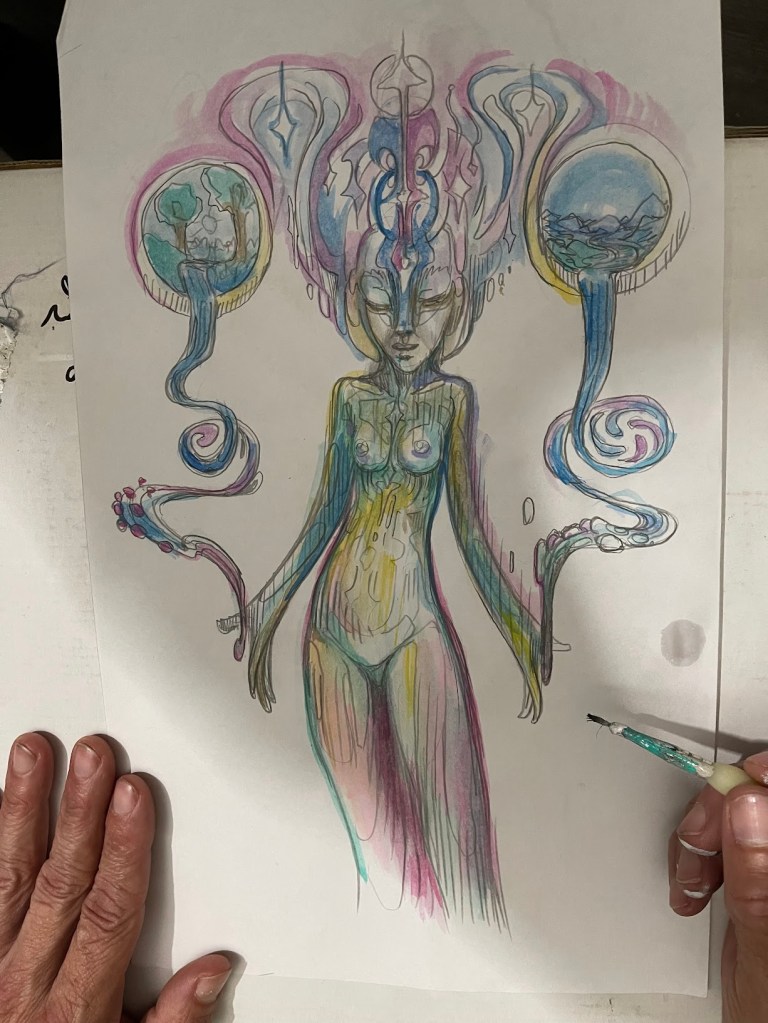
Roman: I definitely use sacred geometry as a thing, but I never really stick to it like some of my contemporaries, for sure. Um. Uh, yeah, I have, like, this deep gratitude for it. But I was thinking, like, if, uh, sacred geometry exists, then, uh, we are part of this, uh, sacred geometry. So, whatever I do is a part of the sacred geometry, because I can’t have a choice other than to create through the sacred geometry. So then at that point, I’m like, out the door. Don’t pay attention to it.

Natascha: Don’t even think about it.

Roman: I know exactly.

Natascha: It’s in the flowers, it’s already there.

Roman: Exactly.

Natascha: All right. What about your local community? How does that inspire your art?

Roman: That it confuses me, which inspires my art. I think our community and that’s why I, like I make a big deal with the dance party and social event because it gives us a view into our community. Where we come and show our art, our dance, our vibe, our talk, or this or the way we get drunk and shitfaced. I only say that that way because we need a safe place that people get to experience themselves and then figure out themselves so they can correct themselves. And I feel that these social settings in a loving and open environment have a way to heal. So those kinds of experiences wouldn’t be happening. And I just say that because we have a lot of healing to do, and we really need to, like, allow people to people to process their inspiration by not just accepting a rude behavior, but to recognizing and knowing that being recognized also starts having an alignment of sorts.

Natascha: I really appreciate you saying that. What shifts have you noticed in the festival scene, and why do you keep returning as an artist?

Roman: Well, to me, if there’s going to be any time traveler’s ever to come into existence, they’ll probably come through portals such as psychedelic events throughout the world.

Natascha: Cool.

Roman: I really believe that because when we go to an event like this with the artists, with the musicians, with the styles, with everybody offering their little trips, it really is like an eclectic group of people that are highly open and well, as far as judging against other forms of people in the world. We’re definitely at that point because we’re in this offering state of being or curious state of being, I guess might be better. That it allows a lot of things to come through, and that’s exciting to me.

Natascha: Kind of like they’re creating something new in these communities. There’s some kind of evolution/ evolving going on.

Roman: I definitely think that there is, but that it’s up to us for being open, because the opposite is also true, where people are being dumb and like, not learning or whatever. But I think that’s part of the fun for me because and what keeps me coming back is because I’m coming back now as an older person that has experienced certain things and like sometimes, I’ll get on my, like, flow where, like, I already know every conversation. [Natascha: Oh, no] -in a really amazing way. Not that I know the whole conversation, but what people are experiencing. And I feel like if we can develop our language, we can help bring people through a lot of experiences, a lot faster by just communicating with each other. And that’s one of my favorite things at a festival.

Like when I open myself up, I get attracted to these little circles and we get to share the pipe and then talk, and then all of a sudden, they’re like I had this one vision, blah blah, blah blah. I’m like, I’m like, I would look at the person and say, so what? And then they’re like, got their little spirit shattered. But then they recognize, like, what do you mean? Like, well, what are you going to do about it? And then like start talking to people like that and then like really brings this awareness to the person’s trip, like, oh, somebody’s actually listening to me. And then they go even deeper into their thing. And then you experience those kinds of awakenings so you can express your awakening to those people, and then you can stop and start helping guide this awakening collectively. So yes, there is an evolution of sorts like that.

-Roman

Natascha: Like, cool. So, on a global level, what changes would you like to see and how do you channel that vision into your art?

Roman: Well, there’s only one mission. The mission is to recognize that everything comes from within, out, and start not judging the external world or feeling like the you’re going to get validation from the external world. But to really believe in oneself, to be able to provide the offering that you really want to provide to the external world, not the other way around. If we could all start understanding that that’s how we fit in.
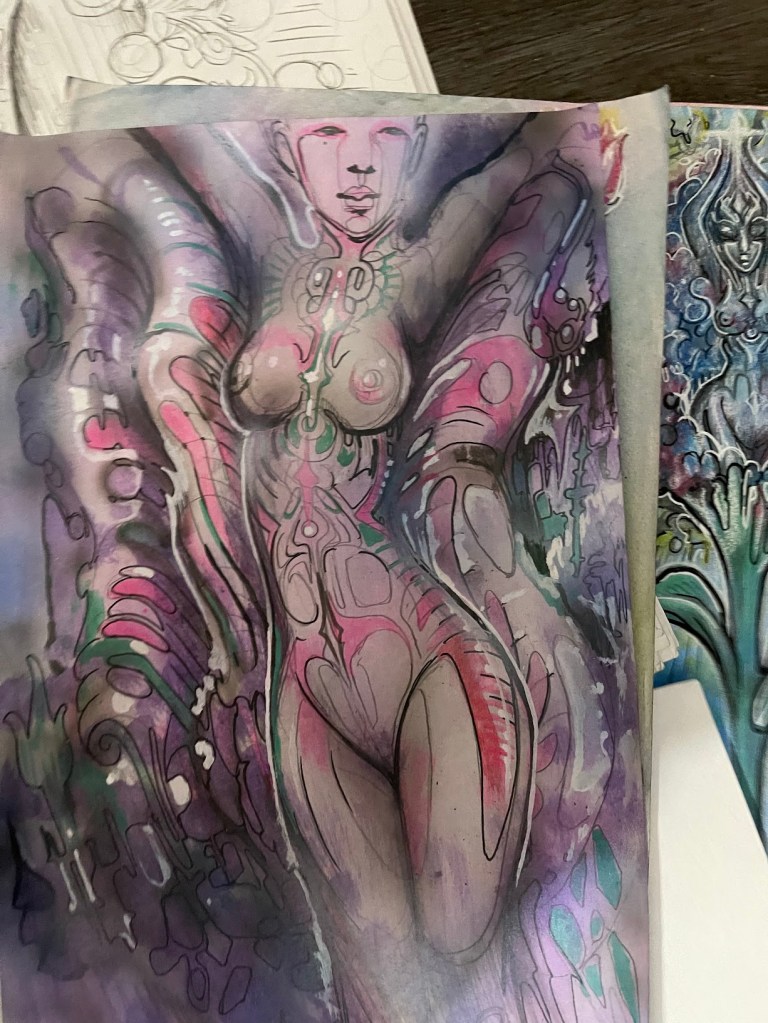
I feel like that’s when the big change happens, because so many people are trying to consume what they need to be or trying to acquire a sense of belonging from an external world to validate themselves. And it really screws up the whole mechanism of our existence. Because the universe is also like a, not an ego. So, it’s like whatever we’re creating is like going to manifest, uh, hugely, you know, because it’s like what we’re focusing on at the moment. So, I feel like once we start offering our true gift from inside then the universe reacts and recognizes that it can only provide abundance.

-Roman

Natascha: Lovely. That goes back to giving, giving, giving, giving. I love that so much. What upcoming events can we expect to see you at?

Roman: I’m excited to show my art across the street at Los Bagels next month in Eureka.

Natascha: Arts alive, right?

Roman: Yeah. Yeah. I still got a piece myself together, so I’m like, oh, yeah. That’s happening.

Natascha: Wonderful. What are some of your bigger goals as an artist?

Roman: I don’t know, I would like to write a book. I guess that’s one of my goals, because then I can solidify what I’ve been talking to with every people and just document it to be able to share that idea to other people, and it’s always been a lifelong dream. As an artist, oh, artist book, that’s an accomplishment. Uh, so there’s that. But that’s the physical. But on the spiritual plane, I’m on the quest to the eternal party at the end of time. Cool.

Natascha: I’ll meet you there.

Roman: Well, that’s the that’s the trick you just mentioned there. But I’m talking about the end of time. So, there are parties right. Right now.

Natascha: That’s happening right now. Yeah, we’re in it.

Roman: It comes back from the state of giving. That’s how you tap into it. So, if you’re in a constant state of giving, you’re at the eternal party.

Natascha: I love that. Awesome. Well, Roman, thank you so much for taking the time to chat with us. We’re here at Azila’s Cauldron. You can find it on Instagram at @azilascauldron. It’s been an absolute pleasure. You can find Roman’s Instagram @Synchromystic and a huge thank you as well to Julian for recording this interview. You can check out his work on Instagram @depixture_media. All right. Thank you everyone.

Nervous System Reset By Creature; Craniosacral Massage

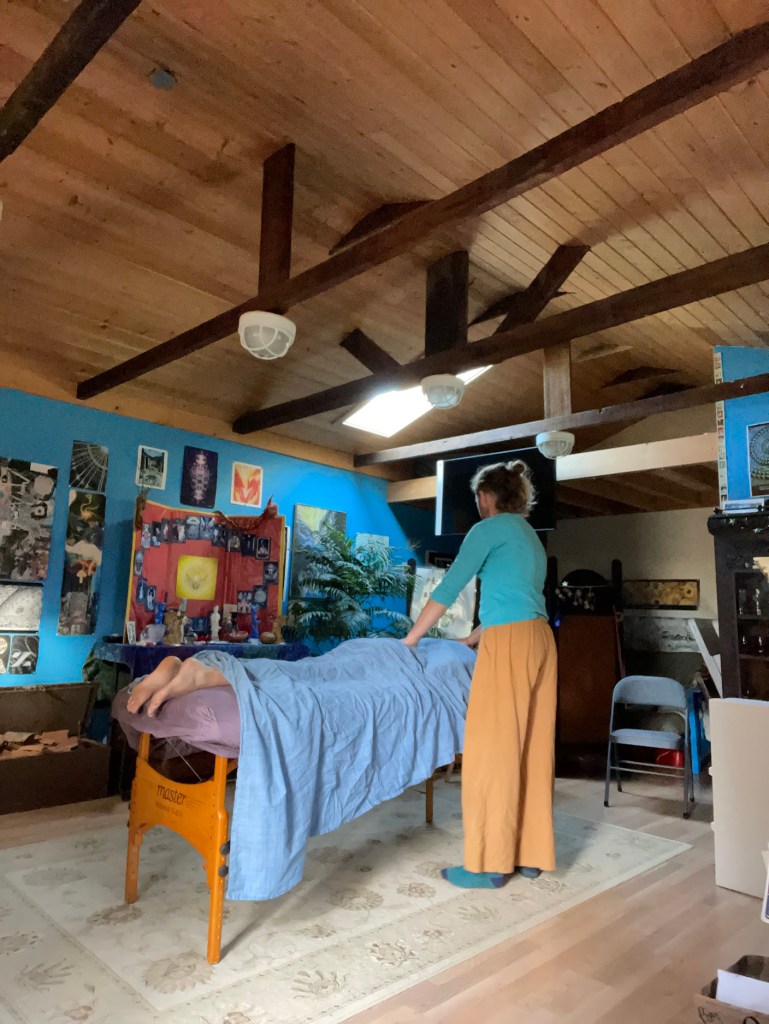
Creature and Natascha sit in a home office in Eureka, CA after a craniosacral massage. Before the interview, Natascha relaxed into her second session with Creature full of powerful energy from the Hunter’s Moon. Natascha wanted to get to know this practice through the practitioner more thoroughly. Together they wrote down Creature’s bio and dove even deeper with a few interview questions. On the end of this post you can read Natascha’s experience during the massage and how she has benefited from Creature’s practice.

Natascha: Hello, welcome to the Little Lost Forest blog. Today we’re going to be interviewing Creature (they/ them) from Eureka, California, practicing massage, spiritual energy work and craniosacral therapy. It’s a beautiful cloudy October afternoon. Hello, Creature. How are you doing today?

Creature: I’m doing really well. I just gave a session not too long ago, and afterwards I feel very clean and clear and centered. Happy to be doing this with you.

Natascha: Thank you. And thank you for the craniosacral massage experience. I really appreciate that as well. What is your mission?

Creature: As far as this work goes, doing body work with people, it really is to offer what has been inherently bubbling up through me over the last decade.I’ve been getting nudges for a while now to offer healing work, and have been hesitant and insecure about it as I’ve been working through my ups and downs. I would say my mission is just to meet people where they’re at. I’m working with this concept of a mirror medicine and really just wanting to help folks get to an empowered state with themselves, with their body, mind, spirit. And I feel like I’m really just here to be a companion on that path for folks. I’m not here to heal anyone, but I’m just here to listen and respond and follow the lead of their own body and nervous system.

Natascha: Okay, thank you. What are your philosophies?

Creature: I would say that I walk a line between spirituality and politics. I don’t feel like they can be separated from me. In my own journey of healing has been very tied in with my identity as a queer and trans person, and also my journey of decolonizing as a white settler person. With those two realities, it’s also this experience of of neurodivergence that the more I embrace, I realize that I’m also embracing my healing gifts, and that being someone that doesn’t operate in dominant culture actually strengthens my role as a healer. It’s directly in opposition to a capitalist, patriarchal, society. And so I see healing and self-care and rest as resistance. And I also see the more that I let go of the expectations of what success looks like in this world, the more I listen to my inner guidance- that I have a lot more to give to other folks. So it’s really for me getting outside of my head and analytical mind and dropping more into trusting my intuition and trusting my energy and my body and my spirit and less of a like. Less of a, um, like I have. I have the answers or the tools to heal you. More like, um, something brought us together, and I’m here to be present and respond.

Natascha: How has plant medicine helped you on your spiritual journey?

Creature: Plant medicine has definitely helped me unlearn and unwind a lot. I was pretty naive and sheltered from a lot of the challenges of the world. Before I started working with plant medicine I was a big believer in college education and feeling like I needed to use that education to have upward mobility in society. But plant medicine really broke that down for me in big ways that that weren’t so much fun all the time. Now that I’ve managed to come through the… Dismembering, falling apart… I realize that there’s a lot more to me than I was aware of.

The plant medicine really helps me drop out of this analytical, judgmental state of mind that I inherited and helps me flow more, helps me dance with my reality. Helps, helps me with neuroplasticity. And was really a guiding force for me. Finding my inherent skills through my lineage that I wasn’t really aware of until I started working with plant medicine.

-Creature

Natascha: On a spiritual path, what does “doing the work” mean to you?

Creature: It means a lot of things. I think primarily it means being in my integrity, which is kind of a constant path of falling in and out of that and finding it again. There’s also lots of layers to that. I also think it’s interesting and funny that we use the word “work,” because I also like to think of it as play. It’s strange to use that word, but also, I think, good to reframe that word and take it back. There’s the work with myself and unlearning, decolonizing, returning to my integrity. Then there’s the play with with others and finding peers who are similarly on that path and learning to discern boundaries and who are healthy people to be around. When am I attracting unhealthy relationships with people? So definitely discernment is a big piece for me.

Natascha: Thank you for that. How does spirituality play a part in your massages?

Creature: I would say spirituality plays a part in most every part of it. Because in order to be present and open enough, I need to to to do the work to wind down and rest and not get all swirled up in the chaos around me. So it requires a certain preparation and lifestyle. I definitely am nowhere close to perfect in that and have my own, you know, struggles like anyone, my own addictions and coping mechanisms. But it requires me to to intentionally drop out of that and take take time to rest before and after. I experience my work as as being a channel of sorts. And so it requires that I have relationship with guides and ancestors, and that I have a practice that is familiar enough to step out of my conscious ego mind and listen and follow. And yeah, it’s, um, about recognizing the more than physical aspects of us our energy body, our emotional or spiritual body, and the many layers involved. It’s also pretty integral with the somatic quality of emotion and trauma and memory and Ancestral generational kinds of of ways that energy gets locked and trapped in our body. I guess beyond the physical layers of muscle and membrane and bones and structure of the body, everything else is entirely spiritual.

Natascha: Thank you. That’s really great to hear. How does self-care play a part?

Creature: It’s definitely essential. I struggle, you know, having regular routines sometimes deciding to commit more to this practice and this way of making a so-called career or identifying as a practitioner, um, was an impetus for me to take self-care more seriously and not put it on the back burner. Um, I spent a lot of time in fight or flight mode, you know, racing around feeling like I need to hustle in this capitalist world. And often self-care it takes a second or third or fourth and so on to all these other things that seem like a priority. This practice is teaching me that it’s actually a guiding force that once I do have a baseline of self-care that speaks to everything else that I do from that state. And and it adds to the quality of, of anything that I have to offer to the world. Whereas without that self-care, I’m more fumbling, agitated and not showing up at in as good a way as I could be.

Natascha: Who introduced you to Craniosacral practices and why did you start practicing?

Creature: Let’s see. I first encountered Craniosacral actually during ayahuasca retreat. I’d never experienced it before, but I was already struggling with, um, dysregulation from the medicine I wasn’t quite prepared for entering so quick and so deep. And there was a practitioner there who gave me some sessions that were really helpful. And since then, it’s been the primary type of therapy that has helped me integrate from my ou-of-body plant medicine trauma. And it’s also been really key to me healing some physical traumas. I have a brain injury, concussion from forest activism. And I’ve recently been able to integrate that more through craniosacral. Out of all the modalities that I’ve experienced, Craniosacral stands out as, it’s hard to compare with with other modalities because there is this there is this spiritual kind of trance state quality to it that. It rides the line between energy work and physical manipulation. I’ve been privileged to receive a couple practitioners really only want one practitioner consistently. It has been pretty inaccessible financially for me. So being able to study it in a beginner way has helped me have a relationship with that [Craniosacral therapy] and myself. So I do some of the work on myself sometimes, and I’ve even learned to, to just sense, the shifting and unwinding in my own body as I do my own meditation and self massage practice

Natascha: What can your clients expect to get out of a session? And what about multiple sessions?

Creature: A lot can happen in one session, but yeah, it’s really the multiple sessions that start to really, really ingrain and train the nervous system to do its own healing, but to keep that new shape and posture.

I would say in one session, it’s kind of like an introduction. It might be the first time ever or first time in a while that the body and nervous system has been reminded that it can adjust the way it’s holding, that it can relax on a deeper level. That it is safe to do so.

-Creature

I think it can be kind of- what’s the word?- It can be surprising to realize how much tension we’re holding and how much dysregulation we experience from the world, especially if we’re used to functioning at a pretty decent level. In my experience, I’ve spent a lot of the last decade very dysregulated, and so even one session can do a lot as far as just a little nudge or reminder that there is another way to be and exist. With multiple sessions, it’s just an opportunity to go deeper and to return to those places that we find the stillness that we’re seeking. It’s certainly not likely that after one session, we won’t just return to those old holding patterns that we’ve likely been familiar with most of our lives. So, each time we return and get that reminder, it’s more likely that we will be able to stay in those new shapes and those new postures and those new vibrations.

Natascha: Yeah. That’s great. What do you think while performing craniosacral therapy?

Creature: Oh, what do I think?

Natascha: What is going through the practitioner’s mind when they’re performing?

Creature: I would say very little. I mean, there’s definitely, um, moments where I’m wondering, like how how the client’s doing. Are they are they feeling this? Sometimes I’m like, “Oh, it’s just working.” You know, little mundane things like, you know, the temperature in the room or how much more time we have. But I would say the majority of the practice, I’m dropping out, out of thinking, and I’m going into a trance state. Um, that’s that’s familiar, you know, from plant medicine or being in ceremony where I fall into a mode with spirit more and I’m feeling the subtleties in the other person. And so my mind is going more into sensation and to feeling the depth of of tension and feeling all the knots and the twists and where those travel and almost just into my hands and not even in my head. So that’s part of why it’s so therapeutic for me as well because it allows me to step outside of that head space that our society teaches us to spend most of our time. It’s actually a huge gift to be able to drop into that state with other people because it does have a mirror effect for me, and it allows me to slow down. And I come out of a session feeling a lot more still and centered and whole then I feel most of the day when I’m not in a session with someone.

Natascha: That really resonates with me. When I got my massage, I’m much more in a state of meditation than I would be in a normal massage. So to think that you’re meditating to while I’m in this like, heightened state of meditation is just such a beautiful combination, like you said, a mirroring effect.

Creature: Yeah. It’s like like co-regulation kind of, you know, it’s that, you know, maybe someone’s coming in just regulated and I have probably some degree of dysregulation from being in the world. But the moment we like tune in there’s this balancing back and forth effect that starts to create this quality that allows for the healing process to unfold.

Natascha: How do you cleanse yourself from the client’s energy after a practice?

Creature: These are great questions. I mean, there’s ways that I do it during the session. The snapping is probably my favorite. Or just flicking the energy off. I can start to feel like pain build up in my arms if I’m, like, holding too much. And so I’ll just release that. I would say even just simple things like washing my hands, going outside and just kind of like opening up to earth energy. Yeah, just brushing myself off. Pretty pretty simple methods. I don’t really have like any sort of complex, wild way that I do that, but it’s definitely important. I definitely don’t like to go rush into something else and like to kind of take a good while to, um, just be in that state and not jump in a car or, you know, go out into, you know, go grocery shopping or something where it’s going to be overstimulating or dysregulating right away because, yeah, it’s important to feel. Let the process of returning to myself before what I might have to like accomplish for the rest of the day. But I would say like, oh, I forgot we had tea. Yeah, like tea or ingesting some sort of, like, gentle plant food. Eating is really good and helpful.

Natascha: Lovely. Where do you see yourself in the future?

Creature: Oh. Where do I see myself in the future? I see a lot of potential paths. I think the one consistent goal for me is to be on land. It’s really important for me to live with nature, live with the trees and the plants and have respite from the hustle and bustle of even a town like Eureka or Arcata. I am pretty sensitive and easily overstimulated, and this work only kind of heightens that, sometimes. It both heightens it and strengthens my capacity to have boundaries from a chaotic, frenetic energy. I really see myself living on land and having some semblance of community.

I really would like to be in alignment, in more solidarity with indigenous peoples and tribes and potentially working with food sovereignty projects and growing food and growing medicine, is really important to me.

-Creature

A lot is up in the air as far as, like how how those goals would work with a body work practice, but I’m staying open. I hope to be in a place where I am just living in reciprocity with with the land and with the people of that place.

Natascha: This is our last question. How has your healing journey positively affected your life?

Creature: My healing journey has positively affected my life just in the way that I can relate to people. I think I was pretty disconnected a lot of my life up into my 20s, and I didn’t really have a sense of purpose or understanding of the miracle of this planet that we live on. And so being able to have a personal living relationship with the earth, with trees and the plants and the animals and the other humans that relate in that way is immensely positive for me. Being able to feel connected to a lineage and like a way of existing before colonization is overall really positive. It’s it can be a challenge at times and has been fairly dark and self destructive for me at times. Just moving forward and continuing to find hope and find guidance has been able to pull me through that. And so now I feel like I have the life experience to to offer to other people, no matter where they are, on that non-linear path. And it just kind of imbues quality into most aspects of life. When I can see through that lens of, of spirit and the more than mundane reality before us it’s very easy to get weighed down by all the pressures of the world and all the toxicity of dominant culture and the ways that it seeps into communities that I’m a part of. When I returned to that simple path of just trusting what’s before me and not getting ahead of myself. Not getting too righteous about where we’re at as humans, then I’m able to, just slow down, sit back and have a more like. Just there’s a simplicity to life through that perspective that is really healing in its own right. I’m grateful for that.

Natascha: Well, thank you, Creature. Thank you for being vulnerable with us, for sharing your gifts, your service and your kindness. I really appreciate your time. I hope you have a wonderful night.

Creature: Yeahhhhhhh.

That was a lot of information for one blog post, but wait I’m not done. I want to share with you my experience with craniosacral massage. I found the results calming, my awareness heightened, and my body more capable of relaxing throughout the day.

My first session was very mesmerizing. I walked into the massage expecting a female’s presence and was happily surprised when my practitioner had the hands of a man. Relaxing on the table I started face forward. Again, I had these expectations that I would start on my back. When we began the massage there was a lot of focus on my head and face, something I had never expected before. As time went on, I noticed that I was becoming very relaxed. So relaxed, I almost fell asleep. Everything was so calming, I felt relaxed in places I didn’t know I had tension.

I think we spent a lot of time on just relaxing my mind and then body. It was like no massage I’ve ever had before. Pressure points were hit but it wasn’t the deep tissue massage I was used to, and I loved it. They flipped me over and massaged my back as well. When I came out of the massage I was beyond grateful for the experience. Even better later when I left the massage, I felt incredibly calmed, like someone had taken their time to feel my body and understand my body rather than mindlessly preform a service. This was like working with body and soul, not overlooking where the pain comes from but giving that pain attention and nurturing it’s needed to process and heal. Maybe that’s why they say they don’t do the healing but offer space for healing, I felt like my body for the first time in a long time could relax.

The second massage was after a stressful week. I was able to relax on the table, back up this time but I was not able to calm my mind. My rushing thoughts were on past and future but hardly focusing on the now. I wonder if this was because the intensive cranalsacral work that we did on the first massage was not the primary focus. This time I felt more energy shift, moving tension and emotion through the body. There was a point when I felt an intense pain in my shoulder I never felt before, not because of their touch but because like some stored trauma was raising to the service. This made me think that there is a lot more going on during Creature’s work than what’s on the surface.

Coming out of the massage I was very relaxed. My body felt great, and my mind was at ease. I felt like I trusted, bonded, and have achieved some kind of mental clarity with my practitioner. I also felt like some emotional wounds I was dealing with earlier on that week was processing. It makes me curious what multiple sessions would look like. What kind of person would I become if my body had time to process pain and emotion so that I didn’t store it in my body. I think I handled problems that arose afterwards with an honest and open hearted. More willing to go through arguments without getting heated. After I was able to relax into my bones. I really appreciate the work that Creature offers, and I look forward to working with them again in the future. I highly recommend trying carinal sacral massage and working with Creature if you want a safe, honest, and receptive light worker. It makes me wonder what I was really getting from the deep massages I’ve received over the years, was it healing my body or was it an instant gratification that wasn’t really allowing my body the time to rest, settle and reset.

Book your appointment today and get a 2 for 1 special: Creature (707) 572-7302

Learn more about C

Therapeutic Art Class: Light and Shadow 1/8

As you may have heard, I have started teaching Acrylic Expression classes at Willow’s in Eureka. This is an all age class where we talk about our shadows and it’s relationship to art. Our shadow is the part of us that we deny attention, rather we be ashamed, or not ready to face that the ego isn’t always as perfect as it makes it’s self out to be. Many times the community asks me, where do you get inspiration for your art? And my answer is through meditation. When I sit in meditation I am able to conceptualize things clearly and then I take those ideas and I use them in my artwork. In this class we begin introductions with a tarot reading. Everyone chooses a card and relates that card to their lives, without knowing anything about tarot. You may be surprised how much the imagery makes strong suggestions to what the tarot card means, but almost always the newcomer is able to relate the card to it’s intended meaning.

@littlelostforestart

Acrylic Expression Class on the Harvest Full Moon at Willows in Eureka. Theme of this class was Light and Shadow.

♬ This D.J. – Warren G

Next we sit (or lay) in a 30min-1hour meditation. During this meditation I guide my participants to the otherworld, but first we thank our directions and ourselves for showing up. When were in the other world I create a safe space that is different for each participant. Once that safe space is created we face our shadow selves, this can be negative traits of ours, problems we may be facing day to day, or with other people. We confront this shadow, talk with it, accept it and then let it pass. Then we return to the safe place and take note of all the details within it. Throughout this experience we draw inspiration to paint in our art session. When the participants wake up from the session we go into an art lesson. The themes are posted on the flier. Our first theme was Light and Shadow. I am going to post the lesson plans on here so you can do this guided lesson at home. Feel free to leave me a tip through the link to my etsy store. If you prefer a video I have also linked a video to my youtube channel so you can participate in the guided meditation at home.

Why do I put these lessons up for free? The class may never come up again in the same manner. These classes are experiences that are unique each and every session. I can’t promise that one session will be just like the other. To get the full experience it is highly recommended that you come to class in person. The classes structure will change after the series is done, next I would like to do a class targeted to pregnant moms, and new moms so they can explore their unconscious reactions to motherhood and paint it on canvas.

For this class we offer high quality, golden paints, a small canvas, a journal that you can take notes on, sketch paper and drawing tools, as well as cookies, and beverages.

This class takes place every other week. Below is the flier. Thank you for reading and I hope to see you in class.

Light and Shadow

6:15pm Introduction

Introduce class, who I am, the shadow and light physically and metaphysically and its relationship to self.

Introductions, Names, what brings you to art class today, What inspires you? What are you working on?

Talk about safe space, letting people speak, and not sharing other people’s stories outside of class.

6:30pm Lesson

Ask we progress through this lesson sketching is encouraged.

There is no light without shadow and no psychic wholeness without imperfection. -Carl Jung

The shadow is everything which one has no wish to be. -After Skool

Persona, social mask. Taboo to talk about our hardships and failures. hiding behind the persona.

The shadow is limitations, biases, fears, traumas, oppressed fears, and untapped potential.

The shadow is often seen in dreams. When the shadow is confronted, we can understand our potential and ideal self.

Similar to the Ying and Yang, we need both the light and the shadow to make a whole.

The shadow is seen as the enemy when really it is knowing what bad one is capable of. The shadow only gets hostile when it is ignored or misunderstood.

If working with a partner, set your intention on your relationship with that person; if you are on your own, focus that energy on your own lights and shadows.

Go over Light and Shadow and what that means to you. The shadow self. How our art doesn’t always come out the way we expect it.

Meditation: 7:00 pm

Deep Breathing Meditation

Something that brings us light.

Something that takes us into the shadow.

Imagine the color of light brought to you.

Imagine the shadow color you hide in the box.

Behind every negative action is a positive intent.

Look for the positive intent and reframe it to yourself as an adult. Heal it and acknowledge it so you can move forward.

The inner child but not limited to, lacks needs and has scars. Or at any point in life, these traumas could have occurred.

Rewrite your perception, I have become successful because of these traumas.

Drawn to the light what color do you see?  What is the light? What do you see?

Now hidden in a chest is another color is illuminating from inside. When you open it what do you see?

Now, these two images draw them together in the shape of a Yin and yang.

Talk about what the colors are and the things and what this may represent to you.

How can I redirect the darkness to support the light?

Confront your dark side.

Light From Above

Average Light

Half Tone Light

Average Shadow

Cast shadows- an object casts a shadow: will shadow adjust to object form shades.

Form Shadows- When planes turn away from the light. The shape is determined by the curve of the shape.

Halftone- Inbetween light and shadow. Control the halftone by choosing colors closer to the average light.

Pick two colors on your palette paper. Blend the colors slowly into one another. Also, make a line to depicting colors from white to dark. See how they correspond on the color wheel. Use only these two colors for your painting.

7:30pm Start Painting

Shadows are darker or lighter than light? Darker obviously

So remember shadows are darker than lights…

Talk about your painting.

8:20 Accept and Redirect 

You can’t be in acceptance and resistance at the same time. Truly accept your circumstances in the now. This can pertain to the painting, and this can pertain to real life. Your worst nightmare can no longer be your worst nightmare if you accept it. By accepting this fault you are no longer feeding into resistance.

Perceive how the mishap is a blessing in disguise. We write the narrative of the mishap to paint a brighter future that makes you unique because of your experiences.

Narrow down how to make your future goal meet your needs and discard the situations that no longer serve you.

8:30 Share your work.

8:45 Ending ceremony. 5 min

The Wigi Dome

An Interactive Art Installation

What inspired the Wigi Dome?

The end of the school semester came in June, which meant a break from substitute teaching for me, and the beginning of summer. My daughter’s previous teacher and good friend forwarded me the “Call to Artist” by the Festival of Dreams in the Lost Coast Outpost. They were giving out $40,000 of art grants up to $2,500/ ea. The gears of my imagination pushed forward. 

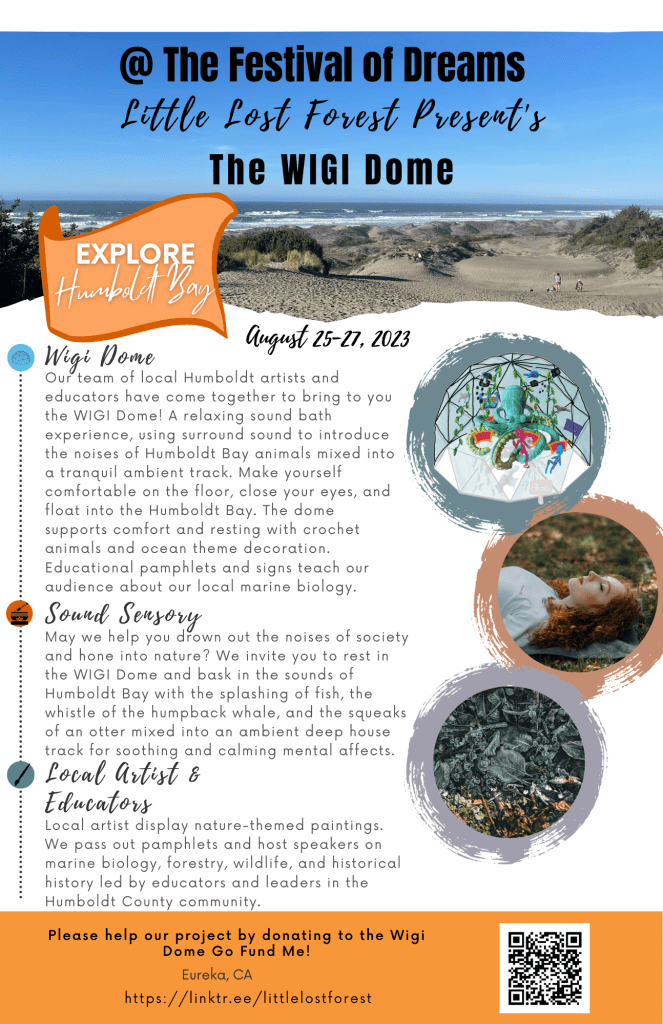
The event’s theme was the Wigi, the Wiyot name for the Humboldt Bay. I was inspired to combine my job as a substitute teacher and my passion as an artist to come up with the Wigi Dome, An Educational type of Magic. 

What is the Wigi Dome? 

The Wigi Dome is a 19×18′ tent that can fit about 13 people, funded by the City of Eureka for the Festival of Dreams. For the event, Fun Facts were lined outside the tent made by second and third-grade students from Laurel Tree Elementary in Arcata. On the top of the canopy, local artists spray painted with water-based acrylic on cloth panels to represent different times of the day and places of the Manila Dunes. Artist such Gizmo (@neudepths), Jackie (@jackalope_studios_arts) and Joe Fox, Ruth (@ruthcreaates_4), and Amber (@mushroom.firy.logs), Autumn, Sera and Georgia.

What is the Festival of Dreams?

The newly created event is Festival of Dreams – a collaboration between the North Coast Repertory Theatre (NCRT), Ink People Center for the Arts and the City of Eureka. The festival will happen in two parts: an outdoor event Aug. 18 through 20 that will take place at Halvorsen Park and around Old Town, and an indoor festival on Oct. 5 through 8, that will be held throughout multiple different Eureka venues. And to make this new festival even more exciting, the City has made more than $40,000 in American Rescue Plan Act (ARPA) grant money available to fund local artists who want to participate. 

Stephanie McGeary, https://lostcoastoutpost.com/

The festival Started on August 25th as a parade danced through Old Town. Local businesses allowed performing artists to set a stage in their occupancy, including Eagle House and Eptimony Gallery. 

Saturday’s event took place in Halvorsen Park as the free interactive art festival commenced. There was a beer garden, vendors, and lots of interactive art. Perhaps you found yourself lounging in the Do Nothing’s Societies Oasis (@thedonothingsociety), hanging out with flow artist Zephyr, making your own tarot cards, and eating complimentary fruit. Enter the Kaleidoscope airplane or sit at a table at the Clam Juice, a psychedelic experience (@glittergizzard). Beautiful fabric acro dancers from Synapsis performed in the center of the park. You may have wandered into a forest of pom poms or the dream-like fabric maze. You step into the photo booth and allow its mechanics to hand draw your photo (@aart.by.mir). Live music and a late-night DJ rocked the stage. In the amphitheater, an artist hung a lanyard of butter wrappers painted with unique images. Ceramic artist Josh Roller (@darthgritty) displayed abstract creatures and wall hangers along the stone edges, along with a smoking dragon, a bone and metal sculpture, and much more art surrounding the amphitheater. 

How was the Wigi Dome experience at the Festival of Dreams? 

The Wigi Dome offered tea and art by Erica Brooks (@fineartbyerica), Joe Mallory (@joemalloryart), Ruth Murphy (@ruthiecreates_4), Drake Munson (@draykinarts), Natascha, and Jeremy Pearson (@littlelostforestart). 10% of all paintings sold inside the dome go to Friends of the Dunes to restore Manilla. Kris Coffman (@kriscoffmaninsight) spoke on Love and Communication with an intimate group that shared stories, laughter, tears, and animal noises. Rah Kiv (@rahkiv) played Flamenco R&B to set the mood as the vendors finished setting up and the festival began. Ruth, vocalist, and Uncle Steve, violinist (@unclesteve1352) performed sea shanty and folk music throughout the day. I made a Wigi mix that was Lofi Hop and had the sounds of the animals of the bay mixed in for in-between sets. Stories on Humboldt County were shared within the Wigi Dome between our community and collaborators, along with discussions, lessons, and music. I ended Saturday night with Alien Paintings, where we free-painted on canvas, folded the cloth in half, and opened it with a groovy alien design. On both days, Jackie (@jackalope_studio_arts) spent a few hours painting fish ceramics with “kids of all ages.” Autumn was an active emotional support partner throughout the festival. 

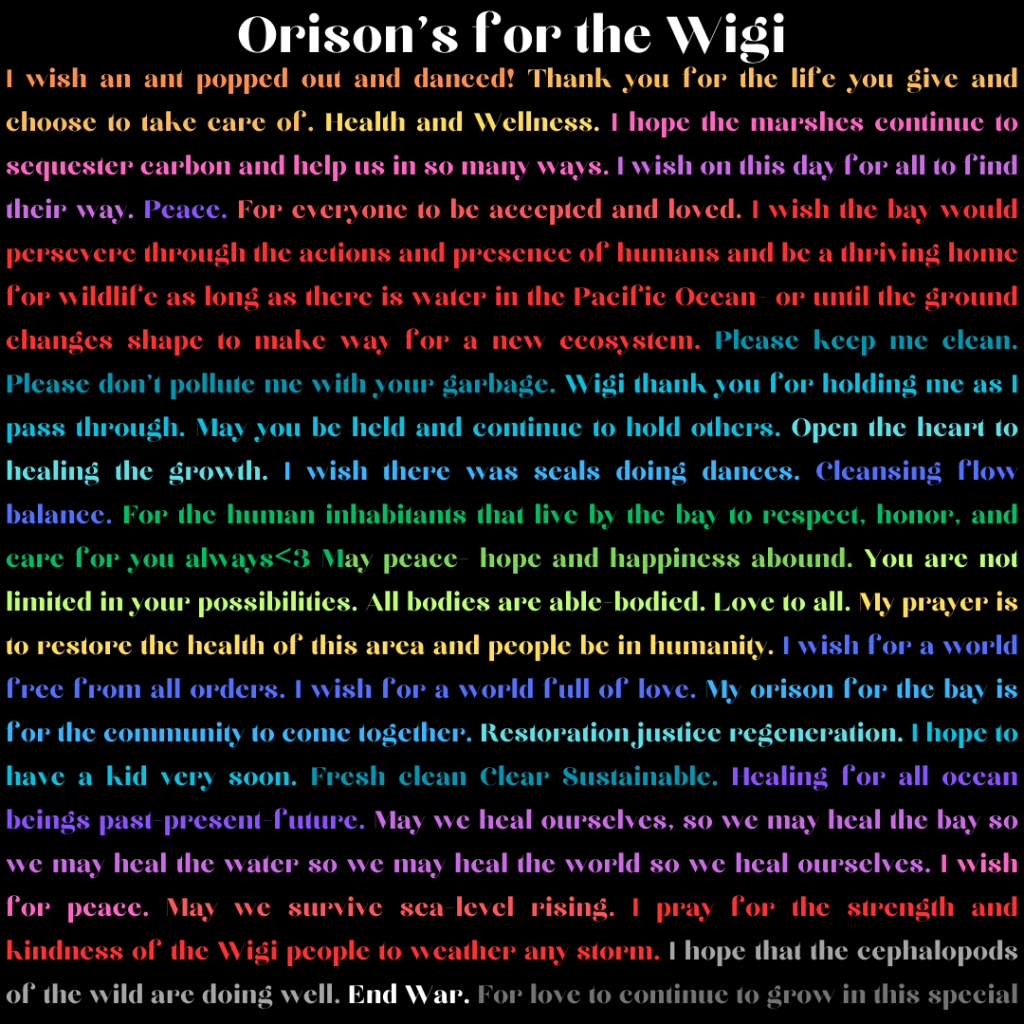
At the Welcome table, we gave out an educational pamphlet by K-12 Educator Crystal Linde about the Wigi, The Wiyot name for Humboldt Bay. We also asked our guests to write an Orison (a 13th-century word for a prayer) for the Wigi. Here is what our community had to say:

We appreciate all the effort that went into the Festival of Dreams. The coordinators, staff, and volunteers. Along with all the other artists that participated. It was truly a beautiful experience to hold space in an interactive art installation to teach our community, hold space for discussion, and supportive relaxation. Thank you to all the Wigi Dome collaborators, artists, musicians, historians, businesses, volunteers, and community guests. 

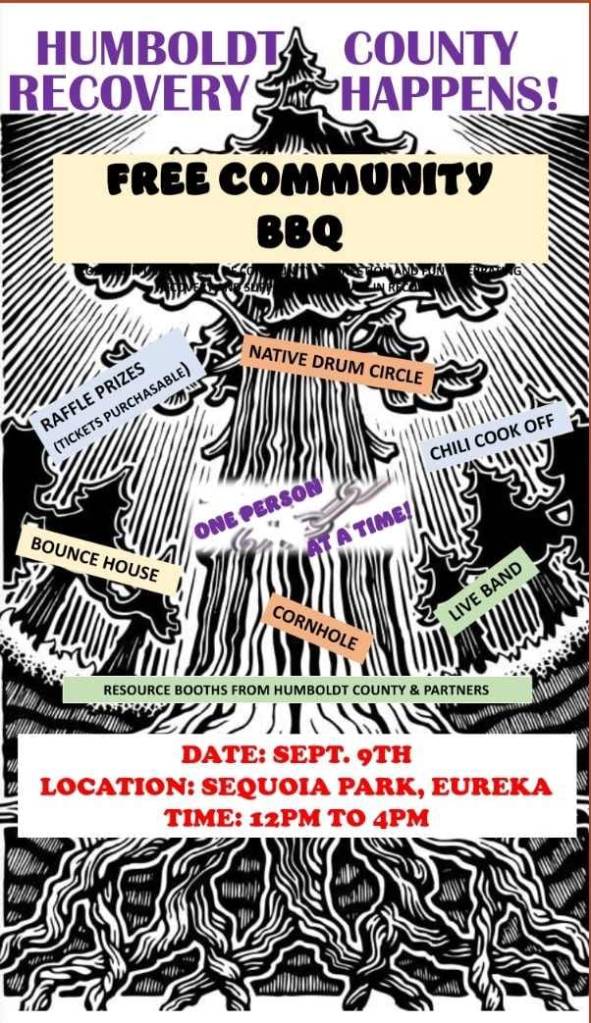
The Wigi Dome doesn’t end at the Festival of Dreams. On September 9th the Wigi Dome will have a booth at Recovery Happens. Autumn and Natascha collaborated on a small interactive art piece where we will ask the community to write on a leaf, What in their life is worth living for and clip it onto the tree. I dream of displaying this place at Morris Grave. We will also be exhibiting the Wigi prayers at the booth. In the future, I can see further collaborations with educators, community, and artists and bring this project to schools to educate our youth in an interactive manner. 

Check out the Wigi Dome Website at https://littlelostforestar.wixsite.com/little-lost-forest.

Please donate toward our Go Fund Me! https://gofund.me/bc4db4cf

Come check us out tomorrow 9/9/2023 at Recovery Happens!

The Wigi Dome: What inspired it, What it is, What it has accomplished, and Where it's going next.

Part 3 and Final Interview

Starbucks was cold and loud, so Dan, Lanie, and Natascha went over to the Shanty to continue their interview.

Natascha: We changed locations to the Shanty for warmer and quieter conditions. Hi Dan. Thank you for coming today!

Dan: Hi.

Natascha: How’s your day going?

Dan: It’s going great. It’s really cold.

Natascha: It is pretty cold day. At least it’s not raining yet.

Dan and Natascha: Yet… [laughs]

Natascha: Can you tell me your pronouns?

Dan: I use she and he. A lot of people get confused about that, so I’m here to talk about it today.

Natascha: Awesome. Can you tell me a little bit about yourself?

Dan: I am a percussionist, and I like to paint. And I work with children on the spectrum. [Inaudible]

Natascha: You want to come a little bit closer?

Dan: I should and talk louder too.

Natascha: There we go. How has transitioning been like for you?

“Yes, the more we learn about this, the more people will have the ability to have language to advocate for themselves in a medical way.”

-Dan

Dan: So, I am intersex. For those that don’t know what that term means. It’s an umbrella term that categorizes a difference in genitalia or chromosomes. It is something someone is born as. It is not an identity. It is a way someone is born, and it is not necessarily what someone identifies. An umbrella term to talk about someone who is born without traditional male or female characteristics.

Natascha: Thank you. Why is it important to use the proper pronouns?

Dan: It brings validation. It shows a sign of care and respect. It’s like learning somebodies name. You wouldn’t- It’s understandable if you don’t want to learn someone’s name, you don’t want to get to know them. But, if you are going to ask their name, you’re not going to call them a different name [second of inaudible.] It’s a sign of respect and acceptance.

Why do you think it might be hard for some cis-gendered folks, or why they would be bothered by the use of they/ them pronouns?

Dan: Learning is hard, and it can be embarrassing if- and seeing somebody upset and sometimes in order to make yourself feel better, they’d say, ‘You have no reason to be upset.’ versus maybe I need to reflect on what I can do differently to accommodate and respect you as a human being.

[Pause.]

Natascha: Thank you. Why is it important to introduce children into the LGBTQ community?

Dan: There are LGBTQ children, and without that community, it can make someone feel isolated and alone.

Natascha: Do you feel that transition has changed you in any way?

Dan: So, particularly with my case, I’ve always felt the need to appear as Afact or a cis-female. If that means altering certain characteristics, which I’m not going to go into detail about, or hormone supplements, at this point of my life, finding a community where we are genderqueer, and I have the ability to accept myself, who I am, and all the lovely characteristics that make who I am and not needing to edit this. So, the act of transitioning for me is essentially me being myself, whatever that looks like- letting myself exist for once, as I am- as I wake up in the morning, as I. Yes.

Natascha: Thank you so much for coming onto Little Lost Forest and talking to me. Also, sharing with our community here in Eureka and everyone else who comes to the blog why it is important to use proper pronouns and why (cis) people shouldn’t take offense when asked what their pronouns are because we’re in this community together and to show respect to one another and the people in the community need to change the way we think and respect and appreciate members of the LGBTQ community within our society these include people with religious degrees and people that assist disabled children. When disrespecting someones announced pronouns, you don’t know who you’re talking to, their background, and what they had to endure. By not respecting someone’s pronouns, they are not respecting our community as a whole. Thank you, folxs, for coming on today. Is there anything that you want to add?

Dan: Yes, the more we learn about this, the more people will have the ability to have language to advocate for themselves in a medical way. I can’t tell you how much that has changed in my ability to talk about the things that my body needs, and that’s not something that necessarily a woman who is cis might need. And even though the doctor might see that’s what I am assigned from my birth, it isn’t necessarily what my body needs. So just those terms, the education behind those terms, just having doctors that are educated on what that is because I have come across a lot of medical professionals that don’t know. It’s healthy. At the very least, I can go to the doctor and get care.

Natascha: That is so important. Alright, thank you.   

Using the Correct Pronouns in the LGBTQ Community Pt.2

Laine, Dan, and Natascha sit out front of Starbucks, sipping coffee and talking about misgendering and using proper pronouns.

Natascha: This is Natascha with Little Lost Forest. I will be conducting short interviews today with Laine and Dan on the LGBTQ community to spread information and create co-existence on non-gender-conforming and intersex persons.

Hello Laine, thank you for coming today.

Laine: Hello, thanks for having me.

Natascha: How’s your day going?

Laine: It’s going alright, thank you. And how about you?

Natascha: It’s going good. It’s been long. Thanks for coming late at night. Can you tell me your pronouns?

Laine: My pronouns are they/ them.

Natascha: Can you tell me a little about yourself?

Laine: I’ve lived in Humboldt County for 21 years. I have degrees from Cal Poly Humboldt in music and religious studies, and I’m learning to be a dog trainer.

Natascha: That’s awesome! How have you transitioned?

Laine: I was born female, and I transitioned in several ways. I had a hysterectomy in 2019. Earlier this year, I had top surgery, which also helped me with a chronic pain condition which I’ve had since high school. I am on a low dose of testosterone which has helped in several ways, but most people couldn’t tell that by looking at me, so not everything is visible to the eye when someone is transitioning.

Natascha: How has transitioning healed you?

Laine: I’m a much happier person. I used to be very grumpy. I had a lot of anxiety about my body and I was always very depressed about my life and about who I was but I’m not like that anymore. Still a little bit because things are still up in the air with a few things, but it’s much better. And having surgery on my chest helped my chronic pain a lot. So physically- much better.

Natascha: Why is it important to use the proper pronouns?

Laine: I see it a lot of times as respect. Do you respect this person and what they’re going through and who they are? That says to me yes! I see you. I see who you are, and I will use the pronouns that you use on a regular basis. There are trans people that I even don’t respect, but I still wouldn’t misgender them, such as *** ***. She’s not a really good person, but I still would never misgender her or deadname her because that’s just not a cool thing to do. You wouldn’t go up to a stranger and say, ‘Hey you, I think you’re a man, and I’m going to call you a woman.’ Why would you do that to a person? That’s just not cool. Do you lack manners?

Natascha: I can totally agree with that. Why do you think some cis-gendered folks are bothered by others’ use, announcement, or display of their correct pronouns?

Laine: For some people, especially the Gen- X and Boomer generations, and maybe because they are older, have trouble getting acclimated to something new. [Loud background noise]  -Sorry about the traffic!

Natascha: I’m sorry.

Laine: They may be like, ‘Okay, this is really new for me. I don’t know how to deal with it. It’s a big change. You might have to remind me a whole bunch’ And that can be hard for some people, especially if it is their child or grandchild. ‘I’ve known you as “this” for so long. It’s gonna take them some time to change to “this.”‘ But for some other people, people of our generation or even younger, they see it as you are taking something from them, especially with trans-fem people. Cis-women will see it as you’re taking away their womanhood. They see it as your putting on a costume. You can’t just take some hormones or put on a dress and some make-up with longer hair and suddenly- bam, you’re a woman! They say you have to have a womb and give birth which totally pushes away cis-women who can’t give birth or don’t want to or anybody who can’t give birth and doesn’t want to because we shouldn’t just be down to our body parts. That’s not just who we are. We’re not just our genitals and our body parts. We’re who we are inside.

Natascha: Thank you. What is the importance of introducing children to the LGBTQ community?

Laine: Well, there are LGBTQ children, and we don’t want them to feel alone and ostracized in not knowing who they are because then it’s kind of sad to feel all alone, and once you find others who are similar to you- it’s like finding others who have the same hobby as you but you’re like ‘Oh my gosh, you’re like me. I can talk to you about this stuff. There’s somebody who understands. I’m not alone,’ and don’t you want your kids to be happy and feel like they’re accepted? And, besides that, even kids who aren’t members of our community, wouldn’t you want them to see other people who are different? Rather if your child is Caucasian, wouldn’t you want them to see people that are Black, who are Hispanic, and people who are different then them so they see that this is a glorious world? There are people who are different, and we’re all wonderful people. Don’t you want them to see people who are disabled and show them that there are people who are not like “me.” That they are still out there and not everybody’s like you.

Interrupted by intoxicated passerby: Whoah, you’re so amazing! So good!

Laine: Wow…

Natascha: I think you’re pretty amazing [Laine.] He just doesn’t get how amazing you really are.

Laine: – Show children that there are so many people out there in our world and not everyone is like what they see on a regular basis.

Natascha: Thank you, thank you so much. Do you feel that transition has changed you in any way?

Laine: Well, I am a happier person. I used to be very depressed and- but- I didn’t really know who I was. I was confused. I was in pain both physically, mentally, and emotionally. I was grumpy all the time. I wasn’t a nice person. I was “Grrrr.” Now, I’ve been through all these struggles with changing my name and being on hormones, and I see people doing the same struggles, and I can help them in some way. I’d like to give them some tips, and tell them ‘This is what I did. If you’re going through the same struggle, I maybe can give you some ideas on how to pass those hurdles in certain processes in what you might need to do so you can get through that faster because I did it in the slow and long way and now you can do it a faster way so you can get through that in a much more expedited manner. And not just that, but if someone is within the community and not transitioning- just tell them what it’s like so they can understand. Or if people are outside of our community and want to be an ally, just talk to them about what it’s like, like what I am doing now. But if someone comes and doesn’t come to be an ally and doesn’t come with openness or love, I don’t have time for that because I’m not going to waste my time with a person who doesn’t want to understand and just comes with hate.

Natascha: Thank you so much, Laine. I really appreciate your time. I know it’s freezing cold out here, and we have horrible background noise, but you have been so wonderful and great. Is there anything else that you wanted to add?

Laine: I don’t know. Do you have any other questions?

Natascha: No, I think you answered my questions just beautifully.

Laine: That’s great, and I am so glad that you are doing this, and I hope it goes over well, and if I can answer more questions or if there are any comments, I’ll be there.

Natascha: Thank you, we will make sure to reach out to you. Thank you.

Laine: Thank you.

Thank you for reading. The correct pronouns list is below. Please share with your friends and family. Dan’s interview is coming up. You can look forward to reading it next week.

Interviews on Using Proper Pronouns

(Ranma)

I conducted three interviews this week on folx in the LGBTQIA community. Here is one of them!

Natascha: Hi, this is Natascha with Little Lost Forest, and I will be interviewing Ranma today. A very good friend of mine for the past ten years. Ranma, how are you doing?

Ranma: I’m doing good, thank you for asking.

Natascha: Awesome, I’m so happy to hear. Will you please tell us your pronouns?

Ranma: Well, my pronouns are she and her.

Natascha: Sweet, and as I understand, you have transitioned?

Ranma: Yes, that is correct. I have been in transition for about a year, and I think four months now.

Natascha: Wow, the time has gone by. It flies. Can you tell me a little about yourself, what you do, and what your hobbies are?

Ranma: I’m an artist. I’m very athletic. I used to break dance. I love listening to music. I love making illustrations. I try to do illustrations for the trans community, and I also do designs for everyone else. As you know, I’m very open with my artwork. As for a real job- that is basically my real job because I have epilepsy and can not work.

Natascha: Well, a full-time artist is definitely a real job, and you keep yourself quite busy.

Ranma: It helps when you’re mad.

Natascha: Yeah, it does help when you’re mad. I can agree with that. How has transition healed you?

Ranma: Um, well, it allowed me to be myself completely. And now I actually have a bigger palette of fashion than I had before. More clothes to choose from, which can be awesome and really bad at the same time. If you saw my room, you could see the toll it’s taken.

Natascha: That’s great. The clean-up might be more now.

Ranma: Yeah! I need one of those machines now that they clean the ice with-

Natascha: Like in Meet the Jetsons.

Ranma: That’s right, a Zambonie. A Zamboni or a mechanical maid or something.

Natascha: I’m sure you can manifest anything. It will come to you. Why is it important to use proper pronouns while someone is transitioning?

Ranma: Well, because, for one, that person was never actually their birth gender. Inside they were always woman or male, and actually saying so would help their body’s energetical cells (helping every trans person realize that they are beautiful, Angelic even) to actually blossom. -Because it feels good to be called what you’re striving for. It was always there, but you know, you’re just trapped in this skin suit.

Natascha: That’s beautiful. Why do you think some cis-gendered folks are bothered by others’ use, announcement, or display of their correct pronouns?

Ranma: Well, to be honest, I think a lot of cispeople are very uneducated about their own sexuality. And also I think that they’re fearful. For instance, if they see a cute woman and that woman turns out to be a transwoman, it’s like, ‘Oh Shit, am I gay now?’ You know, and vice versa. To be honest, I think it’s just insecurity.

Natascha: Do you feel transitioning has changed you in any way?

Ranma: I can’t answer that one too precisely because I have always been me, but the biggest change that I can say is that I am actually 24/7 happy.

Natascha: I’ve heard that a lot in these interviews. That it [transition] has helped with depression and has made people very happy. That is wonderful.

Ranma: One of my friends I went to bars with was like, ‘Oh my god, you’ve changed so much.’ For instance, you smile more, and I thought to myself, I thought I always smiled. No, no, no, you smile a little bit, and then you put on a depressing song for karaoke, and then you sing a depressing song for karaoke, but here you are dancing and smiling and more upbeat songs for karaoke. So I’m like, alright, well, thank you, I didn’t notice that.

Natascha: Cool, this is a question I threw in there, which is kind of important to me because I have children, and I’m introducing my daughter into the LGBTQ(IA) community.

Ranma: Awesome-

Natascha: Why do you think it is important to introduce children to the LBGTQ community?

Ranma: That has so many answers. For one, it’s really good for child evolution right there to be accepting of everyone and everything and to realize that there is more than one way to live life. And everyone is the same. You know, it is also the journey of who you are. There are grown adults who have no idea who they are.

Natascha: Yeah, absolutely, and there are people that transition later in life so, and don’t find happiness until then.

Ranma: I am one of them. I didn’t even know I could do this until four years ago when I had my trans fiance, and we broke up, and I found out that, as much as I don’t want to admit it, I was completely jealous of her.

Natascha: Does it all make sense now? Are things coming together for you?

Ranma: Yeah, the only thing I have to really be cautious of is haters.

Natascha: Can you tell me a little more about that? What kind of negative reactions or discrimination do you have to face?

Ranma: Basically everything that comes with being a woman, those discriminations (referencing that women have to go through, all women have to go through, being judged on their beauty and being seen as just sexual entities, etc.)- that type of stuff. And then there’s little stuff like my aunt still likes to mislabel me, misgender me, as you know he. And like someone did this to you! And it’s like, no, I did this to myself, and I’m happy. I made a choice. And it’s quite interesting. The landlord still calls me he ’cause he caught me at the entrance of my transition, and he’s old, he’s sweet, you know he just can’t open up that third eye and get down with me being a woman and him being able to still talk to me and chill and have a beer with me.

Natascha: Yeah, I’m sorry you have to deal with that. At the same time, I think you’re really blossoming into your true self, and you’re absolutely beautiful and stunning. I don’t think anyone is going to get you down, and if they do, you call me. Is there anything else you want to add?

Ranma: There are some of our old friends that just recently saw me and haven’t seen me in a bit, and I just went to the bar. I have this overall skirt. A beautiful overall skirt, and I think you know Kevin. You know, dreadlock, Kevin. He couldn’t say to my face that he found me attractive. He told Eddie, my housemate instead, and said, ‘Oh my god, who’s that? She’s got beautiful legs,’ and found out it was me. ‘That’s Ranma,’ ‘Oh, Ranma? Can I meet her?’ ‘Kevin, you already know Ranma. Ranma used to be Rasheed. That’s Ranma.’ ‘Oh, okay. She has beautiful legs.’

Natascha: Now you get to show them off.

Ranma: I love showing them off. Especially when an old friend hits on you. ‘You don’t recognize me?’, ‘Okay.’

Natascha: Well, you’re a new person now.

Ranma: Not even how I speak? I think I still speak the same.

Natascha: I think you do, but you know it’s a new you, and I am so proud of you. Is there anything else you wanted to add to help educate the community on transgenders or using pronouns?

Ranma: Well, all I want to offer is a little bit for everyone on this one. Loving yourself will allow you to love others. And that’s the basic thing if you’re cis, trans, or miscellaneous, you know it doesn’t matter. It all starts from loving yourself; once you love yourself, you can be yourself and learn to love everyone else.

Natascha: Thank you so much, Ranma, for coming on today. These are short ten-minute interviews. I appreciate you.

Ranma: No worries.

Thank you, everyone for reading, educating your community, and spreading the word that using the correct pronouns when someone is in transition is showing respect! I look forward to sharing more interviews early next week.

LGBTQ in Children’s Animation

Living in a liberal state, I am surprised to hear the uproar in the mom’s’ community on LGBTQ (Lesbian, Gay, Bisexual, Transgender, Queer) in Disney, Pixar, and children’s animation in general. Children’s’ cartoons have always had heterosexual lead roles. As society becomes more accepting of people in our community, diversity is inching onto the big screen. Yet, some parents insist that homosexuality is being pushed onto their children. For years the princess will one day meet her prince was the “only way” that a child’s movie would play out. I want to ask, “How long are we going to keep homosexuality in the closet?”

In 2013, the hit movie “Frozen” came out, a coming-of-age animation about two princesses, Elsa and Anna, one of whom is overcome with the powers of winter. Frozen was the first Disney movie to portray witchcraft in a positive light, a significant progression compared to Disney’s bias towards Christianity. The hit song “Let it Go” was said to have been an innuendo for coming “out of the closet” and a piece on self-acceptance. Even though I did not find any correlation with to homosexuality in this film, this song started the buzz. When will Disney include everyone in their movies, not just heterosexuals? 

In 2020, the Pixar animation “Onward” was released with a butch lesbian supporting character as the father figure. By no means was this character a leading role. Now with the cat out of the bag, we’re not all made to fit into generic categories. I witnessed mother’s’ taking offense to this character like she was invading their children’s perspective on how they might feel about themselves. If this is the root cause, then these parents also need to reflect on how they view their children, and whether they would love them if they are different. Perhaps that is what Disney has tried to teach people through diversity in their movies: to love everyone and not just those that fit into your category. 

“When The Proud Family premiered on Disney Channel in 2001, it was not only the first original animated show on the channel but one of the few all-ages animation programs on television at the time centered around a Black family.”

(-Radulovic, polygon.com)

Bringing backThe Proud Family” was nostalgic to all 90’s babies. What kind yet strong-headed lead would we want on television for our kids, other than 14-year-old Penny ProudDisney brought it back asLouder and Prouder,” and accompanying the Proud family, in a supporting role is a gay couple with non-binary siblings. They brought in voice actors that also identify as their characters—bringing work and awareness to the community. I am an open space, but it pains me to hear other mothers take offense to this rising trend and the feeling that we can’t be honest with our children about treating people as equals. Let your children follow their hearts instead of making them feel like they have to hide. 

So on that note, is it just a rising trend? This is a rebuttal I heard the other day. “I would be okay with it [homosexuality in animation] if they [animation studios] weren’t doing it to make money from a fad.” 

Well, I hate to break it to you, but as a bisexual female, I have been waiting my whole life for homosexuality to be in children’s animation. I honestly found heterosexuality kind of gross growing up. Seeing the go-to man marry a woman scenario over and over; got me sick. There are so many things we should be protecting our children from,: war, violence, hatred, negativity, but love? If we shield our children from love, what kind of hope are we giving them for the future?

Lastly, Disney released a short film called “Out,” about a man having difficulty telling his parents he’s in a relationship with another man. He switches lives with his dog and they play cat-and-mouse, almost exposing his live-in boyfriend to his folks. My husband didn’t like the movie when he saw it. The situation was all too familiar to him. We’ve all heard of the struggle LGBTQ people may have coming out to their parents. He wasn’t seeing what I was seeing. This was the first step. There it’s “out,” it’s been spoken. For a story to be told, it has to build from the beginning. Otherwise, the audience may not understand the world’s laws, but here it was. I would expect Disney to prep their audience to understand the struggle of queerness through this simple short, so that more complex characters can come into play in the future. Instead of immediately judging the characters, the audience may show compassion. We all live on this earth together. 

Radulovic, P. Feb 17, 2022. Polygon.com, The Proud Family creators: ‘There’s not just one view of Blackness or a Black family.’ https://www.polygon.com/disney-plus/22939385/proud-family-louder-and-prouder-creator-interview