February 19th 2026, Trinidad, CA: I sat in Mihael’s home, which he has rented for the past 20 years, where he has observed the animal life in Humboldt County both in the ocean and on land. Mihael has another home named Fairwind that is off-grid in Honeydew, CA that he built for the ground up, housing his family and his community. It is now used as a spiritual retreat. Mihael has always worked in town as a carpenter, driving from his home in Honeydew to Trinidad and working for the residents inbetween. Through his work, life, and family he has observed the sweeping changes in Humboldt from the beginning of the Cannabis revolution until it’s ultimate down fall after legalization. This interview goes into great detail about the observations that Miheaal hasa madae, from the good to the bad. Focusing on the economy, the cannabis industry and the local environment. Thank you, Mihael and our readers for your time and interest in the stories of Humboldt County.
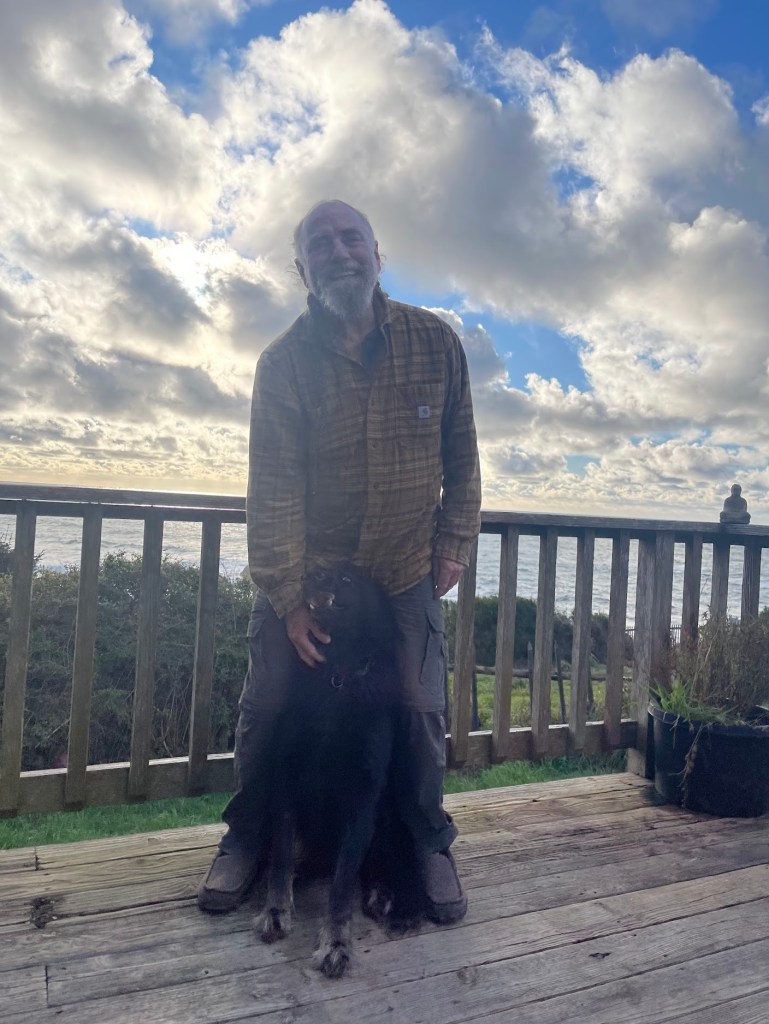
Natascha: Hello and welcome to the Little Lost Forest blog, where we are documenting an oral history of Humboldt County and examining the economic shifts that followed the legalization of cannabis. Today, we’re speaking with Mihael Kavanaugh, creator and steward of Fairwind, a healing retreat in Honeydew, California. As a longtime resident of Humboldt County, Michal built his dream from the ground up, living off grid and creating a space dedicated to healing, safety and community care. When he purchased Fairwind, it had nothing to do with marijuana, but the collapse of the local cannabis economy has deeply affected his ability to sustain Fairwind and the life he created there. His story reflects the broader ripple effects felt across Humboldt, raising important questions about what happens to rural communities when their foundational economy disappears and how those shifts reshape livelihood, land and collective identity.
Hi, Mihael. How are you doing today?
Mihael: I’m doing pretty good, all things considered.
Natascha: Yeah. Thank you for meeting with me. How long have you lived in Humboldt?
Mihael: Oh, 49 years.
Natascha: And what is your history as a resident in this area?
Mihael: When I first came, I was doing tree planting in the winter and construction in the summer. I started going to college at College of the Redwoods, where I opted to not rent and just put a wiki up in the mountains and hike to school.
Natascha: Well that’s creative. What is your history as a resident in this area?
Mihael: Well, going to school was definitely a start and I was very involved with the aspects of preserving nature and environmental concerns. Being a tree planter, I saw the direct effects of logging, I planted trees in Washington, Oregon, California, Idaho, and Montana. So I had a very good perspective of the effects of logging.
Natascha: You also read poetry on a radio station. What radio station was that?
Mihael: That is Kmud radio, the second Wednesday of every month at 8 p.m.
Natascha: That’s lovely.
How would you define cannabis culture prior to legalization?
Mihael: Well, people were growing in the hills in the early 70s, and a lot of the back-to-the-land movement, people from the 60s found little niches. There were certain communities that they found strongholds, in the Mattole was one of them. I was a little bit younger than some of those people, but the back to land movement was part of the reason I bought property in the mountains, to raise my family, in a close way to nature, and try to grow as much food as we could. And I didn’t have anything to do with marijuana, but it was already in the hills, but not a dominant force; police weren’t doing raids, and there wasn’t much being grown. It was definitely a different era.
Natascha: And you’re talking about your property in Fairwind?
Mihael: Yeah, it’s out in the Mattole. I witnessed it go through many transformations; almost every decade, there was something new. I mean, it was almost 20 years before medical marijuana came into effect, which was a huge dynamic. Probably the biggest in the early years, CAMP, campaign against marijuana planting started in 1984, primarily 83, they did a couple of things, but not really. By 84, it was full-on military. They were dropping crews of 16 fully armed military-type people, combing the hills. And that created the whole guerrilla culture of people growing in the woods, hiding things. I never grew on the property in the early years. For the sake of having children there. So I didn’t, you know, we could stand there and wave at them, and neighbors would come to my place because they knew it was a safe place. And, um, it entailed hiking many miles in the woods. So that suited me because I loved nature and hiking. But at that time, the price also fluctuated greatly. People said, ” Oh, it went up so much.”
Mihael: Yeah, but you could only grow two ounces as compared to growing a 1 or 2lb plant because you had to hide it. I mean, it’s extremely hide it or risk getting it all taken. So I saw many helicopters during those years. I think the biggest years were 84 through probably 94 or 5. Um, and they really, uh, they had a thing about honeydew. It was one of the first places they ever hit, and they would come there every year for a couple of weeks. And, um, so that created a whole different culture. In that same time when it started going up in price, then people started moving there solely for the green rush quote – of they could grow 100lbs and leave at the end of the year and make a small fortune. I was still doing construction and raising my family, and that wasn’t me. Although there were people, and unfortunately, with that, it changed the community. I think you have a question later about that, but I could go on right now and address those things.
Natascha: Yeah. I mean, go ahead. Keep talking and we’ll go through the questions.
Mihael: The way it affected the community was that a lot of the people who originally moved there, especially before the marijuana boom, we’re moving there because they love the land. They had a relationship with the land. They wanted to grow their food. They wanted to kind of step out of the system of society and live simply off the land. So there was a sense of community that was really strong, and you knew your neighbors, their children knew your children. On the community at Fairwind, we even built our own school. I allowed 4 or 5 other families to live there so we wouldn’t have to go for social. We were mostly on the land all the time with goats, sheep, donkeys, horses, chickens growing our food, then it was a really unique relationship with one another, but with the animals and the land. There was a certain kind of utopian element about it, especially growing up in San Francisco, where the whole back to the land movement thing was something that drove me as a youth. I was listening to Alan Watts when I was 12 years old and just having those influences. Stephen Gaskin, who started the Tennessee farm he used to teach at San Francisco State College and did a radio show. So I was hearing that stuff. The element of living off the land changed because then people started making big money when some of the neighbors who started making more money than… it was almost too much money.
Mihael: So then lots of drugs started coming in. Unsavory people started coming in, people started getting greedy. It changed the dynamics, except for the people who wanted to just keep it simple. That was a big change in that mid 80s era where I saw a lot of people shift their focus, and there was a certain abundance to it that allowed people to build their house to buy their solar panels too. I almost paid off the land just doing tree planting and construction and, and that was adequate. Land was a lot less expensive. Then, of course, once the boom started happening, the price of land started going up. And then it became a cultural kind of phenomena that when CAMP became so heavy and so oppressive because– they were– people started growing indoors with generators. So that was a whole ‘nother culture that I didn’t adhere to because then they were growing in these bunkers and houses, running diesel generators all the time so that they couldn’t be seen from the helicopters. So that was then another like a layer to the evolution of the grossing. A lot more people started moving up from the city going, oh, I don’t care about the lifestyle, but I can come here and make money.
Mihael: It changed the dynamics of some of the people that were moving there because they weren’t moving there, because of the love of the place and a relationship with the land. They were moving there with the hope of making some big bucks. And so that that was like, and like I say, almost every decade, there was another wave of that where it changed again. That happened again in the late 90s when the medical scripting happened, where then people could grow in a greenhouse and they couldn’t just come and take it because it was potentially legal. So the whole helicopter days of them being so oppressive shifted. In some ways good, because people were not so stressed out. They weren’t having to run around underneath the military M-16s. It kind of simplified things and for a time it didn’t get out of control. But then because that happened, then people started taking advantage of that. And that’s when people started bulldozing tops of mountains and growing way too much. And then that brought in a whole ‘nother energy of people from other countries, you know, and Bulgarians moved in, the cartels moved in. Although some of those people came even in the early 80s but just a little bit, It became much more.
Mihael: The more they realized how much money– you know, when people start floating millions– then other people are like, oh, here, I’m going to be the big dog and run this thing and then that eroded the sense of community because it was so based on money and not caring about the environment. I remember, you know, because I listen to the radio, how many times they would find a grow way out in the woods on a national forest or whatever, and there’d be pallets of poison, you know? Because they were just trying to grow so many thousands of pounds, they didn’t care about the environment. We used to have a ton of great horned owls. Over time, they just disappeared, probably because of people using rat poison. And so those kinds of effects are definitely the negative of people, quote, going for it and going, not caring. I would say that in the early years, most of the original back-to-the-landers and mom-and-pop people were super conscious. They would not use poison. They kept it much more simple. They were stewards of the land. They were taking care of the land. They were the ones trying to defend the land. That culture is, unfortunately, kind of just got overrun by the bigger scenes, and then, hence the kickback from the authorities, because then the authorities are like, oh, we got to go after these environmental people, ruining the environment, and bulldozing and cutting down all the trees and damming creeks.
Mihael: and because some of that stuff, that’s where they were crossing the line. Then making it harder for the people who are living in a good way. There was an in-between time where the schools were thriving, and the children were thriving. The small businesses were doing good and there was rich music, the festivals were happening.
I remember one of the firemen’s Hall burnt down in Garberville and then, you know, a little while later they were like, oh, let’s do this fundraiser to build a new community center, you know, so that’s when the Mateel formed. The fire company, even in Honeydew, we used to do a food booth at Reggae on the River as a fundraiser for our own fire company. But then that evolved into the Roll on the Mattole like, let’s do our own little music thing. And so a lot of the non-profits, schools, fire companies, they all benefited from those bigger events because it was like, hey, we’re bringing in all this people, this culture, and this is a way to help nurture those fundamental parts of our own culture. At the same time, I think there were some of the government agencies that were like, oh, we can’t let them have solar panels and not be on the grid.
Mihael: The whole Say No Reagan-era was actually, they called it a War-on-Drugs. So the government didn’t like the counterculture getting a foothold in becoming self-sustaining. And a lot of these people, a lot of my friends and people that moved in, you know, were Vietnam vets, who didn’t fit well in society, but fit well into the mountain culture. There were a lot of them who might have been called misfits, yet they were just artists. They were people who wanted to live differently and were culturally, actually adjusted to that lifestyle, and people honored that. If there was a certain neighbor that really wanted to be like a hermit, if there was someone who wanted to be plugged in to the school system and helping with the different events, then there was room for that too. I worked at the Petrolia Community Center the very first summer I was there, and you know, straight away, these are your people. They’re in your valley. So you get to know the families. You get to know the elders. You can get to know the youth. And then as you have children, and then, you know, I’m part of the fire company. I was part of the coaching the basketball.
Mihael: You evolve in the ways that you can plug in and be a part. At least that’s my nature. And like I said, some just stayed quiet and just wanted to make money. You know, for me, that wasn’t why I moved there. So that was never a big priority. In the mid to late 90s, when the whole Prop 215, they call it medical marijuana, it allowed people a little more freedom and a little less anxiety because of the anxiety of the oppression of the helicopters and them driving down the roads and convoys coming in and turning people’s lives upside down. It was heartbreaking sometimes. Not always in a just way, you know, they weren’t just going after the big growers, they were going after some of the mom and pa growers, people who were barely making it, you know? And so that’s when it’s like, come on, let it be. That became even more apparent when it became legalized, because then the people who just were making enough to get by and take care of things, they were spending their money in the restaurants, they were spending their money to go see music. They were buying clothes. Even the trimmers, you know, people always, oh, trim-igrants, blah, blah, blah.
Mihael: But they were staying in the motels sometimes, too. They were buying food. They were buying clothes. That money was being totally cycled right back into the county. And in a good way. And unfortunately, when they shut that down, that’s when a ton of businesses shut down because they took away the very foundation of what was helping things thrive. And that element of– let me interject here. When it became legal, there was Prop 19, was the first one to be voted for. It was geared towards small growers and medical, and written by some of the founders of the people who were kind of at the forefront of things. I think I remember hearing that some corporation in Utah spent almost $40 million with advertisements against 19, saying, “We don’t want this in our schools. We don’t want kids to have access to this.” You know, portraying it as a terrible, bad thing we weren’t ready for. It would have been much more well-rounded for the economy in Northern California, and a better situation for all the growers. But most of the voters are in Southern California and San Francisco. So they were swayed to think, Oh, this isn’t good. So then when prop 64, which was written by corporations for corporations, was presented just two years later, the same $40 million was portraying how good it was, like, oh, finally we have this thing.
Mihael: And so that’s an $80 million spread of swaying by propaganda, people’s voting and. And of course, when they first wrote it, it was supposed to only be an acre with all these guidelines. And within a matter of months, they changed that because the stockholders said, we’re not going to be able to make much money if we can only have an acre. And of course, all the growers in the hills, the only stocks they held were the herb stocks, not anything having to do with Wall Street and investment firms. So that was a huge shift in economic status that then limited a lot of the people that could even afford to get a permit. Uh, you know, I knew some people very close to me who, you know, spent $100-200,000 jumping through the hoops, not even being able to grow for a while to get their permits. They were losing money some years, busting their butt growing, growing, growing with all the stipulations, everything and still losing money. So a number, a lot of them just stopped. They said, this isn’t worth it. Why am I working to fail? And I think the county did some things in the beginning. A lot of it was state regulated, and that was beyond the county’s control. But there were other counties that were much more lenient.
Mihael: You know, like Mendocino, you could have 25 plants with no problem. You didn’t have to jump through a million hoops. So a lot of the people were still able to do okay. Humboldt, I think shot themselves in the foot and then the other foot and then the– and not knowing that they were really crippling their own county by having way too many regulations, making it way too hard, making people literally suffer. People were committing suicide because they couldn’t meet all the regulations and and then they were watching their families hurt. And to me, that’s tragic. That’s a system that has failed miserably. When people are doing everything in their power for years and then committing suicide because they’re failing. And some of that was due to, unfortunately, to some of the programs that the county had and too many strict things. It’s one thing to shut down the big dogs who are trying to grow a thousand plants or bulldozing but a lot of the smaller growers who were just one of the small things, they should have just let it be and our economy wouldn’t have just taken a nosedive. It’s sad, I go to Garberville every month for acupuncture and my radio show and half the stores are empty. It’s like a ghost town. The ones that are still there are not thriving. They’re barely making it. There used to be a ton of restaurants and clothing stores and gift shops and– How are they going to cater to tourists, which is what they’re hoping to do again, because tourists are always come here but if someone stays near there and there’s no restaurants and there’s no stores to shop and nothing catering to, then they’re probably not going to stay long.
Obviously, now that the redwoods aren’t going to go anywhere. That was a battle in the 80s and 90s, um, to save them. What degree we could. Corporations had their heyday with that. Again, with junk bonds, and just that’s another story. Now, a lot of people are trying to reinvent themselves. Those that are still in the permit realm of marketing, branding, and developing their science behind some of it.
Mihael: I’m always a little sad that there isn’t more emphasis on the spiritual part and the prayers that are in the plant because people feel that, at least people I sold to way back in the 80s, people came back to me and say, oh, does the guy who grows this actually say prayers over marijuana? So it’s not just about the nitrogen, phosphorus, and potassium; many people emphasize the fertilizer, but how you treat the plant and how it affects the feeling that comes forth from it.
Mihael: There are people though, that are fostering better ways to work with it. With some of the regulations, there are people who are still using chemicals. It’s supposed to be organic, it’s supposed to be tested against that. They’ve even proven that some of the labs are fudging the numbers to make it sound like the plants are better than it is. And that’s just counter if you want to view the plant as a sacred healing medicine plant, that’s where the business part always twists things, because then it’s about money. It’s not about medicine. Hopefully, in the future, it’s hard to say how it’s going to go. People tell me that some of what’s in the dispensaries isn’t actually even that good quality. Sometimes it’s old, and to me, that’s just sad. I think a lot of people have gone back to buying stuff on the black market because it’s just better. That’s the backfiring of all the regulations and rules where for decades, people didn’t have that. And so they always found it. Growing up and in school, it was always there and from all over the world, that was the beauty of it.
Mihael: You know, it’s a very cultural thing to a lot of countries that and it has been growing in a lot of countries for a long time. It’s not just a modern thing. There’s a certain beauty to that, and I don’t think people emphasize enough that different strains create different feelings, that there’s stuff that’ll keep you up. There’s stuff that’s more of an uplifting high, and other stuff that’s more like you’re tired at the end of the day and you want to sit on the couch. So there are different types for those different things, and not enough is spoken about that. And even each plant: if you harvest it on a given day, two weeks later, it’s going to be a different feeling, a different flavor, a different high. Two weeks later, that same plant will be different again. People are starting to learn about that. But, you know, a lot of us knew that stuff 40 years ago. I think there should be more emphasis on that, because it opens the door to it being more beneficial in other ways. And I’m glad that now, like many elderly people, I’m finding such benefits and dropping other pharmaceuticals. I know a couple of people who used to take six different medicines that now, a little cannabis is all they need and they’re actually better off for it and spending less, and having a better quality of life. Of course, the pharmaceutical companies are like that’s why they’ve resisted it all along.
Mihael: Because they don’t have control over it. It’s a plant grown in the hills, and they want to synthesize it into something you buy in a pill bottle. They’ve done some of that, too, because that’s the way big pharma is. That’s the way money corporations are. How do we make a buck? It’s not about providing a service to people. And I think in the early years, it was more about a relationship with it. It was your friends and smaller circles of people you worked with. There was an inherent beauty in that; you had a relationship not only with the plant but also with the people who received it and what they wanted. My musician friends were always like, ” Hey, we want this one because they stay up at night practicing.” Do you have any other questions? I went off on a number of tangents there.
Natascha: Yeah. While you were gorilla growing, which is when you grow off-grid, right?
Mihael: Well, like a mile away from your home in Timberland or forest land, nowhere near anybody’s house, you know, in the trees.
Natascha: Carrying all, all your supplies.
Mihael: I used to hike up to two miles sometimes to go to some of my spots.
Natascha: What was your connection to the plant? Why did you do that?
Mihael: Primarily because of the helicopters, you had to hide it. In the summer, it’s hot and dry.So you have to find a place where there’s a spring. So sometimes that mile and a half or two miles was because that’s where the spring was. Then I would set up simple garbage cans with a drip system from the spring and servicing just eight plants, or maybe 15. Just small, small plots enough to grow, maybe a couple pounds.
Natascha: Why did you grow cannabis? What was important to you to do so?
Mihael: Because I was doing the homesteading thing of raising my kids. We were even homeschooling, growing as much food as we could. It was another infusion of some money that allowed me to still have that lifestyle; of being there, helping raise my children, helping build on the house, tending the fruit trees- it’s 65 fruit trees. When you’re doing farming like that of gardens and that it takes a lot of energy. Heck, I knew people who had huge organic food farms and they’d sell $150,000 worth of produce, but they’d still break even. So even they, after selling $150,000 worth of produce, would have a few plants by the river to help them have a decent quality of life.
Natascha: So what I’m hearing from you is that there is a connection between sustainable living, living off the land and cannabis.
Mihael: Definitely. For me, when you’re doing it in the right way, it’s a right livelihood thing too, because you’re working with a plant and you’re not harming nature, you’re not harming anything. Then it’s something of benefit for people. It’s helping people deal with their pain or dealing with their anxiety, so it’s a win-win that way. It’s not easy work by any means. People think you just put a couple seeds in the ground and no, you got to tend to it for eight months. It’s a lot of work.
Natascha: How did you protect your farm and your business?
Mihael: So in the early years, like I say, just didn’t even grow on the land. So that there was no risk to our well-being and being threatened by the authorities. Even when Prop 215 got passed, I waited two years until I heard the state attorney general, state that as the top law enforcement person in the state, that he had to protect my right to be able to grow. And I was like, cool. So that was the first year I grew something closer to my house and it was just a tiny little 10 x 20. Neighbors teased me and said, what, build yourself a real greenhouse because they had bigger greenhouses. So for me, a 10 x 20 was like way bigger than a cold frame. But for them, it was like, no, you’re still in a cold frame.
Natascha: I mean, your house is the most immaculate, detailed, built home I’ve ever seen. So you had the skills and chose to remain small and humble, it sounds like. When you sold your product, it sounds like you mostly sold to friends and family. Were there any other primary clients, maybe from out of town or–
Mihael: Well, you know, some of my friends from my youth would say bring it to San Francisco, and I’m talking again, 2 to 4 units. Nothing big, you know. And then they would provide some of that to some of their friends. So again, it was just small. You know, friends helping friends kind of thing.
Natascha: When you reflect on the upbringing of your family, was that lifestyle desirable?
Mihael: For the most part. We didn’t have a phone for 20 years because we were out on the mountain. It wasn’t even a possibility. We didn’t have television or the media. We had a little tiny radio, but the children grew up playing in nature. So they made things all the time. They rode their bikes and built tree forts. They created skits and acted. Their imaginations were very fertile. The downside was that when the helicopters came around, they still felt that tension. Even though the helicopter couldn’t land, there was an element of them feeling threatened by it. In part because a couple of times I ran down to the woods to save my crop, so they had this anxiety about that, but also the element of growing up in nature, and, like I say, I made a point of having other children on the land. So they also had friends they could play with. It made it more complete for them. And as they got older and learned that some of their kids, their friends, had video games and stuff like that, of course, they wanted to go stay at that person’s house and hang out and play because they had devices we didn’t have, and that was okay. Of course, they wanted me and I said, no, you get enough of it, you know? So it was all right.
Natascha: What was the crime rate like prior to legalization in Humboldt?
Mihael: Right. Well, so, you know, of course, that’s a remote mountain part. I think it was pretty minimal back then. In the early years, of course, there were always people, but there were a lot of other drugs besides marijuana. I think that’s where a lot of the crime came from. Twas ever thus. It still is that way because I think that some of that stuff. Oh, it just conjures up a whole ‘nother level. Although there were definitely some instances where people, because there was so much money involved with the marijuana deals, there were some very shady stuff that happened. Like that Murder Mountain, I think I didn’t even watch one whole series, but that kind of glorified that part of it. Unfortunately, again, because there was just so much money that then people coming from the city, who maybe were part of gangs and a whole nother kind of thing took advantage of people who were just living on the hill. As far as now, I think we’re in a whole nother era now because money is so tight everywhere. Homelessness has increased. That’s not solely related to marijuana. It’s an influence, but I think that’s more a political agenda of the billionaire class and the ultra rich to suffocate the little people. I think there’s a whole nother level of crime now that didn’t exist before that.
Mihael: Um, I don’t think that can be correlated to the marijuana industry as much as to the bigger picture. Like I say with the ultra rich and corporations and taking away people’s, making the cost of living so extreme when the wages are still the same. For a lot of the people they just up and moved away. Some people went to Oregon, others to Montana, and they found they could live more comfortably outside California. I mean, a lot of people who live in Humboldt are here because it’s just beautiful and they don’t make as much money as they the Bay area, but they just seem to live here rather than there. I left San Francisco as soon as I graduated high school. I’m grateful for having grown up there. It’s so the crime, unfortunately, there’s an undercurrent of young people into meth or heroin or, nowadays, God-awful fentanyl. I think those things drive some of the crime in a whole different way. And people who smoke pot usually are not out in the bars, getting in fights, and even that, alcohol is a whole nother thing compared to marijuana.
Natascha: Do you think the community expected the economic downfall after legalization?
Mihael: I think a lot of people braced themselves for it and knew that that would be a flip side. I know I did. I saw the writing on the wall. Especially with 64 as compared to 19. I think if 19 had passed, it wouldn’t have been such a dramatic nosedive off a cliff. I’ll have to point to the corporations, that’s cold, hard facts.
Natascha: What was the change in Fairwind after legalization?
Mihael: At that point, most of my kids had already moved away, so things were different. Anyway after 20 years of having a community there, I reached a little point of like, I’d rather have no people than the wrong people. So it just became very simplified. I built the temple to create the retreat center. Anticipating that kind of shift. That was again, right when my youngest daughter went to university. So it was like embracing a new stage in my own life. It was going pretty good up until, well, Covid was one thing that happened. In 2019, I only had 17 plants on my land, medical prescription, which was totally in the parameters of what I could have. And they came and raided and tore everything down, went through my house with warrants, totally turned my life upside down. Threatened me with $65,000 a day, fines for a water tank that was leaning two degrees, and they said it was ready to fall down the hill. I’m like, did you actually see it? I had an environmental hazard thing that was double A, C and D batteries in a bucket in my recycling, they were threatening with $10,000 a day.
Mihael: I mean, the list of things that they were trying to find me for were so redundant. They were so pissed off that they thought they were going to find some kind of big grow with guns and they didn’t find any of that. And they found someone who’s taking care of the land and living simply. I think that they were probably just totally ashamed of themselves.
It really tormented me emotionally for months. It was just really tragic because there was no, I wasn’t there, if I was there, I would have said, hey, come on in, have some tea, have some coffee. How can I help you?
And they probably wouldn’t have cut down a single thing, uh, because I was in the parameters of legally. Okay. Uh, one of my elders in Ireland was, um, ill and I went back to visit them before they passed away. So, uh, but that was disheartening. They had come, they had sent me a notice three years before. With what, what how did they term it? Code enforcement. There was a name for the violation and I just went right in the office and talked to the main guy.
Mihael: I was like excuse me, you made a mistake. I shouldn’t even get this letter because again, I hardly had anything grown. Oh, I’ve been in the military 26 years, and I’ve been in this field. Oh, and he does an aerial view with his computer of my house, garden, and orchard. Oh, what’s this? And then he scrolls across the meadow to my lavender field. And he goes, What about this big outdoor cultivation site?” And I laughed, and I said, uh, you mean my lavender field? And he goes, Oh. These were six-foot bushes, lavender that had been in 20 years, big, healthy, several rows, not fenced or anything, because you don’t have to fence lavender. I said, Hey, if you look at those pictures, it’s there year-round. I don’t just plant it every year. Well, can you get me some pictures? I said, Sure. I have tons of pictures of my lavender field. And then he scrolls over to the temple space and goes, well, what about this big building that you built? How do I know you’re not growing in there? And I said, uh, excuse me.
Mihael: We use it for yoga and meditation. I can give you pictures of the inside of it, too. And who in their right mind would build a big, beautiful, sacred geometry-type space to grow pot in? Then he said, Well, are you? I’m going to be really frank. Are you growing anything on the land other than your medical? And I just straight up said, No. I was being honest. I just had a tiny little patch. He wrote it off. He excused it. So the crazy thing was, three years later, when they came with the warrants, I had even less. And I, you know, people said they’d probably been wanting to get me for a long time because I lived there on the hill so long. I’m still in debt because I never did grow much; I was still doing carpentry. I was still doing tile work and building houses for people. And, you know, I mean, I never stopped working for other people and doing things. So that was that.
Natascha: What do you think this says about our government and sustainable living?
Mihael: They are afraid of people who are off-grid and growing their own food and unplugged from the system, because that is what they want to have control over. They want to have a grip on people and their lifestyle. And so when people are living self-sustaining, they’ve shut down almost all the small farms, now it’s industrial-sized farms, even for our food. Small farms, all those people for generations took care of themselves. Ranchers took care of themselves. People used to portray ranchers and growers as two distinct groups. And over time, many people in the community realized: no, you’re growing your own food, you’re doing a lot of the same. There’s actually more in common than not with a lot of the back-to-landers and the ranchers, seeing that. Maybe they dress a little differently, but when their kids are all in school together, and you’re doing school events, and you’re all hanging out, or you’re going to different community events there, you’re all friends, you’re all neighbors, you’re all the same community. I think there are powers that want to create that division; the same goes for environmentalists compared to loggers. A lot of times, those environmentalists were trying to protect the loggers’ jobs, and that came to light in lieu of all the Maxxam stuff and all that, because when Maxxam shut it down, they were taking their pensions.
Mihael: They were screwing the whole community of the logging. And a lot of those environmentalists were trying to preserve the method of their operations because, in the early years, it was more like a family-run business. And they wanted their child to be able to go into that business; they wanted the grandchild to be able to go into that business. The only way that could happen is if even the logging was done sustainably. But once the corporation came in, totally unsustainable, they tried to cut everything as fast as they could rape and destroy. So it was interesting because then even then, a lot of them saw you were actually trying to stand up for us, even though the powers that be were saying, Oh, they’re trying to take your jobs. But that’s the old story. The corporations are always trying to divide. They’ll twist the story to make it sound like you’re against each other. When, even though, it’s not that way. They’re the ones with the big pile of cookies, while the two other people are sitting there with their one cookie, going, ‘they’re trying to take your cookie, not them with their massive pile.’ I just saw a whale by the way.
Natascha: Yeah. I’ve never seen a whale in my life. I’m so happy they’re still here. I’ve heard that the whales are not singing as much as they used to. Have you heard this?
Mihael: They’re not singing. Mm. I haven’t heard that.
Natascha: Okay. It’s really worrisome for me. I’ve been thinking about it.
Mihael: I know.
Mihael: Their migration periods are all messed up because I’ve been watching them for 20, 21 years very closely. For some of them to still be going south, while others in Baja are birthing their babies and heading north soon. I’ve never seen that. I’ve never seen an overlap. Never.
Natascha: What do you think that’s from?
Mihael: The oceans are warming and just the climate changing. Global weirding.
Natascha: I’ll interview you again on the whales.
Mihael: That island there normally has 10,000 murres on it. Right now, there’s not a single one and they usually come in December. But that’s another story.
Natascha: So what changes did you notice in land ownership, housing or access to property after legalization?
Mihael: Well one of the biggest ones is property value has plummeted. Because so many people couldn’t afford to make their land payments and weren’t growing anymore. Then they were forced to sell. Then when you got a thousand parcels on the market, when there used to only be 100, people are desperate. Unfortunately then, say for me, I’m still trying to do carpentry and whatnot to make my payments. I’ve always done okay, but because of injuries and such, it’s harder. But my property value 25 years ago was said to be about 25,000. Okay. I put $200,000 into building the temple and other improvements, and it’s not even appraised at $200k now. So 25 years later, my property is worth less than it was, even though I sunk a ton of money into it. So that’s tragic. The people that are holding on are creating, more people are going back to fishing, more people are going back to logging. I looked into logging myself and was told I would have to cut so many trees and would only make like $5,000. I was like, forget that. Economically people are struggling. But again, the people who have been there a long time, they’re hanging in there. Although I know a few people down in the valley who want to sell their home that’s very dear to them just because they have mega grows right next to them. You have to hear the beeping of forklifts and trucks and fans and their homestead that used to be so dear to them– now, it’s not the same place.
Natascha: So how did these changes affect relationships and community cohesion?
Mihael: A lot more isolation. A lot less community stuff. It seems much more separate. Except for the people with young children who meet up because of school. Those people maybe have a little more and then like in the middle, there’s a pancake breakfast or there’s the cabaret every so many months. So that gets people out of the hills or The Roll on the Mattole, where once a year you see all these people that you only see once a year. It’s changed dramatically for many people. They do their town run, they go up north to get supplies, and don’t even go to the local store as much.
Natascha: So, what do you feel the long-term effects of cannabis legalization are on Humboldt County?
Mihael: Unfortunately, I would say that it’ll take a long time for things to restructure to come out of it economically. There are still some people who are hanging in there with pretty big grows and they’re doing okay. They’re not doing great. And of course, you don’t have to hire trimmers and stuff like that who are getting paid, a third of what they used to get. So even the farm help doesn’t make much because the growers are not making much. It’s sad, I know some people who work on vegetable farms who get paid more than people who grow pot on farms. That’s how bad that is. As far as where it’s going to go in the long term, I think it’s reaching a point where people are trying to recreate it and brand it because a lot of people who do grow here know that its got a reputation because the climate here is one of the best in the world. And so people can grow some of the best herbs in the world. So they have to market it in such a way that they’re not competing with the big grower that grows thousands of pounds. Because once you do that, then you’re losing the touch. I always grew my own seedlings and still do. Then you have a personal relationship with it. So some of the farmers who are still growing sun-grown, that is, well, the best word I can use is consort.
Mihael: So people are growing consort quality, and there’s always a niche for that. I always said that even before the legalization, there would always be a niche for consort quality. It’s harder for them to have a market for it. People have to work harder to get it out and get a dispensary to say, oh, okay, I will pay a little more for this because it’s top shelf. I’ll make that analogy with the top shelf. People will pay a lot more for a fine tequila because of how it is. And so it’s similar with herb. You can buy something that is on sale at the dispensary, but it’s not going to have the flavor. It’s not going to have the same high. There will always be a niche for that. And people just have to work at it. That also requires branding and making a point. I had someone years ago telling me that I should patent some of my strains because I’m the only one in the world who has them, but because I’m only growing my six plants recreationally and I’m not supposed to sell it, then I can’t. What’s the point of doing that? Oh, well. Nice thought.
Natascha: What hopes or concerns do you have for the future of Humboldt County?
Mihael: Irregardless of marijuana, you mean?
Natascha: Yes.
Mihael: Well, Humboldt, how do they say, it’s behind the redwood curtain? I think that, climate-wise, Humboldt is a very, very unique place. Environmentally, it has one of the most diverse ranges of birds in the world. Because there are so many local farmers and industries. Even if all the highways collapsed, Humboldt would still be fine and take care of itself. Some of those elements are something that we can hold on to and know to be true. The concerns are that there are still corporate entities trying to, uh, finagle their way in and change things. They’re still trying to, or they actually even started cutting some of the redwoods in Richardson Grove. Amazon’s now building a big facility here in Mckinleyville and oh, yeah, it’s going to be 167 jobs. But then it’s like, because in my own personal belief system, Amazon is one of the very things that eroded the nature of our country. Just like Walmart, it came to town and destroyed almost every small business thriving in Old Town Eureka. And people fought it for years. Walmart was not able to build here for a long time, and then they found a backdoor way to get into the old coal place. And, you know, and sure enough, you know, you saw all the other K-marts all failed. A lot of the small stores all failed and that’s the eroding of the American dream.
Mihael: To me, the American dream was where individuals could make things happen and make their life a reality. And when the corporations stomp on it and stomp on it and stomp on it and make it impossible to compete, then people just, you know– I think the Humboldt’s really strong in that element of still clinging to a different way. Things like Arcata not letting fast food places build anywhere near downtown, [instead] we’ll give you up there by Giuntoli and Valley West.When Walmart moved into Eureka, you saw the direct effect. I don’t think the Amazon thing is going to change too much, because anyone who wants something from Amazon will buy it anyway. It’ll just make their job easier. It’ll change trucking and maybe even airline stuff that deliver things to get that next-day package. I think that the culture between people wanting to come here for redwoods, people wanting to come here for the ocean, for fishing, those are always going to be points that people from other places will come here and hopefully everybody thinks about that. It’s too foggy and the weather’s not good and they don’t want to move here. Because that would change things.
Natascha: On the topic of hope. After visiting Fairwinds, I decided Arcata has a community that is a healing mecca. Do you have any thoughts on that?
Mihael: I think that Arcata. In the region, the whole region has loaned itself for that. There’s probably more healers per capita here than most places. Just as there are more artists and musicians and instrument makers who are world renowned in this. However many 150,000 people or whatever live in Humboldt and Arcata because of the university. So many people that went to university there back in say, the 60s and 70s fell in love with the place and stayed. And so then we started having the alternative food stores. I mean, the co-op was just in a tiny little thing on the plaza back in the day and they moved, I think one… two… then where Wild Berries is, they were there for a time before building the other place. Things like natural food stores, herb stores, moonrise herbs and HumboldtHerbals, massage schools, places like heartwood that taught alternative healing. All those elements kind of came out of that same era. Kind of going along with the back to the land movement thing of people learning the alternative ways and people having gone to say, India or other cultures where they studied some of those practices. That was also a whole movement out of the 60s and 70s of learning about Buddhism or Hinduism or Ayurvedic or Rastafari. So the spiritual element was also integrated into that healing element. And that I think is their kind of hand in hand because people who are usually leaning into the healing modality, a lot of them have that spiritual foundation. Yeah, so I think, I do believe that there is an element of that one Native American elder I studied with like over 40 years ago spoke about ley lines, which are like energy fields in the earth.
Natascha: Mhm.
Mihael: And she said that there was one going from up near Montana that went through Mount Shasta and then cut over to the coast here near Trinidad. And then it triangulated with the four corners Hopi region. I think that some of that goes way past this generation or that generation that’s pure earth energy. I think that is an undercurrent also of why people are drawn here.
Natascha: Is there anything else you’d like to share that you think is important in understanding this history?
Mihael: I do believe that marijuana herb is a sacred plant and has been used in cultures for thousands of years. I think it has influenced many aspects of our culture in this region. They talk about the Emerald Triangle of Trinity, Mendocino, Humboldt, because that’s where, in the 70s and maybe even late 60s, that’s where people were, first taking the seeds from these other foreign places and bringing them here and developing them. Because of that, some of those pioneers who really had a firm grasp on developing really good quality, it became kind of a mecca of the sort. I think that will continue on in some form; there are people here who are third-generation herb growers. So that’s saying something, you know. And hopefully it integrates in a good way. I wish that legalization, sadly, now everything’s wrapped in plastic and has to be packaged this way and that way; it’s almost contradictory to the whole environmental part. Again, they have to meet safety protocols and things like that.
Natascha: Thank you for sharing your time, your honesty, and your lived experiences with us. Your story reflects the resilience, creativity, and vulnerability that define so many lives in Humboldt County, shaped by its shifting economy. By speaking about your work, your land, and the challenges of sustaining Fairwind, in the wake of these changes, you help illuminate the broader human impact of economic transformation. Your voice contributes to preserving the memory of a community in transition, one built on independence, mutual care, and deep connection to place. We are grateful for your willingness to share your journey and to help ensure that these stories remain part of Humboldt County’s living history. Thank you for being part of this archive.
Mihael: It is an honor.
Please donate to Mihael to keep Fairwind!



 Little Lost Forest