
Find the full interview on YouTube Here.
Natascha: I’m here at Azila’ Cauldron in Eureka with Roman, a visionary artist and OG creative force of Humboldt County. My name is Natascha, and I want to thank you for tuning into the Little Lost Forest blog. I’m beyond excited to dive into the art, theory, history, and creative journey of Roman a.k.a Synchro Mystic. How are you doing?
Roman: Doing pretty good. Thank you.
Natascha: Awesome. Roman, where are you from?

Roman: Mind, body or spirit?
Natascha: All. All of the above.
Roman: I typically say that that way because my body is from Mexico. My spirit is universal, and my mind is global. My mind knows and exists and is part of a global reality that we’re perceiving together. And that definitely is who I am. But also, my physical body is a certain part of who I am, and my spirit is definitely on this mission. That is who I am as well. And those three are distinctly different things in a certain way, and my job is to try and align those together, that’s why.
Natascha: Your universal consciousness has landed you here.
Roman: Yes, but so many dimensions we can talk about that from. And that’s why I like to do art.
Natascha: Wonderful. Well during these interviews, feel free to dive into rabbit holes. We’re all really interested to see what inspires this beautiful art you make.
Roman: Thank you.
Natascha: How old were you when you first started drawing and creating?
Roman: I called myself, and this is, like, one of the most profound and silly, experiences in my life. I called myself an artist at three years old, and I specifically remember this experience that did that. And one of my older sisters came home from school with this big pad of paper, and it looked huge. But then again, I was a little kid, so it might have been a normal sized pad of paper. [Natascha’s Laughter] But then she puts it down, and then she shows me her drawings and I’m like before this moment, I considered myself a magician. And I was like, always pretending to make things disappear out of handkerchiefs and silly things that I saw. And I thought, I’m a magician. So, there’s first, there’s that. And I think that’s very symbolic because I think art is very magical. But anyway, I saw this sketchbook that my sister had, and one there was a crocodile she drew, and I could see a crocodile on this paper with lines drawn on a two-dimensional flat piece of paper, and I could see the three-dimensional crocodile that it was. And I was like, wow, that’s cool. And then the next one was a girl in a bikini. And I was like, that’s a girl in a bikini. I know exactly what it is. And it’s just a few simple lines on a flat piece of paper. And I was like, that’s magical. [Natascha: Mhm.] So, from that moment onward, I instantly call myself an artist, even though I didn’t know how to draw or whatever, because, uh, because at first, I was a magician. So, what did you have to learn?
Natascha: Would you say at a young age you related magic to art.
Roman: Instantly at three years old.
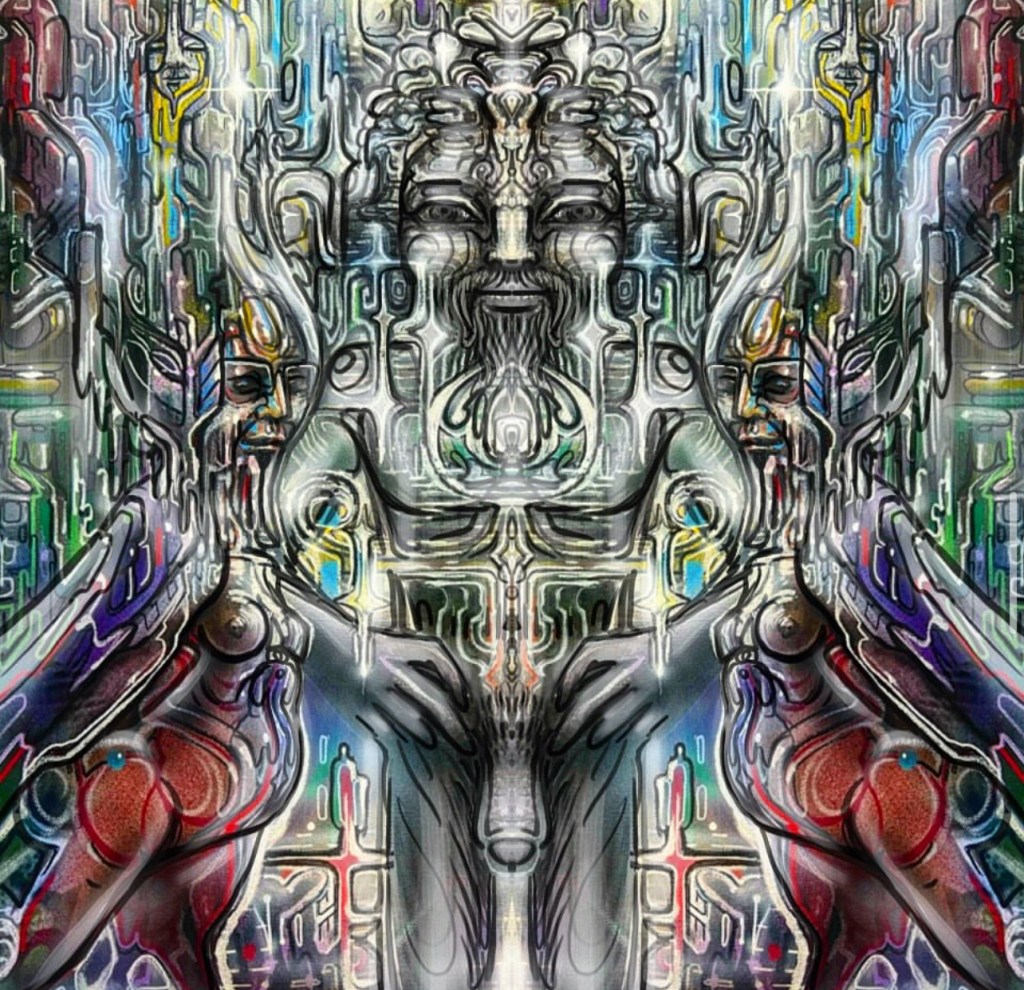
Natascha: That’s wonderful. I think you kind of answered this question, but what initially inspired you? Maybe outside of your sister’s drawing, what were some of the inspirations that have ended up fueling your creativity now?
Roman: Oh, man, I could have countless and countless stories, but I guess one fundamental, um, experience was, uh, being in Seattle during a very critical time in history, and I mean that in many different ways. The music scene and then the technological explosion that was coming from Microsoft at that time, an era when the very beginning and I tried LSD and, something I was never really too proud to boast about. But I also think that it’s a very important thing to express, that there’s these moments of that we can utilize as tools to activate something. Because on my psychedelic awakening, I definitely had so many things come together. And it isn’t all based on the psychedelic awakening. The Psychedelic Awakening gave me a view into the things that were already happening in my life. Like, calling myself a artist/ magician at three years old and a lot of mystical experiences that I never really understood growing up. That happened throughout my life. But for some reason, having a reflection like psychedelics or something external outside of us, like aliens or whatever, if you’re blessed enough to see that. But these external reflections allow us to look back at ourselves to witness these things from a third point perspective. And that helps us wake up, you know, like, oh, yeah, I notice these patterns throughout my life, I’ve never really realized how to deal with those experiences. And sometimes when you have like a psychedelic awakening, it gives you an angle to look at those things through.
Natascha: Wonderful. How would you define visionary art?
Roman: Well, visionary art to me means a lot of things. It leads me to the next thing I’m going to talk about. But just to answer your question first is, you know, at first when I got introduced to visionary Art, it was, outsider art. That was because I looked at a visionary art, magazine when I was really young, and I remembered i. It was more from people that I didn’t go to school to do art. For some reason, it was like, they call them outsider art. I thought that was interesting because there’s a visionary art museum with, uh, all these artists in there before the psychedelic visionary art movement. So then when they called the visionary art movement visionary art movement, it kind of like, wasn’t sure about that. And also, to me, vision means of our vision. But I don’t know what other art isn’t from our vision as much. (Natascha: Okay.) But don’t get me wrong, I still use that title to express our movement of artists because it’s something that people recognize right now within our circles of people, which is very powerful.
Natascha: Mhm.
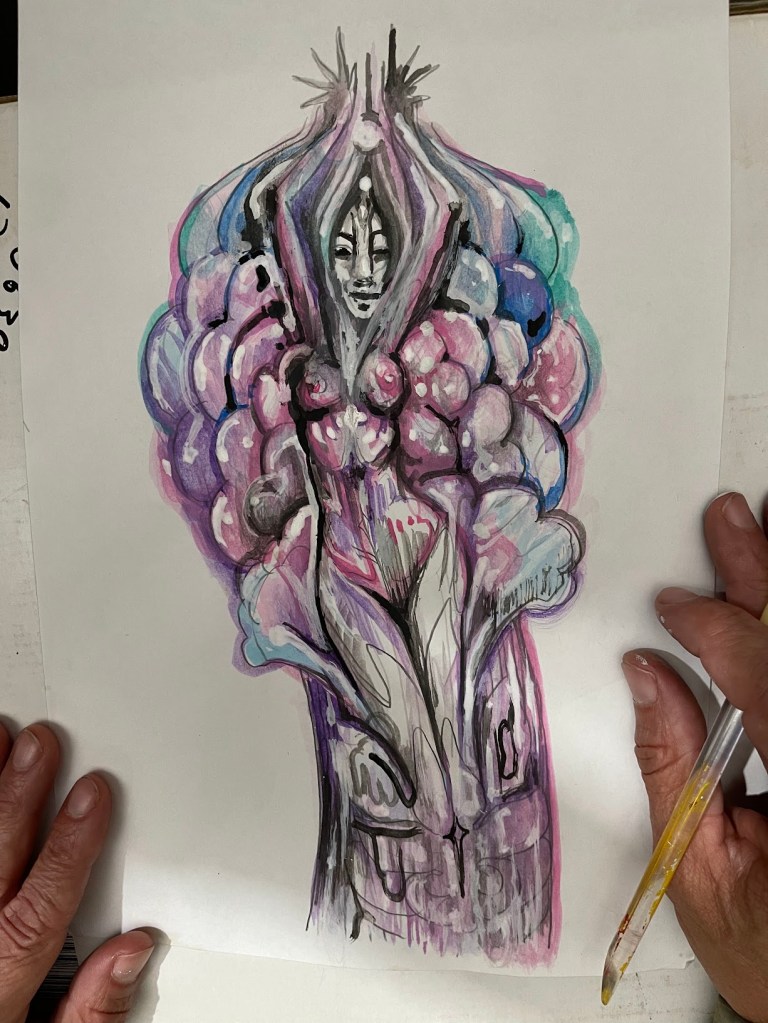
Roman: However, I don’t think that it specifically talks about the movement that I’m a part of which I feel like the people of artists that you recognize yourself liking to are not a part of necessarily only. I created an art movement called the Interdimensional Art movement. (Natascha: Lovely.) And I even told Alex Gray about these things before we named the thing visionary art movement. And this was a long time ago. And he never even heard of that. And he really was vibrating with that idea, too. Which is really cool to always be able to share your ideas with other people and get reflection. And the Interdimensional art movement the acronym is I.M. (Natascha: Nice.) It’s based on the finite of yourself, your personality, your ego or whatever it is you’re that you’re wanting to express. And then the full title, Interdimensional Art movement has no limits. I think that’s more true to the what the visionary art movement that we synchronize with at the moment.
Natascha: Interdimensional Art Movement.Got it. Can you share a bit about your history as a visionary artist?
Roman: To simplify things, psychedelic awakening in Seattle. Recognizing everything at once and wanting to be part of an art movement. Because as an artist, you always look back at art movements and you relate to certain groups like the Surrealists, the Pre-Raphaelites, or like any segment throughout history, which is really inspired in certain ones inspired us more than others. Art Nouveau or whatever. I couldn’t deny that I didn’t want- I wanted to be part of a group like that, but there was no real group to that I could associate myself to at that moment. Plus, I wasn’t that advanced. But these ideas were coming. These desires were coming to me. But then I started paying attention to what kind of art movement would I want to be a part of? And then that’s when a lot of answers started coming, and that’s when I recognized, oh, those art movements. And we’re answering these questions that they ask themselves. And that’s why they became art movements, because they were answering a question of defining who we are as a culture. And that’s what creates a movement. And we attract each other that are representing this, this reality together. And then, um, that harmonizes us as a collective.
Natascha: That’s beautiful. Who are some of your colleagues in the visionary art community?
Roman: To me, I love the way you ask because there’s a seriousness to it. And then that kind of makes me laugh because I’m also a space cadet artist. But my colleagues. I’ve been blessed enough to have colleagues of all different sorts. Like, my Seattle experience was pretty profound because, when I was having this psychedelic awakening, and I was reinterpreting reality. And then I was like, I want to hang out with the Beatles. But the Beatles already happened many years before me. So, like, put the vibration I was getting the LSD vibe or whatever, you know, and I was like, wait a minute, I’m in Seattle. [Natascha laughs.] Just to bring that into perspective and for a few many years I would keep on running into people like Nirvana, Soundgarden, Alice in Chains. And this is my canvas. And I played in this dimension for a few years of running into these people all the time, getting to know these people from different perspectives. Like, I have so many memories to even remember at the moment, but one of them that’s on my mind right now is, uh, Soundgarden when they were recording BadMotorFinger. They had my paintings in the studio while they were recording a little bit of that album and stuff like that.
Roman: I remember going in there and picking up my artwork and them being all, like, polite and kind and gentle, but they’re like, really, they’re all really tall, like over six feet, you know? For me, that’s tall. Just having those memories ingrained in my brain and seeing how influential these people were, it was pretty intense. So there’s colleagues like that, but more precisely, to the art world is like, from Alex Grey. I don’t know. It’s hard to tell because the way that I learned about my colleagues is through a party that we started. That’s why it’s really hard to answer that question, because I have to, like, share the story of why I know these people. Because if I say Alex Grey, who might be the most famous and people recognize him, but there’s. I don’t want to skew the vibe just by that attention when there’s so many other beautiful and amazing artists and they all were attracted from this interdimensional art show we threw up in Seattle. And this was the beginning of before where? Before what we were doing. There was hardly ever, like, a live artist and galleries at events. That’s like something that was, I wouldn’t want to say that we started it, but we definitely made it a ritual.
Roman: And it brought together all these artists that some are now famous visionary artists from Luke Brown, Carrie Thompson. It’s like really challenging to even start naming them because there’s so many that I can’t even name. A lot of them, I’m sure that you would recognize. For instance, like Carrie Thompson came to make the most beautiful stages of electronic events throughout the world. You would recognize them because they’re super beautiful and Alex Gray and Mark Henson. I don’t know if you know Mark Henson, but he’s an amazing artist from not that far from here, from Lake County. And if I showed you his art, you would obviously recognize him.
But the reason why I really enjoy these people is because it was a family calling that brought us together, like these shows that we used to throw up in Seattle. Were exactly that. It really bonded a large group of artists together that never recognized themselves before. Now it’s easy to see. It’s all easily recognizable. But before then, we didn’t have anybody. This was like the beginning of us recognizing each other, which was really amazing.
-Roman
Natascha: Wonderful. At that time, were you part of a community? You say we.
Roman: I would say we because I can’t. I don’t ever want to feel like I’m taking responsibility for it. That’s one aspect which is still egotistical, but I am an ego, [laughter] and it’s very influential to where my idea is coming from. But at the same time, it is a collective thing that I’m just being aware of and I’m wanting to share that with people. So, I say we because, you know, I might have been inspiring certain ideas, but it came to be through a network of different people.
Natascha: Awesome. Okay. So, in your art, you use mixed media in your paintings on canvas, and they’re all very incredible and beautiful. We’ve discussed acrylic paint, pencil and paint pens in the past. Are there other mediums you’d love to work with?

Roman: Did you say airbrush?
Natascha: No.
Roman: That’s probably one of my favorite things, even though my relationship hasn’t been too intense with it yet lately. Definitely airbrush. Cool pencil for sure. Yeah.
Natascha: That leads us to our next question. What role does pencil play in your paintings beyond sketching the initial image?
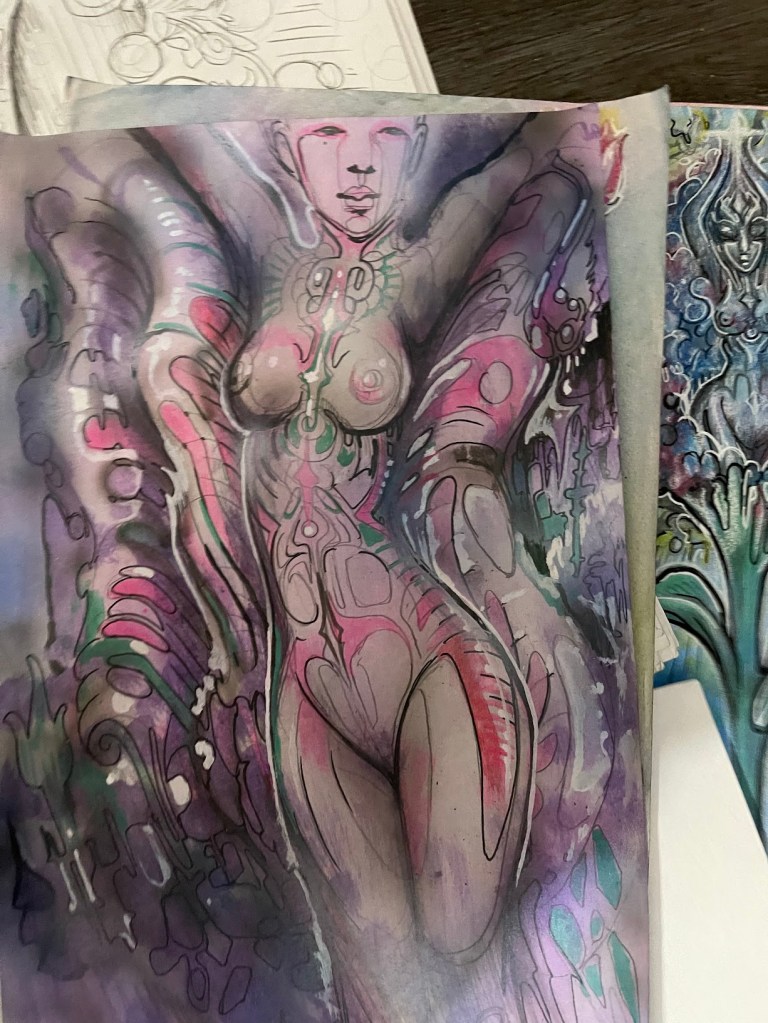
Roman: Well, lately it’s been like taking a central role and I’ve allowed myself to draw more. Then I keep on realizing why I didn’t allow myself to do that more often. Because it really brings my vision together. Because I really love to draw with a pencil, and it really flows. And it’s a relationship between the lead and the and whatever the paper or canvas or whatever. It allows me to put a lot of detail as soon as I start painting, it becomes an emotional thing and I start relating to the canvas with emotions. And then oftentimes I’m I get lost in the emotions of it. When drawing with a pencil, it’s more mental, more ideas. That helps me like navigate because I’m an idea person. I can constantly be channeling my ideas, but then I bring in the emotions of color, and that’s when it starts to get the feeling. But it’s not as controllable for me.
Natascha: Can we take a second and look at this painting over to your left. Is there a pencil in that painting right there?
Roman: Yeah, this one is one of like I said recently, it’s been taking main stage. This is one of the paintings that I did as a live painting. Mhm. And I just allowed myself to just feel the music and vibe and not care about painting and just draw. So I drew pretty much the whole thing with pencil. And then I loosely started airbrushing and painting on top of it, but without covering the pencil. Of course it’s very raw and very loose. But there’s something I like about it. There’s something metallic about it that I really like.
Natascha: How do you select your color palette? You have a very nice rainbow assortment of colors in a lot of your paintings.
Roman: Yeah, definitely spectral for sure, because that’s the reality that I’ve seen. You know, a lot of my art was inspired by me walking around a lot. So, whatever I could bring with me, because that’s the way I’ve explored my reality. But also, with what I have and what I had for a while was black India ink and with airbrush, and that was it, a big bottle of it. And then I started wanting to paint with color. And then you realize you want the least amount of colors, or that was my experience. And then that led me to like, oh, the spectrum, the southern colors. From here I can do different shades of shades of whatever. That was if I look at it from the physical aspect. Like I said, you asked me who I am or, you know, uh, that’s physical. There’s also the mental and the mental is, it’s more chakra style. I use the rainbow colors because I feel like there are these seven dimensions. Those are perceiving reality. So, to me, when I learned about the chakras, it started making sense.
And being a psychedelic artist, I like to travel to different dimensions, so to speak. And the chakra system seems to be a way to understand that because each of the colors are a vibration and each vibration has a negative and a positive polarity. And if you start understanding how they interact with each other, then you can travel consciousness in that manner.
-Roman
Roman: And that’s the primary reason I use the rainbow color palette.
Natascha: Oh. That’s lovely. I hear a lot of entombment in your body when you paint and meditation as you’re painting and choosing your color palette is very interesting. Can you tell us more about the reoccurring themes in your work, what those might look like?
Roman: Definitely a lot of meditating beings, and sometimes I question myself on that. But like, I’ve had visions of tapping higher states of consciousness and feeling that. And there’s always people in the meditating pose and really high vibration. Maybe it’s just me, but I’ve heard this from other people, too that these beings come in from other or we tap into a vibration or dimension that they are meditating in. When I experience that, it makes so much sense why I would be so infatuated with painting that because I’m not necessarily Buddhist, but I definitely visit the teachings a lot because very super profound. And it definitely helps as far as, you know, being present with yourself. So, there’s all those things too. I definitely have to admit there’s a lot of goddess imagery. A lot of awakening. A lot of dance parties. The dance parties are the symbol for humanity, I feel.
Natascha: Yeah. Who are the characters that we’re looking at? Do they have names? Personalities?
Roman: I don’t think about it too much, because I think it’s just like who we are on one level. So, I don’t really recognize any separation from just a snapshot of anywhere I would go. There are people dancing or whatever. That’s the main thing. But then the other profound thing is, I don’t know if you’ve heard of Tribe 13, but that was like our production company up in Seattle that through the Interdimensional Art shows. And it still continues to this day. And we have thousands of artists connected to that name. I think that you would consider visionary artists specifically. But essentially Tribe 13 is a traveling gallery at different events and that’s what we’ve been doing since Seattle, but definitely been to that gallery like boom Festival and Envision Festival and a myriad of other ones.
Natascha: You know, he just posted this on your Instagram, but can you tell us more about the meaning of Tribe 13? What where did you guys derive the name from
Roman: It’s really profound vision that happened to me as I was awakening. I told you about me about my psychedelic awakening that led me into really questioning my reality and really, dropping out, so to speak, to just meditate on these things. I started recognizing different patterns and the desire to be myself and to be accepted for myself and accept other people for themselves, which is a freedom, and all based on just the basic fundamentals of this country. So, it kind of unified all these things. But I was recognizing that nobody’s really living up to it. What does that mean? So, then I started questioning who I am. Who? Where do I belong? Or as a part of society or whatever? As I was having these profound questions, I would run into signs of different things.
And Tribe 13 stems from those realizations- as I was awakening up to this way of looking at reality- the symbols are infinite, and I can point them out later. But essentially what makes a Tribe 13 member is to recognize that we create reality, which means the only way to tap into this presence is to be in a state of giving and constant giving.
-Roman
Roman: A lot of people say, oh, yeah, it makes a lot of sense. That way you can receive. I’m like, no, that’s not the point. You can’t, um, you can’t live in a binary perspective. It’s got to be a unified perspective. And it has to come from source. So, to become a Tribe 13 member is to recognize that you are marrying yourself to your true self, which essentially synchronizes, synchronizes that to all the other beings that are doing that themselves. There’s no control mechanism, no one’s better or worse than you from from that perspective, those kind of perspectives can only come from the outer world. But the outer world is not a reality because we have to be in a state of giving. If you’re wanting to receive things, and that is one way of looking at it, but that you’re going to receive an illusion. So, Tribe 13 is the beings that are synchronized by giving from within out. Which art is the symbol of.
Natascha: Wonderful.
Natascha: I you’ve been talking about spirituality a lot, but how does spirituality influence your creative process?
Roman: Well, it helps me recognize who I am. You ask me who I was in the beginning, and I can’t answer that from one perspective. Like mind, body and spirit and spirituality. I feel like it helps guide us into what we’re supposed to be doing or wanting to do. And we don’t have to be deceived by an external belief of spirit or whatever, but to really recognize what you’re really wanting to intend as your person on this earth, which is really basic and not spiritual at all. But I would consider that spirituality because, again, chapter 13 and the vision of having to offer yourself from this source, from this center, is crucial to that. And why I would call it spirit is because it’s beyond what I could perceive. If I’m in a state of offering, I will be in this state of awe of the actual manifestation, if that’s going on.
Natascha: Would you say your art is an extension of that?
Roman: Without a doubt. But what is not. Everything is from that state. But oftentimes comes from like a really, maybe not evolved state or a weird interpretation or even negative. All these things have a way of manifesting.
Natascha: Sure. Yeah. Okay. What draws you to sacred geometry?
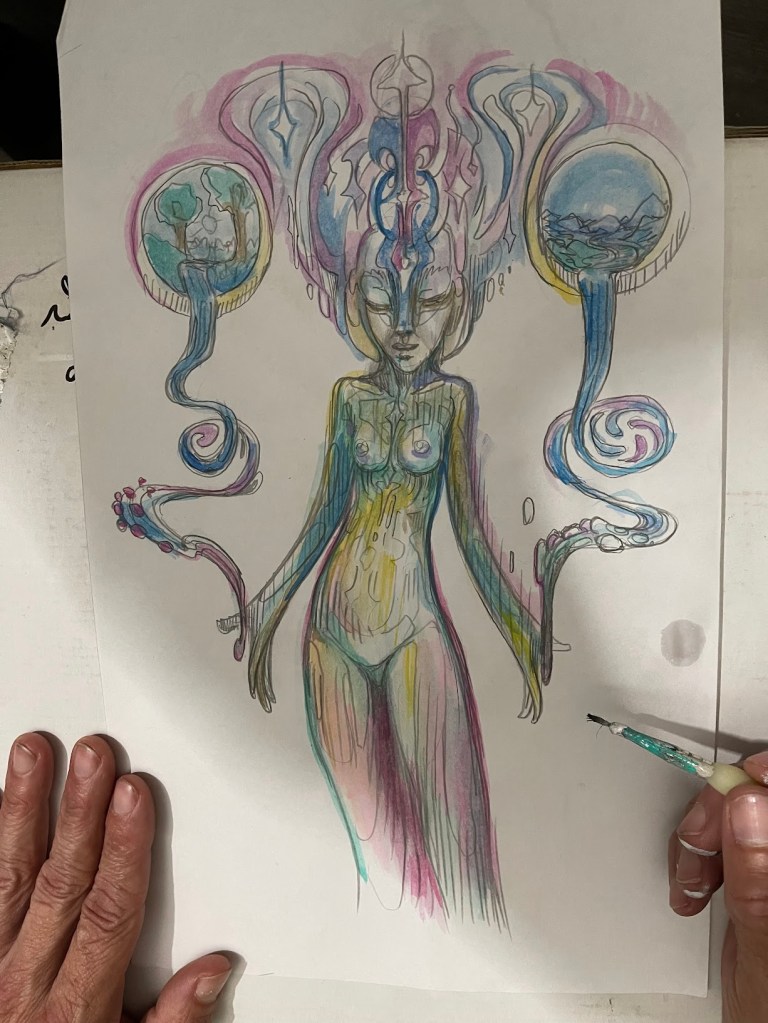
Roman: I definitely use sacred geometry as a thing, but I never really stick to it like some of my contemporaries, for sure. Um. Uh, yeah, I have, like, this deep gratitude for it. But I was thinking, like, if, uh, sacred geometry exists, then, uh, we are part of this, uh, sacred geometry. So, whatever I do is a part of the sacred geometry, because I can’t have a choice other than to create through the sacred geometry. So then at that point, I’m like, out the door. Don’t pay attention to it.
Natascha: Don’t even think about it.
Roman: I know exactly.
Natascha: It’s in the flowers, it’s already there.
Roman: Exactly.
Natascha: All right. What about your local community? How does that inspire your art?
Roman: That it confuses me, which inspires my art. I think our community and that’s why I, like I make a big deal with the dance party and social event because it gives us a view into our community. Where we come and show our art, our dance, our vibe, our talk, or this or the way we get drunk and shitfaced. I only say that that way because we need a safe place that people get to experience themselves and then figure out themselves so they can correct themselves. And I feel that these social settings in a loving and open environment have a way to heal. So those kinds of experiences wouldn’t be happening. And I just say that because we have a lot of healing to do, and we really need to, like, allow people to people to process their inspiration by not just accepting a rude behavior, but to recognizing and knowing that being recognized also starts having an alignment of sorts.
Natascha: I really appreciate you saying that. What shifts have you noticed in the festival scene, and why do you keep returning as an artist?
Roman: Well, to me, if there’s going to be any time traveler’s ever to come into existence, they’ll probably come through portals such as psychedelic events throughout the world.
Natascha: Cool.
Roman: I really believe that because when we go to an event like this with the artists, with the musicians, with the styles, with everybody offering their little trips, it really is like an eclectic group of people that are highly open and well, as far as judging against other forms of people in the world. We’re definitely at that point because we’re in this offering state of being or curious state of being, I guess might be better. That it allows a lot of things to come through, and that’s exciting to me.
Natascha: Kind of like they’re creating something new in these communities. There’s some kind of evolution/ evolving going on.
Roman: I definitely think that there is, but that it’s up to us for being open, because the opposite is also true, where people are being dumb and like, not learning or whatever. But I think that’s part of the fun for me because and what keeps me coming back is because I’m coming back now as an older person that has experienced certain things and like sometimes, I’ll get on my, like, flow where, like, I already know every conversation. [Natascha: Oh, no] -in a really amazing way. Not that I know the whole conversation, but what people are experiencing. And I feel like if we can develop our language, we can help bring people through a lot of experiences, a lot faster by just communicating with each other. And that’s one of my favorite things at a festival.
Like when I open myself up, I get attracted to these little circles and we get to share the pipe and then talk, and then all of a sudden, they’re like I had this one vision, blah blah, blah blah. I’m like, I’m like, I would look at the person and say, so what? And then they’re like, got their little spirit shattered. But then they recognize, like, what do you mean? Like, well, what are you going to do about it? And then like start talking to people like that and then like really brings this awareness to the person’s trip, like, oh, somebody’s actually listening to me. And then they go even deeper into their thing. And then you experience those kinds of awakenings so you can express your awakening to those people, and then you can stop and start helping guide this awakening collectively. So yes, there is an evolution of sorts like that.
-Roman
Natascha: Like, cool. So, on a global level, what changes would you like to see and how do you channel that vision into your art?
Roman: Well, there’s only one mission. The mission is to recognize that everything comes from within, out, and start not judging the external world or feeling like the you’re going to get validation from the external world. But to really believe in oneself, to be able to provide the offering that you really want to provide to the external world, not the other way around. If we could all start understanding that that’s how we fit in.
I feel like that’s when the big change happens, because so many people are trying to consume what they need to be or trying to acquire a sense of belonging from an external world to validate themselves. And it really screws up the whole mechanism of our existence. Because the universe is also like a, not an ego. So, it’s like whatever we’re creating is like going to manifest, uh, hugely, you know, because it’s like what we’re focusing on at the moment. So, I feel like once we start offering our true gift from inside then the universe reacts and recognizes that it can only provide abundance.
-Roman
Natascha: Lovely. That goes back to giving, giving, giving, giving. I love that so much. What upcoming events can we expect to see you at?
Roman: I’m excited to show my art across the street at Los Bagels next month in Eureka.
Natascha: Arts alive, right?
Roman: Yeah. Yeah. I still got a piece myself together, so I’m like, oh, yeah. That’s happening.
Natascha: Wonderful. What are some of your bigger goals as an artist?
Roman: I don’t know, I would like to write a book. I guess that’s one of my goals, because then I can solidify what I’ve been talking to with every people and just document it to be able to share that idea to other people, and it’s always been a lifelong dream. As an artist, oh, artist book, that’s an accomplishment. Uh, so there’s that. But that’s the physical. But on the spiritual plane, I’m on the quest to the eternal party at the end of time. Cool.
Natascha: I’ll meet you there.
Roman: Well, that’s the that’s the trick you just mentioned there. But I’m talking about the end of time. So, there are parties right. Right now.
Natascha: That’s happening right now. Yeah, we’re in it.
Roman: It comes back from the state of giving. That’s how you tap into it. So, if you’re in a constant state of giving, you’re at the eternal party.
Natascha: I love that. Awesome. Well, Roman, thank you so much for taking the time to chat with us. We’re here at Azila’s Cauldron. You can find it on Instagram at @azilascauldron. It’s been an absolute pleasure. You can find Roman’s Instagram @Synchromystic and a huge thank you as well to Julian for recording this interview. You can check out his work on Instagram @depixture_media. All right. Thank you everyone.


 Little Lost Forest