Introduction.
Today we will discuss perspective, perspective in art, and cosmic perspective.
Tarot Card: Choose a card and tell me how the card relates to you today.
Quick warm-up; neckrolls, touch toes, etc.
Breath in 12345, Hold 12345, Slowly Release 12345
Breath in 12345, Hold 12345, Slowly Release 12345
Breath in 12345, Hold 12345, Slowly Release 12345
Breath in 12345, Hold 12345, Slowly Release 12345
Breath in 12345, Hold 12345, Slowly Release 12345
Thank the elementals of the North, in your mind’s eye picture elements of the earth.
Thank the elementals of the East; in your mind’s eyes picture elements of air.
Thank the elementals of the South; in your mind’s eye picture elements of fire.
Thank you elementals of the West; in your mind’s eye picture elements of water.
Thank Pachamama, the earth and ground we sit on,
Thank the cosmos above,
Thank yourself for showing up here today. Sit with the bright light that fuels your soul, the same bright light that fires the sun.
Thank the sun,
thank yourself,
acknowledge your light.
Imagine you are in a dark cosmic space,
In a rush, like a rapid river, you come into the earth, as if out of a womb, to the light.
Where are you?
Notice your surroundings, rather it be inside or outside,
picture the town you are in,
the state that town resides in,
the continent that holds that state.
Now imagine the planet that, that continent calls home.
And the galaxy on the planet lives.
Bring your mind’s eye higher to the Universe that the galaxy is a part of.
Take a deep breath and look around you.
You are never alone.
Say it out loud; I am never alone.
Okay, thank you for allowing me to guide you to this place. Sit here for a second, look around you. What do you see?
This is inside you, and every one of us.
Acknowledge the vastness, that exists within you and within me.
The complexity of that cycle is infinite and continues to exist, exist in you and in me.
Now lift yourself into a flying position, and travel back to your planet, where you came out of the darkness and into space. This is your safe space. Do you remember it?
What is around you? Are there people?
Are you in a city? Are you on a mountain? Near a Lake?
Are you around people? What are the people doing?
Are you around animals? What are the animals doing?
We’re going to paint this space, so sit with you for as long as you are comfortable. Explore the details of this space.
Now while you are in this safe space, take a mirror, and look into the mirror. In the mirror is a problem. A problem that has been bothering you for a very long time.
How do you respond in your day-to-day life to this problem?
Do you scream at it?
Throw objects because of it?
Do you experience hate for others because of this problem?
Self-hate because of this problem?
Self-doubt?
Do you feel unrest because of this problem?
Has it kept you up at night?
Today we’re going to accept this problem for what it is. You can’t hate a problem you accept. You can only move forward once you’ve accepted a problem.
After you have chosen to accept this problem, we are going to explore ourselves by using this problem.
Looking at this problem in this mirror, talk to the problem. Have a conversation with this problem. Ask it questions, express your thoughts, and listen to the answers.
We are going to sit in silence for approximately five minutes.
When you feel satisfied with the conversation, we have had with the problem take a pair of scissors and cut any strings that attach you to this problem This problem is no longer serving you are you are ready to move on. After you have cut the cords, say goodbye to the problem and wish it a safe travel into the light.
Place down the mirror and look at the space you are in. Is anything different?
Do you notice more in the space?
What details stand out to you?
Please hold onto this imagery as you open your eyes.
When we experience uncontrollable rage, we view it from the perspective of the self rather than the global consciousness. This doesn’t devalue your rage. Your rage may or may not be valued. But even great leaders have not solved their problems by running into battle, but rather by placing their pieces deliberately and playing their cards strategically.
Now let’s get into perspective in art:
To understand perspective in art we start with the viewer,
The viewer sees infinitely far away, this is the horizon line. On the horizon line is a vanishing point. A single vanishing point is called one one-point perspective.
Now let’s add a second vanishing point, in most cases the vanishing points are slightly off the frame.
Now lower the horizon line, now the viewer is looking up. Add a third vanishing point above off frame. This is called a three-point perspective. We can also take the horizon line and move it up, now we are looking down.
Now take an object and put it far in the distance, the object will become smaller. Bring that object closer and it will be larger.
Take note that there is a relationship between size/ distance and eye level.
Now imagine a river or a car going from angle to another, you see the slope?
Now put that same river, or that same angle into the distance, the line is going to look horizontal. Distance forces horizontal lines.
Distance forces horizontal
Now quickly let’s talk about light and shadow. We discussed this in detail in our last class.
We have the foreground which is closest to the viewer, then the midground, and the background. In the foreground, we can see the shadow of the sun easily. As well progress into the background the shadow will be less. In the foreground, there is a variety of color and values in the shadow. In the midground, the depth of colors are brought to the cyan-blue colors. In the background, there are simple changes in colors. The sky does not go from yellow to blue but rather the yellow influences the blue and the blue fades into yellow. Color happens due to light, so the light family reserves its colors more than the shadow family. Yellows get filtered out because of the atmosphere.
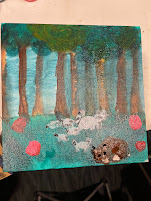
Take your notebook and start sketching your scene. Remember we are focusing on perspective. This will not be a portrait but rather a landscape.
Where are you looking toward the horizon line? Up, down?
Place your horizon line onto the paper.
Are you looking toward the left? the right? the center? Plot your vanishing point. If the vanishing point is a three-point perspective than plot your vanishing points off the frame. Now draw your chart lines.
Where do the buildings, trees, and objects fall on the horizon line?
What objects overlap? Buildings overlapping other buildings? People overlapping the ground? Boats overlapping walls of trees? Not overlapping shapes take away from your scene. Populate your painting. Put basics down, this is a tree, this is a person, etc., and fill the space. We will audit later. Tweak the lines to lead to the vanishing point.
Paint 1.5 hours.
In closing, talk about your painting.



 Little Lost Forest