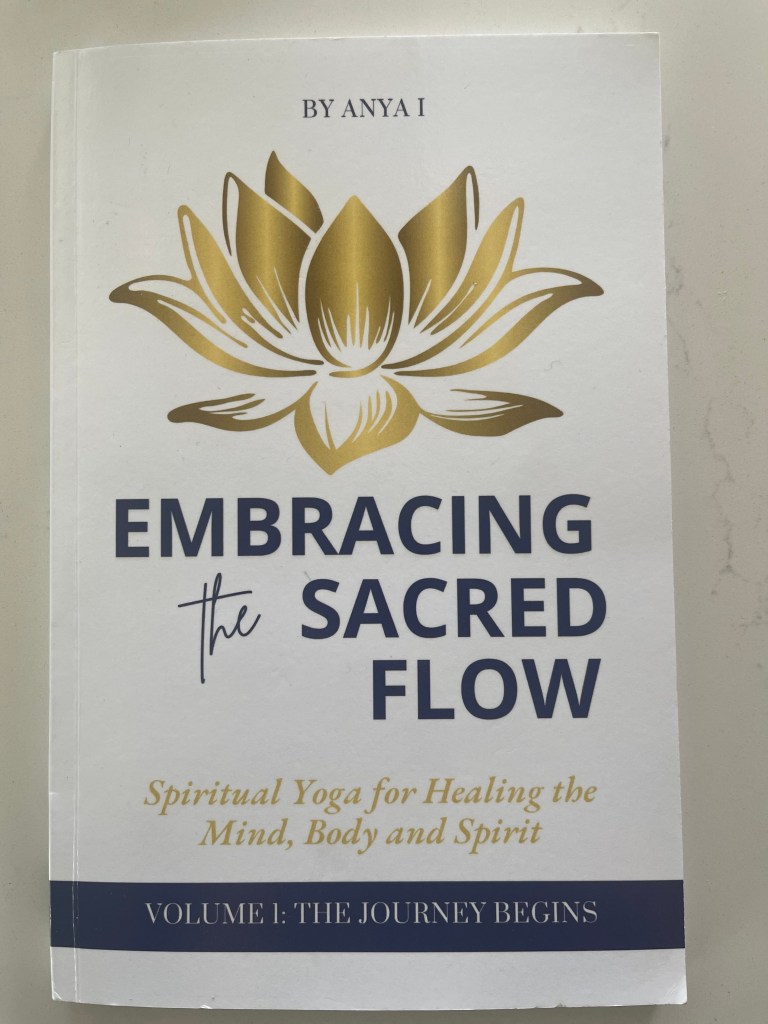
On Dec 21, 2025, I sat down with Anya, and we discussed her new book Embracing the Sacred Flow. You can find it at this Amazon affiliate link. Before we begin with the interview, I’d like to share with you the dedication:
Dedication
This book is dedicated to anyone who has ever felt broken beyond repair, lost without a sense of direction, or silently suffering through the chaos. I see you. It is never too late to reclaim your sense of self, to heal, to transform, and to set yourself free. Spirit is here to guide your soul back home where it’s warm and cozy.
Let’s dive in:
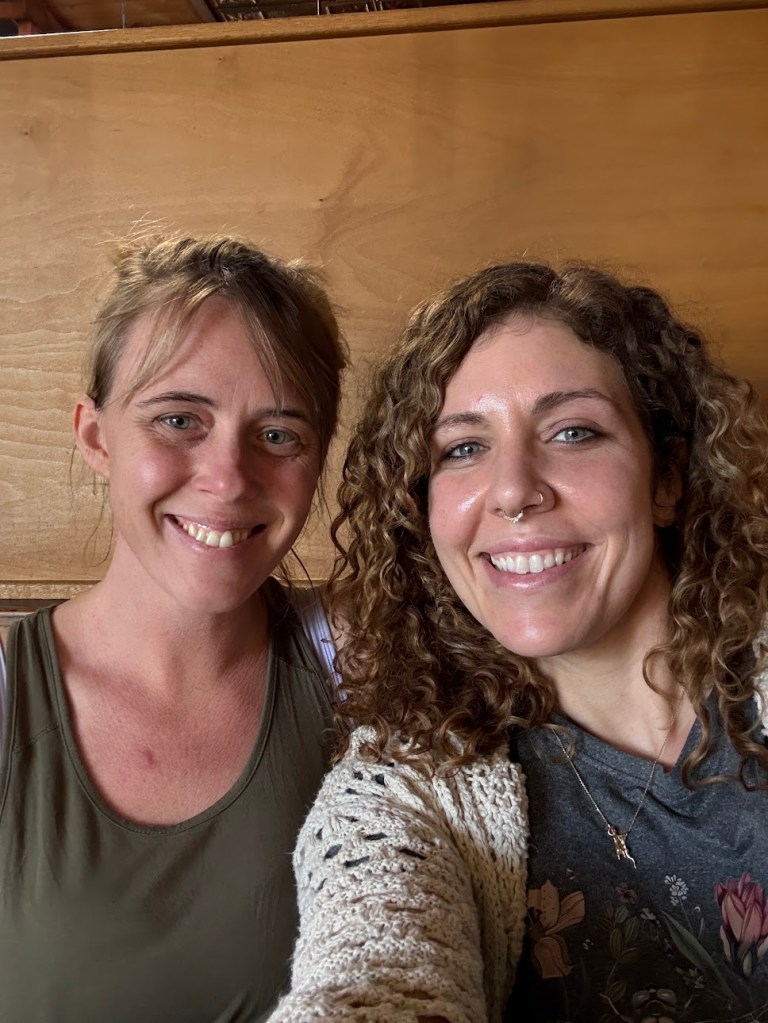
Natascha: Hello, this is Natascha with the Little Lost Forest blog. Today we will be interviewing Anya with the season of Anya and her new book, Embracing the Sacred Flow. We were sitting at the Revolution Roasters with a cup of coffee, and my son Malakai. Anya and I are doing a cross-promotion. She interviewed Spellbound earlier this month and plans to share in the next few weeks I will link the podcast here once it’s available. Anya, how are you doing today?
Anya: I’m doing so well. Just enjoying this beautiful sunny San Diego weather in December. And happy to see you, girlfriend.
Natascha: Yeah, it’s really nice to see you, too. Years of friendship has brought us here to this point where we’re both working on our businesses and our brands, and we get to talk about the different art that we enjoy. And I just so appreciate doing this with you and being here with you today.
Anya: Likewise. Likewise.
Natascha: Can you tell me a little bit about The Season of Anya?
Anya: Yeah. So basically, Season of Anya is an online community, a culmination of healing modalities that are for those of us who are looking to transform ourselves, to transform our personal identities, to maybe transform our physical, mental, spiritual health and finding ourselves. Typically, it’s a journey for those of us who are interested in spirituality. My main healing modalities with The Season of Anya are yoga, magick, and witchcraft. Yoga is for grounding. Magick is for finding that love for life. And then witchcraft is the ritual. It is the practice that ties it all together. Yoga grounds me, witchcraft elevates me and magick is everything else in between. Because life is ultimately what you make it. And so many of us just really don’t understand how much power we have to change and transform. And I am bringing everyone together to give them their own tools and create a positive community filled with individuals who wish to change themselves and the world for the better.
Natascha: Yeah, that really makes me want to self-reflect and see how I could change my life for the more positive. What got you to start this healing journey?
Anya: What got me started? It all started, probably, I mean, well, I used to be 325lbs. That was not a result of just a girl who loved food, but a girl who was in a lot of pain, a lot of emotional pain. Didn’t know how to process her trauma, didn’t have the tools and resources to just feel normal. That resulted in my weight loss journey, which was my commitment to my physical health. Why physical health? Because the three of them are related; mind, body and Spirit. Right? They all interconnect, and with finding that discipline and with finding that balance within – Then yoga came into my life shortly after, and that taught me kind of how to embrace the physical practice of yoga and learning how to feel good in my body. Then shortly after that, my spiritual practice came into act, and that resulted in me learning how to live a spiritual life so I could transform, but also remain positive and free flowing and just feel better about the trajectory of my life. Because it’s been imperative for me to understand that it is me and only me who’s responsible for my trajectory, not the course that others have set for me my whole life. Same goes for those of you tuning into this today.
Natascha: Yeah, I also started with yoga before I got into my witch practices. So that resonates with me as well. Were there mentors early on that helped you when you were most in pain, or did you find yoga and your spiritual practice on your own?
Anya: Oh, absolutely. There are two groups of people that I find really keen that helped me on my journey. First of all, it was Mel and Kaleo from Rebel and Muse. My friend Kristan invited me to their yoga retreat back in 2018, and from there I realized…how messed up I was. If we’re being perfectly honest. Yoga retreats are so awesome and empowering because they remind you that you’re in a safe space to simply be yourself. That experience slowly started my self-awareness, self-reflection journey of, “oh boy, my normal, is not everybody else’s normal”. So, that kind of was an awakening for me. With that, especially with feeling comfortable in my body and just having kind of that mirror of reflection on me help set the stage for the inner work ahead. Then shortly after I met who would become a huge mentor of mine: Taren S with the House of Witchcraft. She opened the Witches Cottage out here in San Diego, and I got to dance around the bonfire with her and our coven out there for many moons. Through that, I learned spirituality, I learned accountability, I learned healing, I learned what it was to take care of myself and to empower myself, but also how important community is and how we are truly in it for one another.
Natascha: Yeah. On the subject of community, how has your spiritual and health journey changed the way that you hold your friendships and your romantic relationships?
Anya: Ooh. That’s a great question. I feel like it’s taken the people pleaser out of the scenario- for sure. I no longer wish to hold on to what’s not for me. And also with that, though, I do give all my friends the benefit of the doubt through open communication and through being vulnerable and being communicative. I mean, the ones who get it, get it. If I bring up an issue with a friend and be like, hey, what the heck? And they respond- that’s the kind of people I want in my life. I find that romantically, it’s been awful because I realize a lot of partners don’t want to do the work, and it’s hard, especially being at this point in my journey and single. Well, I need somebody who’s at least going to match where I’m at.
Natascha: Well, that’s really important for young folks and for women of all ages to hear. We so easily will go along with what partners want from us because we want to appease them, or we don’t want to be by ourselves. By holding your energy and by being an empowered woman, you’re holding boundaries that maybe some of us put down just to get along with others.
Anya: You know, for better or worse, I sometimes- I feel like I have nothing else to lose. I’ve had some pretty horrible life experiences and with that, you know, has come strength, especially my romantic relationships. And it’s like, ‘Hey, I’ve got nothing to lose,’ so why not walk in faith and see what happens and see if I can actually stop limiting myself and create the life I deserve.
Natascha: Before we get into your book, did you want to tell us any more about The Season of Anya? What kind of content you put out, or products or things that people can engage in?
Anya: Sure! So the Season of Anya is the main hub. I’m really passionate about my free monthly newsletter. So, to those of you tuning in to this, I highly recommend you check that out. That is the heart of my blog. Uh, I know that newsletters are so outdated, but that’s where I share my monthly tips, and not only just that, but also shine light about being in tune with the world around me. I have very cute little witchy stories, I share that are just true moments of surrendering to the flow, and I love sharing those stories, and they often bring a laugh out of my audience and give them opportunities to reflect and connect. So, definitely, definitely- check that out. Then I’m also working on YouTube and social medias and trying to figure out my flow and grind with that. But it all centers back to The Season of Anya community, where ultimately, I’d like to host witchcraft retreats. In fact, next year with my friends at House of Witchcraft, we are co-hosting a retreat in New Orleans in July because I want to give that experience of retreats to the rest of the community, so you too, can learn how to open up and feel safe and vulnerable in a protected environment, an empowering environment and find yourself again.
Natascha: Yeah, that sounds like a great community experience. Does your lineage come into play with your practice?
Anya: Ooh, Great question, actually. It has been for sure. So, I’m Italian, American, first generation, and with my lineage being Italian is so much there’s so much witchcraft actually associated with Italian culture. And it’s just so funny because it’s this interesting connection of witchcraft meets Catholicism. And that was actually understanding my Italian roots, even connecting through the Italian Goddess Aradia and other deities, but specifically, she has really just connected me to the essence of who I am as an Italian American witch. And it has been a really cool journey.
Natascha: All right. Thank you so much for sharing that with us. Here I am looking at Embracing the Sacred Flow. What inspired this book?
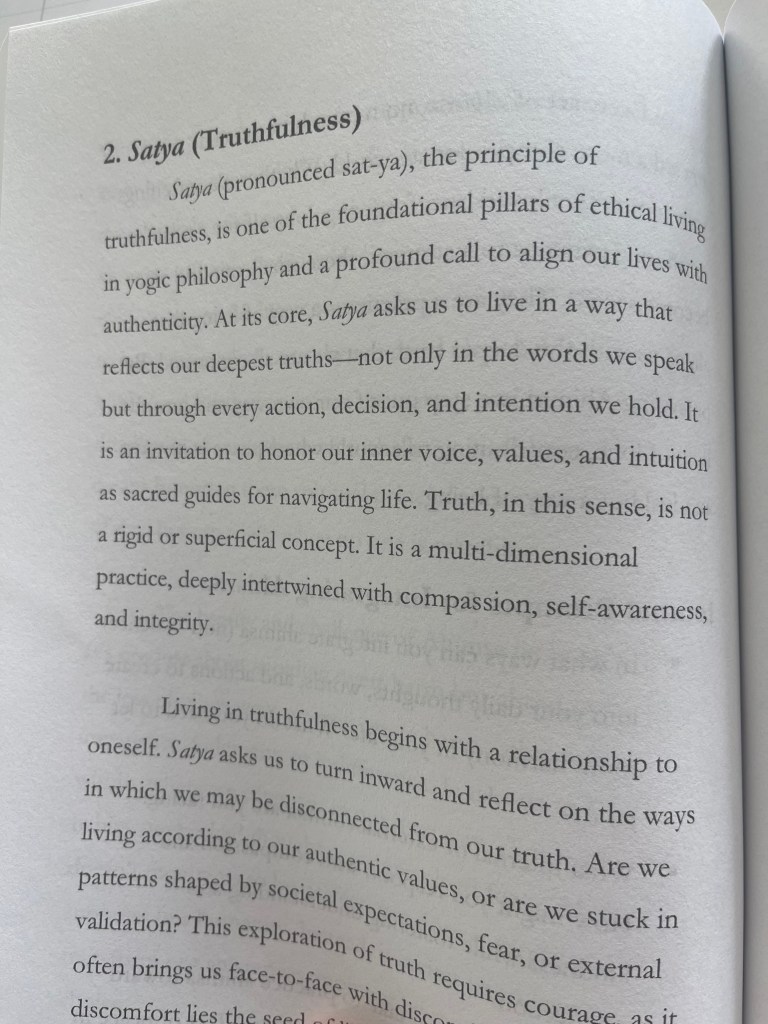
Anya: Well, you know, as somebody with really chronic anxiety and an addiction to over productivity and not learning how to just be present in my body, yoga has been a really crucial component for not only my healing journey, but also my life journey. This book kind of just goes over [that]. It’s going to be a multi-volume series. I wanted to give my audience something that’s really easy to read. I mean, honestly, you can read this in an hour or two, and it’s something reflective that gives you prompts for going inward and just kind of tips to get through your life. I talk about some breathing exercises in there. We talk about yoga philosophies, and I talk about learning how to be comfortable and being in tune with your body. Because especially if you are on the path of a witch, learning how to flow and just feel connected to yourself will always, always, always be your saving grace. It’s your anchor. It’s your life force. I’m really proud of it. I’m happy with this content. It’s a start of many, many books to come. I’m excited for you to check it out.
Natascha: If somebody follows the practices in this book, how often do you recommend that they do the yoga, do the breathing? What kind of schedule does this look like in your everyday life?
Anya: Well, yeah. Well, with everyday life, I try to make it very routine where it’s something that you can just tap into immediately. Yes, I do talk about creating an altar and the stretches and the flows, but really, I mean, it’s almost about like micro meditations because we don’t always have time for the big stuff, right? It’s learning on how to feel comfortable and not overwhelmed in any moment. As somebody who had been overwhelmed with literally everything my whole life, this is a new me, you know? But learning how to get rid of that overwhelm and just be here and learning how to release tension in your body and feel comfortable in every moment is life changing and I want to share that freedom with everyone.
Natascha: Wow. That’s amazing. I mean, I feel like if you’re working in a cubicle or if you have children that drive you crazy, or if you’re just a student that’s trying to find their way, this book could really help create a positive routine in your life and a sacred flow that doesn’t only align with the mind and body, but with your higher consciousness and creating a healthy future for the person that’s tapping into this magic. Yes. So, what’s next?
Anya: Ooh, well what’s next? Writing wise, I definitely have been sitting on a spell jars book: Spell Jars 101 book that I just need to kind of polish up a little bit. Just put my last little touches to it. And I really am excited for this upcoming book as well. You know, it’s like, okay, we learn how to tune in, we know how to stay sacred, we know how to stay connected and this book really talks about manifestation. And it demystifies the practice, a little bit of witchcraft, of spells and workings. Because it’s not about sitting at your altar, it’s about getting out there too and doing the work. You want a better life, you got to do the work…while adding a little witchy twist to it. That makes it my own. And I feel like Spell Jars 101 takes a fresh approach that you haven’t seen in your standard witchy books.
Natascha: That’s wonderful. Thank you so much for being an outstanding witch, doing positive work, light work, spiritual work, tuning into the body, soul, and mind. Is there anything else you’d like to share with us before we end the interview?
Anya: No, just go ahead and check me out on my website, subscribe to my free newsletter, and I promise your life will be forever changed.
Natascha: All right. Thank you so much.
Anya: Thanks, girl!
www.theseasonofanya.com to sign up for my free monthly newsletter, blog, and be the first to know about my upcoming witchy retreats.
In my MFA class at Antioch University Los Angeles, The Uses of Invented Language, Redefined Language, and Foreign Language as Tools for World Building, taught by Rita Bullwinkel, we explored how writers can make language their own by inventing it, subtly altering familiar words to create emphasis, or redefining their meanings entirely.
For this exercise, each writer was assigned a familiar word and asked to redefine it within a fictional world—allowing its meaning to emerge through story rather than explanation. The goal was to let language quietly shape the rules of the world and the limits placed on its characters.
The word canoe was assigned to me. (I offered the word triptych to my partner.)
In this piece, canoe is redefined as a place a woman goes alone to give birth—a space of autonomy, danger, and taboo. Once she enters, no one is meant to follow.
Below is an excerpt from that exercise.
This piece takes place in an imagined world and does not represent any real cultural practice.
Canoe (Excerpt)
My feet hit the ground, brush, and sticks, stabbing the soft cradles of my soles. Through the long grass, I saw the floating structure ahead—a long form with a narrow entrance. A fire burned inside it, smoke slipping upward through a small chimney at the back, surely lit by the swamp witch who knew the intentions of my arrival.
I could hear Agatha screaming from afar.
“Jefferson, Jefferson! Wait, my darling—please don’t do this alone.”
Her voice was desperate. This would be her twelfth delivery—four sons, seven grandchildren—and none of them had been born in the canoe. None of them until this one.
My body ached, and a cry escaped me. My stomach clenched in agony. My water had broken long ago, and I could feel the baby pressing downward.
Why didn’t I come sooner? Why didn’t I listen to my intuition? Now it was almost too late.
Agatha had fallen into a deep depression after my husband’s sudden death. She was weakened by grief and fatigue and could no longer keep pace with me.
The ground shifted to wood and rattled beneath my weight. When was the last time anyone crossed this bridge? Surely it was Jagara—the young nymph who once danced in the trees for play, until play led her into the shelter of the canoe.
“Don’t!” Agatha screamed.
I paused at the edge of Siskou Lake, breathing in the stillness, the warm yellow and inky sunset smeared across the water’s surface.
Inside, the canoe was dark and narrow. I followed the fire’s glow, forcing my body through the tight squeeze of mud and hay adobe. At the far end, the space opened into a wide chamber with a rounded ceiling. The hearth fumed softly, smoke slipping through a small vent toward the heavens.
Now the villagers will not choose how this baby enters the world.
I will birth my child here—despite the risk—and from this place, we will grow within our community without being controlled by a system.
Natascha: This is Natascha with the Little Lost Forest blog, and I’m thrilled to be here today with abstract mixed media artist Sam Pedisich, who is currently showcasing his work at Gallery Cor in Asheville, North Carolina. Fun fact Gallery Cor takes its name from the Latin root “cor”, meaning heart and courage, which feels like a perfect reflection of Sam’s work and artistic spirit. Sam and I are connecting over Zoom today. He’s at his home in North Asheville, North Carolina. It’s 130 in the afternoon, and I’m here in Eureka, California. And it’s 10:30 in the morning. Sam is not only an incredible artist, but also a former middle school teacher of mine from the Environmental Resources Academy. We call the ERA at Guajome Park Academy. He’s been a close family friend of mine ever since. Hi, Sam. How are you doing today?
Sam: I’m great. Thank you. Natascha.
Natascha: Alright, let’s jump into it. I read in your bio on Gallery Cor’s website that you have an avid history as a motorcycle rider, teacher, having served a jail sentence, a youth boat builder, instructor, and so much more. Can you please touch on some points of your expansive history?
Sam: Wow. I think a common thread is being outside, and it was important to me that that when we were working together at Guajome Park Academy, I think you were in the seventh and eighth grade, that that it was outside and we, we experienced the elements and I’ve always tried to look for that. So, my current job enables me to, to see all of what nature is doing now that I’m working on tugboats for the last 12 years. I think the key point with everything about my career path is that I’ve always tried to be outside and encourage other people to be outside.
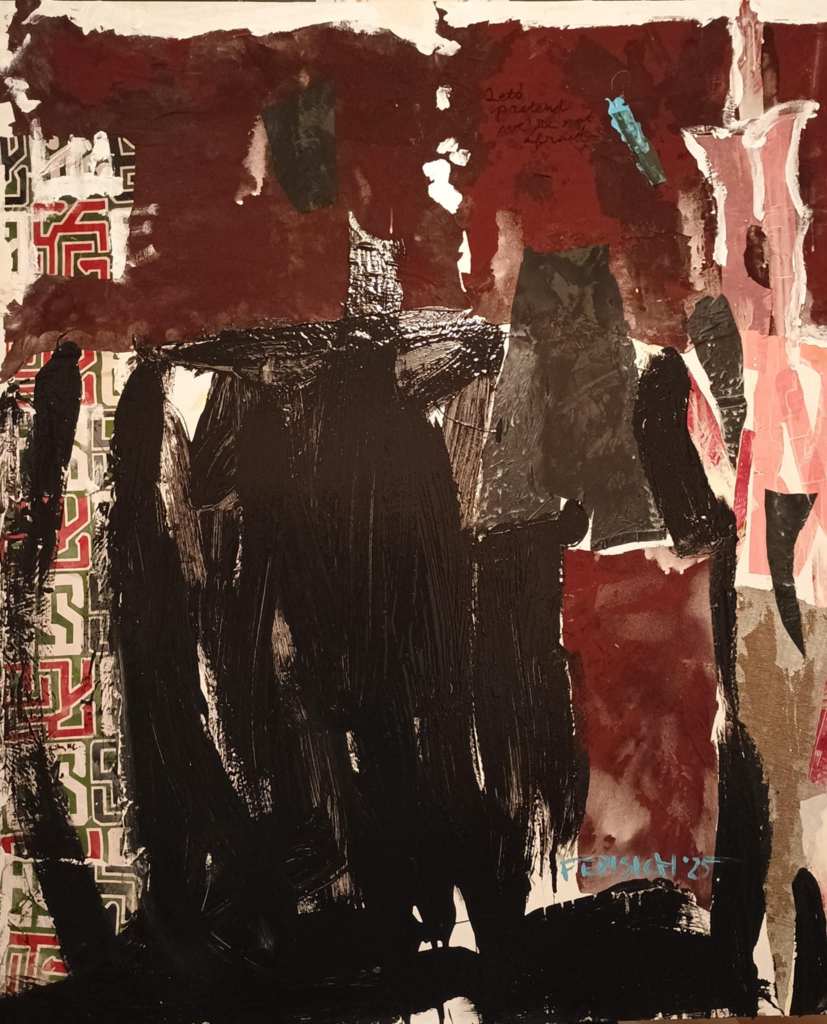
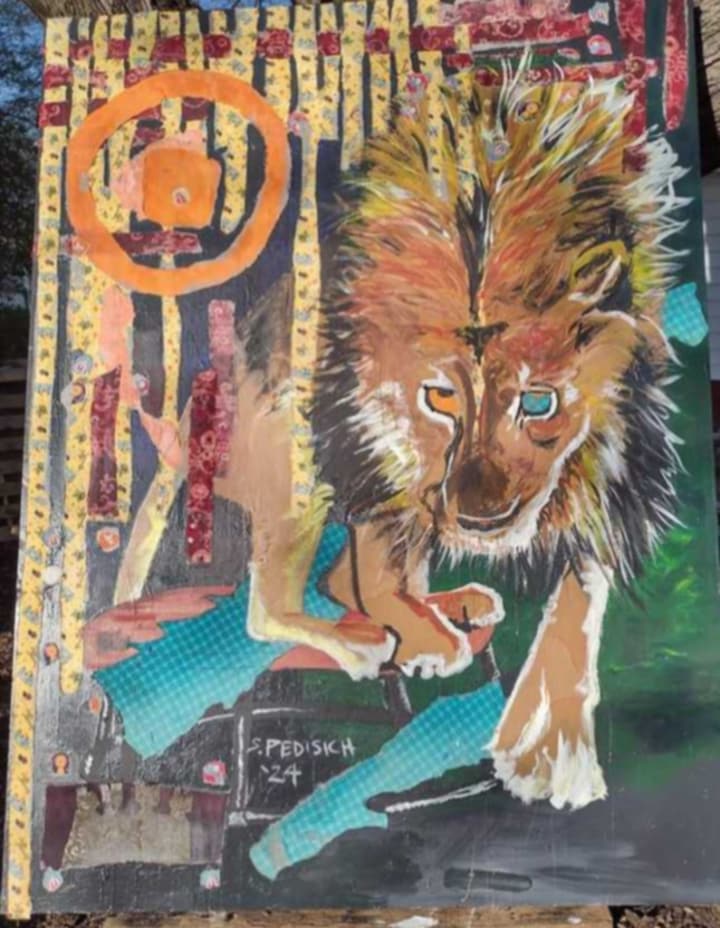
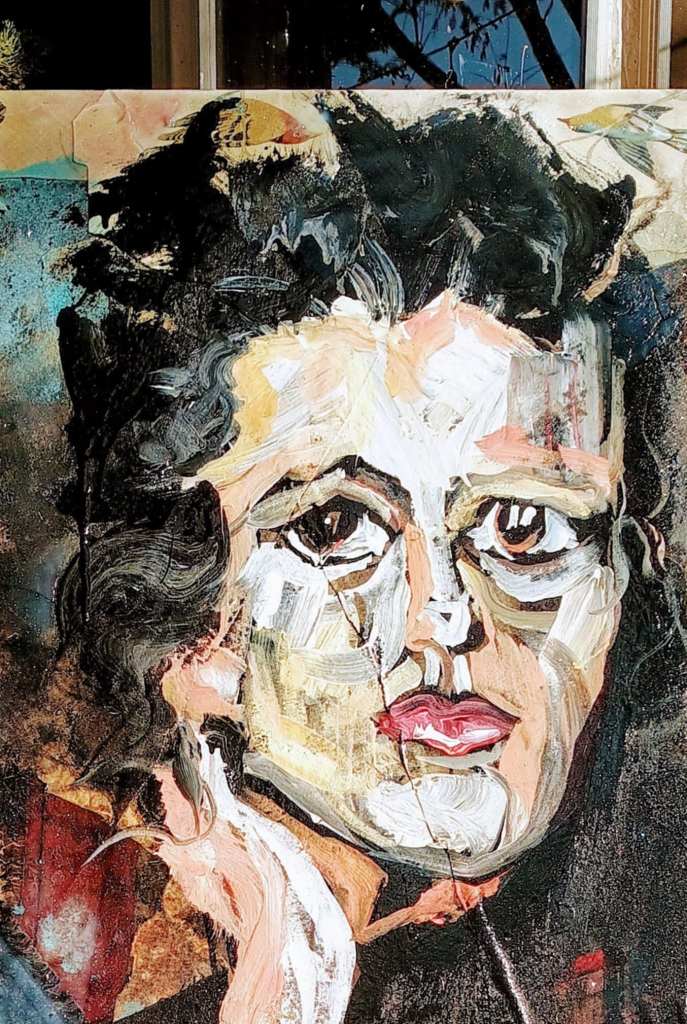
Sam Pedisich Mixed Media
Natascha: That’s lovely. I know I’ve enjoyed the hard lessons we endured in middle school, up on the hill in the sun. I don’t remember too many times in the rain, but definitely there might have been a couple of camping trips we’ve done and diverse weather. How old were you when you started seeing yourself as an artist?
Sam: I made a pretty firm commitment when I was probably about eight, that I wanted to do what I saw in the Chrysler Museum in Norfolk, and I was most attracted by, um, highly textured, probably what might have been the 50s abstract expressionist movement that was going on. And I managed to get in that museum about once a month, it seemed, because it was free, and it still is. And not that big, but global, important pieces in there worldwide throughout history. But the modern American stuff really fascinated me. And I noted that acrylic, which I’d never heard of, of course, was what the paintings were made with. And they sold those paints in the museum gift shop. And the more I think about this, the more important I realize my mother was and how she raised her four kids. I asked for some paints, and she bought some acrylic paints from the museum gift shop, which probably was four times more than it could have been. But over the years, the two of us figured out what kind of bulk we should buy. And like, I needed a lot more white and black and that I could mix colors so we didn’t need to buy a 36 color set. But she would respond pretty quickly if I told her I needed a canvas. I was typically painting like, you know, ten by 20 was big to me.
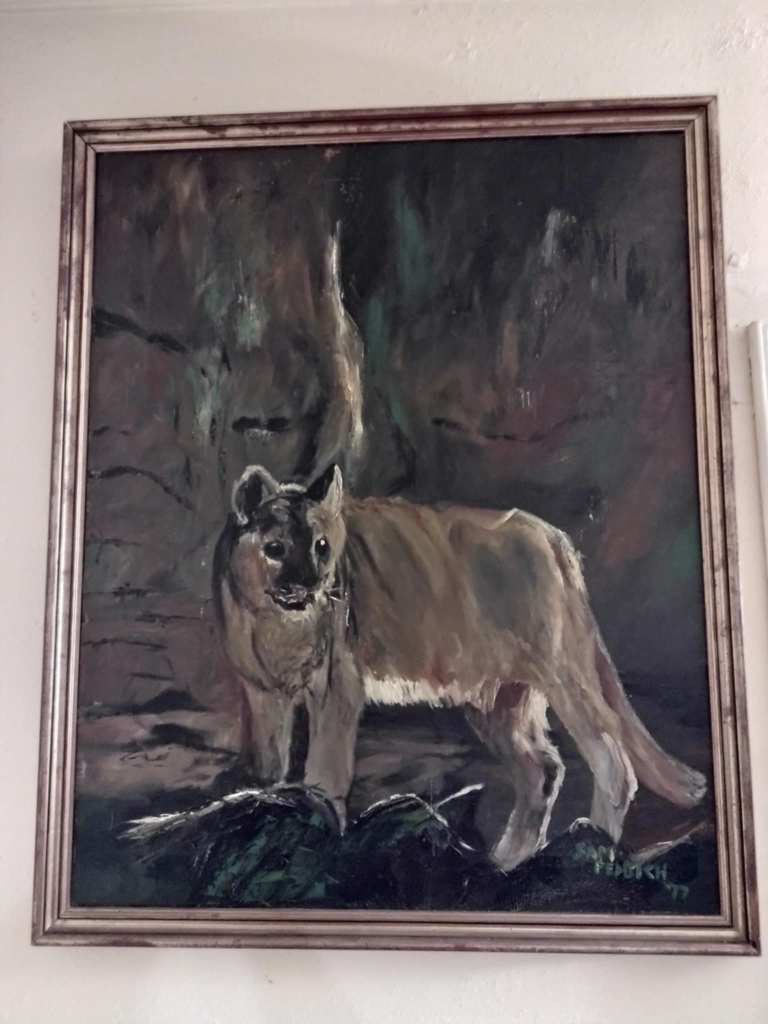
Like, I remember being 13 or 14 when I painted maybe a, a 24 by 30. And I thought that was huge. And I actually just sold that last year. It was a puma that I painted between my eighth and ninth grade in 1977. And that was oils and oil paints expensive. And, um, you know, I would use a tube of, of any given color for one painting. And it’s just remarkable that my mother figured out how to keep me in, in supplies. So, when I think I was in the early fifth grade, beginning of fifth grade, we moved and at that point I told my mother I needed art lessons. And the art at school was- was essentially playtime. And later on in high school, I was fascinated by my fellow students who were in legitimate art classes. But I was very I was interested in electives like band and music and sports. So, I didn’t I didn’t take any academic, public school or even private school, um, art classes or in college either. So that’s why Gallery Core owner, Leslie Rowland, calls me an outside, outsider artist. But that doesn’t mean I’m not. I’m not attuned to the academic traditions. My wife Erin jokes that I’m an outsider artist because when I’m painting something big in the house, she says. Can you take that shit outside? So, I knew when I was eight that I was going to paint.
And when we showed up in North Florida in the boonies, I don’t know how she did it, but my mom found a painter that was just a couple of miles from the house that, had lessons and a small studio that he had. It was a busy little hub for the county for all kinds of artists. And I can remember one named Brita, Brita Hobbs, who was, quite, quite, quite effective in what her vision was. She painted the realistic scenes of the rural South, but also some African animals. And she had she had a predilection for how to present an animal in a way that you wanted to hang it on the wall. And my, my mentor teacher was Jean Barber, and I, I know that he charged $5 every Wednesday, and I was probably there for anywhere between 2 and 3 hours once a week until, let’s see, that would have been fifth, sixth, seventh, eighth, ninth grade and then 10th grade. I went to Catholic school for a couple of years and missed him. Then I went to college in Jacksonville, not far from where Gene Barber Studio was. But he would come out to Jacksonville once in a while because he had some studio friends and some collectors closer to where I was going to college. So maybe once a month I would get on my motorcycle and have a rolled canvas or something, or I’d get one from his, whatever art store he was giving a lesson in, and I would show ad hoc, show up and enjoy his company, and have him coach me with whatever I was working on.
I can remember how he introduced me to palette knives, and I thought that at that point that I was a demigod because I could swing paint around on the canvas. And I like looking back. And I can honestly, truly, totally remember some of those palette strokes that I’ve made when I see some of those works from now. And I actually have a bodily central nervous system memory of those swipes.
So, I don’t I don’t know if you decide that you’re an artist or creator. I just think that, um, this term neurodivergent, I don’t I don’t think that has a whole lot of meaning. I think every single human being is so unique that, um, as an educator, when I figured that out, I was in about my sixth year, and that changed everything. So, when I to answer the question succinctly, when did I decide I was an artist? I mean, I was born to put color on a canvas because that’s all I did. And I, I love doing it. When I was three, I would draw a circle and put some shit in it to make it look like what I thought a face would look like and then two sticks hanging down and you know, my mom would glue that onto a piece of wood, and she probably has it in the attic now, and it’d be hilarious to look at it, because I just love it when- There’s a, there’s a term going around like, um, well, my four year old could do that. I’m like, yes, of course they can. That’s what’s so wonderful about being a person who wants to share, like, yeah, what’s wrong with that? Like, I bet your four-year-old can sing and dance too. And, you know, I just met a man today at physical therapy, and he had to pass some time away doing a certain exercise. And his coach was giving him different ways to account for the time. And I said you could just sing a song. And he goes, I can’t sing. I’m like, I wish somebody would tell me that. So, uh. Yeah. How long have you known you were a singer? Um, I’m not a singer. That doesn’t mean I’m not going to sing. That enough? [funny/sarcastic] I looked at the questions that you’re going to ask me, and some of them I’m going to have, like three words for. So, I’m not going to take four hours doing this interview.
Natascha: I love asking this question, actually. I love hearing the timeline of people’s art history. When they kind of figured that they were an artist and coming into themselves because you see pieces of everything you’ve mentioned in the art you do now, if that’s your passion for history, to using the palette knife, the animals that you saw, it all shows in the artwork that you create now. So, it’s actually, I know it might be a commonsense thing that, “Oh, I’ve always been an artist,” but hearing people explain when and how that evolved for them is a lot of fun for me. So, thank you for explaining thoroughly.
Sam Pedisich
Sam: I’d like to give a couple of milestones that are opportunities for parents and educators to really blow it on this. My family, the older generations owned a wallpaper factory, so we were frequently putting up new wallpaper in our house. And then it occurred to me that that some of the prints were essentially what would look like if you had used a brush. So, there was a commercial for a life saver commercial candy, where there was a monster with a long tongue, and he was catching the Life savers as they fell through the sky. And I was fascinated by that when I was about 11. So, I asked my mom, I just want, I want to paint that on my wall with- and I had a crazy uncle that just died recently- And he was he was very supportive of my art, and he would dabble in everything. He was he was a radio DJ. He gave me a lot of music and he had some Day-Glo stuff in his house. So, I got a bunch of Day-Glo paint which will ruin a wall. You can’t paint over it with latex paint. It will keep bleeding through. But my mother let me paint the lifesaver monster with Day-Glo paint, knowing that no matter what happened, she would just put another coat of wallpaper on it. So, um, so much happened to me from being able to paint my own bedroom walls over and over again. So, I had, you know, a ten foot by eight foot canvas perpetually. And when I got tired of whatever the mural I had, which would sometimes only last a couple of weeks, I’d either put clear coat, clear color wallpaper on it or paint over it and do something different. And in terms of encouragement, it’s just so easy to tell somebody that, “Well, we don’t have time for that” or “that costs money and, or, you know, you can’t paint that wall or we just limit people so much.
And then even with technology. The other issue is you got a ten-year-old, he’s not going- he or she is not going to produce anything of commercial value for years. And this idea, okay, you got talent. That’s meaningless. Nobody has talent. They have practice. It’s the same as walking. Look how long it takes a kid to learn how to walk. Like, I don’t know, a year. But we won’t give them a year to dabble with watercolors. We’ll just find a watercolor set, and then they lose it, and that’s the end of it.
I was never encouraged. I just was never discouraged. And then in middle school, you know, the kids noticed, your classmates noticed that, that you’ve got a tiger painted on the back of your jacket, and they’re like, how’d you do that? I’m like, you know, I’ve been learning how to do this for years. And they go, I want one. I’m like, yeah, you’re going to give me $10. So, I was charging ten bucks and there were several kids walking around in my eighth grade who had various jungle animals on- which was popular back then to have your denim jacket with shit on it, you know? Embroidery and stuff like that. But it takes acrylic paint really well. And the point I’m trying to make is that we act like we respect stuff as a community and as a culture, but we don’t support it in some of the most simplest ways. Make sense?
The Elephant She Knows, Sam Pedisich, Mixed Media
Natascha: Yeah. All right. Have you had any other professional training besides the training that you’ve mentioned? Any other classes?
Sam: I was, I was impoverished and I had a broken leg that wasn’t healing correctly, and I really needed money. And this was in 90 or 89, 89, 90. And I saw an ad for a German club wanted, wanted some murals done. So, they were about an hour away. I managed to get to their clubhouse near Pensacola, and they had these photos They had photographs of people in the club, and they wanted them in, in four foot by four foot, scenes that they could spread around their hall. And I said, okay. It’s going to take me thinking to myself, it’s going to take me a couple of hours to do an impressionistic reasonable cartoon of what they were looking for. And they had about ten of them. So, I charged 35 bucks each for a four foot by four foot, basically portraits of members of the club doing traditional German activities. And they really liked it. And I thought I was rich.
And then I saw an ad in the paper when they used to do that, and there was a sign company that just said painters needed signs. So, I showed up. And I had no idea how to… I knew how to do layout because my father had had had been a poster maker in college. And he had taught us how to space out letters in order to win um elementary school council elections. Like whoever has the best posters wins. Yeah. I showed up at the sign shop that was hand painting signs back before everything was vinyl and technical. I said I don’t have a lot of lettering experience, but I know how to do layout and, you know, I showed him a couple of pictures of some of the murals I’d been doing, and he hired me, and I think that was because I had rowed in college and he had been a coxswain. And so anybody who rowed in college can do anything. And he knew that, and I got to go out on site climbing up ladders to literally hand paint some of the billboards that needed small changes on them. But basically, we would take the billboards in 11 pieces and hang them up in the warehouse and turn the lights off and shoot a projector. So, it was pretty much paint by number kind of shit. But I got to do some portraits of- I did a portrait of Pancho Villa on a billboard by hand, and that took me a day, and I learned how to paint really fast and especially under circumstances where there’s not going to be any up close scrutiny, but it’s, you know, it’s going to be looked at from 100 yards away on the highway. So, you have to know how to work with where the viewer’s eye is going to be so that early 1990 is when I realized that I was set up to be a commercial artist.
Sam Pedisich, Mixed Media
Natascha: Now, were you using stencils for that, or was that all freeform?
Sam: Um, both. It depended on what the pictorial was. Later on in San Diego I was doing, they would just say, we need a palm tree and they’d have an eight and a half by 11 image that they’d taken. They didn’t really care how I got that onto the four foot by eight foot sign up in the corner. So sometimes I would just freehand it. I’m happy with free forming anything that’s not much bigger than me, but I have to get way back. I’ll graph it out. And I learned how to do that from a high school Renaissance class about how the cathedral painters cut, literally cut their… they graph their stuff out just like anybody would, you know, so that AA1, a one inch by one inch piece of paper in your hand equates to one foot by one foot on the cathedral ceiling. And then at that sign painting, the first sign painting job I had, I learned how to make a pounce pattern, which is when you draw the life size thing on a big roll of paper, and you put cardboard underneath it and you take a sewing wheel that puts little holes in it where, where you’re going to put your thread, but instead of sewing thread, you just put the whole piece of paper up on the billboard and then beat on it with a sock full of chalk. Take the paper off and you can see the dotted lines. So that’s how, that’s how, brick wall mural painters often work. Does that answer your question, or did I stray from that too much?
Natascha: I absolutely love that idea. I like thinking of big murals, and I always wonder sometimes how they do things at that big of a scale. So, I’ve never heard the chalk.
Speaker5: Um, it’s called a pounce pattern.
Sam: I mean, you can go online and find some really cute ones. There in these beautiful cedar boxes with, you know, this real soft thing. And it’s actually a little hole you open up and you pour the chalk in there, and then you take that wooden block, and you beat it on the wall and you go, oh, the chalk is coming out. It’s kind of nice- pounce patterns.
Sam Pedisich, Mixed Media
Natascha: So how has art played a healing role in your life?
Sam: I don’t usually prefer to spend time alone. I’m so insecure and neurotic that I like to surround myself by a lot of stimulation. And one of the I have a terrible, terrible short attention span. So it works in my benefit to be working on a painting, because then I’ll spend three, 4 or 5, eight hours by myself happy. AndI think that’s really good for my brain. And I’ll listen to music, but I’m not listening to podcasts where I have to think. I’ll just listen to one single song for 24 straight hours, and then I’ll end up naming the painting after that. And I mean, there’s no way that that cannot be healing, especially if it’s a good song.
Natascha: I think you sent me one of your songs or some inspiration before.
Sam: And you listen to it. You’re like, I don’t know where it’s got to do with the painting, but, I mean, I have a painting of an elephant, you know, two elephants, an uncle and his nephew. And the title is, uh, “they were red violins playing in my dreams.” And, you know, I actually wrote it around the border in pretty sloppy lettering. It’s like, critical to the painting.
Natascha: I like words on paintings. I think that’s fun.
Speaker6: Yeah. Yeah.
Natascha: What is your relationship with Gallery Cor?
Sam: The owner, I met Leslie in our rowing club back maybe over ten years ago. And I don’t know how she found out that I painted. Somebody must have told her. But she had a studio gallery called the London Studio that was located in- it was well placed in the city of Asheville. And it was like an October or something. She said, Sam, I think your stuff’s pretty good, do you want to you want to do a show? And I was like, hell yeah. And then I go like what? And she told me the wall space, she goes, do you have enough? And I said, I mean, I could gather ten paintings, but I don’t feel right about doing that. If I’m going to do a show, they’re going to be the last ten paintings I’ve done. I’m not dredging. It’s not consistent because it doesn’t fit my growth. And, what? I give a shit about my paintings [enough] to be throwing stuff up from five years ago. It’s kind of funny because my (this will tell you that) daughter at the time was about ten and I consider her an artist ever since she was young. So, I came home from that meeting with Leslie and I said, you know, Leslie, I’m working on a tugboat.I don’t have a lot of time to produce, but I can have a series of ten paintings in the beginning of February, which would mean I’d have to paint, uh, 1 or 2 paintings every piece of the six days that I’m home. Which is a pretty good schedule for me if I’m intense. So, actually, I might have been home a week or two at a time then. And so I said, yeah, I can have ten paintings for you in February. She said, great, I’ll give you the month of February and you can have the whole studio. I was like, oh hell yeah. Previous to that, I’d only shown at the little sidewalk thing, you know, every six months in some small town, and I’d sell 3 or 4 paintings of a monkey hanging from a tree or something. I had a gallery in Jacksonville that I was showing stuff in regularly when I was a teenager, young teenager, that, pretty much whatever I painted, it would sell because I was charging like 30, 35 bucks for, you know, an 18 by 24 that was functional. So, Leslie gave me that show, and I think I might have sold 5 or 6 paintings out of there and paid her rent for the month, and she’s pretty happy about that.
[We] had a big party there, and I just I just felt incredibly awesome. That was 2016. And, she’s been keeping track of my stuff on Facebook and around town and occasionally she visits my home, and we’re friends, and we rowed a lot together. We spent a whole much more time rowing together in the old fart rowing Club than having anything to do with art. But I, um, a huge, huge, huge turning point happened last spring when the owner of a big antique barn, who I don’t know, she’s a friend of my son. Oh, let me tell you what Marlene said. When I came home and told my family that, “Hey, Leslie’s going to give me a month. She’s going to give me a show in February. I’m going to have-” and this was like, in October- And I said, “yeah, I’ve got an idea for ten paintings that’s going to be on all one theme. And matter of fact, that’s one behind me right there my mom bought. It’s a portrait of her. She wanted it to stay in the family. I said, well, you’re gonna have to buy it.
Natascha: Right on.
Sam: So, I said my wife is not that in tune with how artists think and what their work is like. But when I said, yeah, I’ve got some ideas start to finish. I’ve already got them sort of sketched out to have ten paintings ready by February. And my daughter just was like, “Dad, you have work to do.”
Natascha: Yeah. Go do it.
Sam: My son had a friend in the house, and she saw- She saw a heron and the elephants that I had. And she said,”Oh my gosh, Elan, you gotta, you gotta- Whose paintings are these? Where did you get these? What’s going on with this?” And he goes, “That’s my dad. He’s a painter.” She goes, “We need to talk, man, because I want him to do a show at the Antique Tobacco Barn because we need to diversify there. And we’ve got this whole outdoor area that maybe it would work.” So I linked up with her in the spring of last year and she has so much room that I was painting six foot by eight foot portable pieces that that were boxed that you could hang anywhere you wanted and you could just lean them up on the wall from the floor. So we arranged. I wanted to have, like, a blowout show where my son, who’s a chef, could smoke a hog and we’d get a band to play, and I’d have about 15, 16 paintings up, which I ended up having 16 paintings up, and I sold ten of them. So, I made enough money to pay a reasonable amount to a rock band that I really like called Hello, June that came down from West Virginia. They stayed at the house. It was one of the best parties in the world. And I mean that stimulated me to start taking shit really seriously. And that show had some much more developed confidence. And that was more expressionistic, realistic stuff. And I wasn’t doing too much abstract back then.
Sam Pedisich, Mixed Media
I’m I’ve only really become confident with straight up abstracts. And in the past year where I’ll start a painting and just go, this is, this is it. It doesn’t need anything else. I’m just going to keep it. What I’m trying to get out is already there and has nothing to do with speed or intention. It’s like you dig a hole and it’s deep enough to lie down in and cover yourself up. Why would you dig it deeper? You know? After that August 2nd show last year, as Lesley was paying attention, and she said she used different words to describe my work that were much more positive. So, I don’t want to sound grandiose, but it was a lot better than “Sam your shits okay.” She’s highly respectful and encouraging and impressed by what I’m up to now. She’s Gallery Cor.
She goes, you’re going to do well in Gallery Cor and we’re going to price these things what you should be charging rather than the ridiculously insane, pathologically low prices that you’re charging right now. And she just rolls her eyes and goes, I can’t believe you sold that for that, because I could have got you, like, a way different number. And I’m like, I’m not doing this for the money because I make a good living. But she’s like, you got to be part of the artist community and you have to, you know you don’t have to but it’s really good for the artist community to keep the price points in a location in a spectrum that can allow artists to survive if they’re good.
Natascha: Well, I like what you said earlier about when you were younger, and you priced everything at $35 and it fly off the shelves. You know, I think there’s a good balance and it’s nice to see the progression and the respect. Your art’s amazing. It definitely deserves recognition.
Sam: Thank you.
Natascha: Yeah. Of course. So you do use mixed media and we’ve talked a little bit in the past about where you source your media. Do you mind telling us what media you use and where you source it from?
Sam: I use any kind of paint I can find. I don’t give a shit what. I don’t care how much is in the can. I’ll go to the hardware store and go “Let me see your bad mixes and your samples and shit.” I’ll go, “Look, nobody’s buying that. I’ll give you ten bucks for those four sample cans.” And you know, what are you going to do? You’re cabinet of bad mixes is full. Here’s 20 bucks. Let me have those six quarts right there because I use a lot of paint. And I mean, I don’t know if you’ve checked lately, but it’s not hard for me to put a quart of paint on a six by eight, and that’s $22. Like, not that I don’t want to spend money on the paintings, but the shit is not free. So, I’m not buying paint at an art store. And I don’t judge people who do that. They can. They can live their life any way they want. And I’m seriously, truly not judging people who paint with expensive oils because they’re painting. They’re doing something different than what I’m doing. I’m a sign painter. And I’m, you know, I like having the label of being an outside artist because then I can do whatever I want, and I don’t have- I mean, I have clients who like my work who have bought more than two of my paintings. And I know that every several months they’ll have an idea and they want me to produce it for them, and I’ll just knock it out and immediately, even if it’s not the style I’m happy with. And I may buy some kind of outdoor epoxy if I know they’re going to have it outside. But to answer your question, I use whatever I can get a hold of.
Natascha: Yeah. Besides paint, what else do you use? Uh, if you don’t use anything else, it’s fine.
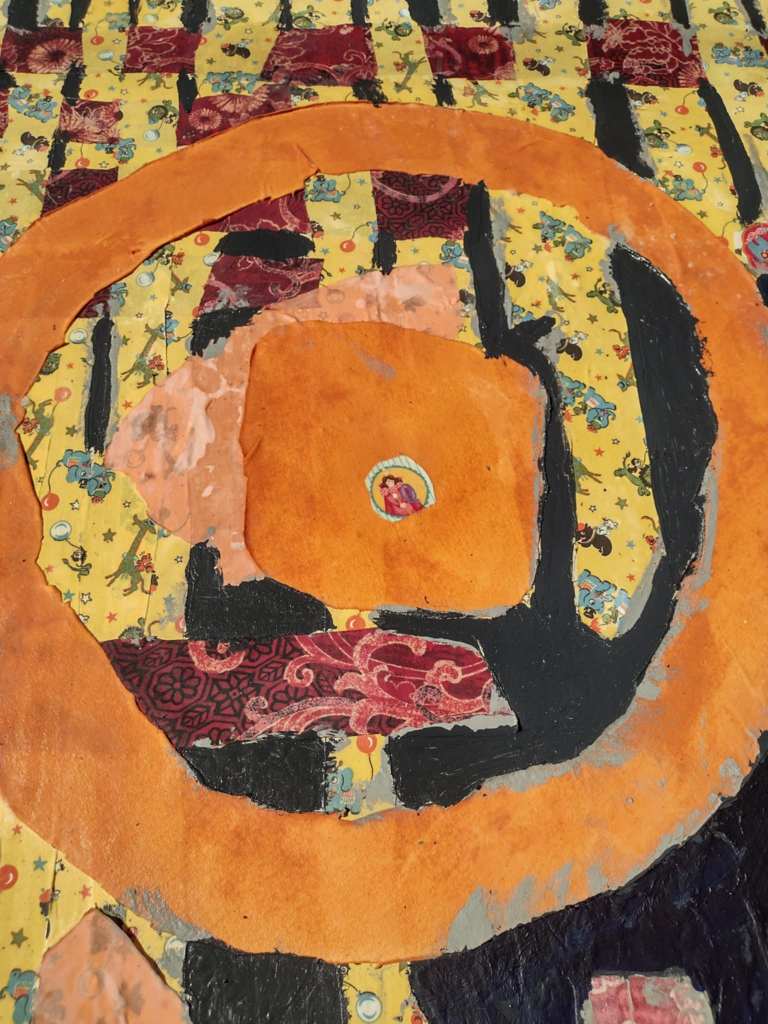
Sam: I use a lot of fabric, and I’ll find out what I want to what the image is going to be after I’ve dug through the bins. I mean, I have one of my favorite paintings I think is the best I’ve done called Little Things. The inspiration for that was this velvety printed, flowery little blue jacket vest that must have belonged to, like a 7 or 8 year old girl that I found on the street downtown during Hurricane Helene recovery. I don’t know that jacket was in the street because of the hurricane, but it just happened to be there, and I said, oh my God, I love that blue. And I love that print on it. So, then I knew that I was going to paint this this row of monkeys, snow monkeys in a pool. And, you know, I wanted a lot of different cool colors and hot colors so that blue really helped. This last painting I did, I had a collection of about five different earthy, warm, soft, gauzy, you know, pinks and oranges and pale tangerine colors. Things that I thought really went well together. And lately I’ve been covering the entire substrate with fabric, up to maybe ten layers. And some of those fabrics are lace or gauze that you can see through. It provides a lot of depth in the painting. So, besides paint, I’ll use fabric. I’m not trying to put like a bunch of collage and crazy shit on a painting, but I did the monkeys that I was speaking of that had the blue jacket. That frame was carefully constructed, intentional, charcoaled, that a wood frame that had been burnt consistently. You had the sense that there had been a fire, but you can also see that it was a very intentional piece that the artist had created that, that that wasn’t just finding firewood, you know.
Sam Pedisich, Mixed Media
Natascha: Is there reoccurring themes and symbols in your art? What would you say is the best example of those?
Sam: Oh gosh, I don’t I don’t even really give a whole lot of attention to what’s reoccurring. I think what usually if there’s a figure they’re looking at the viewer. That might be a recurring theme. Lately there might be a recurring theme of some sort of audacity where the narrative, the thematic narrative is not classic. It’s usually eventful. That’s a tough question. I don’t know. Uh, one of the recurring themes is I’ll have a totally ungrounded figure, like I did a painting of a Fennec fox. Where, I mean, he’s just floating in space. I mean, I’m not really concerned about scenery.
Natascha: In your pieces, I see faces of your community. How do you channel community and individuals in your work?
Sam: I paint people that have changed the way I think about people in general. Like, I choose to paint people who have awakened me in some way. That’s all I can tell you.
Natascha: That’s beautiful. What else inspires your art?
Sam: I went through fabric, um, textures.
Natascha: Maybe events, life events that may influence your art.
Sam: No I don’t. That doesn’t- usually it’s music. The feelings that music gives me. Where I’m feeling something that I want to get out.
Natascha: Does politics governing or even corruption ever play a part in your art?
Sam: I think that we’re experiencing complacency and focusing on minutia. Now, give me an example. Like, you can bring up some really big theme, like human rights where it’s like, let’s discuss what a human right is. A human right means it’s a fucking human right, that there can be no discussion about it, it can’t be parsed. So, it can’t be broken into pieces and turned into some parliamentary procedural thing, because either I have a right or I don’t, and it doesn’t matter if it belongs to the states, the community, the electorate or the executive department. It’s my right. And without getting into any, you know, political discussion about what my human rights are, we don’t need to have a political discussion about what my human rights are, because we know what a human right is. I have control over. Right. So, I don’t want to waste my time with a political discussion. So lately I have been choosing subjects that are audacious or bereft of hope. Like the fox that I painted. He’s on one side of the canvas and he’s not going anywhere. It’s a ten foot long canvas, and from one end of it to the other, it was just an abyss. And there’s nothing on the other side. He’s not looking at it. He’s where he is. All he has is his own self-awareness. And, um, it’s philosophically complicated, but I think you can understand it.
It’s easy to say that we have to be in charge of our own consciousness and our own visions, and I try to paint like that.
Natascha: So yes.
Sam: Yes.
Natascha: Yes, yes, yes.
Sam: I’m not going to paint a pastoral scene because somebody needs/ somebody wants to have a beautiful painting of a wooden barn on their house. I’m so disinterested in that. But I know a painter named Bonnie Mackenzie. She can paint that subject, and it will stir your psychological, philosophical soul. Because she’s that good.
Natascha: Yes.
Sam: And she’s in rifle, Colorado. I’ve been really close with her since 89, I guess. She was a good inspiration for me when I look at what she’s doing today. It just blows my mind. Her command of the medium and her consistency. She’s right up there with Georgia O’Keeffe as far as I’m concerned, even though she paints in a completely different style. This is the last thing that she painted that I saw of her. She’s just full board. I could just see the maelstrom. And we’re looking at scene in the high. You’re not in the mountains, but in rifle, Colorado. It’s not real high mountain. So, you’re not looking at the range of the Rockies or anything. And it’s just it’s you can see the sky swirling and the activity of the wood and the architect of a decaying couple of barns and the way the foliage and the landscape works. It’s just astounding. Now, if I could do that, I would maybe do more of it. I’m not trying not to paint like that. I’m just not attracted to painting, barns and cows. And I remember being at a county fair in Texas, in rural Texas, and being initially very disappointed that all the high school art was paintings of the noses of cows and chickens and people holding eggs and stuff like that.
And it was like, you know, 10% of the artwork was provocative and challenging and risk taking, you know. And I calmed down a bit and I was like, okay, these are 14, 15, 16 year old kids. They’re painting what they love. I mean, they chose those subjects because that’s what they that’s what they’re immersed in. And they want they’re bonded. So, they’re incredible witnesses. And I matured. This was about five years ago. I matured, and I realized that it’s not my job to tell people what they could paint or not even just tell them, but even judge it personally. It’s got nothing to do with me. They’re struggling and they’re trying to figure out what they want to care about and how they want to honor it, and whether it’s a ritual of technique which is prayerful. They’re paying homage to the life around them. The best way they know how. And that’s what I do. So there you go.
North Dartmouth Smoked Your Travel Team
Natascha: I love it. How does fun and play interact with your art?
Sam: If I’m not having fun, I’m not doing it, man. I’ll go get drunk. I mean, I’m ecstatic when I’m painting. And I’ll be celebratory when I’m done. I’ll be like, “God damn, honey, did you see that? Holy shit. I’m so happy with this.” And she’ll go “Do all artists talk about their work like that?” And I’ll go. “The good ones do.”
Natascha: Yeah. Your processing seems very positive. Mine might not always be that way.
Sam: The next day, I always have to make some repairs and fix some things that I didn’t notice when I was in my frenzy the day before. So yeah, I’ll walk slowly into the work and then I’ll, and then there’s a crescendo and then like I’m getting frenzied and then I kind of just call it quits and I’ll leave an incredible mess out and then get a few hours of sleep and wake up and take a look at it and go, oh my God, that red stripe over there just does not work, you know, or something.
Natascha: So, you work on barge boats, and you spend long periods away from your family and home. You talked about how you find time to paint. By scheduling these very disciplined few days when you’re home that you work hard on your paintings. If that’s the case, then is there any times that you maybe take breaks where you feel like you need to step back from your discipline to recuperate or how else does your scheduling tend to fluctuate?
Sam: I don’t put a premium on my painting time. That’s like one of my fifth priorities. If somebody invites me to go hiking in the woods, I’m going hiking in the woods and- I never, ever have tension or any sort of discipline with the schedule. The actions of my painting are disciplined, even though they might not look like it.
I mean, there’s a way to splash in the water intentionally with control. Just because it’s splashing doesn’t mean its pure chaos. I had a young artist friend tell me that they see me, like exploring the edge of chaos. So, I do not prioritize my painting time. There have been a few times when it’s been like two days before a show, and I had a show that I really wanted six paintings in, and it just didn’t seem right. I had a composition/ I had a layout that I really was looking for and like two days before the show, this was in December of last year. I was like, I’m going to do this portrait of Clara. I have to. I’m just not going to leave it in my back pocket anymore. And that took a push, and it turned out to be a powerful piece that actually sold immediately. And I was astounded. Well, you never know. But to answer your question more directly, I don’t push things aside because I want to paint. Painting is not the priority, and that’s why I always just have fun doing it.
Natascha: I think that’s an important point because we’re told that we must work our whole lives and to push, push, push. There’s something about art where, you know, if it if it’s flowing, it’s flowing, and if it’s not, there’s no reason to push it. So, I’m glad that you you clarified that.
Sam: Yeah. I agree with what you just said. I could have said that. Yes, I agree totally.
Natascha: How long does it take you to paint a painting on average?
Sam: Oh, the average would probably be 15 to 20 hours from, well, you got to count starting to build the substrate. You know, I boxed the plywood and that takes an hour and a half to two hours. And then I prime it, and then I’ll glue some fabric here and there and get my color forms down. And I’ll it takes a couple hours to get the basic feel for the fields. You know what I mean by fields of color. Like, okay, it’s going to be a huge big piece of velvet blue over here. And then I’m going to have this kind of intricate shit with a bunch of layers. So oftentimes I don’t even start putting the image on there for about 3 or 4 hours. So, it’ll take me a day or a good session to just prepare the substrate, and then I’ll do a 5 or 6 hour session until I run out of energy. And then oftentimes I’ll paint in one session and it’s typically at night, like after dinner, you know, I’ll get going about 8:00 and I might not finish until 4:00 in the morning, and then I’ll be exhausted and then I’ll fix it. I’ll put another couple hours into it. So, I think it’s fair to say somewhere between 15 and 20 hours typically.
Natascha: Cool. And how do you know when the painting is done? Are there any times when you keep adding and keep adding and keep adding.
Sam: You know, I never really had a problem with that.
Natascha: Okay.
Sam: I always, I always kind of knew when it was done. Usually it’s done sooner than I think.
Natascha: Yeah.
Sam: I’m not trying to be cocky about it, but it’s like, okay, that’s what I was feeling, and we’re good.
Natascha: Uh, what motivates your color palette?
Sam: The fabric that I find that I’m stimulated by. So, I don’t usually have a preconceived notion about how that’s going to happen until I see it. I can tell you, I’m certainly not trying to make it look like what you think the natural world looks like. I don’t really care about that at all. Like, I’m not going to paint a tree with purple leaves. I’m not a visionary or a fantasy illustrator. Right. And that’s left over from Gene Barber when I was a kid. When I painted raccoons and ponds and I was hilariously afraid of painting people because, you know, immature, ignorant viewers, all they care about is what you painted looks like, what they think that thing’s supposed to look like, which is ridiculous. So, it took me. It took me until I was in my 20s to give that up. And it turns out it’s not that hard to paint something that looks like what people think that thing looks like. So color. I don’t really try to make it be realistic. And I usually make the colors more prevalent. And I think maybe you’ve seen have you seen that blue lake with the lake swimmers in it?
Lake Jones State Park, Sam Pedisich, Mixed Media
Natascha: No, it doesn’t ring a bell.
Sam: A lot of those colors are natural colors? But that scene wouldn’t have had the vividness of those colors. I’ll send it to you when we’re done. When we’re done?
Natascha: Yeah, I want to see it.
Sam: I’m really happy with those colors.
Natascha: When I think of your art, I think of earthy tones and bright reds. Blacks and whites. Like a big, major grayscale. I would like to see the lake one with the vibrant colors.
Sam: Have you seen these two sisters called Sisters? They’re armed guerrilla rebel fighters from Eritrea. That’s very, very abstract. Expressionistic. And it’s all black and white, except for the green and red of their uniforms and the wedding dress that I cut up with these yellow flowers on it that I painted yellow. Um, so it’s basically a black painting with overly vivid- what’s the word when there’s a whole… saturation, saturated colors.
Natascha: That’s amazing.
Sam: I’ll send you that.
Natascha: Yeah, I’ll definitely post it in the interview. That sounds great.
Sam: Cool. Yeah, that’s a good example.
Natascha: I know you said that there’s not many events [ that influensed you] and this questions on traveling. Has travel influenced your art? Have you learned new skill sets when you traveled or has travel at all influenced, if anything the theme of your art? Or the way you paint?
Sam: No, traveling just allows me to see more art, and that’s inspiring. I would say reading and understanding different cultures through my avid reading. Like, I learned a lot about composition from reading Joseph Campbell describing the difference between an eastern painter and a Western painter. And then I was fascinated by this book, Orhan Pamuk about the Muslim and the Renaissance painters who were figuring out that you could paint an actual likeness of somebody and maybe not go to hell. Because the Islamic, the Islam art history is, is that it’s um, it’s just not appropriate when in their religious beliefs. At least in what very importantly, in the 1400s, that it was inappropriate to paint someone’s likeness. And it was done surreptitiously because they were imitating the Venetian artists who were doing these gloriously beautiful portraits with oils and stuff. And Joseph, I had a painting that I stole the image from a magazine. The Christian Science Monitor had a photo of two kids, and I think they were in China and they’re squatting down- their asses are almost sitting on the road- and they’ve got this bowl of water between the two of them, and each of them has a wash rag up to their face and they’re facing each other.
So it’s just totally balanced, totally mathematically set up. I was inspired to recreate that because it’s such an eastern motif where it’s a very balanced pattern of equilibrium on both sides. And I think that that is a challenging composition in contemporary art, to have something that’s both sides of the camera are exactly the focus point is in the middle, and you know that each figure is a mirror of itself. And so, I was you know, I may be an outside outsider artist, but that doesn’t mean I haven’t read 75ft on shelves worth of art history and theory and things like that. I know what happens to the eye when it looks at it. When it looks at something. Inspiration has not been traveled. It’s just been learning.
Natascha: I love that, thank you. Thanks for sharing. Is there a few of your favorite artists maybe that you haven’t mentioned yet that you would like to share with us?
Sam: I was heavily influenced by Picasso for 20 years, and one of my favorite paintings is Three Musicians. It’s different. He came up with a new language and he almost be like discovering a new instrument. And I, I have carried those images around, from that painting, forever. And I’m only like in the past decade or so, kind of released the film that’s always going on, the “Imax theater” inside my skull, has that image of that painting gone away. I have recently been very attuned with Soutine. He’s a Jewish French post-war painter who, Leslie of Gallery Cor, turned me on to a few years ago, and it was very complimentary that she said, I think you would like this guy because it reminds me of how you paint. I was like, Jesus Christ, this guy’s amazing. And I like Chagall a lot because he puts stuff untethered. And his stuff is not aloof. It’s not. You don’t have to work your ass off to find out what he’s trying to tell you. I like the fact that it’s memory and it’s fantasy going on, but he doesn’t really care whether or not everything is anatomically perfect other than Scheille. Scheille is one of my favorites because of his audacity and his confidence. He just does not fuss around. He fascinates me because there’s no telling what would happen to him. He died at 27 of the Spanish flu in the same room that his girlfriend had died.
Was a terrible judge of that. So he interests me. And he was the darling of Klimt. Klimt I like, even though his shit is so prevalent. Um. But then. Then there’s. I forget their names. Forgive me this, but the crass Krasner, I think. Or Krasinski. Uh, I’m feeling like an asshole right now, but, um. Um. Oh, shit. Who’s the guy who was slinging paint that everybody was like, uh, you’re painting? Who’s that? God damn it. I can’t think of his name. Oh, but his wife was better than him because you could tell that that she had, um…
Natascha: Jackson Pollock.
Sam: Yeah. Pollock’s wife (Lee Krasner). He’s a super pain in the ass dude. He was a terrible, terrible person to live with. And it’s amazing that she was even able to survive and put up with him. He’s just a total drunk. Like, way worse than Hemingway. And she’s good. You would look at her stuff and you go, he was doing her poorly. I mean, he was a shitty rendition of what she could come up with. And there’s also another male famous 50s American abstract expressionist. And I think his last name begins with an R (Willem de Kooning), but I’m old. I forget all kinds of shit. His wife (Elaine de Kooning) was badass, and, uh, I think I meant to have it written down in front of me because I knew you would ask me this, but, um, it’s interesting to go back to the 50s because there’s so many women who were badass painters that nobody gave a shit about because it was so patriarchal.
Natascha: Yeah.
Sam: And there’s a lot, a lot of good discoveries still to be made.
Natascha: Yeah.
Sam: What else you got?
Natascha: How does your art align with Gallery Cor mission to make the world a better place?
Sam: They are trying to get people to see- to give more opportunity to get out of, to get out of the boundaries of what you think needs to go up on your living room wall. The clients at Gallery Cor are acquisitive in a positive way. They are wanting to get a hold of something that has value in the realm of the humanities. So, they’re really very respectful of the creative process that helps us understand our senses and our sociology and for example, just beautiful sculptures that make beautiful noise. There’s a sculptor there. His first name is John. I forget his last name, but he takes cast-off metal pieces and makes these gorgeous Japanese style looking things. They’re highly balanced and sort of like a good flower arrangement where it’s just not -everything’s not in perfect arrangement. But yet, if you strike this bell with one of the pieces of metal that are appropriated into the sculpture, it’s just beautiful. So, you know, John the sculptor is asking you to participate in the creation. This is not a new idea in museums of contemporary art to have had interactive exhibits, since probably the 60s.
Natascha: Yeah.
Sam: I’ve been to some very interesting ones that still resonate with me. So Gallery Cor is trying to- It sounds preposterous or like excessive- but I hate to use the word, but I can’t think of a better word. They’re trying to redefine the relationship between the viewer and the painting. A lot of the artwork in there, it’s clear what the engagement of the body of the artist was. You can visualize the process. That brush was drug from the top to the bottom. And over there it was drug from the bottom to the top. And it’s evident. And so, to make the world a better place, they’re choosing subjects that that are not necessarily that popular in the fine art museums.
Natascha: Nice.
Sam: If you look at their website, it’s pretty evident.
Natascha: That’s cool. It’s radical. Were you living in North Carolina during Hurricane Helena, and how did it affect your community and your daily life?
Sam:
It inspired me to do. I painted every night during the recovery, and it was, it was blood and guts. I’ve done a lot of difficult things, and I’ve, I’ve been traumatized in various different ways. I can tell you that Helene fucked this city up, and we’re fucked up, and we’re not- We’re not good to go. We’re damaged. Heart, body, soul. Terrain. The Asheville, the city of Asheville is fucked up.
And it affected everybody. I did a portrait towards the end of the- We didn’t have drinking water for 53 days. Think about it. We’re not a town. We have apartment buildings that are socially subsidized, that have residents on the 11th floor who are not ambulatory. They can’t go up and down stairs. We didn’t have electricity for weeks, so people had to carry five-gallon buckets upstairs, me, to flush toilets for people who hadn’t had their toilet flushed for over a week. So that’s just one concrete image that you can multiply by 100 to figure out what we were going through. So how are you going to eat when there’s no ATM and there’s no grocery store open because, HELLO, there is no electricity?
So, it didn’t look like dystopia, it was dystopian and it didn’t look like a movie. It was real. And so, you had to just walk down the street to figure out where you were going to eat, and there’d be somebody with a fire cooking food. And that was going on for weeks. It was unbelievable. [Deep Breath] So back to that. I painted a portrait of a young woman who I identified in my own heart as like, the hardest working person in recovery. Everywhere I went, I saw her doing something. She was hooking a trailer up or unloading/ hauling water or organize and or telling people what was still left to be done at a certain site that had been had been cleared out. She was amazing. The painting is called Clara, and the woman who bought that painting didn’t even know why, why that portrait was done at all. And when she found out, she was even more, more pleased, than understood why she was attracted to it. Because I think it comes across in the painting.
Natascha: Was she able to see the painting?
Sam: Oh, yeah. Yeah, she was appreciative of it. She was endeared to it.
Natascha: Well, I’m so sorry you guys had to go through that. That’s tragic. And I hope that the recovery is continuing and that you guys are getting some support.
Sam: We’re improving. We’re improving. Nobody gave up. Nobody’s in despair.
Natascha: Yeah. What work of art is your favorite? And can you tell us some details about the processing of that painting?
Sam: You mean my own personal work?
Natascha: Yeah.
Sam: I think this fennec fox that I spoke about. This fox is aligned with the writings of Antoine de Saint Exupéry, who wrote The Little Prince. There’s a fox in that story. And it turns out Antoine de Saint-Exupéry was a pilot for decades. And he was a shitty pilot because he crashed a lot, and he was flying his airplane in the 20s across Africa and shit. And he’d end up in the desert. And he had like three near-death experiences and so did I, and not three, but a couple. It’s hard to, it’s hard to really tell when, what, they are, you know? But I definitely had 1 in 2020 where I was in the abyss and there were no lights and nobody was wearing robes and nobody was assigning me a harp. I didn’t know how I could speak about that, and I, I actually figured out how to paint it. And it’s the ten foot long by three feet wide of a fox coming out of/ from behind some burlap that looks like it could be either a building or a tree or something. So, the fabric is suggestive of damaged trees. And this I painted at the end of the first week in recovery. And it took me a good 20 or 30 hours, of a couple hours every night, several hours every night.
Because when it got dark, it was hard to do any more recovery work. And we were moving trees out of people’s driveways or figuring out how to keep a roof from leaking. Thank God it didn’t rain after that. But people’s roofs were caved in all over the place, from trees falling and wind ripping the roofs off. So, there was a huge scramble to try to get as much as we could get done as quickly as possible. And so, I was exhausted.
These paintings that I did, I did six of them and hung them at a gallery on December 7th. And that hurricane hit the last weekend of September. So those eight weeks were still recovery. I took a break for about a week and a half. I rode my motorcycle down to Jacksonville and took a breather. I just could not believe how affected I was by that hurricane. But this painting that I spoke about before with this fennec fox, Antoine de Saint-Exupéry, was fascinated by how little, little they need. They survive on no water, no food. And they’re just really compact. And they’re cute as fuck. They have these big old long ears. And everybody loves them. And it was interesting because this thing was hanging up across the alley outside of the gallery, because it was too big to fit with the rest of my other five paintings in there. And across the alley was a Christmas, crafts warehouse pop-up gallery with maybe 200 vendors. And I felt like my painting was the perfected antithesis of the Christian myth. And one of my Christian friends says, “Well, I see some hope in this painting.” I said, “Identify because I’m going to tell you, there’s no hope in this painting. The fox doesn’t even have any eyes. He’s just his eyes are black. There’s nothing for him to see, and his body’s position where he’s not moving anymore. He’s stopped and he’s just floating. It’s he is noticing. That’s all he’s doing.” I actually named it after a friend of mine named Byron, and I asked him ahead of time if I could do this, and he said, “Yes, that’d be. I want you to name a painting after me if you feel like you want to.” And it’s called Byron Notices Joy. The joy is that he knows. He’s noticing he’s got nothing, nothing, nothing but his ability to be aware. And that’s the best painting and the most important painting I’ve ever done.
Natascha: I love that. Thank you for sharing. Um, okay, so we had if you had a message you wanted to share with emerging artists, what would it be?
Sam: It’s it’s going to be hard to get critique because everybody loves you and they want you to create. So, you have to listen to what they like and you can ask them questions instead of saying, hey, would you like to hang this on your wall? You say, what part of this do you find compelling? Or they’ll go, oh, I just love the way you did the grass. And hold that. Hold what they say.They mean your loved ones because it’s your family that’s going to tolerate you first and then. So, my advice is to listen and stop thinking that you’re doing some sort of personal expression.None of this shit that I just told you about this fox has anything to do with me. It’s not my self-expression. It’s Antoine de Saint-Exupéry. It’s the fox. It’s the abyss. It’s. It’s like people who go to go find themselves. There’s no self to find. You already are yourself. You’re sitting with yourself, so there’s no looking you can learn. Instead of going, oh, I want to go find myself. What you might mean is I want to pour some more shit into my brain. In my heart. But you’re still going to be yourself. You’re still going to be that fox with nowhere to go. That’s not really advice. That’s just philosophy.
I don’t know what to tell somebody who wants to paint if just paint or create or you know, and it doesn’t, it does. Nothing matters if it’s- you’re going to die anyway.Nobody gives a shit about your art. You just do what you want to do, you know? And don’t take advice either. My dad gave me the best advice in the world. He said, the reason you shouldn’t take advice from anybody, they’re not you. How’s that?
Natascha: I think you’re going to create emerging artist rebels. A coming explosion. But I love that. What upcoming pieces or exhibits can we look forward to of yours in the future at Gallery Cor or elsewhere?
Sam: I’m loyal to Gallery Cor. I’m thinking that when I get back from Alaska I’ll speak with Gallery Cor about approving or encouraging me to do a series that would show up maybe in early March of 2026. Where Hello, June would play again. It would be more of a multi- what’s it called? You know, like a festival. You’d have music and you’d have some art and there’s a farm not far from downtown Asheville called Rare Bird. And it’s a good venue for something like that because they have a big giant cabin, they can put a band up. They have beautiful, lush grass, and they have a wonderful, wonderful barn performance space where it’s just idyllic. So, I’m going to be in Alaska for seven months. I’m going to take a break from art. I might do some charcoal or some pencil portrait work or to try to hone my skills about some stuff like that. But I’m going to be busy in Alaska. I’m certainly not going to be painting large canvases and stuff until November of this year when I get back, so it remains to be seen. But I do dream of having another festival that I might bring another couple of artists into, but that’s about a year from now.
Natascha: What would you name your festival?
Sam: Oh God. That’s interesting. Oh, I don’t even know yet. I’m going to think of something. That’s a good idea.
Natascha: Um, would you live to paint at your festival?
Sam: I’m starting to see that that would be a good idea, because the owner of the tobacco barn that gave me that show in August of last year. She is keen on having some live painting going on. I saw a live artist at a New Orleans style, jazz horn and saxophone band that we all love in Asheville. And, a dude was doing a wonderful, wonderful piece off to the side. It was inspiring. That seems like something that people are interested in. Anybody who I talk to, I mean, dozens of people I brought that up with have always been enthusiastic about the concept. I’m totally happy with somebody seeing how I start to finish the painting.
Natascha: Yeah. If you have the canvas or the wood block made already, I can imagine you almost finishing or, you know, getting a good, a good start on it.
Sam: Yeah. If I start, if I had everything primed and all my fabric in a pile, I mean, I could have something feasible that three feet by five feet in the course of 3 or 4 hours.
Natascha: Well, that’s really exciting. That is something to look forward to.
Sam: Right on.
Natascha: Well, thank you so much, Sam, for your time today.
Sam: It’s been a wonderful break from acting like I’ve got important shit to do.










 Little Lost Forest