March 18th 2026- I met up with Andia in Arcata, CA at her studio for an Energy Healing. I had a wonderful experience. I’ll post my experience below along with my intentions! Here is Andia’s interview about her intuitive energy-healing practice, Teachings of the Earth.
Natascha: All right, thank you for tuning in to the little Lost Forest blog. Today I’m sitting here with Andrea in her studio in Arcata. I just had a healing session. This is my first session of this kind. Andia, how are you doing today?
Andia: I’m good. How are you?
Natascha: I’m great. Thank you so much for giving me this offering. What brought you to ask me to come here today?
Andia: Well, I know we talked a long time ago about doing an energy healing session, and I needed to get my window fixed because it was leaking. I’m just getting back into energy healing and wanting to lean into that more, build more clientele, and just practice more. You’re definitely one of the first people I thought of because you’re one of my good friends, and also because we had talked about that. I just wanted to circle back and share this with you.
Natascha: I had a really amazing experience, which I’ll share in the blog post after the interview. What is energy healing?
Andia: Energy healing is. It’s, I would explain it like we all have an energetic body. There is energy that exists, you know, like there’s a type of energy healing called Reiki or that there’s Qi and there’s different things that we call this energy. And it’s a healing frequency that we’re all connected to. Anyone could have the ability to channel it. It’s like setting the intention for this energy to facilitate healing and cleansing, stagnant energy, transmuting the energy into whatever we want to create, into whatever healing we’re calling in. And basically, I would say it’s when a person has received attunements to be able to channel energy healing, they are able to channel natural healing energy that exists through them. They’re just a channel, you know, they’re not exactly doing anything. They’re channeling it. But the energy is what’s coming through, and it’s a healing energy that knows where to go and just exists in this reality.
Natascha: Where is that energy source from?
Andia: I think it’s just the existence, like I personally believe in a spirit world. I believe we’re in the physical realm and that a spirit world exists simultaneously with us. And I believe that energy healing is coming from there.
Natascha: What keeps the positive energy and not the negative energy?
Andia: It’s all intention. It’s like every time you give energy healing, you set the space before. I always ground myself to the earth, cleanse my energy of what no longer serves me, what I don’t want to be sharing or transmuting, just letting that go. And then I always put a bubble of protection of energetic light around me. When I’m going into channel the energy healing for someone– First I talk with them, and check with them, what their intentions are, and what they want to get out of it. Then I can set intentions. And for me, I set, you know, positive, loving, healing intentions and use that energy in a good way, and then also go off what the person says about what their intentions are and calling that in as well.
Natascha: Super cool. What brought you to this kind of healing?
Andia: It was like 11 years ago. It was just a deep calling for me. It’s really interesting because I, I don’t know, it’s like that kind of feeling, like I kept going to festivals and transformational festivals and just finding different healers. And I kept connecting to different energy healers.
And it was this, really deep calling, like, I might as well not exist if I don’t become a healer.
It was just so strong. I need to do this, and also, just my family lineage on my mom’s side comes from healers, and my grandpa did energy work, like in his older years, and just different ancestors of mine on that side have. So I felt very deeply connected to it because, I mean, I was taught to meditate and do energy. I received energy healing and was taught to meditate when I was little. And so yeah, about 11 years ago, I don’t know what year that would be, 2015, I really felt called to that. And then someone gave me my first energy healing session. And I just remember I felt this blockage or this weird energy in my left shoulder while they were doing it. And at the end I was asking them what their experience was, without telling them what mine was.
Andia: And they were saying, um, yeah, you know, everything was really good, except there was this blockage in your left shoulder and I was just like, whoa, like, so mind blown because I felt that. And then at that time, I started leaning into learning how to receive energy, which brought me to Reiki initially. I got my first attunement from someone. And then I was trying to find someone to teach me my second attunement. And I met this woman, Victoria Luna, whom I wanted to get another attunement from. And she was like, ” Oh, actually, I meditated on it, and I wanted to take you from your first attunement all the way through your Reiki mastership. So she taught me everything that I know, but she did an interesting way because she taught me traditional Usui Reiki, but she also taught me to really lean into my intuition and just do it in a different way.
And now I no longer practice Reiki because for me, it’s a more intuitive practice— that’s deeply connected with the earth, that’s what I do now.
Natascha: If you don’t mind me asking, what is your lineage heritage?
Andia: Like my ethnicity.
Natascha: The culture that your family came from.
Andia: On my mom’s side, it’s, it’s interesting. They’re all from Mexico, but a lot of them came from Europe before that. Then they lived for hundreds and hundreds of years in Mexico. So they are blond-haired, blue-eyed Mexicans. So I have a lot of French, Italian, German and Polish. And then, I do have some indigenous Mexican in me, indigenous from Mexico. Then on my dad’s side, I’m Ashkenazi Jewish. So it’s 50% of my lineage. Yeah.
Natascha: It’s so interesting. I do not come from a lineage of healers. I come from a lineage of war vets and journalists. So that’s why I was just interested in where they draw their form of healing from culturally. That’s beautiful, thank you for sharing. Anything else that you want to share? Maybe, how could people find you if they’re interested in a session?
Natascha: I’ll tag that. And after a session, what can somebody expect to come out of it with?
Andia: I would say it depends on what your intentions are, but most of the time I find people are very much relaxed, and that a lot of processing is going to continue happening. So I always tell people, make sure you rest and drink a lot of water. But I think what you come out of it really depends on your intentions. Like, obviously, people are coming for healing. So I would say like that continues to unfold and things continue to deepen, but it just really for specifics, I think it depends where you put your energy into.
Natascha: Awesome. Well, thank you so much for your time.
Andia: Thank you.
Teachings of the Earth gave me a two-hour energy-healing session. It was my first time, and I received incredible benefits from it. I set clear intentions and spoke them aloud. While I was on the table, I could feel where the energy was being exchanged as she moved around my body. There was no doubt that energy is a quantifiable source and that the practitioner could channel it. Toward the middle of the session, I felt myself wanting to transcend, lifting inches beyond my physical realm. I had thoughts of my first love, of giving birth, and of my father’s influence on me. After the session, I felt relaxed and rejuvenated. We discussed my experience, and she shared that much of the healing energy had been focused on the womb. We also talked about how the energy process works. Afterwards, I rested and drank lots of water. Thank you so much for this experience, and I can’t wait to do it again!
My Intentions:
Make Room to become the author and writer I always dreamed of.
Secure a positive dynamic with my husband.
Be an uplifting and child-first mom
Not to offer unsolicited advice, but to hold boundaries and be mindful of community and world struggles.
On Dec 21, 2025, I sat down with Anya, and we discussed her new book Embracing the Sacred Flow. You can find it at this Amazon affiliate link. Before we begin with the interview, I’d like to share with you the dedication:
Dedication
This book is dedicated to anyone who has ever felt broken beyond repair, lost without a sense of direction, or silently suffering through the chaos. I see you. It is never too late to reclaim your sense of self, to heal, to transform, and to set yourself free. Spirit is here to guide your soul back home where it’s warm and cozy.
Let’s dive in:
Natascha: Hello, this is Natascha with the Little Lost Forest blog. Today we will be interviewing Anya with the season of Anya and her new book, Embracing the Sacred Flow. We were sitting at the Revolution Roasters with a cup of coffee, and my son Malakai. Anya and I are doing a cross-promotion. She interviewed Spellbound earlier this month and plans to share in the next few weeks I will link the podcast here once it’s available. Anya, how are you doing today?
Anya: I’m doing so well. Just enjoying this beautiful sunny San Diego weather in December. And happy to see you, girlfriend.
Natascha: Yeah, it’s really nice to see you, too. Years of friendship has brought us here to this point where we’re both working on our businesses and our brands, and we get to talk about the different art that we enjoy. And I just so appreciate doing this with you and being here with you today.
Anya: Likewise. Likewise.
Natascha: Can you tell me a little bit about The Season of Anya?
Anya: Yeah. So basically, Season of Anya is an online community, a culmination of healing modalities that are for those of us who are looking to transform ourselves, to transform our personal identities, to maybe transform our physical, mental, spiritual health and finding ourselves. Typically, it’s a journey for those of us who are interested in spirituality. My main healing modalities with The Season of Anya are yoga, magick, and witchcraft. Yoga is for grounding. Magick is for finding that love for life. And then witchcraft is the ritual. It is the practice that ties it all together. Yoga grounds me, witchcraft elevates me and magick is everything else in between. Because life is ultimately what you make it. And so many of us just really don’t understand how much power we have to change and transform. And I am bringing everyone together to give them their own tools and create a positive community filled with individuals who wish to change themselves and the world for the better.
Natascha: Yeah, that really makes me want to self-reflect and see how I could change my life for the more positive. What got you to start this healing journey?
Anya: What got me started? It all started, probably, I mean, well, I used to be 325lbs. That was not a result of just a girl who loved food, but a girl who was in a lot of pain, a lot of emotional pain. Didn’t know how to process her trauma, didn’t have the tools and resources to just feel normal. That resulted in my weight loss journey, which was my commitment to my physical health. Why physical health? Because the three of them are related; mind, body and Spirit. Right? They all interconnect, and with finding that discipline and with finding that balance within – Then yoga came into my life shortly after, and that taught me kind of how to embrace the physical practice of yoga and learning how to feel good in my body. Then shortly after that, my spiritual practice came into act, and that resulted in me learning how to live a spiritual life so I could transform, but also remain positive and free flowing and just feel better about the trajectory of my life. Because it’s been imperative for me to understand that it is me and only me who’s responsible for my trajectory, not the course that others have set for me my whole life. Same goes for those of you tuning into this today.
Natascha: Yeah, I also started with yoga before I got into my witch practices. So that resonates with me as well. Were there mentors early on that helped you when you were most in pain, or did you find yoga and your spiritual practice on your own?
Anya: Oh, absolutely. There are two groups of people that I find really keen that helped me on my journey. First of all, it was Mel and Kaleo from Rebel and Muse. My friend Kristan invited me to their yoga retreat back in 2018, and from there I realized…how messed up I was. If we’re being perfectly honest. Yoga retreats are so awesome and empowering because they remind you that you’re in a safe space to simply be yourself. That experience slowly started my self-awareness, self-reflection journey of, “oh boy, my normal, is not everybody else’s normal”. So, that kind of was an awakening for me. With that, especially with feeling comfortable in my body and just having kind of that mirror of reflection on me help set the stage for the inner work ahead. Then shortly after I met who would become a huge mentor of mine: Taren S with the House of Witchcraft. She opened the Witches Cottage out here in San Diego, and I got to dance around the bonfire with her and our coven out there for many moons. Through that, I learned spirituality, I learned accountability, I learned healing, I learned what it was to take care of myself and to empower myself, but also how important community is and how we are truly in it for one another.
Natascha: Yeah. On the subject of community, how has your spiritual and health journey changed the way that you hold your friendships and your romantic relationships?
Anya: Ooh. That’s a great question. I feel like it’s taken the people pleaser out of the scenario- for sure. I no longer wish to hold on to what’s not for me. And also with that, though, I do give all my friends the benefit of the doubt through open communication and through being vulnerable and being communicative. I mean, the ones who get it, get it. If I bring up an issue with a friend and be like, hey, what the heck? And they respond- that’s the kind of people I want in my life. I find that romantically, it’s been awful because I realize a lot of partners don’t want to do the work, and it’s hard, especially being at this point in my journey and single. Well, I need somebody who’s at least going to match where I’m at.
Natascha: Well, that’s really important for young folks and for women of all ages to hear. We so easily will go along with what partners want from us because we want to appease them, or we don’t want to be by ourselves. By holding your energy and by being an empowered woman, you’re holding boundaries that maybe some of us put down just to get along with others.
Anya: You know, for better or worse, I sometimes- I feel like I have nothing else to lose. I’ve had some pretty horrible life experiences and with that, you know, has come strength, especially my romantic relationships. And it’s like, ‘Hey, I’ve got nothing to lose,’ so why not walk in faith and see what happens and see if I can actually stop limiting myself and create the life I deserve.
Natascha: Before we get into your book, did you want to tell us any more about The Season of Anya? What kind of content you put out, or products or things that people can engage in?
Anya: Sure! So the Season of Anya is the main hub. I’m really passionate about my free monthly newsletter. So, to those of you tuning in to this, I highly recommend you check that out. That is the heart of my blog. Uh, I know that newsletters are so outdated, but that’s where I share my monthly tips, and not only just that, but also shine light about being in tune with the world around me. I have very cute little witchy stories, I share that are just true moments of surrendering to the flow, and I love sharing those stories, and they often bring a laugh out of my audience and give them opportunities to reflect and connect. So, definitely, definitely- check that out. Then I’m also working on YouTube and social medias and trying to figure out my flow and grind with that. But it all centers back to The Season of Anya community, where ultimately, I’d like to host witchcraft retreats. In fact, next year with my friends at House of Witchcraft, we are co-hosting a retreat in New Orleans in July because I want to give that experience of retreats to the rest of the community, so you too, can learn how to open up and feel safe and vulnerable in a protected environment, an empowering environment and find yourself again.
Natascha: Yeah, that sounds like a great community experience. Does your lineage come into play with your practice?
Anya: Ooh, Great question, actually. It has been for sure. So, I’m Italian, American, first generation, and with my lineage being Italian is so much there’s so much witchcraft actually associated with Italian culture. And it’s just so funny because it’s this interesting connection of witchcraft meets Catholicism. And that was actually understanding my Italian roots, even connecting through the Italian Goddess Aradia and other deities, but specifically, she has really just connected me to the essence of who I am as an Italian American witch. And it has been a really cool journey.
Natascha: All right. Thank you so much for sharing that with us. Here I am looking at Embracing the Sacred Flow. What inspired this book?
Anya: Well, you know, as somebody with really chronic anxiety and an addiction to over productivity and not learning how to just be present in my body, yoga has been a really crucial component for not only my healing journey, but also my life journey. This book kind of just goes over [that]. It’s going to be a multi-volume series. I wanted to give my audience something that’s really easy to read. I mean, honestly, you can read this in an hour or two, and it’s something reflective that gives you prompts for going inward and just kind of tips to get through your life. I talk about some breathing exercises in there. We talk about yoga philosophies, and I talk about learning how to be comfortable and being in tune with your body. Because especially if you are on the path of a witch, learning how to flow and just feel connected to yourself will always, always, always be your saving grace. It’s your anchor. It’s your life force. I’m really proud of it. I’m happy with this content. It’s a start of many, many books to come. I’m excited for you to check it out.
Natascha: If somebody follows the practices in this book, how often do you recommend that they do the yoga, do the breathing? What kind of schedule does this look like in your everyday life?
Anya: Well, yeah. Well, with everyday life, I try to make it very routine where it’s something that you can just tap into immediately. Yes, I do talk about creating an altar and the stretches and the flows, but really, I mean, it’s almost about like micro meditations because we don’t always have time for the big stuff, right? It’s learning on how to feel comfortable and not overwhelmed in any moment. As somebody who had been overwhelmed with literally everything my whole life, this is a new me, you know? But learning how to get rid of that overwhelm and just be here and learning how to release tension in your body and feel comfortable in every moment is life changing and I want to share that freedom with everyone.
Natascha: Wow. That’s amazing. I mean, I feel like if you’re working in a cubicle or if you have children that drive you crazy, or if you’re just a student that’s trying to find their way, this book could really help create a positive routine in your life and a sacred flow that doesn’t only align with the mind and body, but with your higher consciousness and creating a healthy future for the person that’s tapping into this magic. Yes. So, what’s next?
Anya: Ooh, well what’s next? Writing wise, I definitely have been sitting on a spell jars book: Spell Jars 101 book that I just need to kind of polish up a little bit. Just put my last little touches to it. And I really am excited for this upcoming book as well. You know, it’s like, okay, we learn how to tune in, we know how to stay sacred, we know how to stay connected and this book really talks about manifestation. And it demystifies the practice, a little bit of witchcraft, of spells and workings. Because it’s not about sitting at your altar, it’s about getting out there too and doing the work. You want a better life, you got to do the work…while adding a little witchy twist to it. That makes it my own. And I feel like Spell Jars 101 takes a fresh approach that you haven’t seen in your standard witchy books.
Natascha: That’s wonderful. Thank you so much for being an outstanding witch, doing positive work, light work, spiritual work, tuning into the body, soul, and mind. Is there anything else you’d like to share with us before we end the interview?
Anya: No, just go ahead and check me out on my website, subscribe to my free newsletter, and I promise your life will be forever changed.
Natascha: All right. Thank you so much.
Anya: Thanks, girl!
www.theseasonofanya.com to sign up for my free monthly newsletter, blog, and be the first to know about my upcoming witchy retreats.
On November twentieth, around nine in the morning, Natascha and her family friend, Sam P, met with Satya at Ramone’s Bakery and Coffee in Eureka. Their conversation became a deep dive into Satya’s history in the healing arts and the many ways she serves the community as a facilitator of sound baths, microdose offerings, yoga, reiki, and tuning fork sessions. Satya has brought peace of mind to many by offering a safe space to release, recover, nurture, and learn how to move through life’s challenges with greater ease.
As we enter the winter season, we invite you to explore the power of sound healing and discover how giving this practice a chance can enhance your life in the most positive way.
Natascha: Good morning Satya. Thank you so much for joining me today. At Little Lost Forest we’re always honored to highlight local healers, artists and visionaries. And today we’re in for a special treat. Humboldt County sound healing artist Satya Earth, founder of Satya Healing, is here to share her journey, her craft and the heart centered intention behind her work. I first discovered Satya during one of her sound healings and mushroom microdose sits. Over the course of about 90 minutes, a small mushroom microdose, gentle yoga and closed eyes opened the door to a vivid inner landscape. The soundscape she and her collaborators created carried me from the depths of the ocean to a fairy lantern forest, and eventually into the far reaches of space. The magic she facilitates comes not only from the instruments she uses, but from a deep well of knowledge, intuition, and care. Today we dive into that magic, its origins, its purpose, and the person behind it. Can you tell us a little bit about yourself?
Satya:Thank you for having me here. It’s really great to see you. A little bit about myself. I’m a mama of two little ones. They are my whole world and have been a driving force for my evolution in the landscape of sound healing, energy work and working with medicine. My background comes from psychology. I majored in psychology and got my bachelor’s in 2014, and from there I decided to branch out and study different forms of holistic healing. I studied yoga and herbalism, energy work, and sound healing, and have now branched out into the realm of working with psilocybin.
Natascha: Yay! Thank you for sharing. When did your journey with sound healing begin?
Satya: I attended my first sound bath with Jen Madrone back in 2017, and that was an initiation into the world of sound healing and experiencing. Noticing where I was in my life at that time.
Sound healing can stir up a lot of things for us, especially if we’re just beginning the journey. Throughout the years, I’ve gathered tools to support integrating the experiences and emotions that arise when receiving sound healing. This has helped to make it easier to understand and navigate the things that come up. It can really bring up a lot of stuff. Like old stories and thought patterns. Bringing them forward to be acknowledged and felt. It was a beautiful introduction to getting to know myself. The stories that I hold and how to how to work with them and how to transform them. In 2021 was when I bought my first gong and that was inspired through the birth of my second daughter. I had a very challenging experience with postpartum depression. In a place of desperation to not return to pharmaceuticals, I searched online things that could help my nervous system and help with depression and anxiety. Sound healing was the first thing that popped up. I was reminded of my experiences with Jen and decided to take the leap to purchase my first gong.
Natascha: That’s beautiful. I really love how you worked against the postpartum and found natural ways to heal instead of falling into it. Did you have any mentors or influential teachers along the way?
Satya: Absolutely. My number one mentor, her name is Josie Bravo. I met her when I was when I was in a hospital. I had a really hard adolescence; childhood. She met me at some of the hardest times in my life. I’ve known her for 29 years now. She has been a guiding light and I wouldn’t be where I am today without her support.
Natascha: Wow.
Satya: She’s been a really big influence. Like a guardian angel for me along this path. My other mentors are Jen Madrone. She’s an incredible being, here in Humboldt County. I’ve studied Reiki II and my Master Reiki course with her. A couple other influential teachers are Eileen McKusick. She’s the woman that discovered tuning the human biofield. I love blending my own interpretation of her teachings into my sessions. I scan the field with a tuning fork and listen for different sounds and that resonate from the tuning forks to let me know where there is perhaps some stuck energy that can be brought into coherent energy. Another incredible teacher that I haven’t had the opportunity to learn from yet, but I’ve heard great things of his name is Mike Tamburo and he will be here in Humboldt County in March 2026.
Natascha: What will Mike be teaching you or working with you?
Satya: He’s a gong master. He’ll be doing three day long class for a few days. And we’ll be learning different techniques and styles of how to work with sacred healing instruments, mainly gongs.
Natascha: During your sessions, there’s usually other people in the room that are playing the instruments along with you or offering the mushroom micro-doses. Who do you choose to collaborate with for your sound healing sessions?
Satya: I just collaborated with Fallon Orr. We had a beautiful offering where we offered microdosing, yoga nidra and sound healing. It was a different space from the class that that you attended. More stillness and opportunity to reflect in that stillness. It was very supportive for rest.
I just received my certification as a psychedelic facilitator through Emerald Valley Institute. After sharing medicine in the community for nearly 4 years, I decided I wanted to learn more about the history, culture and varying approaches to holding ceremony in psychedelic spaces. Another person I have worked with is Michiah Tobin. She’s an acupuncturist based out of Fortuna. I love blending multiple modalities together for a transformative intentional experience.
Natascha: Well thank you. How do these sounds and frequencies impact your participants?
Satya: That’s a great question. Each person and how they experience sound is very unique. And each session is very unique. Some of the things that I have noticed participants experience would be emotional clearing and release. I’ve heard some really good feedback on how people will come into a session feeling highly stressed and overwhelmed with life and would leave with a new state of grounded clarity. The beautiful thing about sound healing is that it creates neural plasticity and neurogenesis. By approaching your session with an intention this offers us an opportunity to see, feel and think differently about the things that we’re experiencing in life. And like you said, when we’re in this space there are visuals, there’s feelings of floating. It can be a psychedelic experience without the medicine, with the things that we see and that we feel. It offers a place of deep rest for the nervous system.
Natascha: Absolutely. I definitely found a release for my anxiety when I go to your sound healings and I feel really well going back into the world, more prepared. Your vocal work is especially moving where you learn to sing? What language or tradition are you drawing from?
Satya: I’ve been singing since I was three. Song has been a part of my whole life. I was in choir for eight years, and I was in a band for a couple years. Interestingly, I always felt nervous. And to this day, I still feel some nerves before I sing. But, after I traveled to India back in 2014, I was studying yoga there and we learned a lot of mantras and Sanskrit prayers. It is in this place of prayer that the anxiety dissolves and my intention of sharing song expands. I sing in Sanskrit, and the songs that you’ve probably heard are called the beginning prayer, the ending prayer and the Anahata prayer.
Our voices are our most powerful instrument, and it’s my mission to continue sharing this instrument, along with these other instruments and empowering other people to come into a place of comfort in their own body and their voice. I encourage people when I’m singing, when the sounds are going; we can hum, we can sing too, and start to vocalize because that’s how we can move energy throughout our body.
Natascha: Yeah, that’s some of my favorite moments. I really enjoy your singing, and I like that you pushed me to sing and your participants to sing, because oftentimes I don’t use my voice. It does resonate with me, and it does bring something positive out. So thank you for doing that. What dreams and aspirations do you have for such a healing moving forward?
Satya: I love this question.
Natascha: What’s next?
Satya: Yes I am so excited about what’s next.
I am creating some packages to make these experiences more accessible. After going through my psychedelic facilitator training, I really want to work with marginalized communities. Whether that means I look into what it would be to become a nonprofit or I look into fiscal sponsorship. I really believe that this type of medicine is something that everybody needs.
Natascha: Cool. I can’t wait to see where you go with it. Was there anyone who inspired the evolution of your art or an event? Possibly.
Satya: Absolutely. I had some moments to reflect on this, and the evolution of my art truthfully, has come from a place of pain and suffering and knowing that these wounds can be transformed. And I’m speaking from a mother wound that without that experience and without those wounds, I wouldn’t be where I’m at today. Having a troubled relationship inspired me to ask: how can I best show up for myself and how can I best show up for my children and for my community? How can I create this space of safety and trust within myself and within my community?
I’ve been learning different communication styles, like compassionate communication, paraphrasing and reflecting. These are all practices that I’m in a space of learning right now and eager to implement into how I parent my children and how I speak to myself, how I speak to my community and to my clients, and I’m really encouraging all of us to become more curious about how are we communicating with ourselves? How are we communicating with our loved ones? Because this is where we can we can really come together and come together in a space of safety and trust.
Natascha: I think you’re really advocating for people that are struggling, that there’s a light on the end of the tunnel. As a mother, too, there’s a lot of stress in motherhood and seeing you blossom and bloom that shows that we don’t have to be the pain of our families, but that we could create our own positive walk of life and the way that you impact your community. It loudly speaks that you walk the walk that you’re not just talk. So thank you for doing all the all the work you do with us here in Humboldt. What are your thoughts on human consciousness?
Satya: Another fabulous question, Natascha. My thoughts on human consciousness; human consciousness to me, is a state of being. I come from a spiritual and perhaps Buddhist approach where I believe that all living sentient beings from our animals to the trees to the rocks, to the dirt, to the insects. We all have a consciousness. We are all here coexisting as one on this cell of Earth. And when we can come into that place of connection, we can really start to come together in this collective ecosystem.
Natascha: That’s beautiful. How does that deconstruct the ego when you come into a mindset of a universal consciousness?
Satya: Mmm, yeah. We’re definitely deconstructing the ego and perhaps deconstructing the hierarchy of humans being at the top and everything else being below us. I know that there is definitely some advancement in technology where we are now having the opportunity to communicate with our animal friends. And it is deconstructing how we view our existence and how we view the existence of other beings in this world. It’s really powerful. We can come into this from a wholehearted space, or we can, you know, use it for power. So it’s really up to the individual and how we approach this type of technology. Language is technology too. You know, it’s like these things are always advancing. And so it’s like, who is behind this and what are our intentions behind it? And it’s how we show up and how we reflect that into our circles and into our community. And that’s when we really have that opportunity again, to come together into this collective space of awareness, which is kind of linking to that state of consciousness, the consciousness and the awareness, how we show up, how we reflect, how we have awareness of our energy and how we impact the environment around us. I feel like I could go on forever.
Natascha: I love this, I just want to dig a little deeper into it. You mentioned animals briefly. Is there a connection between your sound healing and nature? Maybe you play your music outside, or you feel a deeper connection to the earth and to the animals when you perform sound healing?
Satya: Absolutely. I have a very deep connection with the elements and with nature. When I take my gong out and I play next to that maple tree and Cheatham Grove, I’m playing for that tree and I’m playing for the land. And I just imagine this time lapse of this tree living there and all the things that have surrounded it. And for me, I just, I want to be with that tree for that moment and play the sounds. And when I play my infinity disc, that sounds like the ocean, I’m like, man, this tree won’t ever have that opportunity to be by the ocean. So maybe I could bring the ocean to the tree.
Natascha: Cool and lastly, what are your beliefs or reflections on the afterlife?
Satya: Reflections on the afterlife. I do believe that we are reincarnated. I do believe in karma. I believe that the things that we’re experiencing in this life are perhaps a reflection of the life we’ve led before. I also go between this, you know, when we die, we go into the void. We go into emptiness. No one knows. And we have access to so much information that we can decide what we want to believe. But we truly just don’t ever know. So when I think about what the afterlife is, I like to consider a lot of things. But I also don’t have a concrete belief because nobody truly knows.
Natascha: Absolutely.Do you have any advice for someone that might be depressed, anxious, or struggling in their life? How to get out of that negative spiral?
Satya: Well, there are many approaches to helping ourselves through these stagnant, dark places. The first approach that I like to suggest is, depending on the severity of it, is having a counselor or a therapist. Somebody to offer an objective perspective, somebody who will support us in our stories that we share and perhaps guide us into healthier states of thinking. Also bringing in the element of what are we putting in and on our body. And that’s not just food, that’s not just cosmetics. That includes the things that we watch, that includes the people that we surround ourselves with. That includes supplements that we’re taking. So it’s really a whole approach when we start getting into this world of depression and anxiety. I mean, we can look at our gut microbiome that’s definitely linked to anxiety. Parasites are linked to anxiety. And then when we start to go in a little bit deeper outside of the the physical being of depression and anxiety, we can start to go into like the emotional body and the ethereal body, and that’s where we can bring in these alternative modalities to help us. That could be energy work, that could be sound healing and microdosing. But then again, drawing it back into the self, it’s really about our perspective, how we speak to ourself. So again, coming into that tug of war that we experience when we’re going into this place of depression and anxiety: The stories that we tell ourselves, how we talk to ourselves. And a lot of this is linked to how we were raised and how we were talked to and how we were taught to manage these things.
Satya: In my psychedelic facilitator training, we learned about this thing called the default mode network. And when we’re born, up until we’re about four, this network in our mind is very malleable. But around the age four, we are now learning to exist in the world through the way that we are talked to by our family members and the authority around us. And those pathways start to get very rigid. And so then we start existing in that story. So when we are working with psilocybin in larger doses, we have the opportunity to do what is called a reset dose, where the default mode network gets shut down. And this is where we have access to new pathways, new ways of thinking and feeling existing, perceiving and we want to be slow with this. Whenever we’re in this place of depression and anxiety, how long did it take us to get here? How long have we been in that place? And just know that there’s no one pill. There’s no one experience that’s going to shift things. This is a practice that we have to implement and be dedicated to daily. The most important facet of that is who are we surrounding ourselves with? Who is our support system, our community, the classes we attend, the people we talk to. These are all factors to consider when we’re starting to address these symptoms of depression and anxiety.
Natascha: Coming into the winter, is there are certain practices that you do seasonally; more winter style forms of healing?
Satya: When we come into the winter. I personally think about darkness. I think about going into a place of hibernation. I think about what is nature doing? And I do my best as a single mother, to slow down. Some practices that we can do is look at how we can slow down. How we can create spaciousness and just noticing when we are overdoing. When we are doing too much and just taking a moment to step back, reflect and say “hey, I need to cancel.”
Satya: One practice that I learned recently that’s been so helpful, is tuning into our breath and tuning into what it means to clear our energetic field. When we are starting to experience that tightness in the body, or we notice we’re getting really overwhelmed and feeling frantic. Come back into the breath. Breathe through the souls at the feet.
Satya: And as we’re exhaling, we’re releasing this energy out through the crown of the head. And this is the cycle. Breathing in through the feet, coming through the center of the body, breathing out through the crown. And as we continue this breath, we’re starting to think about, I’m breathing in calm and I am letting go of any tension. I’m letting go of any chaos that I’m holding in my belly, that I’m holding in my heart. I’m holding in my brain. I’m letting that go. I’m returning it to sender. I’m returning it to the universe. And I love this practice, especially for people who are highly sensitive or for highly empathic people. People who tend to absorb energies easily. This is an amazing breath practice, because then we get to tune into not only our breath and clearing our fields, but we’re starting to acknowledge what is mine and what is not mine. What am I holding on to? Maybe I’m holding on to something that I experienced yesterday, and now it’s time to let that go. And it’s time to bring in that clearing and that self-forgiveness, so that we can have a clear field and show up for our friends and our family in a more balanced state.
Natascha: As we move into the winter, sound healing offers a powerful way to calm the nervous system, reconnect with the heart, and bring clarity to the mind. Satya, thank you so much for your time and for sharing your wisdom with our Little Lost Forest community.
Satya: Thank you so much. I appreciate you. Thank you for calling me in and sharing these moments together. Blessings.
Natascha: I’m here at Azila’ Cauldron in Eureka with Roman, a visionary artist and OG creative force of Humboldt County. My name is Natascha, and I want to thank you for tuning into the Little Lost Forest blog. I’m beyond excited to dive into the art, theory, history, and creative journey of Roman a.k.a Synchro Mystic. How are you doing?
Roman: Doing pretty good. Thank you.
Natascha: Awesome. Roman, where are you from?
Roman: Mind, body or spirit?
Natascha: All. All of the above.
Roman: I typically say that that way because my body is from Mexico. My spirit is universal, and my mind is global. My mind knows and exists and is part of a global reality that we’re perceiving together. And that definitely is who I am. But also, my physical body is a certain part of who I am, and my spirit is definitely on this mission. That is who I am as well. And those three are distinctly different things in a certain way, and my job is to try and align those together, that’s why.
Natascha: Your universal consciousness has landed you here.
Roman: Yes, but so many dimensions we can talk about that from. And that’s why I like to do art.
Natascha: Wonderful. Well during these interviews, feel free to dive into rabbit holes. We’re all really interested to see what inspires this beautiful art you make.
Roman: Thank you.
Natascha: How old were you when you first started drawing and creating?
Roman: I called myself, and this is, like, one of the most profound and silly, experiences in my life. I called myself an artist at three years old, and I specifically remember this experience that did that. And one of my older sisters came home from school with this big pad of paper, and it looked huge. But then again, I was a little kid, so it might have been a normal sized pad of paper. [Natascha’s Laughter] But then she puts it down, and then she shows me her drawings and I’m like before this moment, I considered myself a magician. And I was like, always pretending to make things disappear out of handkerchiefs and silly things that I saw. And I thought, I’m a magician. So, there’s first, there’s that. And I think that’s very symbolic because I think art is very magical. But anyway, I saw this sketchbook that my sister had, and one there was a crocodile she drew, and I could see a crocodile on this paper with lines drawn on a two-dimensional flat piece of paper, and I could see the three-dimensional crocodile that it was. And I was like, wow, that’s cool. And then the next one was a girl in a bikini. And I was like, that’s a girl in a bikini. I know exactly what it is. And it’s just a few simple lines on a flat piece of paper. And I was like, that’s magical. [Natascha: Mhm.] So, from that moment onward, I instantly call myself an artist, even though I didn’t know how to draw or whatever, because, uh, because at first, I was a magician. So, what did you have to learn?
Natascha: Would you say at a young age you related magic to art.
Roman: Instantly at three years old.
Natascha: That’s wonderful. I think you kind of answered this question, but what initially inspired you? Maybe outside of your sister’s drawing, what were some of the inspirations that have ended up fueling your creativity now?
Roman: Oh, man, I could have countless and countless stories, but I guess one fundamental, um, experience was, uh, being in Seattle during a very critical time in history, and I mean that in many different ways. The music scene and then the technological explosion that was coming from Microsoft at that time, an era when the very beginning and I tried LSD and, something I was never really too proud to boast about. But I also think that it’s a very important thing to express, that there’s these moments of that we can utilize as tools to activate something. Because on my psychedelic awakening, I definitely had so many things come together. And it isn’t all based on the psychedelic awakening. The Psychedelic Awakening gave me a view into the things that were already happening in my life. Like, calling myself a artist/ magician at three years old and a lot of mystical experiences that I never really understood growing up. That happened throughout my life. But for some reason, having a reflection like psychedelics or something external outside of us, like aliens or whatever, if you’re blessed enough to see that. But these external reflections allow us to look back at ourselves to witness these things from a third point perspective. And that helps us wake up, you know, like, oh, yeah, I notice these patterns throughout my life, I’ve never really realized how to deal with those experiences. And sometimes when you have like a psychedelic awakening, it gives you an angle to look at those things through.
Natascha: Wonderful. How would you define visionary art?
Roman: Well, visionary art to me means a lot of things. It leads me to the next thing I’m going to talk about. But just to answer your question first is, you know, at first when I got introduced to visionary Art, it was, outsider art. That was because I looked at a visionary art, magazine when I was really young, and I remembered i. It was more from people that I didn’t go to school to do art. For some reason, it was like, they call them outsider art. I thought that was interesting because there’s a visionary art museum with, uh, all these artists in there before the psychedelic visionary art movement. So then when they called the visionary art movement visionary art movement, it kind of like, wasn’t sure about that. And also, to me, vision means of our vision. But I don’t know what other art isn’t from our vision as much. (Natascha: Okay.) But don’t get me wrong, I still use that title to express our movement of artists because it’s something that people recognize right now within our circles of people, which is very powerful.
Natascha: Mhm.
Roman: However, I don’t think that it specifically talks about the movement that I’m a part of which I feel like the people of artists that you recognize yourself liking to are not a part of necessarily only. I created an art movement called the Interdimensional Art movement. (Natascha: Lovely.) And I even told Alex Gray about these things before we named the thing visionary art movement. And this was a long time ago. And he never even heard of that. And he really was vibrating with that idea, too. Which is really cool to always be able to share your ideas with other people and get reflection. And the Interdimensional art movement the acronym is I.M. (Natascha: Nice.) It’s based on the finite of yourself, your personality, your ego or whatever it is you’re that you’re wanting to express. And then the full title, Interdimensional Art movement has no limits. I think that’s more true to the what the visionary art movement that we synchronize with at the moment.
Natascha: Interdimensional Art Movement.Got it. Can you share a bit about your history as a visionary artist?
Roman: To simplify things, psychedelic awakening in Seattle. Recognizing everything at once and wanting to be part of an art movement. Because as an artist, you always look back at art movements and you relate to certain groups like the Surrealists, the Pre-Raphaelites, or like any segment throughout history, which is really inspired in certain ones inspired us more than others. Art Nouveau or whatever. I couldn’t deny that I didn’t want- I wanted to be part of a group like that, but there was no real group to that I could associate myself to at that moment. Plus, I wasn’t that advanced. But these ideas were coming. These desires were coming to me. But then I started paying attention to what kind of art movement would I want to be a part of? And then that’s when a lot of answers started coming, and that’s when I recognized, oh, those art movements. And we’re answering these questions that they ask themselves. And that’s why they became art movements, because they were answering a question of defining who we are as a culture. And that’s what creates a movement. And we attract each other that are representing this, this reality together. And then, um, that harmonizes us as a collective.
Natascha: That’s beautiful. Who are some of your colleagues in the visionary art community?
Roman: To me, I love the way you ask because there’s a seriousness to it. And then that kind of makes me laugh because I’m also a space cadet artist. But my colleagues. I’ve been blessed enough to have colleagues of all different sorts. Like, my Seattle experience was pretty profound because, when I was having this psychedelic awakening, and I was reinterpreting reality. And then I was like, I want to hang out with the Beatles. But the Beatles already happened many years before me. So, like, put the vibration I was getting the LSD vibe or whatever, you know, and I was like, wait a minute, I’m in Seattle. [Natascha laughs.] Just to bring that into perspective and for a few many years I would keep on running into people like Nirvana, Soundgarden, Alice in Chains. And this is my canvas. And I played in this dimension for a few years of running into these people all the time, getting to know these people from different perspectives. Like, I have so many memories to even remember at the moment, but one of them that’s on my mind right now is, uh, Soundgarden when they were recording BadMotorFinger. They had my paintings in the studio while they were recording a little bit of that album and stuff like that.
Roman: I remember going in there and picking up my artwork and them being all, like, polite and kind and gentle, but they’re like, really, they’re all really tall, like over six feet, you know? For me, that’s tall. Just having those memories ingrained in my brain and seeing how influential these people were, it was pretty intense. So there’s colleagues like that, but more precisely, to the art world is like, from Alex Grey. I don’t know. It’s hard to tell because the way that I learned about my colleagues is through a party that we started. That’s why it’s really hard to answer that question, because I have to, like, share the story of why I know these people. Because if I say Alex Grey, who might be the most famous and people recognize him, but there’s. I don’t want to skew the vibe just by that attention when there’s so many other beautiful and amazing artists and they all were attracted from this interdimensional art show we threw up in Seattle. And this was the beginning of before where? Before what we were doing. There was hardly ever, like, a live artist and galleries at events. That’s like something that was, I wouldn’t want to say that we started it, but we definitely made it a ritual.
Roman: And it brought together all these artists that some are now famous visionary artists from Luke Brown, Carrie Thompson. It’s like really challenging to even start naming them because there’s so many that I can’t even name. A lot of them, I’m sure that you would recognize. For instance, like Carrie Thompson came to make the most beautiful stages of electronic events throughout the world. You would recognize them because they’re super beautiful and Alex Gray and Mark Henson. I don’t know if you know Mark Henson, but he’s an amazing artist from not that far from here, from Lake County. And if I showed you his art, you would obviously recognize him.
But the reason why I really enjoy these people is because it was a family calling that brought us together, like these shows that we used to throw up in Seattle. Were exactly that. It really bonded a large group of artists together that never recognized themselves before. Now it’s easy to see. It’s all easily recognizable. But before then, we didn’t have anybody. This was like the beginning of us recognizing each other, which was really amazing.
-Roman
Natascha: Wonderful. At that time, were you part of a community? You say we.
Roman: I would say we because I can’t. I don’t ever want to feel like I’m taking responsibility for it. That’s one aspect which is still egotistical, but I am an ego, [laughter] and it’s very influential to where my idea is coming from. But at the same time, it is a collective thing that I’m just being aware of and I’m wanting to share that with people. So, I say we because, you know, I might have been inspiring certain ideas, but it came to be through a network of different people.
Natascha: Awesome. Okay. So, in your art, you use mixed media in your paintings on canvas, and they’re all very incredible and beautiful. We’ve discussed acrylic paint, pencil and paint pens in the past. Are there other mediums you’d love to work with?
Roman: Did you say airbrush?
Natascha: No.
Roman: That’s probably one of my favorite things, even though my relationship hasn’t been too intense with it yet lately. Definitely airbrush. Cool pencil for sure. Yeah.
Natascha: That leads us to our next question. What role does pencil play in your paintings beyond sketching the initial image?
Roman: Well, lately it’s been like taking a central role and I’ve allowed myself to draw more. Then I keep on realizing why I didn’t allow myself to do that more often. Because it really brings my vision together. Because I really love to draw with a pencil, and it really flows. And it’s a relationship between the lead and the and whatever the paper or canvas or whatever. It allows me to put a lot of detail as soon as I start painting, it becomes an emotional thing and I start relating to the canvas with emotions. And then oftentimes I’m I get lost in the emotions of it. When drawing with a pencil, it’s more mental, more ideas. That helps me like navigate because I’m an idea person. I can constantly be channeling my ideas, but then I bring in the emotions of color, and that’s when it starts to get the feeling. But it’s not as controllable for me.
Natascha: Can we take a second and look at this painting over to your left. Is there a pencil in that painting right there?
Roman: Yeah, this one is one of like I said recently, it’s been taking main stage. This is one of the paintings that I did as a live painting. Mhm. And I just allowed myself to just feel the music and vibe and not care about painting and just draw. So I drew pretty much the whole thing with pencil. And then I loosely started airbrushing and painting on top of it, but without covering the pencil. Of course it’s very raw and very loose. But there’s something I like about it. There’s something metallic about it that I really like.
Natascha: How do you select your color palette? You have a very nice rainbow assortment of colors in a lot of your paintings.
Roman: Yeah, definitely spectral for sure, because that’s the reality that I’ve seen. You know, a lot of my art was inspired by me walking around a lot. So, whatever I could bring with me, because that’s the way I’ve explored my reality. But also, with what I have and what I had for a while was black India ink and with airbrush, and that was it, a big bottle of it. And then I started wanting to paint with color. And then you realize you want the least amount of colors, or that was my experience. And then that led me to like, oh, the spectrum, the southern colors. From here I can do different shades of shades of whatever. That was if I look at it from the physical aspect. Like I said, you asked me who I am or, you know, uh, that’s physical. There’s also the mental and the mental is, it’s more chakra style. I use the rainbow colors because I feel like there are these seven dimensions. Those are perceiving reality. So, to me, when I learned about the chakras, it started making sense.
And being a psychedelic artist, I like to travel to different dimensions, so to speak. And the chakra system seems to be a way to understand that because each of the colors are a vibration and each vibration has a negative and a positive polarity. And if you start understanding how they interact with each other, then you can travel consciousness in that manner.
-Roman
Roman: And that’s the primary reason I use the rainbow color palette.
Natascha: Oh. That’s lovely. I hear a lot of entombment in your body when you paint and meditation as you’re painting and choosing your color palette is very interesting. Can you tell us more about the reoccurring themes in your work, what those might look like?
Roman: Definitely a lot of meditating beings, and sometimes I question myself on that. But like, I’ve had visions of tapping higher states of consciousness and feeling that. And there’s always people in the meditating pose and really high vibration. Maybe it’s just me, but I’ve heard this from other people, too that these beings come in from other or we tap into a vibration or dimension that they are meditating in. When I experience that, it makes so much sense why I would be so infatuated with painting that because I’m not necessarily Buddhist, but I definitely visit the teachings a lot because very super profound. And it definitely helps as far as, you know, being present with yourself. So, there’s all those things too. I definitely have to admit there’s a lot of goddess imagery. A lot of awakening. A lot of dance parties. The dance parties are the symbol for humanity, I feel.
Natascha: Yeah. Who are the characters that we’re looking at? Do they have names? Personalities?
Roman: I don’t think about it too much, because I think it’s just like who we are on one level. So, I don’t really recognize any separation from just a snapshot of anywhere I would go. There are people dancing or whatever. That’s the main thing. But then the other profound thing is, I don’t know if you’ve heard of Tribe 13, but that was like our production company up in Seattle that through the Interdimensional Art shows. And it still continues to this day. And we have thousands of artists connected to that name. I think that you would consider visionary artists specifically. But essentially Tribe 13 is a traveling gallery at different events and that’s what we’ve been doing since Seattle, but definitely been to that gallery like boom Festival and Envision Festival and a myriad of other ones.
Natascha: You know, he just posted this on your Instagram, but can you tell us more about the meaning of Tribe 13? What where did you guys derive the name from
Roman: It’s really profound vision that happened to me as I was awakening. I told you about me about my psychedelic awakening that led me into really questioning my reality and really, dropping out, so to speak, to just meditate on these things. I started recognizing different patterns and the desire to be myself and to be accepted for myself and accept other people for themselves, which is a freedom, and all based on just the basic fundamentals of this country. So, it kind of unified all these things. But I was recognizing that nobody’s really living up to it. What does that mean? So, then I started questioning who I am. Who? Where do I belong? Or as a part of society or whatever? As I was having these profound questions, I would run into signs of different things.
And Tribe 13 stems from those realizations- as I was awakening up to this way of looking at reality- the symbols are infinite, and I can point them out later. But essentially what makes a Tribe 13 member is to recognize that we create reality, which means the only way to tap into this presence is to be in a state of giving and constant giving.
-Roman
Roman: A lot of people say, oh, yeah, it makes a lot of sense. That way you can receive. I’m like, no, that’s not the point. You can’t, um, you can’t live in a binary perspective. It’s got to be a unified perspective. And it has to come from source. So, to become a Tribe 13 member is to recognize that you are marrying yourself to your true self, which essentially synchronizes, synchronizes that to all the other beings that are doing that themselves. There’s no control mechanism, no one’s better or worse than you from from that perspective, those kind of perspectives can only come from the outer world. But the outer world is not a reality because we have to be in a state of giving. If you’re wanting to receive things, and that is one way of looking at it, but that you’re going to receive an illusion. So, Tribe 13 is the beings that are synchronized by giving from within out. Which art is the symbol of.
Natascha: Wonderful.
Natascha: I you’ve been talking about spirituality a lot, but how does spirituality influence your creative process?
Roman: Well, it helps me recognize who I am. You ask me who I was in the beginning, and I can’t answer that from one perspective. Like mind, body and spirit and spirituality. I feel like it helps guide us into what we’re supposed to be doing or wanting to do. And we don’t have to be deceived by an external belief of spirit or whatever, but to really recognize what you’re really wanting to intend as your person on this earth, which is really basic and not spiritual at all. But I would consider that spirituality because, again, chapter 13 and the vision of having to offer yourself from this source, from this center, is crucial to that. And why I would call it spirit is because it’s beyond what I could perceive. If I’m in a state of offering, I will be in this state of awe of the actual manifestation, if that’s going on.
Natascha: Would you say your art is an extension of that?
Roman: Without a doubt. But what is not. Everything is from that state. But oftentimes comes from like a really, maybe not evolved state or a weird interpretation or even negative. All these things have a way of manifesting.
Natascha: Sure. Yeah. Okay. What draws you to sacred geometry?
Roman: I definitely use sacred geometry as a thing, but I never really stick to it like some of my contemporaries, for sure. Um. Uh, yeah, I have, like, this deep gratitude for it. But I was thinking, like, if, uh, sacred geometry exists, then, uh, we are part of this, uh, sacred geometry. So, whatever I do is a part of the sacred geometry, because I can’t have a choice other than to create through the sacred geometry. So then at that point, I’m like, out the door. Don’t pay attention to it.
Natascha: Don’t even think about it.
Roman: I know exactly.
Natascha: It’s in the flowers, it’s already there.
Roman: Exactly.
Natascha: All right. What about your local community? How does that inspire your art?
Roman: That it confuses me, which inspires my art. I think our community and that’s why I, like I make a big deal with the dance party and social event because it gives us a view into our community. Where we come and show our art, our dance, our vibe, our talk, or this or the way we get drunk and shitfaced. I only say that that way because we need a safe place that people get to experience themselves and then figure out themselves so they can correct themselves. And I feel that these social settings in a loving and open environment have a way to heal. So those kinds of experiences wouldn’t be happening. And I just say that because we have a lot of healing to do, and we really need to, like, allow people to people to process their inspiration by not just accepting a rude behavior, but to recognizing and knowing that being recognized also starts having an alignment of sorts.
Natascha: I really appreciate you saying that. What shifts have you noticed in the festival scene, and why do you keep returning as an artist?
Roman: Well, to me, if there’s going to be any time traveler’s ever to come into existence, they’ll probably come through portals such as psychedelic events throughout the world.
Natascha: Cool.
Roman: I really believe that because when we go to an event like this with the artists, with the musicians, with the styles, with everybody offering their little trips, it really is like an eclectic group of people that are highly open and well, as far as judging against other forms of people in the world. We’re definitely at that point because we’re in this offering state of being or curious state of being, I guess might be better. That it allows a lot of things to come through, and that’s exciting to me.
Natascha: Kind of like they’re creating something new in these communities. There’s some kind of evolution/ evolving going on.
Roman: I definitely think that there is, but that it’s up to us for being open, because the opposite is also true, where people are being dumb and like, not learning or whatever. But I think that’s part of the fun for me because and what keeps me coming back is because I’m coming back now as an older person that has experienced certain things and like sometimes, I’ll get on my, like, flow where, like, I already know every conversation. [Natascha: Oh, no] -in a really amazing way. Not that I know the whole conversation, but what people are experiencing. And I feel like if we can develop our language, we can help bring people through a lot of experiences, a lot faster by just communicating with each other. And that’s one of my favorite things at a festival.
Like when I open myself up, I get attracted to these little circles and we get to share the pipe and then talk, and then all of a sudden, they’re like I had this one vision, blah blah, blah blah. I’m like, I’m like, I would look at the person and say, so what? And then they’re like, got their little spirit shattered. But then they recognize, like, what do you mean? Like, well, what are you going to do about it? And then like start talking to people like that and then like really brings this awareness to the person’s trip, like, oh, somebody’s actually listening to me. And then they go even deeper into their thing. And then you experience those kinds of awakenings so you can express your awakening to those people, and then you can stop and start helping guide this awakening collectively. So yes, there is an evolution of sorts like that.
-Roman
Natascha: Like, cool. So, on a global level, what changes would you like to see and how do you channel that vision into your art?
Roman: Well, there’s only one mission. The mission is to recognize that everything comes from within, out, and start not judging the external world or feeling like the you’re going to get validation from the external world. But to really believe in oneself, to be able to provide the offering that you really want to provide to the external world, not the other way around. If we could all start understanding that that’s how we fit in.
I feel like that’s when the big change happens, because so many people are trying to consume what they need to be or trying to acquire a sense of belonging from an external world to validate themselves. And it really screws up the whole mechanism of our existence. Because the universe is also like a, not an ego. So, it’s like whatever we’re creating is like going to manifest, uh, hugely, you know, because it’s like what we’re focusing on at the moment. So, I feel like once we start offering our true gift from inside then the universe reacts and recognizes that it can only provide abundance.
-Roman
Natascha: Lovely. That goes back to giving, giving, giving, giving. I love that so much. What upcoming events can we expect to see you at?
Roman: I’m excited to show my art across the street at Los Bagels next month in Eureka.
Natascha: Arts alive, right?
Roman: Yeah. Yeah. I still got a piece myself together, so I’m like, oh, yeah. That’s happening.
Natascha: Wonderful. What are some of your bigger goals as an artist?
Roman: I don’t know, I would like to write a book. I guess that’s one of my goals, because then I can solidify what I’ve been talking to with every people and just document it to be able to share that idea to other people, and it’s always been a lifelong dream. As an artist, oh, artist book, that’s an accomplishment. Uh, so there’s that. But that’s the physical. But on the spiritual plane, I’m on the quest to the eternal party at the end of time. Cool.
Natascha: I’ll meet you there.
Roman: Well, that’s the that’s the trick you just mentioned there. But I’m talking about the end of time. So, there are parties right. Right now.
Natascha: That’s happening right now. Yeah, we’re in it.
Roman: It comes back from the state of giving. That’s how you tap into it. So, if you’re in a constant state of giving, you’re at the eternal party.
Natascha: I love that. Awesome. Well, Roman, thank you so much for taking the time to chat with us. We’re here at Azila’s Cauldron. You can find it on Instagram at @azilascauldron. It’s been an absolute pleasure. You can find Roman’s Instagram @Synchromystic and a huge thank you as well to Julian for recording this interview. You can check out his work on Instagram @depixture_media. All right. Thank you everyone.
Sunday, August 18th, 2024 2:35pm, Honeydew, California, Fairwind: Natascha spent the weekend at Fairwind to participate in an Ayahuasca ceremony. Afterwards she interviewed practitioners Chonon and Adelina. From her experience this plant medicine opens the third eye, allowing in information and reflection on communal living, healthy life choices, clearing chakras, and giving thanks to ones ancestors and those who have passed. You can learn more about their projects by visiting shipibocollectiveshop.com and shamanic-dream.com. The spread of this information and donations toward their tribe help keep their traditions alive.
“Plant medicine enables me to confront my triggers rather than suppressing them. It supports me in processing my trauma rather than overlooking it.”
-Natascha
Natascha: Thank you, everyone, for tuning in to the Little Lost Forest blog. Today I’m going to be interviewing Adelina and Chonon from the Shipibo tribe of the Amazon in Peru. Hello, Adelina and Chonon. Thank you for taking this time for this interview. Thank you, Albert, for translating this conversation from English to Spanish. How have your travels been so far? Where have you stopped?
Albert: ¿Cómo han sido tus viajes y a dónde has ido?.
Adelina: Oh thank you. Mhm. En mi viaje ha ido todo bien. Hemos venido acá, también tenemos un amigo. Gracias a Alberto también. Estamos acá en Arcata y después de acá vamos a ir a Utah también visitar una Amiga.
Albert: So yeah she says the travels have been great right now in Arcata California. Honeydew. Um after this she’s going to be going to Utah. And that’s where she was before this as well. They have community there and friends.
Natascha: Wonderful, thank you. What is your mission?
Albert: ¿Cuál es tu misión?
Adelina: Mi misiós es esta, ¿No? Como vuelvo a decir que he trabajado con 25 mujeres de mi comunidad y también buscar el mercado donde vender para poder ayudar a mi comunidad.
Chonon: Claro, mediante la medicina estar… Siempre conectar con la gente y una de las aazones por las que hacemos todo esto es simplemente por el amor tenemos al ser humano. Un gran amor y un gran respeto.
Albert: Gracias. So she says that her mission is well back in Pucallpa. She works with 25 other women in her community, and one of her missions is to network. And they do this all out of love. And, um, she wants to help support the community. And so she’s looking for different outlets and places to show her art and exhibit the beautiful artwork that they do make.
Natascha: Thank you. When working with plant medicine, is it grown on a farm or found in the jungle?
Chonon: Yo puedo responder esa pregunta. La medicina que nosotros hacemos, tú sabes la razón, ¿Verdad? Ahora en esta globalización de la Ayahuasca, se ha tomado especialmente en la comunidad donde nosotros vivimos a que no haya, es muy dificil de encontrar en su estado natural. Como Los antiguos, ¿Verdad? Entonces, lo que nosotros hacemos es trabajar con los tios, con la familia, ¿Verdad? Tenemos hectáreas para sembrar la medicina, la chacruna, la ayahuasca… Entonces, mediante eso, para no poder abusar de lo que está trayendo a la salud, es mejor reforestar. Asi es como nosotros hacemos la medicina.
Albert: Gracias, Chonon. So in their community, with the globalization of ayahuasca and a lot of the plants that they use, um, these plants are very rare to find in the wild. And so in order to keep them safe in the jungle, they try to keep the oldest vines alive, the plants alive and in properties of their, uh family members, they try to plant as much as they can in order to keep what’s natural alive and and to to save that.
Natascha: Thank you. How is it processed?
Albert: ¿Cuál es el proceso de hacer la medicina?
Adelina: ¿Cómo hacemos la medicina? Bueno, para hacer la medicina, nos toma alrededor de tres a cinco dias, dependiendo cuanto vamos a hacer. Nosotros lo hacemos en la selva. Siempre.
Albert: Vamos a hacer un bloqueado para… un poquito. And she says it takes about 3 to 5 days to make the medicine, depending on how much they’re gonna make. And they make it up in the jungle.
Chonon: Lo que hacemos es con ayahuasca y chacruna, esas dos únicas plantas.
Albert: So they have two ingredients. It’s ayahuasca and chacruna which uh ayahuasca is a vine. Capoeira banisters and the chacruna leaf in combination.
Chonon: Nosotros lo que hacemos primero es pues, hacemos un proceso de machacar la liana y después vamos en capas poniendo la ayahuasca… Es una olla muy grande, así. Todo eso, tal vez ponemos unos sesenta litros de agua, más o menos, todo eso se reduce a tres litros.
Albert: Okay, so they start by, um, smashing up the vine. The chacruna or the ayahuasca vine. Sorry. And, um, then they have a really large pot that they put it all in, and they put it in layers and they layer the ayahuasca and the chacruna, and then they put about 100l of water into the pot, and they cook it down until it turns into about just three liters of the medicine. So 100 will turn into like three after cooking it for 3 to 5 days.
Natascha: Well, thank you for sharing. How does art play a role in your ceremony?
Chonon: ¿Cómo hace…?
Adelina: Yeah.
Chonon: Yo voy a responder eso también.
Albert: Okay, perfecto.
Chonon: El arte es muy importante. Especialmente este arte, ¿No? Este arte viene de la ayahuasca.
Albert: She says the art is really important especially with what they have here. She said this comes from the ayahuasca.
Chonon: Entonces todo esto es la inspiracion de las vibraciones de los ícaros, de las canciones que vienen de las visiones.
Albert: So this is all inspired by the visions that come through the, um, the icaros that come through the visions of ayahuasca. When received-
Chonon: Y todo esto tiene un significado, no es un diseño que está hecho por hacer, especialmente ¿Qué significado tiene? La mayoría es a sanación, protección, traernos sabiduría de los ancestros.
Albert: She said that every design on these patterns is not just set there for looks. Every single design and shape has a meaning, um, healing, protection, um, gifts from their ancestors.
Chonon: Sí, entonces, obviamente nosotros al llevarlo a la ceremonia, es una forma de honor, de respeto hacia todos los grandes espiritus que cuidan, nos guían y nos llevan a la dirección de la medicina.
Albert: So this is all in honor of, um, their ancestors and their guides that help guide them through these ceremonies. Mhm.
Natascha: Thank you. How has the medicine strengthened the relationship between you and your daughter.
Albert: Está preguntando cómo se ayudan la medicina a poder de usted y su hija y cómo ayuda a crecer su relacion.
Adelina: Nuestros ancestros nos enseñaron también. Entonces nosotros también. Yo aprendí de mis abuelos, mis abuelos, tías, tíos. Entonces ahora a mi hija yo le he transmitido y le estoy enseñando cómo trabajar con la medicina.
Albert: So these practices have been passed down from generation to generation. Um, Adelina was taught by her grandparents and her uncles and aunts and in lieu she is also teaching her family. She also has sons and other daughters back at Pucallpa. We’re really happy to have Chanon here with her. And, um, that is just part of their culture and how they how they grow together. Mhm.
Natascha: How are you received as medicine woman in your community?
Albert: ¿Cómo eres recibida en tu comunidad como una mujer de la medicina?
Adelina: Sí, nosotros en la comunidad, hombres y mujeres casi somos… Toda comunidad hacemos medicina en nuestra comunidad.
Albert: Mhm.
Adelina: Mhm.
Albert: ¿Y Cómo eres recibida en la comunidad?
Adelina: Nos tratan bien, porque la medicina para nosotros es muy sagrado y cuando nos enfermamos, con eso nosotros sanamos. Es una sanacion muy buena. Es medicina muy fuerte, es nuestra farmacia en nuestra comunidad.
Albert: Qué bueno.
Albert: She says we’re kind of like a pharmacy in the community. They’re very well received. Um, you know, her and the whole community make a lot of medicine. And, um, when people get sick in the community, you know, the ayahuasca and the medicines that they make alongside that really help cure a lot of sickness in the community. So jokingly looked at as a pharmacy. Yeah.
Adelina: Haha.
Natascha: What is the role of the assistants? How do they enhance the experience.
Albert: The assistance of-
Natascha: During ceremony
Albert: ¿Qué es el trabajo de la existencia en ceremonia y cómo se ayuda a la experiencia?
Chonon: Bueno, el asistente forma una vital parte de la ceremonia también, especialmente cuando hay grupos mayores de 10 personas en el circulo. ¿Por qué? Porque si es menos está bien, el chamán se puede hacer cargo de todos. Pero cuando no está a su alcance de poder ver tal vez más de 20 personas digamos un ejemplo, forma un poquito de dificultad, especialmente, y eso es asi siempre, no simplemente cuando venimos acá vamos a tener un asistente. En la comunidad, en la selva con toda familia siempre hay alguien toma una dosis muy pequeña para poder cuidar de todos. Siempre va a ser importante.
Albert: So she says.
Albert: Usually when sitting down with anything less than ten people, they really don’t need assistance in any way that they can take care of everybody in that circle. But usually like ten or more people, um, they’ll have somebody that maybe drinks a little bit less in order to watch over people, because when there’s like 20 people in a sitting, you know, it’s a little bit harder for the facilitator who is sitting in the very back to have a watchful eye over everybody. So therefore there’s somebody who takes a little bit less that is there to take care of other people that are in need of assistance, thus enhancing the experience.
Natascha: How does ayahuasca represent your culture?
Albert: ¿Cómo representa el ayahuasca tu cultura?
Chonon: Oh, el ayahuasca. Bueno, como dicen los abuelos, del ayahuasca venimos nosotros.
Albert: She says, just like their grandparents say, from the ayahuasca is from which where they came.
Chonon: Entonces nosotros formamos parte, nosotros somos los hijos de la ayahuasca, dicen los abuelos. Por eso dicen que nosotros debemos practicar. No podemos hacer desaparecer este conocimiento. De la ayahuasca viene el idioma, de la ayahuasca viene el arte, de la ayahuasca viene el conocimiento de la medicinas. Abre todas las puertas hacia el conocimiento. Es la escuela de la vida.
Albert: Wow.
Albert: So ayahuasca. Gracias. Ayahuasca to them is extremely huge. It is, um, everything from which where they came. They said that it brings them their language, their songs, their culture, their art, their visions, their healing. And, it’s told by their grandparents that they need to practice with this medicine because without it they are not. You know, it is everything for them.
Natascha: That’s a very beautiful answer. Thank you. What are some struggles in your community that you would like to overcome?
Albert: ¿Cuáles son los problemas de tu comunidad que te gustaría solucionar?
Adelina: Nuestro problema ahora en las nuevas generaciones, nuestros hijos ya no quieren… El problema más grande es que ya no quieren usar nuestra vestimenta, ya no quieren hablar nuestro idioma y algunos ya no quieren practicar la medicina. Entonces, ese es el problema más grande de la comunidad ahorita y eso nosotros queremos que no se acabe la cultura, el arte y esa es mi preocupacion. Yo quiero ayudarlo. También yo quiero hacer como una pequeña escuela también para ensenarlos a ellos también.
Albert: So she says, one of the problems in her community right now that she is really working on is that the new generations and the, the younger people in their community are starting to lose sight of the practice. They don’t find as much interest in wearing the traditional garbs the garments making the art. Um, a lot of people are speaking less of their traditional language or the Shipibo language. Adelina wants to make a school to teach people to continue these traditions, to teach them the language so that they don’t lose these special traditions.
Albert: Mhm.
Natascha: Can you share with us a prayer for the earth in your native tongue?
Albert: ¿Puedes compartir un rezo para el mundo en tu idioma nativo?
Albert: Gracias.
Adelina:
Albert: That’s right. Yeah Thank you.
Natascha: If you would like to translate.
Albert: Chonon, is there any of that that you would like to translate?
Chonon: Que nos guía, que nos dé la fuerza para seguir caminando.
Albert: That they guide us and they give us the strength to continue walking this earth.
Chonon: Para poder compartir siempre la alegría, los buenos pensamientos.
Albert: To continue to share happiness and good thoughts.
Chonon: Que por favor, la gente que tiene estos malos pensamientos, guíalos hacia los buenos sentimientos.
Albert: And to please help the people with bad thoughts, to guide them into better thoughts and good states of mind.
Chonon: Así para que no haya más sufrimiento en este planeta.
Albert: To no longer have suffering on the planet.
Chonon: Por favor, guíanos una vez mas.
Albert: Again, please guide us.
Chonon: Y muchas gracias a tí, gran creador por siempre…
Albert: And thank you so much. Great creator for always-
Chonon: acompañarnos, guiarnos.
Albert: -For always accompanying us and guiding us.
Chonon: Gracias.
Albert: Thank you.
Chonon: Gracias. Gracias.
Natascha: All right. This is our last question. What is tribe life like? And what does it mean to you?
Albert: Esta es la última pregunta. ¿Cómo es el vida en una tribu? Y ¿Qué es para ustedes?
Chonon: ¿Cómo es más o menos?
Albert: ¿Cómo es la vida…?
Adelina: O cómo viven.
Speaker3: Cómo viven, sí.
Albert: Cómo viven.
Adelina: En.
Adelina: la comunidad más que todo.
Chonon: Bueno, en la comunidad… Forma dos partes, especialmente si hablamos del curanderismo, de las prácticas, es una práctica muy común. Todo Shipiru aabe qué es un curandero y tiene mucho respeto a quien practica la medicina y saben quienes somos. Y también está la comunidad que no practica la medicina. Entonces todo es un balance, todos vivimos en armonía y asi es como decimos. Especialmente cuando dicen los abuelos, en nuestra comunidad, nosotros siempre hay que compartir con nuestras abuelas… Cuando viene alguien, visita… Nosotros con mucha alegria, mucho amor. Entonces nuestra comunidad siempre trata de vivir en armonía.
Albert: Déjenme atravesar un poquito para no atravesarme. She’s saying so it’s like there’s like two parts and it’s a balance because there’s the curanderos in the community, which they are a part of the medicine and there’s people that don’t practice the medicine. And it’s really important that when somebody comes into the community that they receive them with joy and love and they bring them into the community and embrace them. And you know, everybody in the community knows that like that. The people that don’t practice medicine know the people who do practice medicine and really, um, rely on that as well. Um, so yeah, she’s saying it’s a balance.
Albert: Mhm. Mhm.
Chonon: Entonces, eso es lo que nos enseña la ayahuasca. Porque somos la ayahuasca. La ayahuasca nos enseña a tener balance en la vida. Entonces por eso en la comunidad los abuelos siempre dicen “hay que tener un balance, estar en siempre en neutro”, no podemos tampoco como explotar y tampoco en este otro, siempre en el medio.
Albert: Wow.
Albert: So she said it all comes back to the ayahuasca and what is taught by their grandparents and the people that came before them, the generations before them, is that they must remain balanced. They cannot go too far in either direction. You know, be too loud in medicine or be too quiet in the community. And so, yeah, it’s really important in the ayahuasca helps them bring balance to the community in those ways.
Natascha: Well, thank you so much for your time. Thank you for your service. Thank you for coming. I appreciate you guys.
Albert: Iraqshi.
Adelina: Iraqshi. Iraqshi. Gracias. Thank you.
Fairwind is a remote mountain retreat center, nestled in the Mattole Valley on a knoll looking out across at the King’s Range Wilderness. It has had the honor of hosting several cultural healers from different countries. Its intention is to respect all traditions and spiritual paths. This combined with the spirit of the land that has long fostered healing. The Temple is built with sacred geometry, using the trees from the location . There is also a seven circuit Labyrinth which allows visitors to engage in creating sacred space and share prayers for the benefit of all.
Little Lost Forest presents the Tea Lounge at Eclectic Farms, providing a donation-based tea and cuddle puddle space.
Eclectic Farms is a Northern California event located in the mountains of Titlow Hill, a multi-generation oasis for underground music events. The lively EDM scene hosts multiple stages and genres, artists, and play areas for performers, carnies, and lovers of nightlife. Located an hour from Cal Poly Humboldt, people aged 18-99 from all over the world and different walks of life gather to dance under the musical umbrella. Supporting local talent, Eclectic Farms is a community-made event that showcases local DJs, musicians, painters, interactive art pieces, paracord trampolines, farm living, and is placed in the heart of the Redwoods. Lasers, concert visuals, premium sound, pole dancing, aerial performers, fire dancers, and go-go dancers all enhance the main stage, while two garage stages played live music and more trap-style EDM. This year, the Mush Love Crew hosted a second stage lit with black lights, neon decor, and bodypaint with a pop-rock dance vibe. If you dare enter the tea lounge, Little Lost Forest hosts a relaxing space in a bell tent covered in local art, cushy pillows, and delectable tea.
The past three events have been out of this world. You might be familiar with some of the talent coming through Eclectic Farms. DJ and live artist Joe Mallory opened the first party in June with psychedelic ambient music. June’s headliner was Rammun, a couple from Willits who played spiritual funk rap. While Narion worked the mixing board, Luna rapped conscious, mind-expanding lyrics. Maggie fire-hooped with Humboldt Circus, and her performance was both mesmerizing and inspiring. Something about the relationship between the dancer and the fire creates a trance-like ambiance on the dance floor. LoCo Flow Fusion is a central Humboldt-based fire troupe. Bartending and performing is the incredible Boofy the Clown. Mushroom cocoa and niche tea blends offered by Ana’s Herbals. Deep, intercate tarot readings channeled by TOAD and art and firespinning by local artist @psychicmisfit.
When asking Mush Love Crew to make a statement for the blog, they gladly told us a little about themselves:
“Our June show was our first all-night outdoor party as Mush Love Crew, so that was super special. Our deco coordinator is Stacia Weener at @Staciaflowersolutions on ig, she absolutely deserves to be mentioned because our stage only looks that good because of her. We also did that one as a collaborative effort with Siskiyou Psytrance. At that party we had an international dark psy duo called Promnesia play. We also had Feral Selector from SoHumSyndicate, Agent 37 from Siskiyou Psytrance.
Our July party we collaborated with our sister crew Fractal Factory out of Oakland. Our headliner was Tugadoom, a brilliant live experimental dark psy act from South Africa originally. Also from the crew was Luzidtrip who played an outstanding forest set.
Mush Love Crew’s resident DJs are Melting Vision, Pymander, and Joe-E. I founded this crew on New Year’s Eve of 2023 with the goal of building a home for psytrance in Humboldt County. Hope this is helpful, and I’m happy to provide any more info! We’ve got another party in the works for early November!
Stacia is renowned as a found and foraged artist, creating her works using materials she finds around her. She emphasizes reusing, repurposing, and utilizing nature as much as possible. Her unique vision aligns perfectly with our Psytrance crew. Additionally, she’s very welcoming to other artists who wish to collaborate or get involved.”
I highly appreciate their ability to bring high-energy dancing and a neon atmosphere to the event. The DJs bring high-quality psytrance back to the dance floor.
Our Tea Lounge is a new addition to the Eclectic Farms parties. Our goal is to create a place to relax, revive, and connect with the community. The Tea Lounge dome tent came from a grant for the Festival of Dreams in Eureka, where many of our crew members participated in the “Wigi Dome” project. The Tea Lounge displays art by local artists, offers donation-based tea and sweet treats, and has a plethora of pillows, blankets, and small tables. I enjoy offering tarot readings in the tea lounge, along with live painting outside of the lounge. Some of the aesthetics might be familiar to those who know Little Lost Forest, with themes of the forest, the human body, and otherworldly creatures. As a team, we collaborate on art projects and strive to create immersive art so others can join in the experience of creation. In July we featured Cal Poly Artist Jolie.
This Saturday 8/10/24 we will be back on Titlow Hill. Tealulah will be joining us with @tealullahstravelingtealounge. We look forward to serving unique tea blends that stimulate or relax the mind. I expect to be showcasing ceramic sculptures by Jackalope Studios. Jackie is a Cal Poly graduate, ceramics studio artist and painter. We display paintings by Natascha and Jeremy Pearson. Natascha has been painting at EDM events since 2012 with San Diego crews Triptych, Soul Works and the Cool Cat Cafe. Jeremy is a local cannabis grower with twenty years of experience, currently working @primeexotics_dispensary off broadway in Eureka. @Orioncooksit is our team chef, who specializes in health conscious and energizing organic options. Our newest team member @disenchantedcreations is our rave mom who is embarking on a van life adventure and world schooling. Together we make the Tea Lounge a place for you to enjoy.
Today we will discuss perspective, perspective in art, and cosmic perspective.
Tarot Card: Choose a card and tell me how the card relates to you today.
Quick warm-up; neckrolls, touch toes, etc.
Breath in 12345, Hold 12345, Slowly Release 12345
Breath in 12345, Hold 12345, Slowly Release 12345
Breath in 12345, Hold 12345, Slowly Release 12345
Breath in 12345, Hold 12345, Slowly Release 12345
Breath in 12345, Hold 12345, Slowly Release 12345
Thank the elementals of the North, in your mind’s eye picture elements of the earth.
Thank the elementals of the East; in your mind’s eyes picture elements of air.
Thank the elementals of the South; in your mind’s eye picture elements of fire.
Thank you elementals of the West; in your mind’s eye picture elements of water.
Thank Pachamama, the earth and ground we sit on,
Thank the cosmos above,
Thank yourself for showing up here today. Sit with the bright light that fuels your soul, the same bright light that fires the sun.
Thank the sun,
thank yourself,
acknowledge your light.
Imagine you are in a dark cosmic space,
In a rush, like a rapid river, you come into the earth, as if out of a womb, to the light.
Where are you?
Notice your surroundings, rather it be inside or outside,
picture the town you are in,
the state that town resides in,
the continent that holds that state.
Now imagine the planet that, that continent calls home.
And the galaxy on the planet lives.
Bring your mind’s eye higher to the Universe that the galaxy is a part of.
Take a deep breath and look around you.
You are never alone.
Say it out loud; I am never alone.
Okay, thank you for allowing me to guide you to this place. Sit here for a second, look around you. What do you see?
This is inside you, and every one of us.
Acknowledge the vastness, that exists within you and within me.
The complexity of that cycle is infinite and continues to exist, exist in you and in me.
Now lift yourself into a flying position, and travel back to your planet, where you came out of the darkness and into space. This is your safe space. Do you remember it?
What is around you? Are there people?
Are you in a city? Are you on a mountain? Near a Lake?
Are you around people? What are the people doing?
Are you around animals? What are the animals doing?
We’re going to paint this space, so sit with you for as long as you are comfortable. Explore the details of this space.
Now while you are in this safe space, take a mirror, and look into the mirror. In the mirror is a problem. A problem that has been bothering you for a very long time.
How do you respond in your day-to-day life to this problem?
Do you scream at it?
Throw objects because of it?
Do you experience hate for others because of this problem?
Self-hate because of this problem?
Self-doubt?
Do you feel unrest because of this problem?
Has it kept you up at night?
Today we’re going to accept this problem for what it is. You can’t hate a problem you accept. You can only move forward once you’ve accepted a problem.
After you have chosen to accept this problem, we are going to explore ourselves by using this problem.
Looking at this problem in this mirror, talk to the problem. Have a conversation with this problem. Ask it questions, express your thoughts, and listen to the answers.
We are going to sit in silence for approximately five minutes.
When you feel satisfied with the conversation, we have had with the problem take a pair of scissors and cut any strings that attach you to this problem This problem is no longer serving you are you are ready to move on. After you have cut the cords, say goodbye to the problem and wish it a safe travel into the light.
Place down the mirror and look at the space you are in. Is anything different?
Do you notice more in the space?
What details stand out to you?
Please hold onto this imagery as you open your eyes.
When we experience uncontrollable rage, we view it from the perspective of the self rather than the global consciousness. This doesn’t devalue your rage. Your rage may or may not be valued. But even great leaders have not solved their problems by running into battle, but rather by placing their pieces deliberately and playing their cards strategically.
Now let’s get into perspective in art:
To understand perspective in art we start with the viewer,
The viewer sees infinitely far away, this is the horizon line. On the horizon line is a vanishing point. A single vanishing point is called one one-point perspective.
Now let’s add a second vanishing point, in most cases the vanishing points are slightly off the frame.
Now lower the horizon line, now the viewer is looking up. Add a third vanishing point above off frame. This is called a three-point perspective. We can also take the horizon line and move it up, now we are looking down.
Now take an object and put it far in the distance, the object will become smaller. Bring that object closer and it will be larger.
Take note that there is a relationship between size/ distance and eye level.
Now imagine a river or a car going from angle to another, you see the slope?
Now put that same river, or that same angle into the distance, the line is going to look horizontal. Distance forces horizontal lines.
Distance forces horizontal
Now quickly let’s talk about light and shadow. We discussed this in detail in our last class.
We have the foreground which is closest to the viewer, then the midground, and the background. In the foreground, we can see the shadow of the sun easily. As well progress into the background the shadow will be less. In the foreground, there is a variety of color and values in the shadow. In the midground, the depth of colors are brought to the cyan-blue colors. In the background, there are simple changes in colors. The sky does not go from yellow to blue but rather the yellow influences the blue and the blue fades into yellow. Color happens due to light, so the light family reserves its colors more than the shadow family. Yellows get filtered out because of the atmosphere.
Take your notebook and start sketching your scene. Remember we are focusing on perspective. This will not be a portrait but rather a landscape.
Where are you looking toward the horizon line? Up, down?
Place your horizon line onto the paper.
Are you looking toward the left? the right? the center? Plot your vanishing point. If the vanishing point is a three-point perspective than plot your vanishing points off the frame. Now draw your chart lines.
Where do the buildings, trees, and objects fall on the horizon line?
What objects overlap? Buildings overlapping other buildings? People overlapping the ground? Boats overlapping walls of trees? Not overlapping shapes take away from your scene. Populate your painting. Put basics down, this is a tree, this is a person, etc., and fill the space. We will audit later. Tweak the lines to lead to the vanishing point.
Natascha: Hello. You’ve made it to the Little Lost Forest blog. Today I’m going to be interviewing Jonathan, a Kambo practitioner. After doing my third session of Kambo. Hi, Jonathan. Thank you so much for our session.
Jonathan: Thanks, Natasha. I really appreciate you having me on here today.
Natascha: How are you feeling?
Jonathan: I’m feeling great. I’m feeling good. Nice and grounded.
Natascha: I’m just going to ask you a few quick questions. What inspired you to offer Kambo ceremonies?
Jonathan: Yeah. Beautiful. So. I’ve been an advocate and a body worker and a coach for transformational practices for ten, fifteen plus years. And so, in my experience, when I when I come across a modality or a transformational practice, something that really transforms and causes a huge shift in my energy and in my life, it’s made me really inspired to go study those modalities and then offer them as sacred service to the world as my passion and as my service, my sacred service. So in terms of the Kambo, it’s a heart medicine and it really recalibrates the heart, much like Kundalini yoga and breathwork and those types of things. The Kambo, after the first time I did it, I could really feel the medicine working, you know, physically, emotionally, spiritually, working on many, many different levels to cut cords, cut energetic hooks and cords of things that were not really serving my highest consciousness and my highest evolution. And what really inspired me about this medicine is it’s a fire medicine, and I’m a fiery being and use fire as my element. So that was really inspiring and also as well a non-psychedelic. So psychedelics are great and I’ve really enjoyed using them in my life, yet they’re not the end all, be all. And ideally psychedelics in a way they take us out of our body. And so where I’m at in my life now, I want to be in my body. I want to be quick and strong and fast and embodied in my body. The Kambo [makes shooo sound] drops us directly into an embodied state of self, of groundedness, strength in a really practical and applicable way. So. So that’s really what that’s really what what drew me in to the Kambo was just firsthand experience of a complete shift. A catalyst may have you in my own spiritual growth.
Natascha: Thank you so much for your service. What led you on your spiritual path?
Jonathan: What has led me, just in general?
Natascha: What was the beginning that began seeking out?
Jonathan: The beginning of my spiritual path. Yeah. The beginning of my spiritual path was was nature. So excuse me. I draw a lot of inspiration and power and vitality and reflection and meaning. Just from nature, just from the beauty, the reflection, the immersing my my soul and spirit in nature. And so growing up, I didn’t I wasn’t like an iPhone generation baby, thank God. And, you know, AOL was just like dial up internet and all the things. So anyway, I wasn’t a tech kid. And my parents. Did a lot of camping with me and my brother and sailing and fishing. And so I grew up in a nature based reality. Thankfully, my parents shared the same values and they bestowed those, those values onto me.
Natascha: What unique insights has this path given you?
Jonathan: The path of nature?
Natascha: The path of spiritual awareness.
Jonathan: The path of spiritual awareness. Unique insights. Wow! Hmm.
Jonathan: Well, I would say, you know, studying Buddhism and whatnot in college, just the ephemeral nature of all things, the fact that everything is in a way, temporary. So that includes our pain, that includes our suffering, that also includes our joy, our gratitude, the higher vibratory states bliss that we that the brain really seeks us to experience. But there is a certain. Acceptance. I think that comes with the realization that everything is impermanent. So it brings us what does it bring? It brings us into present awareness that if we’re having a hard day, if we’re having a hard feeling, a hard emotion, that this too shall pass. So really it’s a liberating. It’s a liberating thing for me.
Natascha: And that’s beautiful. In your experience, how has Kambo enhanced your clients lives?
Jonathan: Yeah. Great question. Well, I mean, the Kambo has, as I mentioned before, it’s a it’s a heart medicine and it recalibrates the heart to the heartbeat of the universe and to the heartbeat of the earth. And I think when people come and see me, they come and see me for a variety of different reasons. Candida, depression, addiction. Some people just want to like, supercharge their immune system and not get Covid or something like that. I think that that the Kambo, is a very powerful catalyst for change, and it shows us the areas of our lives where that need attention. And then it asks us, it also shows us what our fears are. In life, everyone has fears, so it shows us these fears in a very real and palpable way. And then it asks us to summon the courage to overcome those adversities and those challenges. And so, in a way, when any individual does their work, when they do the work to change, when they do the work to shift, to transform, to uplift their life, to uplevel their consciousness. Then everybody wins. Then all of the collective consciousness is raised because that individual is choosing to do their medicine work. So I think the Kambo has really been really profound for a lot of people with heart blockages, you know, because a lot of people have been hurt. They’re carrying trauma, PTSD. Some of it’s from this lifetime, some of it’s from ancestral previous lifetimes. And, you know, until that stuff is really looked at and healed, it can be really difficult to move forward in life in a clear and in a purposeful way. And so the the Kambo can really show us our trauma and help us to overcome it.
Natascha: What does the Caboclo inoculation offer?
Jonathan: Yeah. So the Caboclo Inoculation is a modern-day take on taking three sessions of Kambo within a 28-day lunar cycle. So the Caboclo people are a tribe of indigenous that live in Brazil and they left the Amazon to come out into the cities. So they started this tradition with Kambo. And the idea behind it is that Kambo works accumulatively in the system to detox the body, spirit and mind. And so if you do one session, if you do another session shortly thereafter, it’s going to go a little bit deeper and then it’s going to go a little bit deeper. So much in the way that sometimes, you know, an ayahuasca ceremony, if there’s a two-night ceremony, the first night is about working through energetic congestion. That’s maybe outside the energy field or right on the edge of the energy field. And then the next night, the medicine moves more, more inward to the physical because it’s already cleared out the energy, the energetic realm. So in the same way Kambo is, is similar. That way, every time that you take Kambo, you’re flooding your body with beneficial bio peptides, which are short chain amino acids which do an amazing job at detoxing the cells, and also causing white blood cells on the liver to start rapidly, rapidly producing. This in turn greatly enhances the immune system of the body.
Natascha: Where do you where do you see yourself in the future?
Jonathan: [laughs] Yeah great question. Well, I see a family in my future and I see it just continuing to be an educator and a teacher of Kundalini yoga and also retreats like that’s been like a big calling for me for, for many years is how to create and market and successfully pull off. Transformational, immersive retreats where people come and have an amazing experience with nature, food, all these things that are medicines, right? Nature as medicine, food as medicine, breathing, breathwork, yoga, alignments and perhaps Kambo as well. So all the different heart medicines. So that’s what I would love. That’s what I am creating. It’s what I’m working on and would also get me out of Humboldt in the wintertime, which would be lovely.
Natascha: Thank you Jonathan, for sharing your knowledge and watching over me and giving me the medicine. I really appreciate you and thank you to everyone that reads the blog.
Jonathan: Yeah, thanks a lot Natascha. That was that was really a beautiful transformation to witness. So, thanks for showing up for yourself when you do your work. When you win, I win. We all win. We’re all here to do our work. And so, we’re up leveling humanity one day at a time.
Natascha: So true.
My voice was frail during that interview. I had just finished my third Kambo session, which meant twenty to thirty minutes of intense purging and detoxing. I followed up that session by going to work with frog (swollen) lips. So, let’s get into this, shall we?
What made me take Kambo? I saw the Kambo sessions marketed on a signal group called “What’s going on?” An Arcata-based group. A friend had told me she was into trying it perhaps two years ago. She mentioned they take an incense stick and some medicine and go through an experience. I think this is all she told me. After my sessions, when I told her I had done the Kambo, she said she hadn’t tried it yet. So, I had very little knowledge of Kambo. I don’t even think I researched it before my first session. I knew it would be healing. I was smoking mole bowls (a mix of tobacco and marijuana in a bong) at the time, a nasty habit I had been exposed to in my college years in San Francisco, and I set the intention to stop smoking moles. This was my intention. I had a quick orientation over the phone with Jonathan, agreed to a donation, and met up a few days later in Arcata to a quaint healing facility. He recommended three days of a vegetarian diet prior to the Kambo session and that we do not drink any water for eight hours prior to the session. I went upstairs into a flat with a waiting area, bathroom, kitchen, and two rooms.
I did a group session, and we were asked to bring two liters of water, a pillow, and a yoga mat. I laid out my yoga mat in front of Jonathan, who sat on his knees next to a drum and a ceremonial serving tray. On the tray was a small statue of a green frog. Another woman joined us. He asked us if we wanted an alignment, and taking turns, he took us to the other room to give us one. By the end of the alphabiotic alignment, he said something along the lines of how your legs are now equal lengths. It felt great, and I’m generally scared of any alignment work.
He had the other woman and myself speak about our intentions, and then we began the ceremony. We saged one another, washing away bad energy. Jonathan chanted and then started by thanking the directions, the participants, and the medicine, and intensively bringing awareness and appreciation to the indigenous of the Amazon and Brazil who had taught this practice. He awoke our higher consciousness and spoke of the sun’s power, burning within our hearts. He called in our ancestors. He asked for there to be a physical reaction that would tell us when they had landed. I had an incredible shift at this moment, calling on the help of my ancestors and feeling their presence with me in the room. After this meditation, he asked us how much medicine we wanted to take. He said, “Think of it like you are doing any entheogen. Do you like to microdose, or are you a heavy doser?” He suggested the most we take during our first session was five. The lady beside me decided on four, even though she said she would usually dose lightly, and I went for five. Jonathan began to burn a coal incense. With a knife, he scrapped off the medicine from a wood stick that came out of a wooden box. The medicine was clear with a slight tint of yellow. He placed the doses onto a quartz crystal. Then he showed us the patterns the burns would be in. I chose a straight-line pattern. Than he asked where we would like the burns placed. The traditional way was for women to get it on the inside of their ankles and men on their triceps. I decided to do it on the backside of my heart, next to the spine. He told me this is a very powerful place to put the medicine. He then burned small dots into my back with an incense stick in a line.
I opted to go first, sitting upright (like he instructed) on my yoga mat in front of an empty bucket. I began drinking the water. Jonathan drummed as I drank and drank. I drank so much water it came up, and I thought I had already taken the medicine. He told me to keep drinking, and I did, and then he asked if I was ready to take the medicine. At this point, I had already spat out water. He then placed the five doses onto my back. I could feel the medicine on my back. I could feel the medicine like a rush inside my body. I didn’t know what to expect. I wasn’t tripping, but I was hyper-aware of my body. A few minutes went by, and it wasn’t so bad. Ten minutes later, I started to feel nauseous. I began to purge, and I purged a lot. Twenty minutes, maybe thirty, after he wiped the medicine off and began a ritual with the lady next to me. I felt hungover, but I was no longer purging. Afterward, I was glad I had followed through with my goal and sent a picture of my frog lips to my friend.
Immediately after my session, I had no cravings for alcohol, tobacco, or cannabis. My liver seemed rejuvenated, and my mind was clear, like my third eye had opened, and I could see things for what they were.
The following day, I questioned myself. I no longer craved to drink, but why would I want to stop drinking? This wasn’t my intention going into Kambo. I like drinking; it helps me manage my stress, and I have fun with my friends when I drink. Then I thought of all the goals I set out when I was a young adult: I wanted to write a book, do animation, and, most of all, sail the world. Before taking the Kambo, I had fallen into a depression. I told my partner, “I no longer see a future. All the goals I have ever had seem to be distant memories now.” So when I started questioning myself why I wouldn’t want to drink, these thoughts came up, and I told myself that I wanted to see a future again where I’m alive when my kids are old and happy with my partner. I want to see a future where all my dreams come true, and I have worked hard to achieve them. Most of all, I thought, I want to be my best self for my children so they can have a mommy who is present with them and not intoxicated. With these thoughts, I knew I had to contact Jonathan again and tell him I was ready to continue on my path of Kambo by completing the Caboclo Inoculation.
The next session was done a week later. He drove me to the beach, where we sat in a ceremony in a secluded dune. This time, I intended to feed my creativity, become a writer and an artist, and fulfill my goals. Again, I drank the water to his chants, and he placed the medicine in a line on my back—this time, I did seven hits. A beautiful image came to me, one where I was in a prayer pose, and a deer with antlers was over my head, birds and butterflies were coming off my arms, mushrooms, and flowers supported me on the ground, and the frog was in front of me. An elderly male to the left of my head and an elderly female to the right were there to help me get through my processing. When the medicine hit me, I pucked into the sand in agony. I moved away from the watery vomit and rolled in the sand, trying to find comfort in the earth. Jonathan directed me to breathe to try and soothe the sensations. In twenty minutes, he wiped off the medicine, and the ceremony came to a closure.
After my second session, I went to an EDM show with my best friend at Blue Lake Casino. I drank NA drinks and danced all night. My energy and personality wasn’t less of from being sober. We had a blast.
In my third Kambo session, I asked myself why am I even doing this again. I’m putting my body through agony, and even though I feel great after, the purging process is so intense; why would I do this to myself? We completed the ceremony, and I left feeling like, well like a frog. (Did you know frogs only jump forward? Not backward?)
During the time of taking Kambo, I had distanced myself from my partner. I felt he needed to be more supportive of me taking on the role of a breadwinner, working long shifts, and not getting the time I craved with my kids. After my third session, I was able to communicate differently with him. I didn’t give him what he wanted to make peace. Instead, I told him what I needed to feel fulfilled and supported. This is straightforward advice to give someone, but doing it can be hard when you feel stuck in routine, and your partner won’t listen to you. I starved him of my attention until he would listen, and when he was ready to listen, I didn’t let him fall back into routine. I asked for the things I needed: time with the kids, time with him, and to be non-competitive with chores and daily practices. Our business has taken off since my Kambo sessions. I feel like Kambo helped me achieve these things, and I hope I can continue moving forward with a clear mind to reach more of the goals I have set out.
As you may have heard, I have started teaching Acrylic Expression classes at Willow’s in Eureka. This is an all age class where we talk about our shadows and it’s relationship to art. Our shadow is the part of us that we deny attention, rather we be ashamed, or not ready to face that the ego isn’t always as perfect as it makes it’s self out to be. Many times the community asks me, where do you get inspiration for your art? And my answer is through meditation. When I sit in meditation I am able to conceptualize things clearly and then I take those ideas and I use them in my artwork. In this class we begin introductions with a tarot reading. Everyone chooses a card and relates that card to their lives, without knowing anything about tarot. You may be surprised how much the imagery makes strong suggestions to what the tarot card means, but almost always the newcomer is able to relate the card to it’s intended meaning.
Next we sit (or lay) in a 30min-1hour meditation. During this meditation I guide my participants to the otherworld, but first we thank our directions and ourselves for showing up. When were in the other world I create a safe space that is different for each participant. Once that safe space is created we face our shadow selves, this can be negative traits of ours, problems we may be facing day to day, or with other people. We confront this shadow, talk with it, accept it and then let it pass. Then we return to the safe place and take note of all the details within it. Throughout this experience we draw inspiration to paint in our art session. When the participants wake up from the session we go into an art lesson. The themes are posted on the flier. Our first theme was Light and Shadow. I am going to post the lesson plans on here so you can do this guided lesson at home. Feel free to leave me a tip through the link to my etsy store. If you prefer a video I have also linked a video to my youtube channel so you can participate in the guided meditation at home.
Why do I put these lessons up for free? The class may never come up again in the same manner. These classes are experiences that are unique each and every session. I can’t promise that one session will be just like the other. To get the full experience it is highly recommended that you come to class in person. The classes structure will change after the series is done, next I would like to do a class targeted to pregnant moms, and new moms so they can explore their unconscious reactions to motherhood and paint it on canvas.
For this class we offer high quality, golden paints, a small canvas, a journal that you can take notes on, sketch paper and drawing tools, as well as cookies, and beverages.
This class takes place every other week. Below is the flier. Thank you for reading and I hope to see you in class.
Light and Shadow
6:15pm Introduction
Introduce class, who I am, the shadow and light physically and metaphysically and its relationship to self.
Introductions, Names, what brings you to art class today, What inspires you? What are you working on?
Talk about safe space, letting people speak, and not sharing other people’s stories outside of class.
6:30pm Lesson
Ask we progress through this lesson sketching is encouraged.
There is no light without shadow and no psychic wholeness without imperfection. -Carl Jung
The shadow is everything which one has no wish to be. -After Skool
Persona, social mask. Taboo to talk about our hardships and failures. hiding behind the persona.
The shadow is limitations, biases, fears, traumas, oppressed fears, and untapped potential.
The shadow is often seen in dreams. When the shadow is confronted, we can understand our potential and ideal self.
Similar to the Ying and Yang, we need both the light and the shadow to make a whole.
The shadow is seen as the enemy when really it is knowing what bad one is capable of. The shadow only gets hostile when it is ignored or misunderstood.
If working with a partner, set your intention on your relationship with that person; if you are on your own, focus that energy on your own lights and shadows.
Go over Light and Shadow and what that means to you. The shadow self. How our art doesn’t always come out the way we expect it.
Meditation: 7:00 pm
Deep Breathing Meditation
Something that brings us light.
Something that takes us into the shadow.
Imagine the color of light brought to you.
Imagine the shadow color you hide in the box.
Behind every negative action is a positive intent.
Look for the positive intent and reframe it to yourself as an adult. Heal it and acknowledge it so you can move forward.
The inner child but not limited to, lacks needs and has scars. Or at any point in life, these traumas could have occurred.
Rewrite your perception, I have become successful because of these traumas.
Drawn to the light what color do you see? What is the light? What do you see?
Now hidden in a chest is another color is illuminating from inside. When you open it what do you see?
Now, these two images draw them together in the shape of a Yin and yang.
Talk about what the colors are and the things and what this may represent to you.
How can I redirect the darkness to support the light?
Confront your dark side.
Light From Above
Average Light
Half Tone Light
Average Shadow
Cast shadows- an object casts a shadow: will shadow adjust to object form shades.
Form Shadows- When planes turn away from the light. The shape is determined by the curve of the shape.
Halftone- Inbetween light and shadow. Control the halftone by choosing colors closer to the average light.
Pick two colors on your palette paper. Blend the colors slowly into one another. Also, make a line to depicting colors from white to dark. See how they correspond on the color wheel. Use only these two colors for your painting.
7:30pm Start Painting
Shadows are darker or lighter than light? Darker obviously
So remember shadows are darker than lights…
Talk about your painting.
8:20 Accept and Redirect
You can’t be in acceptance and resistance at the same time. Truly accept your circumstances in the now. This can pertain to the painting, and this can pertain to real life. Your worst nightmare can no longer be your worst nightmare if you accept it. By accepting this fault you are no longer feeding into resistance.
Perceive how the mishap is a blessing in disguise. We write the narrative of the mishap to paint a brighter future that makes you unique because of your experiences.
Narrow down how to make your future goal meet your needs and discard the situations that no longer serve you.
The end of the school semester came in June, which meant a break from substitute teaching for me, and the beginning of summer. My daughter’s previous teacher and good friend forwarded me the “Call to Artist” by the Festival of Dreams in the Lost Coast Outpost. They were giving out $40,000 of art grants up to $2,500/ ea. The gears of my imagination pushed forward.
The event’s theme was the Wigi, the Wiyot name for the Humboldt Bay. I was inspired to combine my job as a substitute teacher and my passion as an artist to come up with the Wigi Dome, An Educational type of Magic.
What is the Wigi Dome?
The Wigi Dome is a 19×18′ tent that can fit about 13 people, funded by the City of Eureka for the Festival of Dreams. For the event, Fun Facts were lined outside the tent made by second and third-grade students from Laurel Tree Elementary in Arcata. On the top of the canopy, local artists spray painted with water-based acrylic on cloth panels to represent different times of the day and places of the Manila Dunes. Artist such Gizmo (@neudepths), Jackie (@jackalope_studios_arts) and Joe Fox, Ruth (@ruthcreaates_4), and Amber (@mushroom.firy.logs), Autumn, Sera and Georgia.
The newly created event is Festival of Dreams – a collaboration between the North Coast Repertory Theatre (NCRT), Ink People Center for the Arts and the City of Eureka. The festival will happen in two parts: an outdoor event Aug. 18 through 20 that will take place at Halvorsen Park and around Old Town, and an indoor festival on Oct. 5 through 8, that will be held throughout multiple different Eureka venues. And to make this new festival even more exciting, the City has made more than $40,000 in American Rescue Plan Act (ARPA) grant money available to fund local artists who want to participate.
The festival Started on August 25th as a parade danced through Old Town. Local businesses allowed performing artists to set a stage in their occupancy, including Eagle House and Eptimony Gallery.
Saturday’s event took place in Halvorsen Park as the free interactive art festival commenced. There was a beer garden, vendors, and lots of interactive art. Perhaps you found yourself lounging in the Do Nothing’s Societies Oasis (@thedonothingsociety), hanging out with flow artist Zephyr, making your own tarot cards, and eating complimentary fruit. Enter the Kaleidoscope airplane or sit at a table at the Clam Juice, a psychedelic experience (@glittergizzard). Beautiful fabric acro dancers from Synapsis performed in the center of the park. You may have wandered into a forest of pom poms or the dream-like fabric maze. You step into the photo booth and allow its mechanics to hand draw your photo (@aart.by.mir). Live music and a late-night DJ rocked the stage. In the amphitheater, an artist hung a lanyard of butter wrappers painted with unique images. Ceramic artist Josh Roller (@darthgritty) displayed abstract creatures and wall hangers along the stone edges, along with a smoking dragon, a bone and metal sculpture, and much more art surrounding the amphitheater.
How was the Wigi Dome experience at the Festival of Dreams?
The Wigi Dome offered tea and art by Erica Brooks (@fineartbyerica), Joe Mallory (@joemalloryart), Ruth Murphy (@ruthiecreates_4), Drake Munson (@draykinarts), Natascha, and Jeremy Pearson (@littlelostforestart). 10% of all paintings sold inside the dome go to Friends of the Dunes to restore Manilla. Kris Coffman (@kriscoffmaninsight) spoke on Love and Communication with an intimate group that shared stories, laughter, tears, and animal noises. Rah Kiv (@rahkiv) played Flamenco R&B to set the mood as the vendors finished setting up and the festival began. Ruth, vocalist, and Uncle Steve, violinist (@unclesteve1352) performed sea shanty and folk music throughout the day. I made a Wigi mix that was Lofi Hop and had the sounds of the animals of the bay mixed in for in-between sets. Stories on Humboldt County were shared within the Wigi Dome between our community and collaborators, along with discussions, lessons, and music. I ended Saturday night with Alien Paintings, where we free-painted on canvas, folded the cloth in half, and opened it with a groovy alien design. On both days, Jackie (@jackalope_studio_arts) spent a few hours painting fish ceramics with “kids of all ages.” Autumn was an active emotional support partner throughout the festival.
At the Welcome table, we gave out an educational pamphlet by K-12 Educator Crystal Linde about the Wigi, The Wiyot name for Humboldt Bay. We also asked our guests to write an Orison (a 13th-century word for a prayer) for the Wigi. Here is what our community had to say:
We appreciate all the effort that went into the Festival of Dreams. The coordinators, staff, and volunteers. Along with all the other artists that participated. It was truly a beautiful experience to hold space in an interactive art installation to teach our community, hold space for discussion, and supportive relaxation. Thank you to all the Wigi Dome collaborators, artists, musicians, historians, businesses, volunteers, and community guests.
The Wigi Dome doesn’t end at the Festival of Dreams. On September 9th the Wigi Dome will have a booth at Recovery Happens. Autumn and Natascha collaborated on a small interactive art piece where we will ask the community to write on a leaf, What in their life is worth living for and clip it onto the tree. I dream of displaying this place at Morris Grave. We will also be exhibiting the Wigi prayers at the booth. In the future, I can see further collaborations with educators, community, and artists and bring this project to schools to educate our youth in an interactive manner.
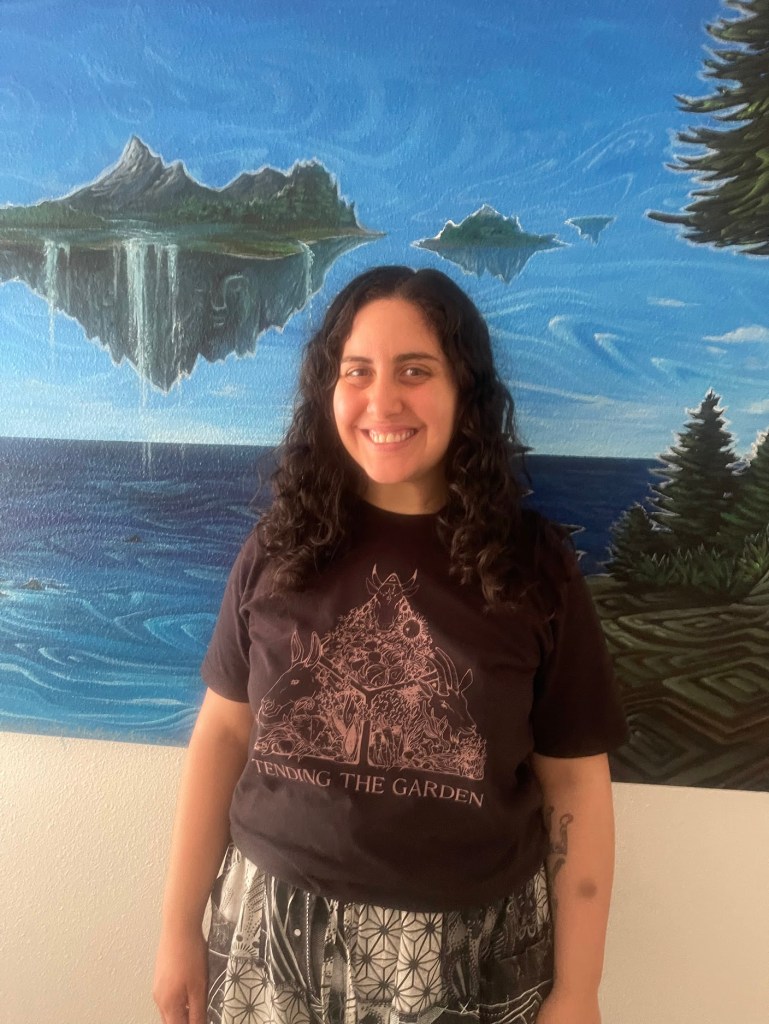
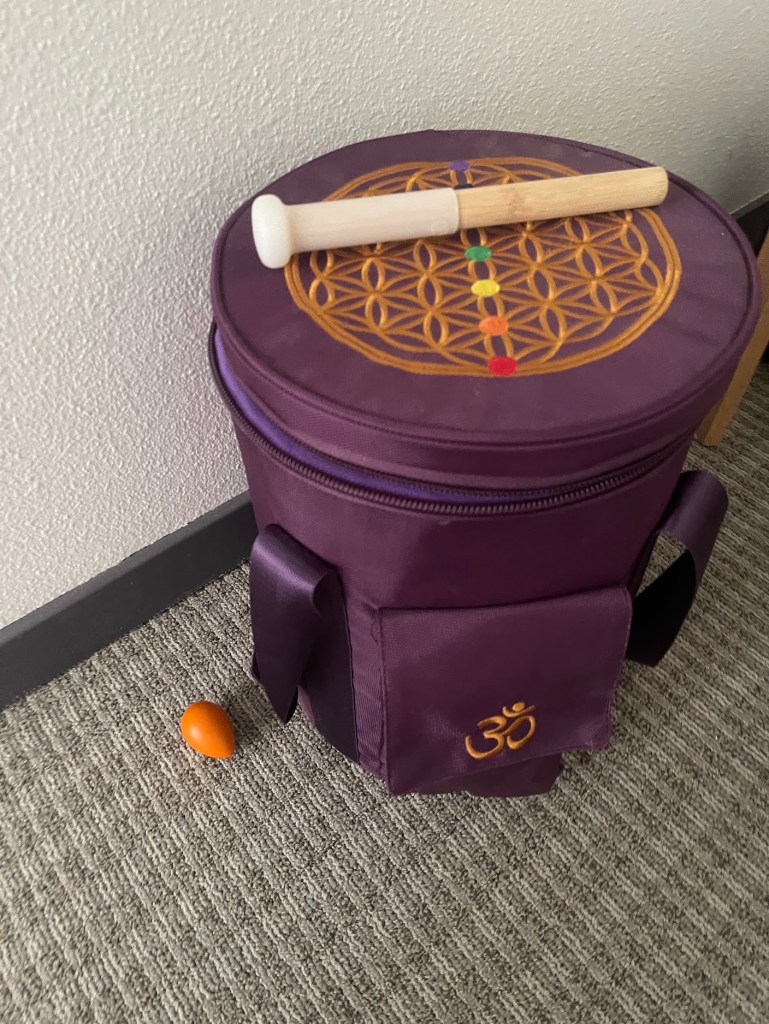
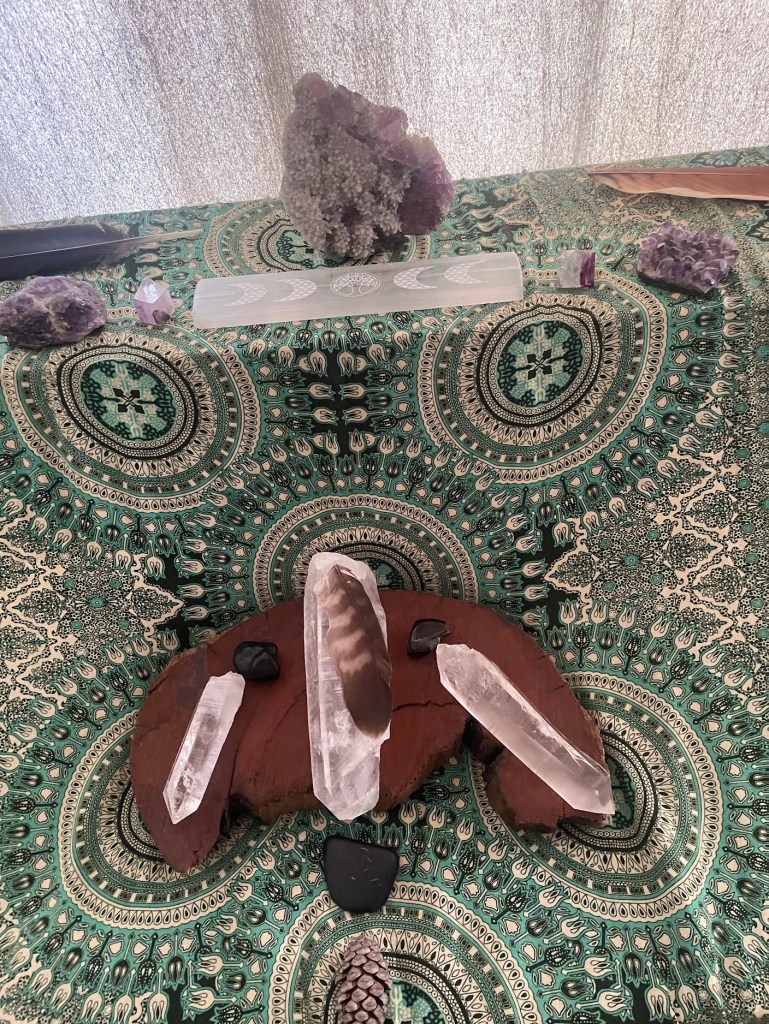

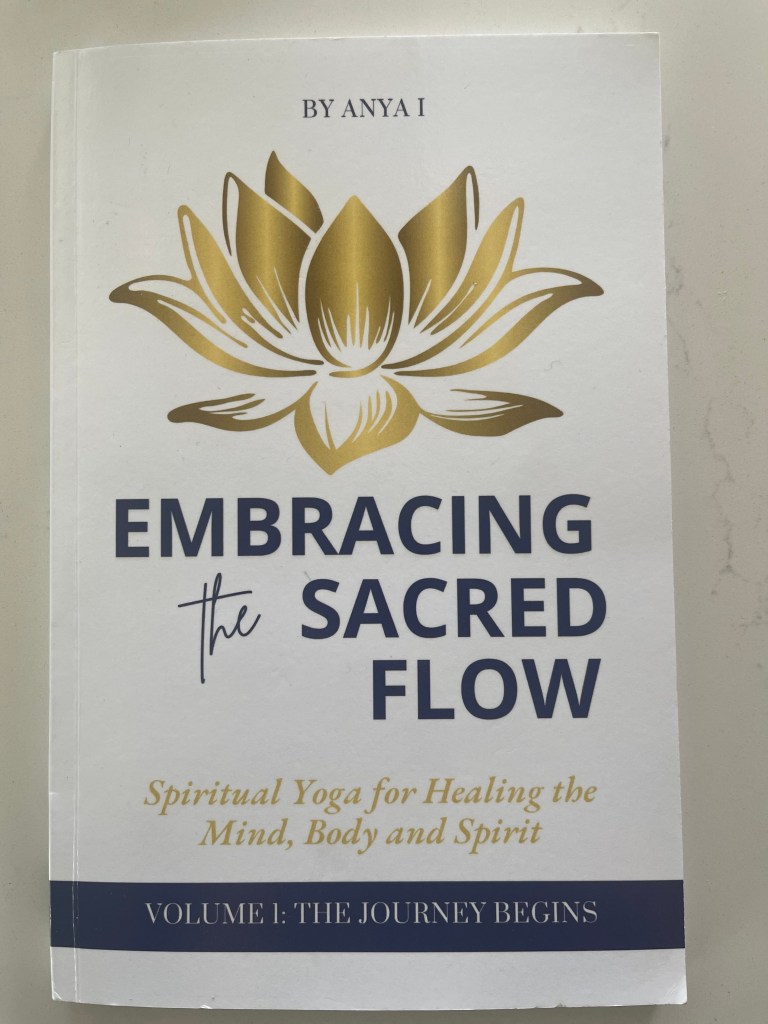

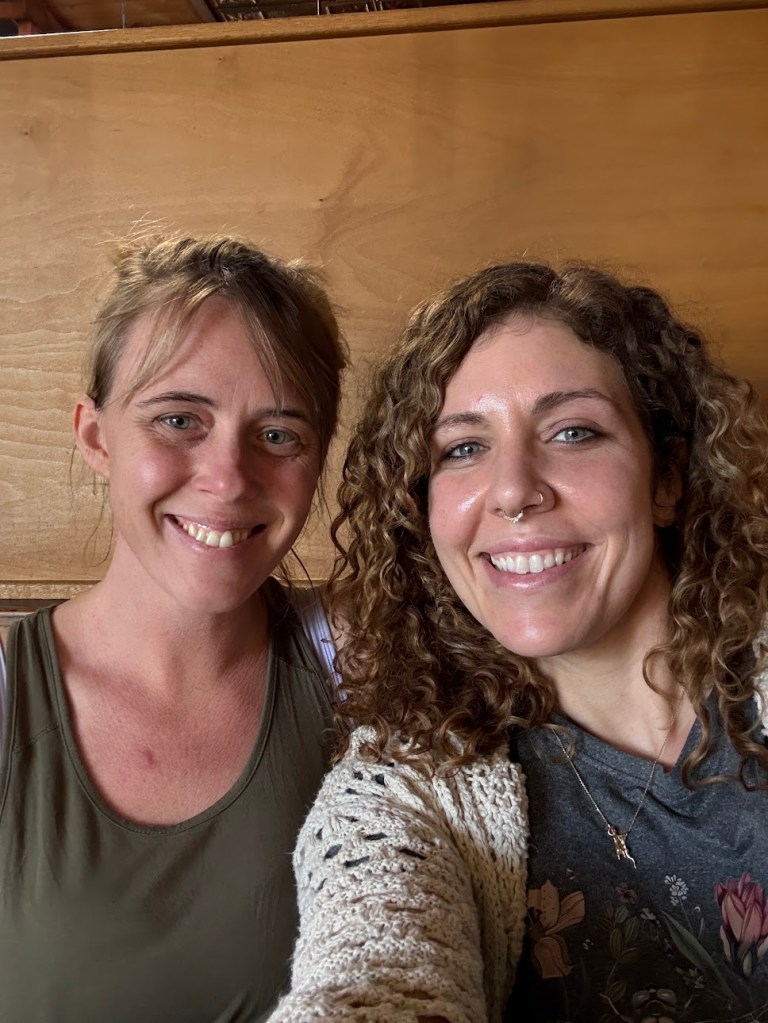

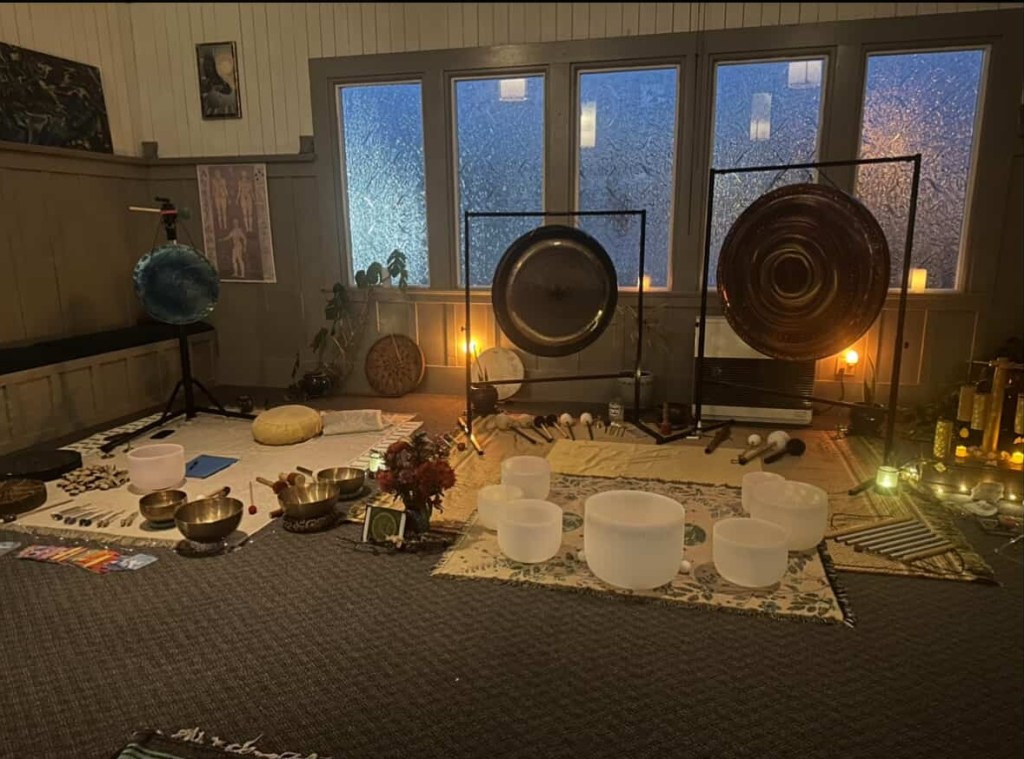
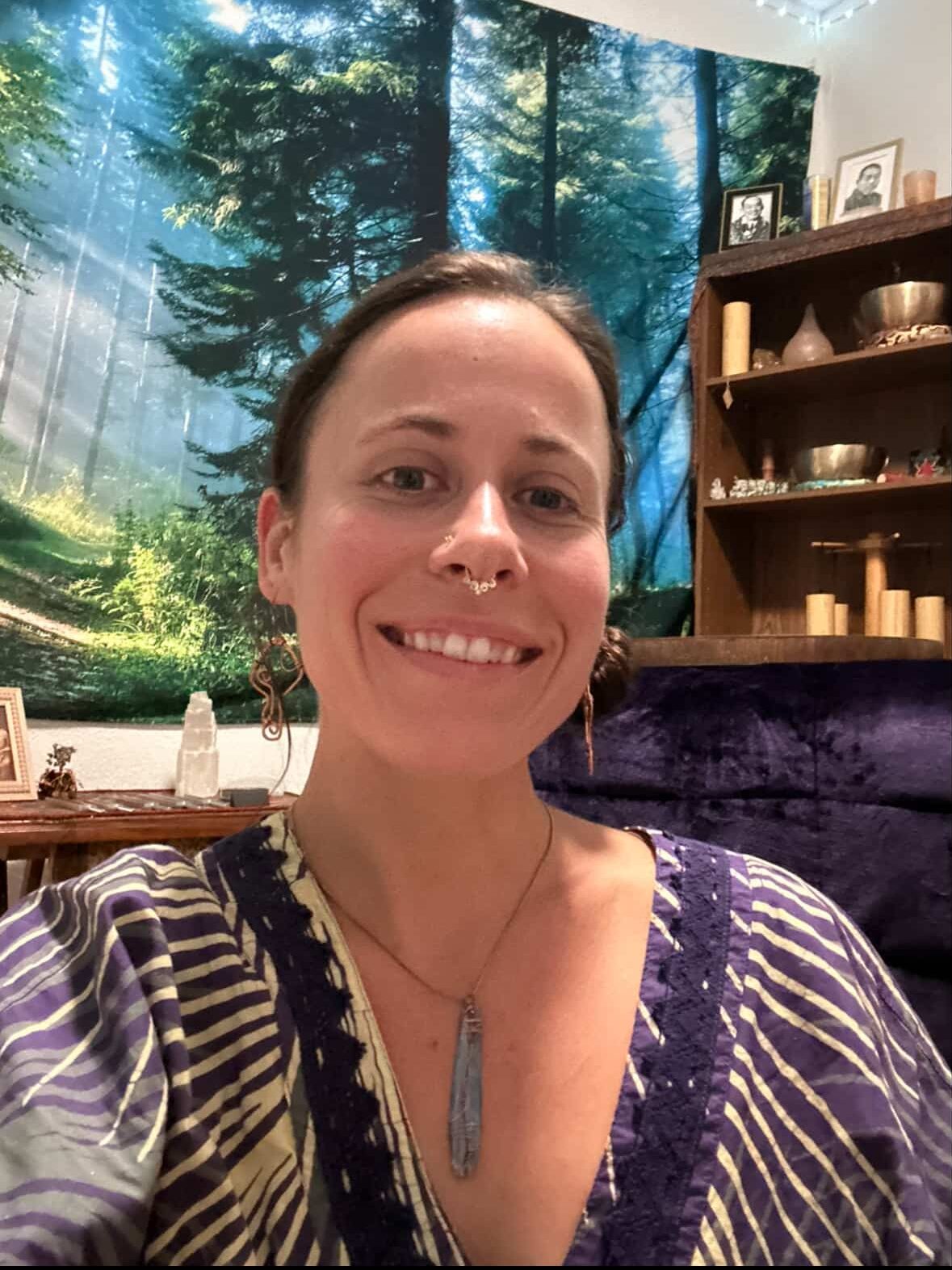


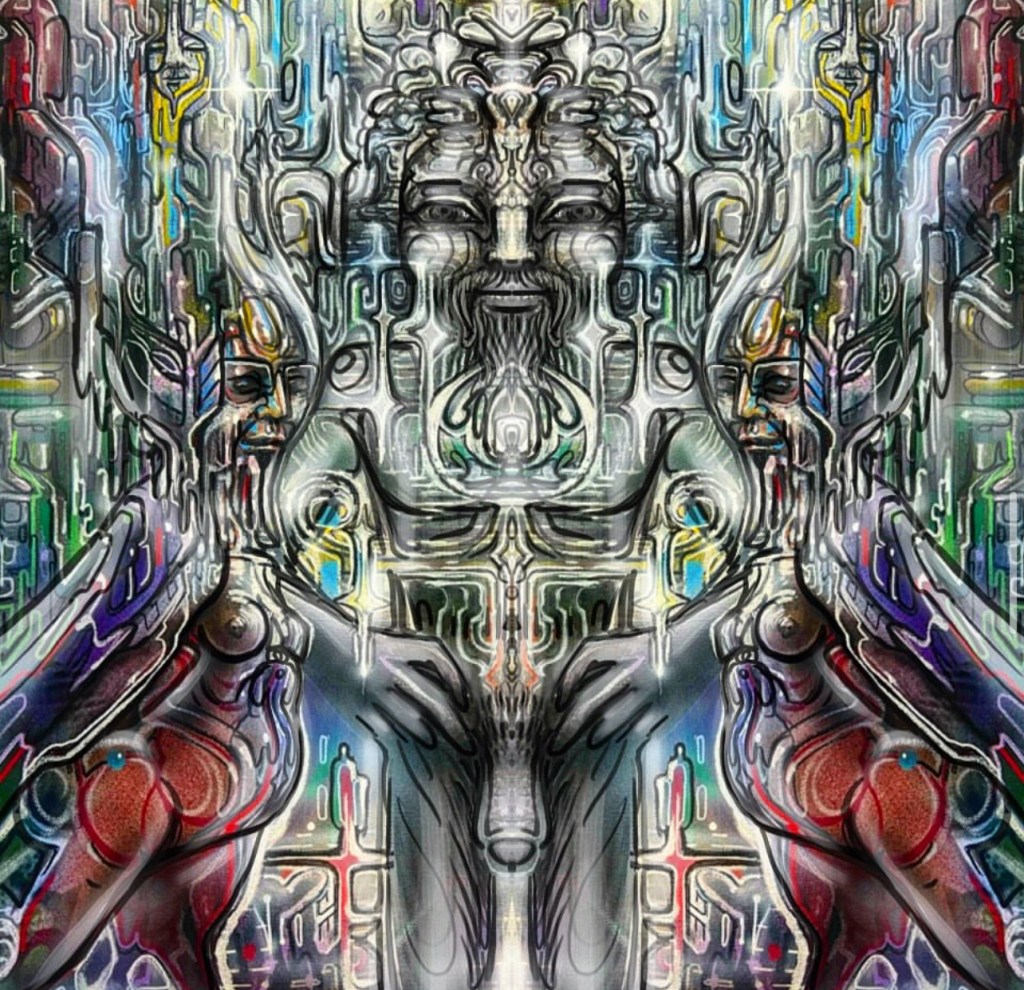
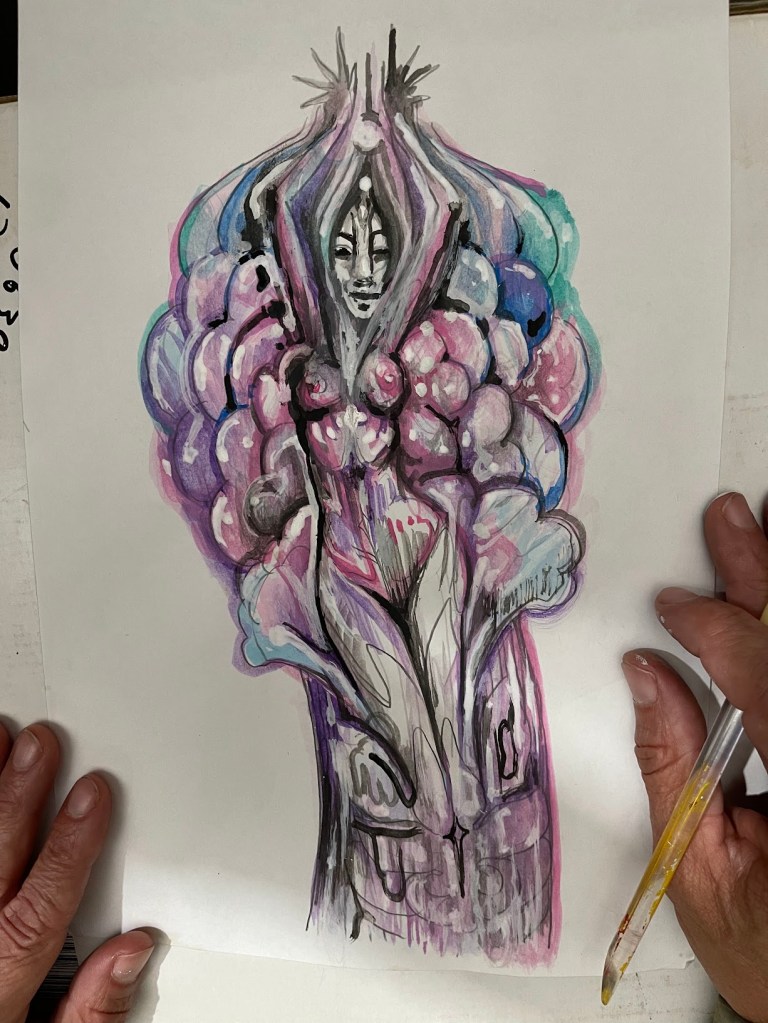

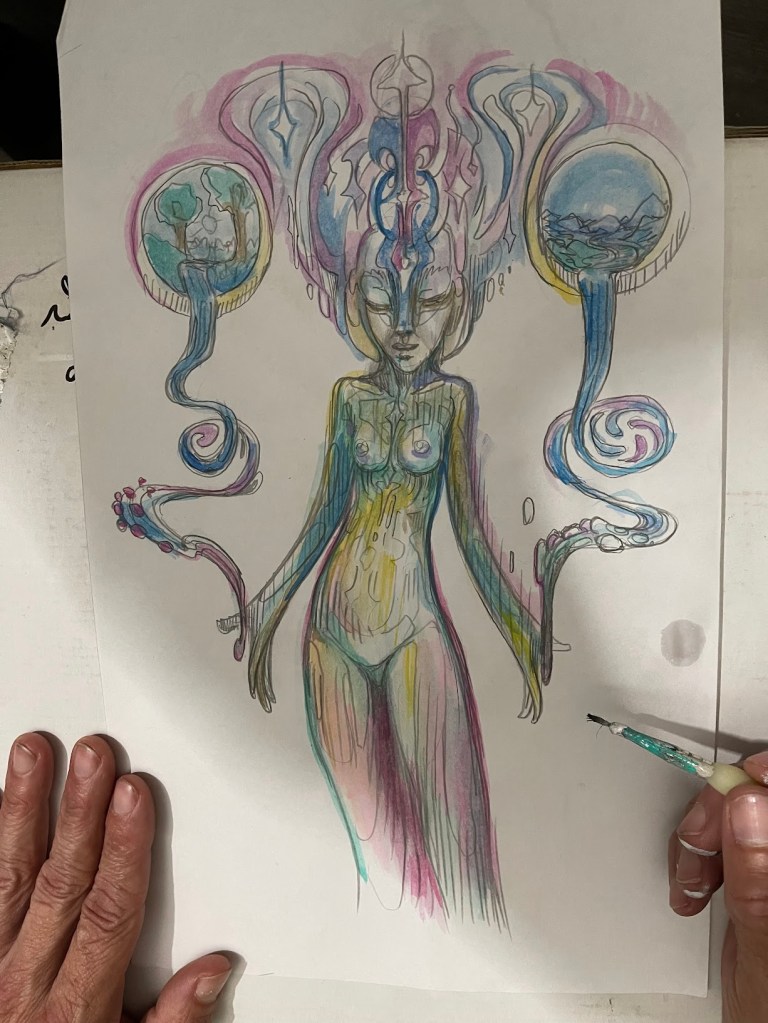
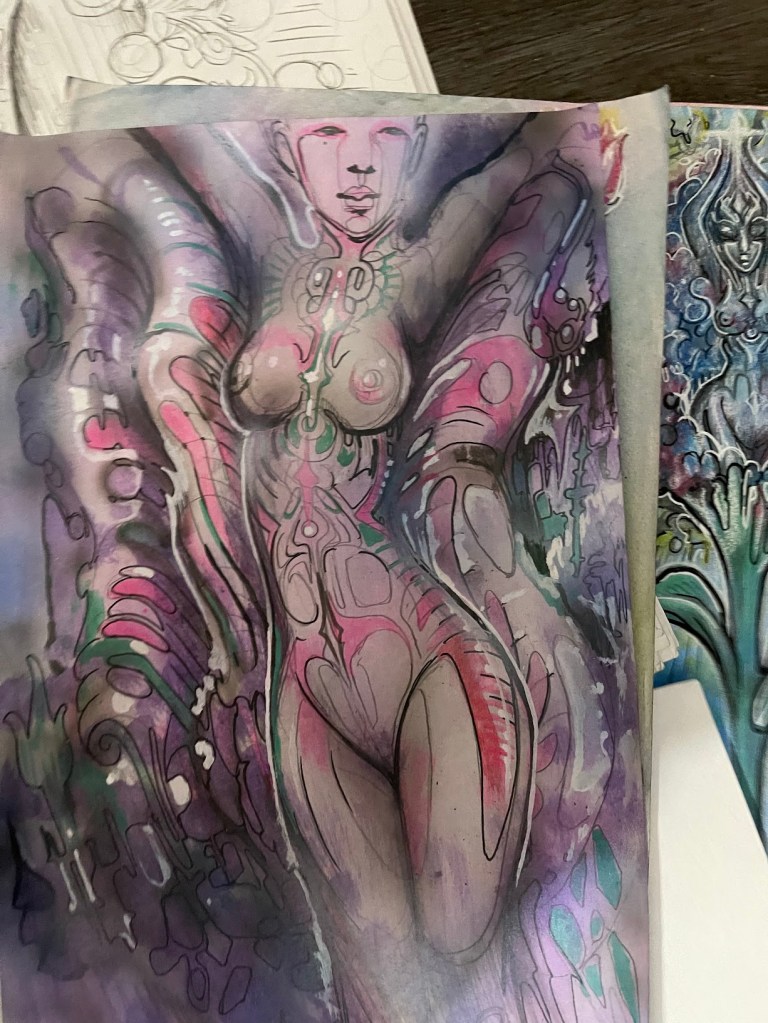

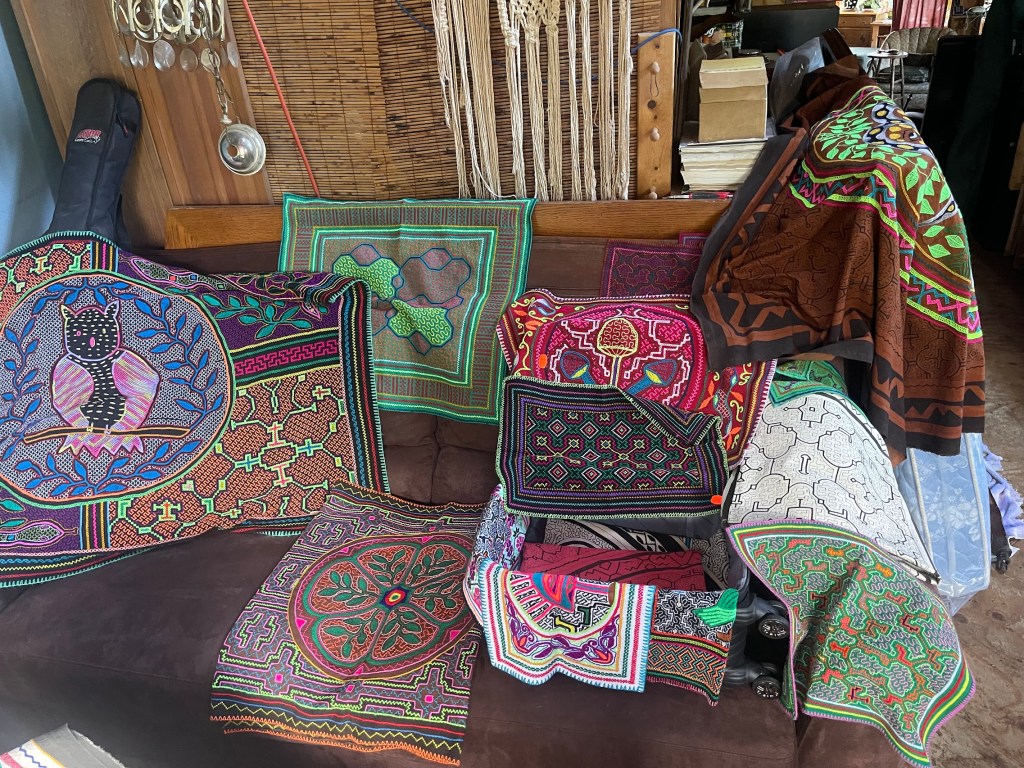


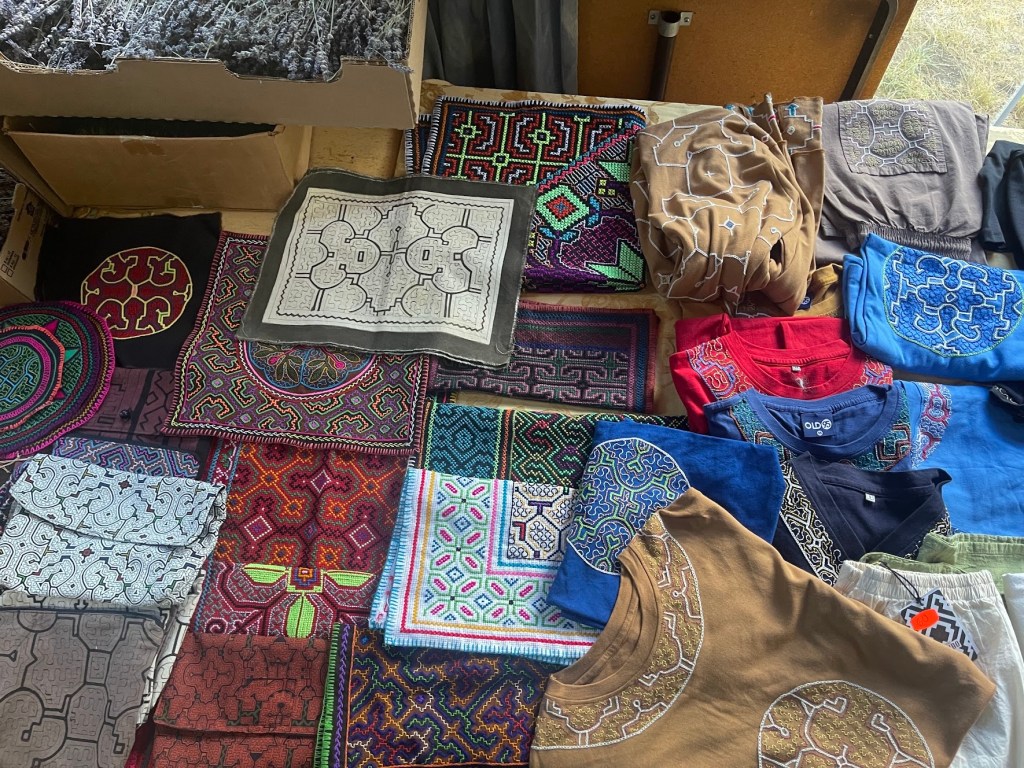


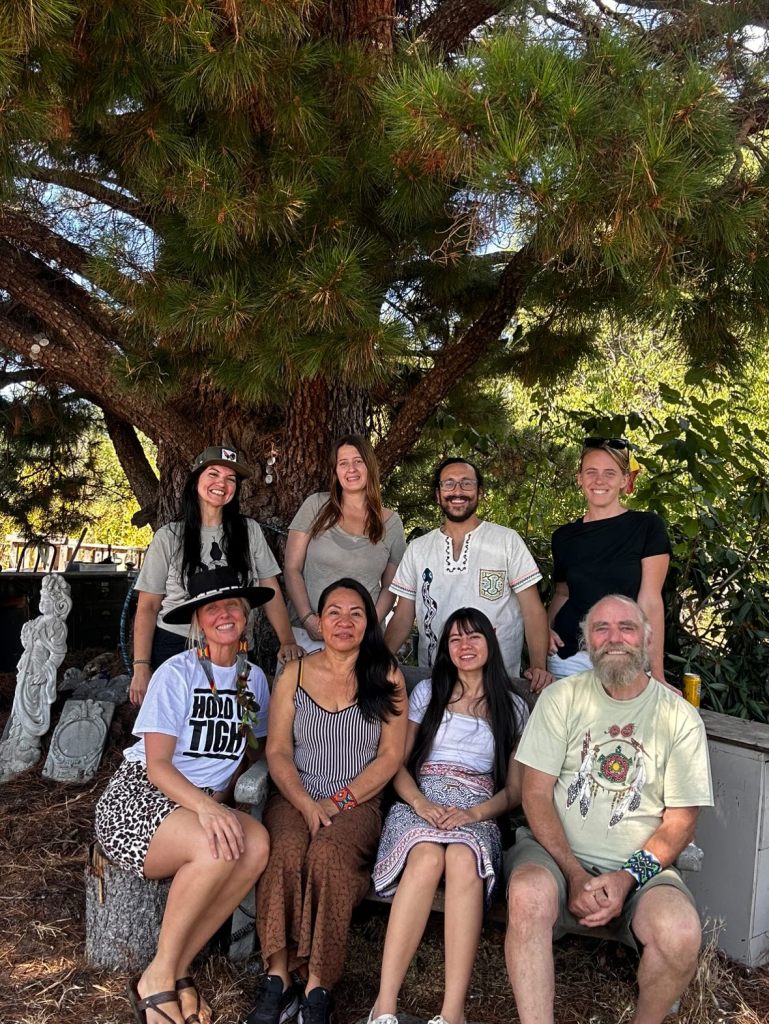

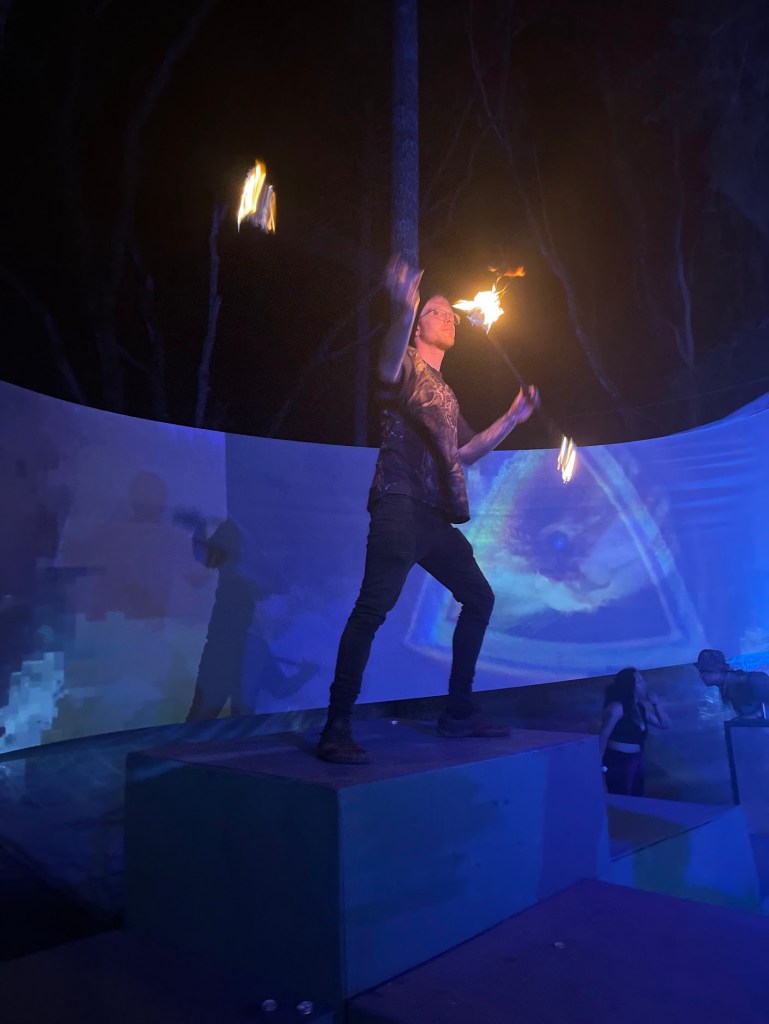


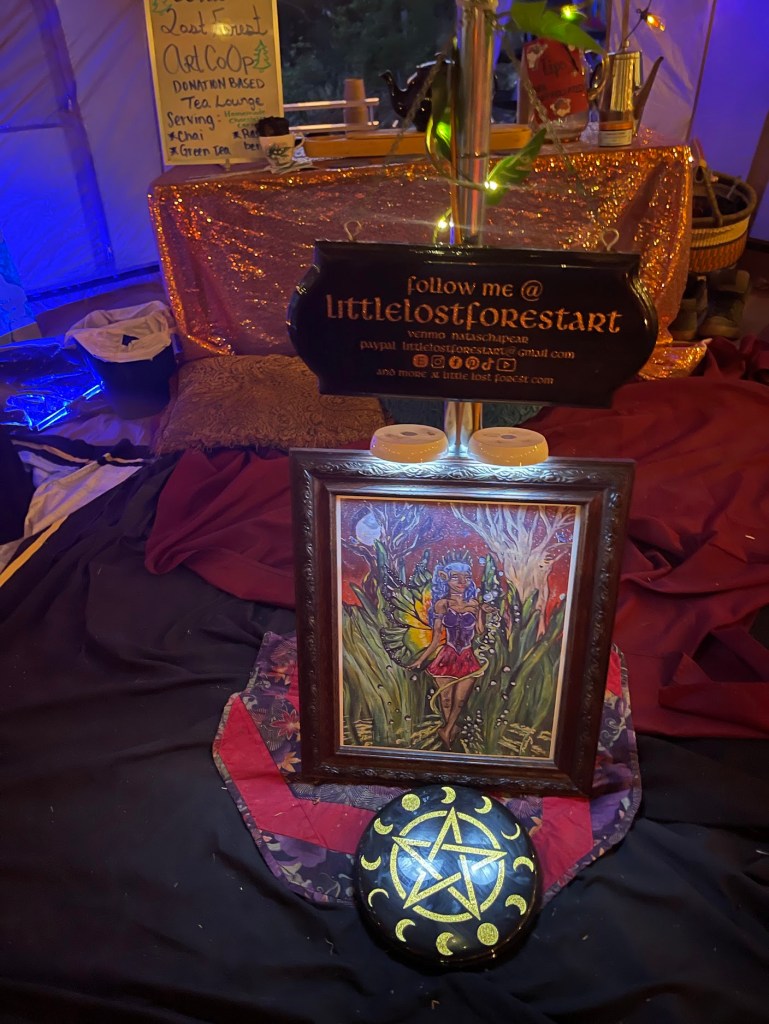
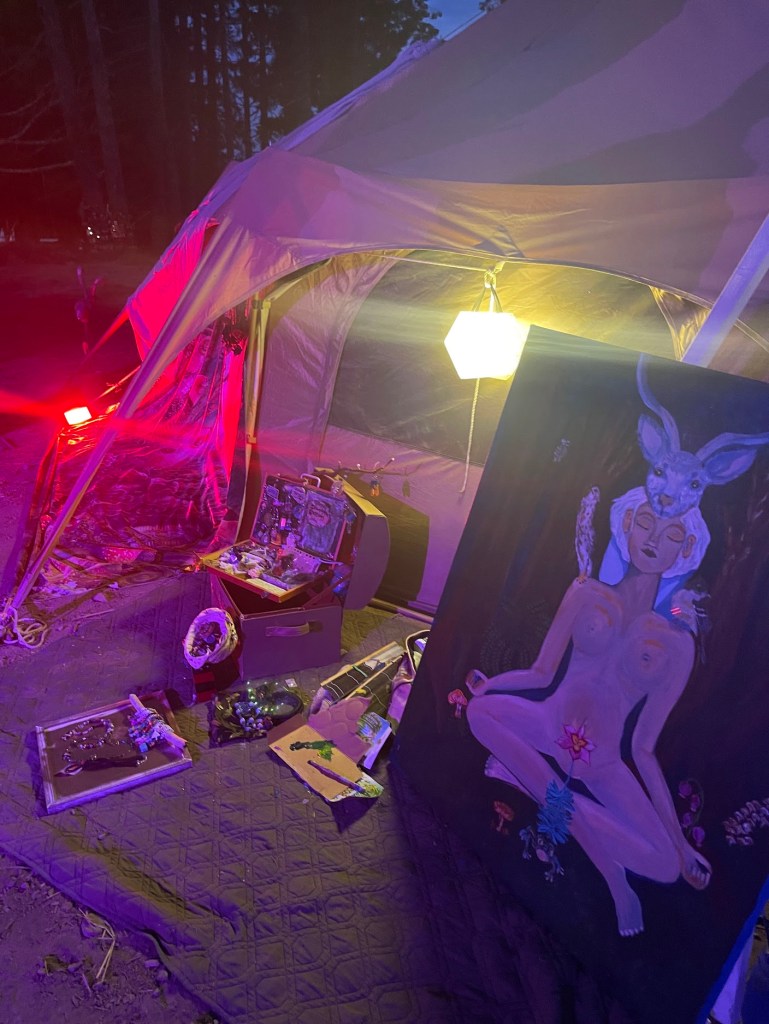


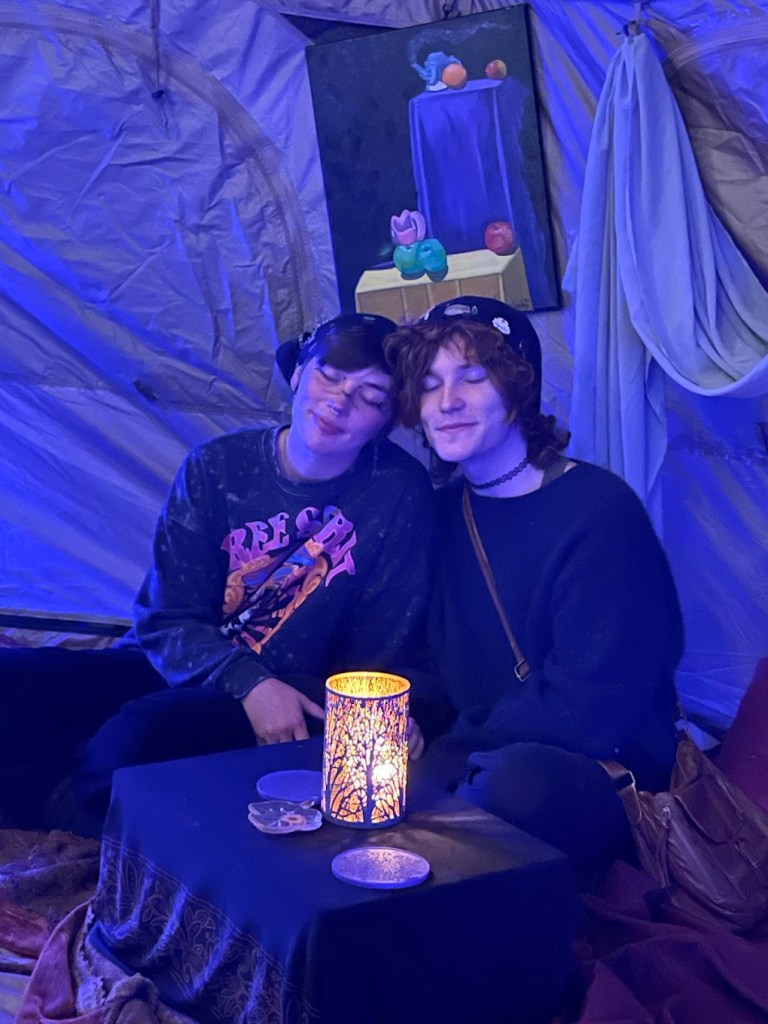


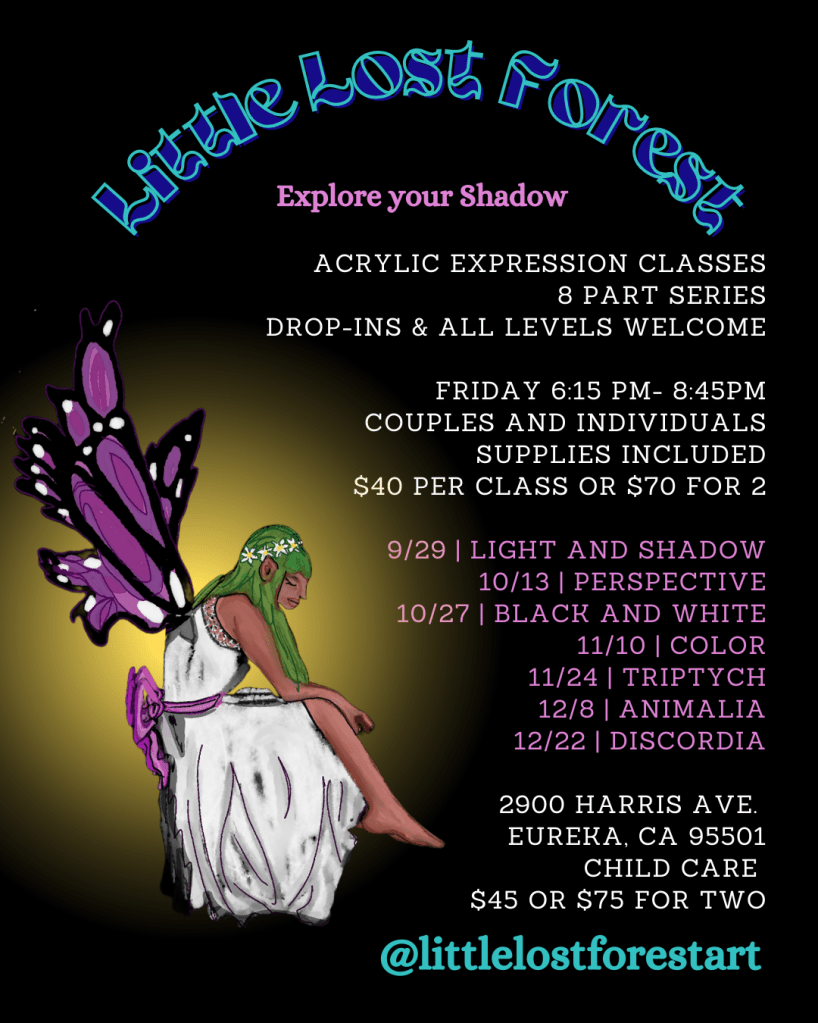


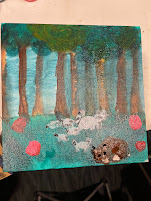


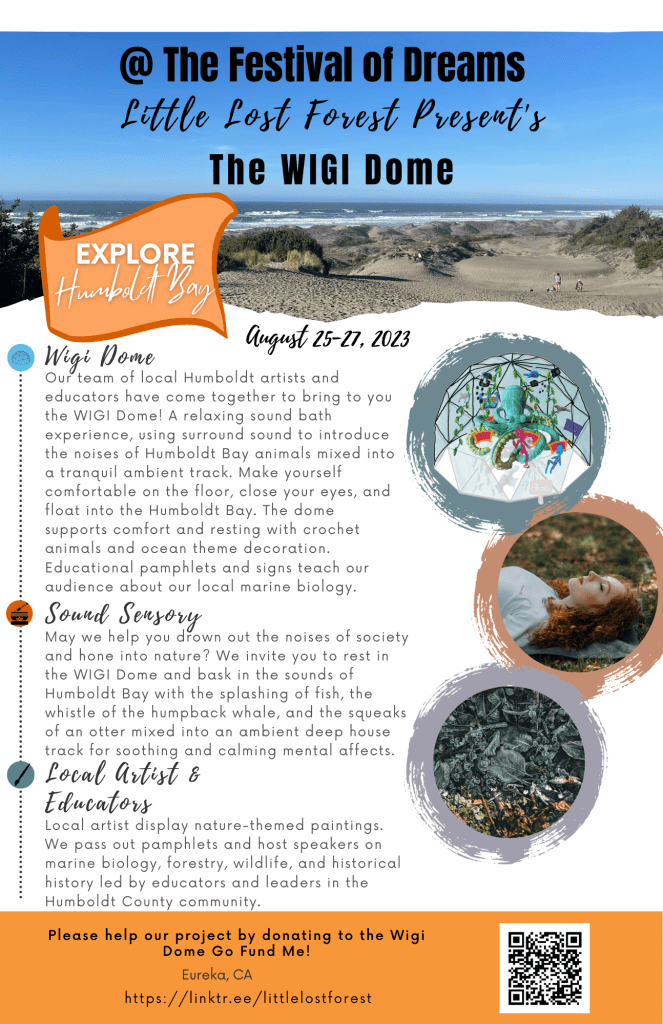
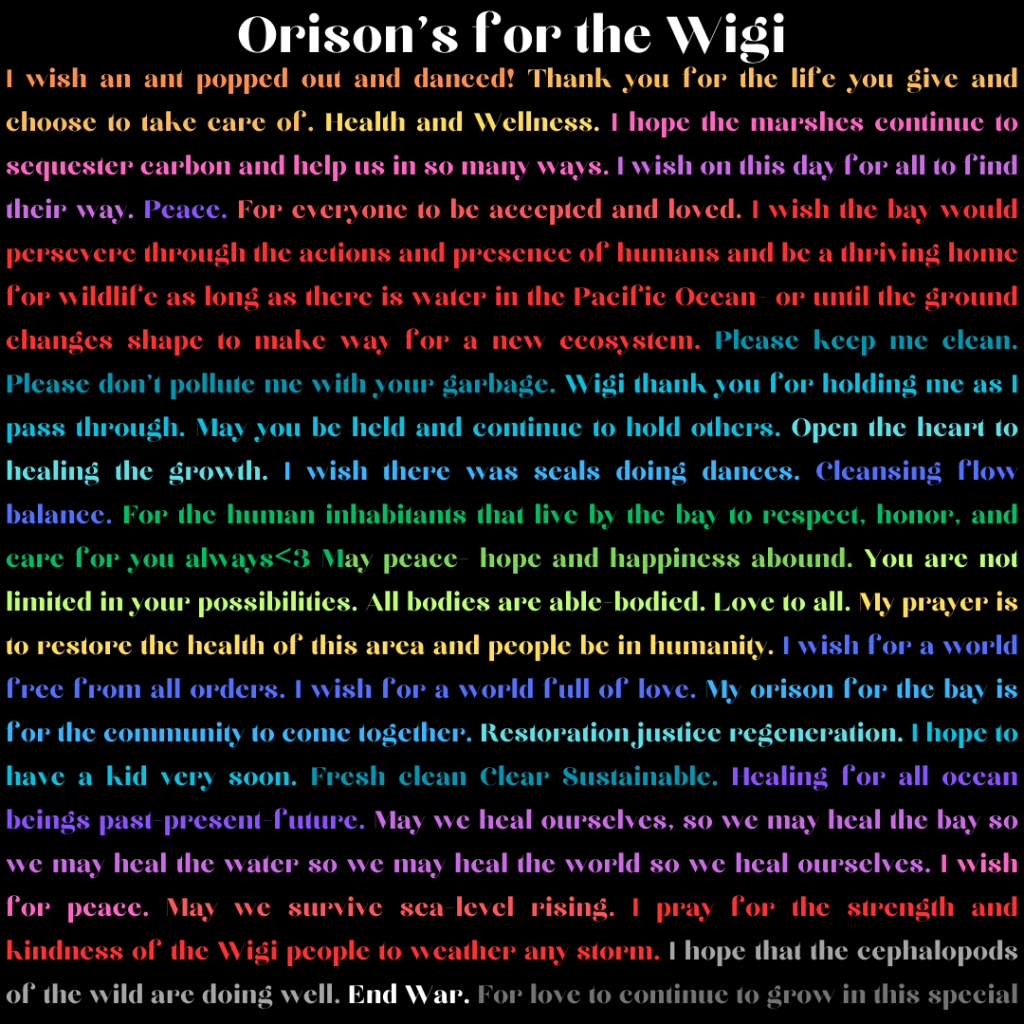
 Little Lost Forest