March 18th 2026- I met up with Andia in Arcata, CA at her studio for an Energy Healing. I had a wonderful experience. I’ll post my experience below along with my intentions! Here is Andia’s interview about her intuitive energy-healing practice, Teachings of the Earth.
Natascha: All right, thank you for tuning in to the little Lost Forest blog. Today I’m sitting here with Andrea in her studio in Arcata. I just had a healing session. This is my first session of this kind. Andia, how are you doing today?
Andia: I’m good. How are you?
Natascha: I’m great. Thank you so much for giving me this offering. What brought you to ask me to come here today?
Andia: Well, I know we talked a long time ago about doing an energy healing session, and I needed to get my window fixed because it was leaking. I’m just getting back into energy healing and wanting to lean into that more, build more clientele, and just practice more. You’re definitely one of the first people I thought of because you’re one of my good friends, and also because we had talked about that. I just wanted to circle back and share this with you.
Natascha: I had a really amazing experience, which I’ll share in the blog post after the interview. What is energy healing?
Andia: Energy healing is. It’s, I would explain it like we all have an energetic body. There is energy that exists, you know, like there’s a type of energy healing called Reiki or that there’s Qi and there’s different things that we call this energy. And it’s a healing frequency that we’re all connected to. Anyone could have the ability to channel it. It’s like setting the intention for this energy to facilitate healing and cleansing, stagnant energy, transmuting the energy into whatever we want to create, into whatever healing we’re calling in. And basically, I would say it’s when a person has received attunements to be able to channel energy healing, they are able to channel natural healing energy that exists through them. They’re just a channel, you know, they’re not exactly doing anything. They’re channeling it. But the energy is what’s coming through, and it’s a healing energy that knows where to go and just exists in this reality.
Natascha: Where is that energy source from?
Andia: I think it’s just the existence, like I personally believe in a spirit world. I believe we’re in the physical realm and that a spirit world exists simultaneously with us. And I believe that energy healing is coming from there.
Natascha: What keeps the positive energy and not the negative energy?
Andia: It’s all intention. It’s like every time you give energy healing, you set the space before. I always ground myself to the earth, cleanse my energy of what no longer serves me, what I don’t want to be sharing or transmuting, just letting that go. And then I always put a bubble of protection of energetic light around me. When I’m going into channel the energy healing for someone– First I talk with them, and check with them, what their intentions are, and what they want to get out of it. Then I can set intentions. And for me, I set, you know, positive, loving, healing intentions and use that energy in a good way, and then also go off what the person says about what their intentions are and calling that in as well.
Natascha: Super cool. What brought you to this kind of healing?
Andia: It was like 11 years ago. It was just a deep calling for me. It’s really interesting because I, I don’t know, it’s like that kind of feeling, like I kept going to festivals and transformational festivals and just finding different healers. And I kept connecting to different energy healers.
And it was this, really deep calling, like, I might as well not exist if I don’t become a healer.
It was just so strong. I need to do this, and also, just my family lineage on my mom’s side comes from healers, and my grandpa did energy work, like in his older years, and just different ancestors of mine on that side have. So I felt very deeply connected to it because, I mean, I was taught to meditate and do energy. I received energy healing and was taught to meditate when I was little. And so yeah, about 11 years ago, I don’t know what year that would be, 2015, I really felt called to that. And then someone gave me my first energy healing session. And I just remember I felt this blockage or this weird energy in my left shoulder while they were doing it. And at the end I was asking them what their experience was, without telling them what mine was.
Andia: And they were saying, um, yeah, you know, everything was really good, except there was this blockage in your left shoulder and I was just like, whoa, like, so mind blown because I felt that. And then at that time, I started leaning into learning how to receive energy, which brought me to Reiki initially. I got my first attunement from someone. And then I was trying to find someone to teach me my second attunement. And I met this woman, Victoria Luna, whom I wanted to get another attunement from. And she was like, ” Oh, actually, I meditated on it, and I wanted to take you from your first attunement all the way through your Reiki mastership. So she taught me everything that I know, but she did an interesting way because she taught me traditional Usui Reiki, but she also taught me to really lean into my intuition and just do it in a different way.
And now I no longer practice Reiki because for me, it’s a more intuitive practice— that’s deeply connected with the earth, that’s what I do now.
Natascha: If you don’t mind me asking, what is your lineage heritage?
Andia: Like my ethnicity.
Natascha: The culture that your family came from.
Andia: On my mom’s side, it’s, it’s interesting. They’re all from Mexico, but a lot of them came from Europe before that. Then they lived for hundreds and hundreds of years in Mexico. So they are blond-haired, blue-eyed Mexicans. So I have a lot of French, Italian, German and Polish. And then, I do have some indigenous Mexican in me, indigenous from Mexico. Then on my dad’s side, I’m Ashkenazi Jewish. So it’s 50% of my lineage. Yeah.
Natascha: It’s so interesting. I do not come from a lineage of healers. I come from a lineage of war vets and journalists. So that’s why I was just interested in where they draw their form of healing from culturally. That’s beautiful, thank you for sharing. Anything else that you want to share? Maybe, how could people find you if they’re interested in a session?
Natascha: I’ll tag that. And after a session, what can somebody expect to come out of it with?
Andia: I would say it depends on what your intentions are, but most of the time I find people are very much relaxed, and that a lot of processing is going to continue happening. So I always tell people, make sure you rest and drink a lot of water. But I think what you come out of it really depends on your intentions. Like, obviously, people are coming for healing. So I would say like that continues to unfold and things continue to deepen, but it just really for specifics, I think it depends where you put your energy into.
Natascha: Awesome. Well, thank you so much for your time.
Andia: Thank you.
Teachings of the Earth gave me a two-hour energy-healing session. It was my first time, and I received incredible benefits from it. I set clear intentions and spoke them aloud. While I was on the table, I could feel where the energy was being exchanged as she moved around my body. There was no doubt that energy is a quantifiable source and that the practitioner could channel it. Toward the middle of the session, I felt myself wanting to transcend, lifting inches beyond my physical realm. I had thoughts of my first love, of giving birth, and of my father’s influence on me. After the session, I felt relaxed and rejuvenated. We discussed my experience, and she shared that much of the healing energy had been focused on the womb. We also talked about how the energy process works. Afterwards, I rested and drank lots of water. Thank you so much for this experience, and I can’t wait to do it again!
My Intentions:
Make Room to become the author and writer I always dreamed of.
Secure a positive dynamic with my husband.
Be an uplifting and child-first mom
Not to offer unsolicited advice, but to hold boundaries and be mindful of community and world struggles.
I was invited to an Imbolc ceremony last weekend. Imbolc is the midpoint between the winter and the spring solstice. It is associated with the Celtic goddess Brigid. This is a time when we should come together to abolish darkness and share light. Cleansing our hearts of what doesn’t benefit us and considering which seeds we want to plant in the spring. When we move with intention, we can take this time to consider what we want to manifest in our lives before calling it in. This is a time to finish reflections on past lessons and appreciate the people who stick by us, who appreciate and love us.
This is a call on the four directions. Welcoming the elementals into the circle in a time of darkness, calling for resistance, change, and guidance.
Call of the Four Directions
We gather at the threshold of winter and spring, in the quiet moment where the soil stirs beneath frost. Imbolc hums softly now— a promise of the light to come and green growth
not yet visible, but undeniably there.
We call the Four Directions, The elements within us and outside the forces that remind us who we are To rise, again, and again, above fear, above silence, above tyranny of spirit.
It’s the elements that cause change but always foster internal growth.
May this circle be a place of remembering— our resilience, our community, and our sacred power.
Spirits of the East, Guardians of Air, we welcome you.
Breath of dawn and birdsong, you arrive like the first crack of light after a long, unyielding night. You are the wind that carries seeds across frozen fields, the idea that sparks before action, the thought that refuses to be caged.
We honor the Air, of new beginnings and sharpened intellect, of clear vision and truth spoken aloud. Teach us the resilience of the raven and the crow, wise messengers who adapt, remember, and endure.
Move through us like pollen on the breeze, stirring dormant dreams, lifting us above imposed limits, reminding us that thought itself is an act of freedom.
As the stars shift and the days grow longer, may we listen to the whispers of the cosmos— That change is already in motion.
Spirits of the East, be welcome.
Spirits of the South, Guardians of Fire, we welcome you.
Flame of hearth and heartbeat, You are the returning warmth beneath the snow, The spark Imbolc hides in candlelight and in Brigid’s forge.
You are passion reclaimed— not solitary flame, but shared warmth. The courage to stand is found shoulder to shoulder, the courage to act in voices raised together, the courage to transform in community, refusing to freeze.
We honor the fire of people gathering in the cold— kitchens, streets, homes, and hearts— tending one another when systems fail.
This is the fire burning across this land now, not given by the government, not extinguished by power, but carried by the people
Teach us the power of the stag and the phoenix, symbols of vitality, rebirth, and fierce presence. Burn away what was imposed upon us— fear, control, smallness— and temper us instead into something true.
Like the sun fusing elements in distant stars, remind us that creation is born of heat and pressure, And that transformation is sacred.
Spirits of the South, be welcome.
Spirits of the West, Guardians of Water, we welcome you.
Tide, rain, river, and tears You carry us into the deep— where memory is stored, and truth awaits, passed down by our ancestors.
Yet here we meet you with waters warming too quickly, The currents altered, The silence grows where songs once traveled for miles. You are the grief of the oceans and the endurance still pulsing beneath it.
We call now upon the ancestral waters, and upon the whales, keepers of ancient songs, migratory wisdom older than nations, voices that have taught this planet how to remember itself.
Their songs are thinning. Their paths are breaking. Extinction depleting.
Teach us how to listen again. Teach us how to grieve without turning away, to feel without drowning, to mourn without surrendering
May the wisdom of the whales move through us— slow, vast, and communal— reminding us that survival has always been collective, that life endures through relationships,
not domination.
We ask the waters to carry our vow: to resist forgetting, to fight erasure, To live once again with the Earth, bound with care—
and to offer that same care
to every human life entwined with our own.
Spirits of the West, Waters of Memory and Life, be welcome.
Spirits of the North, Guardians of Earth, we welcome you.
Stone, root, bone, and soil, You are the deep memory of the land, the quiet strength beneath winter’s stillness. You teach us that rest is not weakness,
and endurance is not loud,
but strengthened by return—
by lives folded back into the Earth,
becoming ground.
We honor the wisdom of the earth the patience of mountains, The resilience of evergreens and moss that thrive in shadow and cold.
Teach us the grounding of the bear and the tortoise, keepers of ancient knowing, Anchor us in our bodies, in our boundaries, in the unshakeable truth of who we are.
As planets turn and time stretches vast and slow, remind us that liberation is not always swift— but it is inevitable.
Spirits of the North, be welcome.
Air, Fire, Water, Earth— within us, around us, and beyond us. At Imbolc’s threshold, We rise from the winter
May we walk forward inspired, act with passion, trust our inner tides, and stand rooted in our power.
The circle is cast. The path is opening. We remember who we are.
On November twentieth, around nine in the morning, Natascha and her family friend, Sam P, met with Satya at Ramone’s Bakery and Coffee in Eureka. Their conversation became a deep dive into Satya’s history in the healing arts and the many ways she serves the community as a facilitator of sound baths, microdose offerings, yoga, reiki, and tuning fork sessions. Satya has brought peace of mind to many by offering a safe space to release, recover, nurture, and learn how to move through life’s challenges with greater ease.
As we enter the winter season, we invite you to explore the power of sound healing and discover how giving this practice a chance can enhance your life in the most positive way.
Natascha: Good morning Satya. Thank you so much for joining me today. At Little Lost Forest we’re always honored to highlight local healers, artists and visionaries. And today we’re in for a special treat. Humboldt County sound healing artist Satya Earth, founder of Satya Healing, is here to share her journey, her craft and the heart centered intention behind her work. I first discovered Satya during one of her sound healings and mushroom microdose sits. Over the course of about 90 minutes, a small mushroom microdose, gentle yoga and closed eyes opened the door to a vivid inner landscape. The soundscape she and her collaborators created carried me from the depths of the ocean to a fairy lantern forest, and eventually into the far reaches of space. The magic she facilitates comes not only from the instruments she uses, but from a deep well of knowledge, intuition, and care. Today we dive into that magic, its origins, its purpose, and the person behind it. Can you tell us a little bit about yourself?
Satya:Thank you for having me here. It’s really great to see you. A little bit about myself. I’m a mama of two little ones. They are my whole world and have been a driving force for my evolution in the landscape of sound healing, energy work and working with medicine. My background comes from psychology. I majored in psychology and got my bachelor’s in 2014, and from there I decided to branch out and study different forms of holistic healing. I studied yoga and herbalism, energy work, and sound healing, and have now branched out into the realm of working with psilocybin.
Natascha: Yay! Thank you for sharing. When did your journey with sound healing begin?
Satya: I attended my first sound bath with Jen Madrone back in 2017, and that was an initiation into the world of sound healing and experiencing. Noticing where I was in my life at that time.
Sound healing can stir up a lot of things for us, especially if we’re just beginning the journey. Throughout the years, I’ve gathered tools to support integrating the experiences and emotions that arise when receiving sound healing. This has helped to make it easier to understand and navigate the things that come up. It can really bring up a lot of stuff. Like old stories and thought patterns. Bringing them forward to be acknowledged and felt. It was a beautiful introduction to getting to know myself. The stories that I hold and how to how to work with them and how to transform them. In 2021 was when I bought my first gong and that was inspired through the birth of my second daughter. I had a very challenging experience with postpartum depression. In a place of desperation to not return to pharmaceuticals, I searched online things that could help my nervous system and help with depression and anxiety. Sound healing was the first thing that popped up. I was reminded of my experiences with Jen and decided to take the leap to purchase my first gong.
Natascha: That’s beautiful. I really love how you worked against the postpartum and found natural ways to heal instead of falling into it. Did you have any mentors or influential teachers along the way?
Satya: Absolutely. My number one mentor, her name is Josie Bravo. I met her when I was when I was in a hospital. I had a really hard adolescence; childhood. She met me at some of the hardest times in my life. I’ve known her for 29 years now. She has been a guiding light and I wouldn’t be where I am today without her support.
Natascha: Wow.
Satya: She’s been a really big influence. Like a guardian angel for me along this path. My other mentors are Jen Madrone. She’s an incredible being, here in Humboldt County. I’ve studied Reiki II and my Master Reiki course with her. A couple other influential teachers are Eileen McKusick. She’s the woman that discovered tuning the human biofield. I love blending my own interpretation of her teachings into my sessions. I scan the field with a tuning fork and listen for different sounds and that resonate from the tuning forks to let me know where there is perhaps some stuck energy that can be brought into coherent energy. Another incredible teacher that I haven’t had the opportunity to learn from yet, but I’ve heard great things of his name is Mike Tamburo and he will be here in Humboldt County in March 2026.
Natascha: What will Mike be teaching you or working with you?
Satya: He’s a gong master. He’ll be doing three day long class for a few days. And we’ll be learning different techniques and styles of how to work with sacred healing instruments, mainly gongs.
Natascha: During your sessions, there’s usually other people in the room that are playing the instruments along with you or offering the mushroom micro-doses. Who do you choose to collaborate with for your sound healing sessions?
Satya: I just collaborated with Fallon Orr. We had a beautiful offering where we offered microdosing, yoga nidra and sound healing. It was a different space from the class that that you attended. More stillness and opportunity to reflect in that stillness. It was very supportive for rest.
I just received my certification as a psychedelic facilitator through Emerald Valley Institute. After sharing medicine in the community for nearly 4 years, I decided I wanted to learn more about the history, culture and varying approaches to holding ceremony in psychedelic spaces. Another person I have worked with is Michiah Tobin. She’s an acupuncturist based out of Fortuna. I love blending multiple modalities together for a transformative intentional experience.
Natascha: Well thank you. How do these sounds and frequencies impact your participants?
Satya: That’s a great question. Each person and how they experience sound is very unique. And each session is very unique. Some of the things that I have noticed participants experience would be emotional clearing and release. I’ve heard some really good feedback on how people will come into a session feeling highly stressed and overwhelmed with life and would leave with a new state of grounded clarity. The beautiful thing about sound healing is that it creates neural plasticity and neurogenesis. By approaching your session with an intention this offers us an opportunity to see, feel and think differently about the things that we’re experiencing in life. And like you said, when we’re in this space there are visuals, there’s feelings of floating. It can be a psychedelic experience without the medicine, with the things that we see and that we feel. It offers a place of deep rest for the nervous system.
Natascha: Absolutely. I definitely found a release for my anxiety when I go to your sound healings and I feel really well going back into the world, more prepared. Your vocal work is especially moving where you learn to sing? What language or tradition are you drawing from?
Satya: I’ve been singing since I was three. Song has been a part of my whole life. I was in choir for eight years, and I was in a band for a couple years. Interestingly, I always felt nervous. And to this day, I still feel some nerves before I sing. But, after I traveled to India back in 2014, I was studying yoga there and we learned a lot of mantras and Sanskrit prayers. It is in this place of prayer that the anxiety dissolves and my intention of sharing song expands. I sing in Sanskrit, and the songs that you’ve probably heard are called the beginning prayer, the ending prayer and the Anahata prayer.
Our voices are our most powerful instrument, and it’s my mission to continue sharing this instrument, along with these other instruments and empowering other people to come into a place of comfort in their own body and their voice. I encourage people when I’m singing, when the sounds are going; we can hum, we can sing too, and start to vocalize because that’s how we can move energy throughout our body.
Natascha: Yeah, that’s some of my favorite moments. I really enjoy your singing, and I like that you pushed me to sing and your participants to sing, because oftentimes I don’t use my voice. It does resonate with me, and it does bring something positive out. So thank you for doing that. What dreams and aspirations do you have for such a healing moving forward?
Satya: I love this question.
Natascha: What’s next?
Satya: Yes I am so excited about what’s next.
I am creating some packages to make these experiences more accessible. After going through my psychedelic facilitator training, I really want to work with marginalized communities. Whether that means I look into what it would be to become a nonprofit or I look into fiscal sponsorship. I really believe that this type of medicine is something that everybody needs.
Natascha: Cool. I can’t wait to see where you go with it. Was there anyone who inspired the evolution of your art or an event? Possibly.
Satya: Absolutely. I had some moments to reflect on this, and the evolution of my art truthfully, has come from a place of pain and suffering and knowing that these wounds can be transformed. And I’m speaking from a mother wound that without that experience and without those wounds, I wouldn’t be where I’m at today. Having a troubled relationship inspired me to ask: how can I best show up for myself and how can I best show up for my children and for my community? How can I create this space of safety and trust within myself and within my community?
I’ve been learning different communication styles, like compassionate communication, paraphrasing and reflecting. These are all practices that I’m in a space of learning right now and eager to implement into how I parent my children and how I speak to myself, how I speak to my community and to my clients, and I’m really encouraging all of us to become more curious about how are we communicating with ourselves? How are we communicating with our loved ones? Because this is where we can we can really come together and come together in a space of safety and trust.
Natascha: I think you’re really advocating for people that are struggling, that there’s a light on the end of the tunnel. As a mother, too, there’s a lot of stress in motherhood and seeing you blossom and bloom that shows that we don’t have to be the pain of our families, but that we could create our own positive walk of life and the way that you impact your community. It loudly speaks that you walk the walk that you’re not just talk. So thank you for doing all the all the work you do with us here in Humboldt. What are your thoughts on human consciousness?
Satya: Another fabulous question, Natascha. My thoughts on human consciousness; human consciousness to me, is a state of being. I come from a spiritual and perhaps Buddhist approach where I believe that all living sentient beings from our animals to the trees to the rocks, to the dirt, to the insects. We all have a consciousness. We are all here coexisting as one on this cell of Earth. And when we can come into that place of connection, we can really start to come together in this collective ecosystem.
Natascha: That’s beautiful. How does that deconstruct the ego when you come into a mindset of a universal consciousness?
Satya: Mmm, yeah. We’re definitely deconstructing the ego and perhaps deconstructing the hierarchy of humans being at the top and everything else being below us. I know that there is definitely some advancement in technology where we are now having the opportunity to communicate with our animal friends. And it is deconstructing how we view our existence and how we view the existence of other beings in this world. It’s really powerful. We can come into this from a wholehearted space, or we can, you know, use it for power. So it’s really up to the individual and how we approach this type of technology. Language is technology too. You know, it’s like these things are always advancing. And so it’s like, who is behind this and what are our intentions behind it? And it’s how we show up and how we reflect that into our circles and into our community. And that’s when we really have that opportunity again, to come together into this collective space of awareness, which is kind of linking to that state of consciousness, the consciousness and the awareness, how we show up, how we reflect, how we have awareness of our energy and how we impact the environment around us. I feel like I could go on forever.
Natascha: I love this, I just want to dig a little deeper into it. You mentioned animals briefly. Is there a connection between your sound healing and nature? Maybe you play your music outside, or you feel a deeper connection to the earth and to the animals when you perform sound healing?
Satya: Absolutely. I have a very deep connection with the elements and with nature. When I take my gong out and I play next to that maple tree and Cheatham Grove, I’m playing for that tree and I’m playing for the land. And I just imagine this time lapse of this tree living there and all the things that have surrounded it. And for me, I just, I want to be with that tree for that moment and play the sounds. And when I play my infinity disc, that sounds like the ocean, I’m like, man, this tree won’t ever have that opportunity to be by the ocean. So maybe I could bring the ocean to the tree.
Natascha: Cool and lastly, what are your beliefs or reflections on the afterlife?
Satya: Reflections on the afterlife. I do believe that we are reincarnated. I do believe in karma. I believe that the things that we’re experiencing in this life are perhaps a reflection of the life we’ve led before. I also go between this, you know, when we die, we go into the void. We go into emptiness. No one knows. And we have access to so much information that we can decide what we want to believe. But we truly just don’t ever know. So when I think about what the afterlife is, I like to consider a lot of things. But I also don’t have a concrete belief because nobody truly knows.
Natascha: Absolutely.Do you have any advice for someone that might be depressed, anxious, or struggling in their life? How to get out of that negative spiral?
Satya: Well, there are many approaches to helping ourselves through these stagnant, dark places. The first approach that I like to suggest is, depending on the severity of it, is having a counselor or a therapist. Somebody to offer an objective perspective, somebody who will support us in our stories that we share and perhaps guide us into healthier states of thinking. Also bringing in the element of what are we putting in and on our body. And that’s not just food, that’s not just cosmetics. That includes the things that we watch, that includes the people that we surround ourselves with. That includes supplements that we’re taking. So it’s really a whole approach when we start getting into this world of depression and anxiety. I mean, we can look at our gut microbiome that’s definitely linked to anxiety. Parasites are linked to anxiety. And then when we start to go in a little bit deeper outside of the the physical being of depression and anxiety, we can start to go into like the emotional body and the ethereal body, and that’s where we can bring in these alternative modalities to help us. That could be energy work, that could be sound healing and microdosing. But then again, drawing it back into the self, it’s really about our perspective, how we speak to ourself. So again, coming into that tug of war that we experience when we’re going into this place of depression and anxiety: The stories that we tell ourselves, how we talk to ourselves. And a lot of this is linked to how we were raised and how we were talked to and how we were taught to manage these things.
Satya: In my psychedelic facilitator training, we learned about this thing called the default mode network. And when we’re born, up until we’re about four, this network in our mind is very malleable. But around the age four, we are now learning to exist in the world through the way that we are talked to by our family members and the authority around us. And those pathways start to get very rigid. And so then we start existing in that story. So when we are working with psilocybin in larger doses, we have the opportunity to do what is called a reset dose, where the default mode network gets shut down. And this is where we have access to new pathways, new ways of thinking and feeling existing, perceiving and we want to be slow with this. Whenever we’re in this place of depression and anxiety, how long did it take us to get here? How long have we been in that place? And just know that there’s no one pill. There’s no one experience that’s going to shift things. This is a practice that we have to implement and be dedicated to daily. The most important facet of that is who are we surrounding ourselves with? Who is our support system, our community, the classes we attend, the people we talk to. These are all factors to consider when we’re starting to address these symptoms of depression and anxiety.
Natascha: Coming into the winter, is there are certain practices that you do seasonally; more winter style forms of healing?
Satya: When we come into the winter. I personally think about darkness. I think about going into a place of hibernation. I think about what is nature doing? And I do my best as a single mother, to slow down. Some practices that we can do is look at how we can slow down. How we can create spaciousness and just noticing when we are overdoing. When we are doing too much and just taking a moment to step back, reflect and say “hey, I need to cancel.”
Satya: One practice that I learned recently that’s been so helpful, is tuning into our breath and tuning into what it means to clear our energetic field. When we are starting to experience that tightness in the body, or we notice we’re getting really overwhelmed and feeling frantic. Come back into the breath. Breathe through the souls at the feet.
Satya: And as we’re exhaling, we’re releasing this energy out through the crown of the head. And this is the cycle. Breathing in through the feet, coming through the center of the body, breathing out through the crown. And as we continue this breath, we’re starting to think about, I’m breathing in calm and I am letting go of any tension. I’m letting go of any chaos that I’m holding in my belly, that I’m holding in my heart. I’m holding in my brain. I’m letting that go. I’m returning it to sender. I’m returning it to the universe. And I love this practice, especially for people who are highly sensitive or for highly empathic people. People who tend to absorb energies easily. This is an amazing breath practice, because then we get to tune into not only our breath and clearing our fields, but we’re starting to acknowledge what is mine and what is not mine. What am I holding on to? Maybe I’m holding on to something that I experienced yesterday, and now it’s time to let that go. And it’s time to bring in that clearing and that self-forgiveness, so that we can have a clear field and show up for our friends and our family in a more balanced state.
Natascha: As we move into the winter, sound healing offers a powerful way to calm the nervous system, reconnect with the heart, and bring clarity to the mind. Satya, thank you so much for your time and for sharing your wisdom with our Little Lost Forest community.
Satya: Thank you so much. I appreciate you. Thank you for calling me in and sharing these moments together. Blessings.
Natascha: This is Natascha with the Little Lost Forest blog. Today I will be interviewing Noelle Cox, a local Eureka legend who specializes in oil paints, gold leaf, and customized frames. Noel Cox showcased her exhibit Underneath the Surface at Morris Graves in January 2024. Noel takes a surreal and abstract approach to local animals. Fantasized creatures, glorified bugs, and self-portraits. In her sci-fi paintings, a dark humor lingers in the foreground as each piece is staged with class and elegance. It’s September 7th, around 5:00, and we’re sitting down together in her home studio.
Natascha: Hi, Noel. How are you doing today?
Noelle: I’m okay. I’m good. It’s good to have you.
Natascha: Thanks for having me.
Noelle: Thank you for having an interview with me.
Natascha: I was very excited all the way up to this point. So thank you so much for sitting with me.
How old were you when you started seeing yourself as an artist?
Noelle: Well, I think it was kind of gradual, but I think that I really got serious when I was about 16. I painted my first oil painting. Yeah, but I would draw, you know, I took it very seriously, actually. It was something I could do by myself that I could feel sacred about.
Natascha: And what was the oil painting of?
Noelle: It was kind of dark. It was a dead lady. With strings attached to it in the night sky.
Natascha: And how did it make you feel when you saw the finished piece?
Noelle: I wasn’t quite, you know, what do you call it? Satisfied with it. But when I look at it/ when I looked at it, I was like, wow, okay, This is kind of how I feel, you know?
Natascha: From what I understood, your father just passed.
Noelle: Yeah.
Natascha: I’d like to take a moment of silence in remembrance of him. What was his name?
Noelle: David Dinkfeld.
[Pause]
Natascha: I wanted to know, how has your father influenced your art?
Noelle: Yeah, that’s still something I’m trying to figure out. But I know that my dad was a very intense person, and he, you know, he had the sort of the mentality of that if your second place thats the first loser. And I was a swimmer before. He wanted me to win. Win, win.
Natascha: Yeah.
Noelle: Yeah. I think that when I pushed, you know, when I stepped back from that, because I had to. Because it was too much pressure. That was kind of a time when I retreated back into art. That was something that I could hold for myself. I would lock myself in my room and do art. I think.
Noelle Cox, Mr.Sadie
Natascha: Did you ever have any professional training?
Noelle: No, I mean. I went to; when I was seven, I went to watercolor classes that my dad took me to- my mom, my parents. I learned how to do a little bit of art. But no, I have- I tried to take a class in junior college but I’m so stubborn. I don’t want to be told how to paint, so.
Natascha: Wow. The work that you’re putting out looks like it has gone through many courses.
Noelle: Well, it takes a long time to do too. Yeah.
Natascha: How long did it take you to look at a finished piece of yours and think, this is good quality work? I’m really feeling proud of the standard of work I’m putting out.
Noelle: I think it’s more of a feeling that it gives me when I see it. But no work is really ever finished. I think mostly it’s about, for me: When I look at it, I’m just done with it. And it’s also combined with, that the image sort of disappears for me and then it doesn’t have anything else that I can add. Like disappears in the sense of not like not seeing it, but there’s nothing left.
Natascha: I love the way you phrased that. What are your favorite things to paint?
Noelle: Anything that means a lot to me. Yeah. The feeling it has to have some sort of meaning to me and something to say. Those are my favorite.
Natascha: You mentioned that you use oil. Can you expand on the mediums you use and where you source your mediums?
Noelle: I buy my oil paints from Blick and I get the Winsor and Newton. I mean, they’re not the greatest, but they’re affordable.
Natascha: Okay.
Noelle: I mean, it depends on which ones. There’s the higher end and then there’s the lower end, and I usually get the lower end.
Natascha: And then you have to use a thinner with it, correct?
Noelle: I just use the refined linseed oil.
Natascha: Interesting. Thank you. What events in your life have influenced your work as a painter?
Noelle: So many things. Being a mom, being a woman, you know, in this weird capitalistic, patriarchal culture that it seems like you can’t- it’s almost like we see ourselves as women through, like the patriarchal eye. And I think that it can be very confusing.Yeah, it’s bizarre.
Noelle Cox, I love you Zed
Natascha: Your gallery work is different than your commissioned work. Next to you is a commission of my dog Zed, who passed a year ago. While your gallery work really encompasses these fantasized creatures and the animals and bugs. How has becoming a commissioned artist impacted the way you paint?
Noelle Cox, The Fly on the Wall
Noelle: I think that what it does is it puts less- I think about myself less and I think about what other people want from me more. That’s the difference. My personal work is about my voice, about saying what I want to say. And then when you have the commission work, it’s- you’re trying to telepathically sort of connect with what another person wants out of your work, you know?
Natascha: Yeah, there’s definitely a connection there.
Natascha: What was the timeline and process like through the transition of painting for yourself and painting for others? When did you start opening yourself up to commission work?
Noelle: So that was when the pop market died. It’s not just one time. It was a gradual thing, but it happened pretty quickly.
Natascha: Yes.
Noelle: And. You know, my husband and I we grew pot and that was how we made a living. And that was how I had the time and the money to be able to do art. I think that once we lost the farm I was like, what? What am I going to do? You know what everybody says is like, well, I shouldn’t say what everybody says, but what a lot of people say is, do what you love and make money at that. And so I tried. And I don’t regret it at all. But art is a tricky thing to make money on. It’s, you know, and especially in an economy, I think the economy globally is having a rough time right now. And on top of that our area here in Humboldt is having an even worse time because of that. There’s not as much money.
Natascha: Agreed.
Noelle: Yeah.
Natascha: Has art played a healing role in your life?
Noelle: Oh, yeah. Oh, yeah. If I didn’t have it, I don’t know where I would be. It gives me stability and a voice. I would probably be an addict, honestly.
Natascha: Go art.
Noelle: Seriously, yeah. Because I’m so determined to do it and to keep doing it that I want to have the right state of mind for it. I don’t want to waste my life. I want to be able to do the best I can with what I have.
Natascha: I think you’re speaking loudly to this community. And a lot of people could gain a lot of inspiration just from the words that you’re saying now. Thank you.
I did have a chance to glance at your bio on the Morris grave site, and you mentioned that your move from SoCal to NorCal, was a culture shock that was both healing and dark. Would you say that your paintings now express your impression and self-expression of Humboldt?
Noelle: Oh, yeah. But I don’t think it’s like- I think it’s more subliminal. The culture here in Humboldt is, in my opinion, way better than down in Southern California. Southern California is very, you know, it’s about money and looks, itemizing your body and it’s very Capitalistic, cultural, patriarchal. I don’t know, it’s very destructive.
Natascha: Okay
Noelle Cox
Noelle: And up here, there’s more of- at least in the social ring that I was in, there’s more of an awareness of the goddess and more of the feminine- the feminine power, rather than down in Southern California. It’s more like you’re an object for making money and stuff, and there’s not really any power besides how you are sexualized or whatever that is. This place is a very healthy place, compared to down there.
Natascha: That really makes me wonder. Can you tell me a little bit more about your experience in Los Angeles and how perceptions of body image may have influenced your process as a painter, and what you paint?
Noelle: Yeah, there’s a lot of pain in self-image when you grow up on movies and TV and plastic surgery and all this stuff. You start to learn what you’re valued as. I think that a lot of my self-portraits are a quest to accept myself as a human being, for being beautiful the way that I am and not an item.
Natascha: Thank you.
Noelle: Yeah.
Natascha: What impact on your community do you want to convey with the message in your work?
Noelle: I think that I want people to question why. Why things are the way they are. Don’t just go with what people say. Question it. You know, we need to reevaluate our perception and our way forward.
Natascha: How does politics, governing, and even corruption play a part in your art?
Noelle: Oh, politics is greatly corrupted no matter where you go. I’m sure that it has a lot of influence in subtle ways, but I try not to concentrate too much on it because I don’t really have a lot of faith in politics. And because I’ve understood that when you’re someone who wants to be in power, a politician. Those are the people that you don’t want to have in power. And I’m not really sure how to solve that in this system.
Natascha: I think talking about is a great first step.
Noelle: Yeah.
Natascha: How does fun and play interact with your art and processing?
Noelle: I used to have more fun. I think the trick is to not be married to your ideas so tightly and to try to let loose. When you get an image done, to not hold so tightly to it. If it’s not working, let it have room, and that’s the play. But it does take discipline too. And then sometimes I have good days where I’m painting and I’m just like, yeah, this is great, you know, and I do like a little jig or whatever.
Natascha: And then others, you don’t.
Noelle: Yes.
Natascha: Every time you see people painting on social media, they look so happy. And sometimes when I paint, it’s like, fuck, shit.
Noelle: Oh, yeah.
Noelle Cox
Noelle: Well, I mean, that’s like at least half of it. You know, it’s a lot of frustration and it’s a lot of work. And I think that one of the things that a lot of people who don’t paint don’t realize is- that I think a lot of people think that painting is just like this happy go lucky. You know, you just poop out of product without any like, you know, effort. But it takes a lot of effort and a lot of commitment and a lot of times, a lot of times it is very consuming and frustrating. And it’s a lifestyle, really.
Natascha: Wow.
Noelle: Yeah.
Natascha: How long does it take you to paint a painting?
Noelle: Well, I think it depends, but for this one, it takes. I think it took about 25 days of full, full 25 days. Not including building the frame and working the image, like going, okay. I’m going to work with this image and then you dream on it and you think about it and you kind of formulate it. And that takes time too. It’s more just like a subconscious time. But yeah, it consumes you, you know? It’s the way that I live.
Natascha: You’re very generous with the way you value your art, the way that you offer to others. Thank you. Thank you for putting all your time and effort into it.
Noelle: Yeah. You’re welcome, very much.
Natascha: How do you know when the painting is done?
Noelle: When I’m just done, [laughter] I mean, I don’t know. Yeah. That’s a hard question. I mean, when it sometimes a painting will start to become invisible to me, as in, not like I can see it, but it’s not- I’m not feeling it anymore. And I think that’s kind of when it becomes done is there’s nothing else I can add.
Natascha: What motivates your color palette?
Noelle: I love warm colors. Um, you know, but blues are not my favorite. Um, but I love the sky. You know, the sky blues are- When you’re painting a sky, you got to use blue but I, you know, my favorite colors are red, black and gold.
Natascha: Cool. Who are some of your favorite artists?
Noelle: You know, I don’t really look at a lot of art, honestly. I think that a lot of people are artists that don’t create art. I’ve gone through my different, like, I like Klimt. But lately, the artists that I’ve been really inspired by are people who have been doing research and, you know, creating ideas of a reality that we don’t see in what we’re taught in our culture. You know, like Marija Gimbutas and Vicki Noble and people who are visioning a different reality, a different future for us. That’s important. It’s very important.
Natascha: What work of art that you’ve made are you the proudest of? And can you tell me in depth details about your processing?
Noelle: I think- I’m not sure about proud, but I guess, I don’t know, probably Beneath The Veil. The cross one. That was the most- it took a while, and it was the most involved. It took a lot of [pause] looking inside about how I’m feeling about all this and what it means. How I’m feeling about the signals I’m getting from- throughout my life. With that one, because I used to have, like, sort of a vague image that would come to me and then I would create a frame around it. But with that one- I had to make that cross frame. And it had sit in storage for a good year or two until I finally formulated what needed to be on it. And that’s usually what I do now, is that I create different shapes.
Noelle Cox
[Recording got interrupted.]
Noelle: Yeah, the actual frame. Because I like to create frames that are different sizes or different shapes and stuff because I get tired of painting in squares and rectangles. The different shapes actually conjure different feelings for me. And so that’s an avenue that I can work with.
Noelle: That one was in storage for a while and it took a little bit. Well, a little bit, it took probably about a year to actually really be… Honest with how I’m feeling. I mean, I’m really good at being honest about things, but you have to let things, solidify and coagulate and then you start working with the image and drawing it on a piece of paper and kind of working through the different symbolism and what it means to me and how people might interpret it. So, there’s a lot of cerebral stuff. You have to kind of be in touch with your subconscious. I’ve been learning more about the things that I didn’t learn in public school or just the culture in general, is that there’s quite a bit of subconscious stuff going on for everybody. And I try to, you know, use my intuition and to go into that route of subconscious.
Natascha: Would you say it’s a joint subconscious? Is this something that you feel on a communal level?
Noelle: I think.
Noelle: The older I get, the more I realize that it’s possible that I have sort of empathic, or I don’t really know what that is, but there’s signals and it’s hard to- it’s hard to know. What it is. But I think that there’s communication and there’s like, I just have to say what I’m feeling, I’m still trying to figure this out [head scratch.]
Natascha: Sometimes I like to think that it bubbles out. It comes up to the surface and-
Noelle: Just.
Natascha: Comes out.
Noelle: And that’s the way that I can- or that I feel like I can. That’s my voice. I feel most confident being able to communicate through painting, through imagery.
Natascha: Lovely.
Noelle Cox
Natascha: If you had a message you wanted to share with emerging artists, what would it be?
Noelle: I think it depends on what kind of artist you are.
Natascha: Okay.
Noelle: People want, you know, neutral, beautiful images, and they’ll buy them. But there’s not a lot of money right now. I think that part of an artist’s job, if you want to make money at it, because I don’t, you know, I make a little bit here and there but it’s connections. You have to be social. You have to socialize in a group that has a lot of money. But at the same time, a lot of people who have a lot of money. And I’m not saying everybody, but a lot of people who have a lot of money, they’re not going to- You’re kind of a toy. You’re something to play with. And I mean, not saying that with everybody, but they launder money through it and, you know, it’s a whole game. But yeah, it’s not. Anyways my advice is to be careful and to listen to yourself, your inner self and what it is that you want out of it. Because this world is full of givers and takers, and there’s a lot of takers. And you have to be careful and to not don’t dishonor yourself. Yeah.
Natascha: What upcoming pieces or exhibits can we look forward to see from you in the future?
Noelle: I don’t have any personal work shows coming up, but I do have the mounted prints that I make. They’re going to be shown at the Humboldt Herbs Herbals this November and December and then in Arcata, at the A to Z, I care. Yeah.
Natascha: The same pieces?
Noelle: I’m making a whole stack of mounted prints.
Natascha: Well, thank you so much for your time today. I’m happy to take home our commission piece. I love you, Zed. My family’s 12-year-old terrier passed away in the summer of 2024. Below is Noelle Cox’s oil on canvas painting and Zed’s obituary. Thank you so much.
Noelle: Thank you so much. So much.
Noelle Cox
Zed’s Obituary
I met Zed in February 2016, the first night I stayed with Jeremy in the Tarzan house in Oceanside. We watched Courage the Cowardly Dog, and Zed had his precious tennis ball. Jeremy drew his pointer finger along the horizon, and Zed nudged the ball with his nose, following Jeremy’s line. I remember Jeremy having a profound connection with his dog, and I thought if this guy is that good to his dog, he will be that good to his woman. Zed always loved to lick face and bark at squirrels. On long car rides, he would get excited over the cows. No matter where we went, Zed was always a good guard dog, friendly to cats, a cuddler, and licker. When it was just Jeremy, Zed, and me living in the tent, Zed would sleep curled against my belly, and I imagined him as my baby.
When I moved in with Tallulah in her LB apartment, Jeremy followed shortly after, and Tallulah was nervous to host Zed with her two cats. But Zed was really good with the cats, and she grew to love Zed. On our wedding day Zed walked with Orion and I down the aisle. Everyone thought it was rehearsed, but Zed just knew, knew that the day was something special, and when we got down to the stand, he stood post at Jeremy’s side. I cannot imagine the sense of loss Jeremy has; their bond was unbreakable. Every day with Zed was absolutely beautiful, full of love and care. He was an emotional support dog for me and kept me calm and supported while I went through hard times. He was an emotional support dog to Halaya as she transitioned into a new home with a new mother figure, and he was by Malakai’s side from the moment of birth. Zed went on lots of walks, he ate lots of good meat, and slept in our bed every night. I got to spend his last night with him against my belly; after we’ve gotten so far together, into a home, a family, our babies. Jeremy got to spend Zed’s last moments with him, watching the sunrise. I wish I could spend a million more nights with Zed, a million more walks, a million more face licks, but he’s in a better place, and I am grateful for the memories we had. I love you, Zed.
If you’ve been following my blog, you might know that Headwaters, in Eureka, CA, is one of my favorite hiking spots. After a good rain, it transforms into a mushroom paradise, with various types of fungi appearing all along the trail. The Eel River runs through the area, providing a home for anadromous salmon that use this sacred ground as their breeding grounds. The hike is alive with vibrant green vegetation, from towering trees above to the lush undergrowth below. Banana slugs cross your path while small birds flit about, their songs echoing through the ferns and low-hanging branches.
On this hike, I was joined by my friend Sevlynn, a talented photographer who captures stunning images of mushrooms along the West Coast. Everywhere we went, the sound of running water followed us, a calming rush that felt like a peaceful, yet energizing force.
Curious about mushroom exploration? The best part is—this time of year, you can’t miss them. Mushrooms sprout in clusters along the trail, whether you’re heading toward the water or trekking up the mountain. They’re everywhere, no matter which direction you take.
Did we pick them and eat them? Not quite—at least, not yet. We picked a few, touched them, and marveled at their unique qualities. We guessed which ones might be edible, laughed at the oversized ones, and examined the tiny black ones that were so small they were almost a curiosity in themselves. When you pick a mushroom, it releases spores, creating new mushrooms. While you shouldn’t pick every mushroom you see, touching them is an essential part of understanding them—feeling the texture, whether slimy or firm, studying the gills or spines, and noticing the changes in shape or color with age. I watched as Seveylnn carefully uncovered mushrooms hidden under layers of decayed foliage. It’s amazing what can be found beneath the forest’s blanket of leaves and moss.
Mushroom identification can be a fascinating and rewarding experience, but it requires careful attention to detail. When you’re documenting a mushroom, take clear pictures of the cap, gills, and stem to capture its key features. It’s also helpful to note important characteristics like the color and texture of the mushroom, whether it has a skirt or ring, and the type of gills it has—are they attached, free, or decurrent? For a more thorough observation, you can cut the mushroom in half and examine what it looks like inside. These details will help you better understand the mushroom and make identification easier.
Another step in the identification process is collecting spores. This can be done by creating a spore print, which is a simple yet informative method. First, remove the mushroom stem and place the cap, with the gills facing down, on a piece of paper or foil. Add a drop of water to the cap to encourage the spores to fall, then cover it with a glass or a paper cup. Leave it undisturbed for anywhere from one to 24 hours. When you gently lift the cap, you’ll see the spores left behind on the paper or foil. Store the spore print in a cool, dry, and dark place, sealed in a bag to preserve it for future reference. [More experimentation with spore prints will offered in a future post.]
If you’re interested in growing mushrooms at home, spores can also be collected using a spore syringe. This method involves placing your spore print inside a plastic bag, injecting a few drops of sterile water into the bag, and then gently rubbing the print from the outside to release the spores into the water. Once the spores are suspended in the liquid, use a sterile syringe to draw up the spore water. This makes it easy to use the spores for mushroom cultivation.
Whether you’re identifying mushrooms in the wild or collecting spores to grow them at home, safety and cleanliness are essential. Always work in a clean environment to avoid contamination, and take your time to carefully document each step. The process can be both fun and educational, giving you a deeper appreciation for the incredible diversity of mushrooms.
Let’s dive into some mushrooms we encountered.
Inocybe geophylla(White Fibrecap) – This poisonous mushroom can be found under both conifer and deciduous trees in summer and autumn. It’s common in North America and Europe, so be cautious when exploring.
Psilocybe cyanescens (Wavy Cap) – Known for its potent psychedelic properties due to psilocybin and psilocin, this mushroom is not considered dangerous in terms of physical harm, though it should be approached with care and knowledge.
Lactarius deliciosus (Saffron Milk Cap) – Found under pine trees, this mushroom is edible and known for its distinct orange cap and gills that exude a greenish latex.
Hygrocybe coccinea (Scarlet Waxy Cap)- If you’ve been following this blog, then the Scarlet Waxy Cap (Hygrocybe coccinea), also known by its former name Hygrophorous coccineus, will likely be familiar to you. This vibrant mushroom stands out in the woods with its striking red appearance, making it a favorite for both mushroom hunters and nature enthusiasts alike.
The Scarlet Waxy Cap has a conical, smooth cap that shines in various shades of scarlet to deep blood red. When fresh, its surface is moist to the touch, giving it a glossy, waxy look that truly lives up to its name. The gills beneath the cap are a brilliant reddish yellow, broad and closely spaced, though they can become almost distant as the mushroom matures. The edges of the gills are delicate and thin, further enhancing the mushroom’s fragile beauty. These gills are attached to the stalk, and the entire structure, though thick, maintains a light and waxy feel.
The stalk of this mushroom is equally captivating—orange-red in color, it gradually becomes lighter towards the base. Its moist texture is consistent with the rest of the mushroom, and like the cap, the stalk is hollow. The spore print is white, and the spores themselves are smooth and elliptical, adding a finishing touch to the Scarlet Waxy Cap’s delicate yet vibrant nature.
This mushroom is typically found growing on the ground in mixed woodlands during the warmer months, from July to October. Its colorful and eye-catching appearance makes it a standout during foraging expeditions. However, while beautiful, this mushroom is not typically sought after for culinary purposes. Its main role in nature is as part of the intricate web of decomposers, helping break down organic matter in its environment.
Trametes versicolor(Turkey Tail) – A bracket fungus that grows in concentric rings around tree trunks, Turkey Tail is used in traditional wellness practices and has potential medicinal benefits.
We also spotted (above) Clavulinopsis helvola(Yellow Club), a small, yellow mushroom often found in grasslands or woodland litter, and Bolbitius titubans (Yellow Field Cap), young specimen can be easily distinguished by its yellow, egg shaped cap (below).
As we continued along the trail, we found more mushrooms like (above) Caulorhiza Umbonata (which you can see from the brown pointed hood) and (below) Hygrocybe punicea (Crimson Waxcap), with its vibrant red cap.
But not all mushrooms are harmless. Amanita ocreata(Death Angel) is one to watch out for. It’s a deadly mushroom that closely resembles edible varieties, making it particularly dangerous. Always be cautious when foraging.
We also discovered Turbinellus floccosus (Scaly Vase), a beautiful chanterelle with orange-red caps and unique ridges on its underside. Its appearance is striking, but it’s a reminder of the diversity found in these magical forests.
Known as the black-footed polypore or black-leg, Picipes badius is a striking mushroom with a deep connection to its environment. Its name derives from the Latin word “badius,” meaning reddish-brown, which aptly describes the dark, earthy tones of its cap. The mushroom’s most notable feature is its dark stipe (or stem), which contrasts with the lighter, brownish cap.
In its early stages, the cap starts out convex before flattening as it matures, often becoming kidney-shaped or lobed with a wavy edge. The cap’s surface begins smooth and glossy but becomes wrinkled with age, typically darker in the center and lighter towards the edges. The stipe, dark brown to black, is velvety and covered in longitudinal wrinkles as it matures.
Although Picipes badius is inedible due to its tough, woody texture, its ecological role is essential. This fungus is a saprobe, meaning it feeds on decaying organic matter, and is particularly fond of hardwoods. It thrives in temperate regions of Asia, Europe, and North America, where it contributes to the breakdown of decaying trees, playing a key part in the natural cycle of forest ecosystems.
Under the microscope, this species reveals a fascinating structure. Its spores are smooth and translucent, while its hyphal construction is dimitic, containing both generative and skeleto-ligative hyphae, which give the mushroom its sturdy texture. These tough tissues reflect the mushroom’s role in decomposing wood, as it slowly breaks down and returns nutrients to the soil.
Coprinellus micaceus, commonly known as the mica cap, is another mushroom with its own set of captivating features. This species was once classified as Coprinus micaceus but was reclassified to Coprinellus in 2001 after phylogenetic studies provided a clearer understanding of its genetic relationships.
The mica cap is a small yet beautiful mushroom, often found in dense clusters. Its cap starts off oval or bell-shaped and expands as it matures, eventually becoming convex. The cap’s surface is initially covered in shimmering, mica-like particles, which give it a glistening appearance. As the mushroom ages, these particles are lost, leaving behind a smooth cap that can range from tan to yellow-brown in color, often darkening toward the center.
What sets Coprinellus micaceus (shiny cap, the mica cap or the glistening inky cap,) apart is its unique process of autodigestion, or deliquescence. After picking, the gills of the mushroom begin to dissolve into a black, inky liquid, a process that allows the spores to spread. This transformation happens rapidly, and the mushroom can be eaten only before the gills begin to blacken. It’s this delicate balance between being edible and quickly deteriorating that makes C. micaceus such a fascinating organism.
This mushroom thrives in environments rich with decaying organic matter, particularly in rotting hardwood stumps and logs. It prefers wood that has already begun to decompose, contributing to the final stages of wood decay. Though it’s an important part of the ecosystem, feeding on the bark and softened wood, it’s also quite adaptable, often growing in disturbed areas like gardens, roadsides, and even indoors in humid conditions.
Despite its small size, C. micaceus has some impressive qualities. It is edible and often used in cooking, particularly in dishes like omelets or as a flavoring for sauces. However, due to its fragile nature and tendency to degrade quickly after picking, it’s important to handle it carefully and cook it promptly. The mushroom’s delicate flavor makes it a treat, though it can be easily overwhelmed by stronger ingredients.
The Importance of Fungi in Ecosystems
Both Picipes badius and Coprinellus micaceus demonstrate the fascinating roles fungi play in our natural world. While Picipes badius might not be edible, its role in breaking down dead wood and returning nutrients to the earth is invaluable. On the other hand, Coprinellus micaceus offers a unique combination of ecological function and culinary delight, with its ability to break down decaying wood and its brief window as an edible mushroom.
These fungi remind us that mushrooms are more than just food; they are vital players in the web of life, contributing to the health of forests and ecosystems across the world. Whether you’re an avid forager or simply a lover of nature’s wonders, the next time you encounter these mushrooms, take a moment to appreciate their beauty and their role in the environment.
The forest at Headwaters is rich with life, from the towering redwoods to the tiny mushrooms underfoot. Every hike offers something new, a deeper connection to nature, and a chance to witness the delicate balance that sustains the ecosystem. Whether you’re a seasoned mushroom hunter or just starting to explore, there’s always more to discover in this lush, thriving world.
Until next time, keep exploring and always tread with care.
Happy mushroom hunting!
Disclaimer: I am not a professional mycologist, and the content on this blog is for informational and educational purposes only. While I strive to provide accurate information about mushrooms, I cannot guarantee the accuracy of mushroom identification or safety.
Harvesting and consuming wild mushrooms can be extremely dangerous and should only be done by individuals with proper training and expertise. Misidentification can result in serious illness or even death. Always consult with a qualified mycologist or local mushroom expert before consuming any wild mushrooms.
By using this blog, you acknowledge and agree that I am not responsible for any harm, injury, or loss that may result from your actions based on the information provided here.
Foraging responsibly means prioritizing safety first!
Everything about my daughter is spicy and wild. She is creating a storm, and her actions and movements express the full seasoned attitudes she stomps with. Running down the dirt paths into the Sunny Brea Forest my son takes off down the trail after her. Taking long running strides without resistance. Like Sonic the hedgehog on a track. The idea of siblingship drives my children bonkers. They want to push, pull, resist but they can’t help but to collide back into one another with love and compassion. Being a child even though full of wonderment and adventure it is also filled with a victim mentality, as the children blame each other every step of the way, sissy pushed me, Malakai left the water bottle not me, etc.
Under the Hunter’s moon I felt emotions stir that I had no control over. I felt so passionate about my feelings, I had to act on them, I couldn’t resist. Now in the new moon, I am wondering if I could have held back those feelings. If I was able to suppress them, hide them, until they dissipated. In the new moon I wonder what I could have done differently to not have acted on my emotion, how to be a new me, how to be a different me. I don’t regret having feelings, but I do regret not having the tools, knowledge, and power to have formulated those feelings in a different way.
All Hallows Eve is among us and we are preparing with trips to the pumpkin patch, making costumes, and preparing sweet treats for friends and family. There is nothing better than being surrounded by your best friends, and Halloween is a great time to indulge in doing fun things with the people you love. We went to the pumpkin patch and got lost in the maze. It was a relief to find the exit (I think we exited where we entered, we were that lost.) Our family and friends took their time choosing the best pumpkins. My husband chose mine, an orange and green pumpkin with lots of warts and a twisted stem. I took the kids to the haunted museum, then we went to see the witches on paddle boards. Bonding and spending time with the kids in this manner was very rewarding to me.
My daughter has been working on her Therian costume. If you didn’t know, Therian’s believe they are a non-human animal species, but are human on a physical level. They may mimic the behaviors of their animal identity. She burnt her hand with the hot glue gun making her costume and I realized even if she thinks she’s old enough (age 11) to do these things on her own, she still needs adult supervision. My son also wanted an animal costume to match his sisters. He got a wolf tail and ears, we’re going to make it out to look like Max from Where the Wild Things Are.
I’ve been sharing with my best friend/ roommate ideas for Halloween dishes. Dishes like corn fritters, pumpkin cake pops, stuffed sweet and savory butternut squash (stuffed with chicken, brussels sprouts, and beets,) pumpkin cheesecake cookies, and honey lavender white chocolate truffles. I’m fascinated with all the good recipes we can find on the internet.
On that note, my roommate cooks the best meals. He makes fish, fresh pizza, and the best tasting quinoa. I am constantly so busy from work and childcare that I can’t always perform as the best cook. But I want to cook like my roommate. I want to dedicate time in the kitchen. I want to enjoy the work. I love being a mom but it’s taxing. To find the balance that offers my children the best life possible and the healthiest options.
Last of all childcare for toddlers; It is so scary to put your children in the hands of someone else. As a substitute teacher I strive to give the kids the best experience possible. The experience I want my children to have while I’m away. Part of me doesn’t want to return to work in the New Year. I’d rather stay home with my children, so I know they are safe. Work on cooking and home life. To become a better writer and artist by dedicating time at home. My mom was a stay-at-home mom till I was four. My son doesn’t have to attend school for another year. Yet, childcare has a lot to offer too. Will I be able to work with him on his education, give him the socializing skills the school offers, and the play structure? Will I be able to keep my calm as a stay-at-home mother, or will it be a burden on my child’s and my relationship? Is there a hybrid version (stay-at-home mom + daycare) that won’t make me feel obligated to be at work? Coming to the end of the year I wonder what I can do to better my child’s lives.
Creature and Natascha sit in a home office in Eureka, CA after a craniosacral massage. Before the interview, Natascha relaxed into her second session with Creature full of powerful energy from the Hunter’s Moon. Natascha wanted to get to know this practice through the practitioner more thoroughly. Together they wrote down Creature’s bio and dove even deeper with a few interview questions. On the end of this post you can read Natascha’s experience during the massage and how she has benefited from Creature’s practice.
Natascha: Hello, welcome to the Little Lost Forest blog. Today we’re going to be interviewing Creature (they/ them) from Eureka, California, practicing massage, spiritual energy work and craniosacral therapy. It’s a beautiful cloudy October afternoon. Hello, Creature. How are you doing today?
Creature: I’m doing really well. I just gave a session not too long ago, and afterwards I feel very clean and clear and centered. Happy to be doing this with you.
Natascha: Thank you. And thank you for the craniosacral massage experience. I really appreciate that as well. What is your mission?
Creature: As far as this work goes, doing body work with people, it really is to offer what has been inherently bubbling up through me over the last decade.I’ve been getting nudges for a while now to offer healing work, and have been hesitant and insecure about it as I’ve been working through my ups and downs. I would say my mission is just to meet people where they’re at. I’m working with this concept of a mirror medicine and really just wanting to help folks get to an empowered state with themselves, with their body, mind, spirit. And I feel like I’m really just here to be a companion on that path for folks. I’m not here to heal anyone, but I’m just here to listen and respond and follow the lead of their own body and nervous system.
Natascha: Okay, thank you. What are your philosophies?
Creature: I would say that I walk a line between spirituality and politics. I don’t feel like they can be separated from me. In my own journey of healing has been very tied in with my identity as a queer and trans person, and also my journey of decolonizing as a white settler person. With those two realities, it’s also this experience of of neurodivergence that the more I embrace, I realize that I’m also embracing my healing gifts, and that being someone that doesn’t operate in dominant culture actually strengthens my role as a healer. It’s directly in opposition to a capitalist, patriarchal, society. And so I see healing and self-care and rest as resistance. And I also see the more that I let go of the expectations of what success looks like in this world, the more I listen to my inner guidance- that I have a lot more to give to other folks. So it’s really for me getting outside of my head and analytical mind and dropping more into trusting my intuition and trusting my energy and my body and my spirit and less of a like. Less of a, um, like I have. I have the answers or the tools to heal you. More like, um, something brought us together, and I’m here to be present and respond.
Natascha: How has plant medicine helped you on your spiritual journey?
Creature: Plant medicine has definitely helped me unlearn and unwind a lot. I was pretty naive and sheltered from a lot of the challenges of the world. Before I started working with plant medicine I was a big believer in college education and feeling like I needed to use that education to have upward mobility in society. But plant medicine really broke that down for me in big ways that that weren’t so much fun all the time. Now that I’ve managed to come through the… Dismembering, falling apart… I realize that there’s a lot more to me than I was aware of.
The plant medicine really helps me drop out of this analytical, judgmental state of mind that I inherited and helps me flow more, helps me dance with my reality. Helps, helps me with neuroplasticity. And was really a guiding force for me. Finding my inherent skills through my lineage that I wasn’t really aware of until I started working with plant medicine.
-Creature
Natascha: On a spiritual path, what does “doing the work” mean to you?
Creature: It means a lot of things. I think primarily it means being in my integrity, which is kind of a constant path of falling in and out of that and finding it again. There’s also lots of layers to that. I also think it’s interesting and funny that we use the word “work,” because I also like to think of it as play. It’s strange to use that word, but also, I think, good to reframe that word and take it back. There’s the work with myself and unlearning, decolonizing, returning to my integrity. Then there’s the play with with others and finding peers who are similarly on that path and learning to discern boundaries and who are healthy people to be around. When am I attracting unhealthy relationships with people? So definitely discernment is a big piece for me.
Natascha: Thank you for that. How does spirituality play a part in your massages?
Creature: I would say spirituality plays a part in most every part of it. Because in order to be present and open enough, I need to to to do the work to wind down and rest and not get all swirled up in the chaos around me. So it requires a certain preparation and lifestyle. I definitely am nowhere close to perfect in that and have my own, you know, struggles like anyone, my own addictions and coping mechanisms. But it requires me to to intentionally drop out of that and take take time to rest before and after. I experience my work as as being a channel of sorts. And so it requires that I have relationship with guides and ancestors, and that I have a practice that is familiar enough to step out of my conscious ego mind and listen and follow. And yeah, it’s, um, about recognizing the more than physical aspects of us our energy body, our emotional or spiritual body, and the many layers involved. It’s also pretty integral with the somatic quality of emotion and trauma and memory and Ancestral generational kinds of of ways that energy gets locked and trapped in our body. I guess beyond the physical layers of muscle and membrane and bones and structure of the body, everything else is entirely spiritual.
Natascha: Thank you. That’s really great to hear. How does self-care play a part?
Creature: It’s definitely essential. I struggle, you know, having regular routines sometimes deciding to commit more to this practice and this way of making a so-called career or identifying as a practitioner, um, was an impetus for me to take self-care more seriously and not put it on the back burner. Um, I spent a lot of time in fight or flight mode, you know, racing around feeling like I need to hustle in this capitalist world. And often self-care it takes a second or third or fourth and so on to all these other things that seem like a priority. This practice is teaching me that it’s actually a guiding force that once I do have a baseline of self-care that speaks to everything else that I do from that state. And and it adds to the quality of, of anything that I have to offer to the world. Whereas without that self-care, I’m more fumbling, agitated and not showing up at in as good a way as I could be.
Natascha: Who introduced you to Craniosacral practices and why did you start practicing?
Creature: Let’s see. I first encountered Craniosacral actually during ayahuasca retreat. I’d never experienced it before, but I was already struggling with, um, dysregulation from the medicine I wasn’t quite prepared for entering so quick and so deep. And there was a practitioner there who gave me some sessions that were really helpful. And since then, it’s been the primary type of therapy that has helped me integrate from my ou-of-body plant medicine trauma. And it’s also been really key to me healing some physical traumas. I have a brain injury, concussion from forest activism. And I’ve recently been able to integrate that more through craniosacral. Out of all the modalities that I’ve experienced, Craniosacral stands out as, it’s hard to compare with with other modalities because there is this there is this spiritual kind of trance state quality to it that. It rides the line between energy work and physical manipulation. I’ve been privileged to receive a couple practitioners really only want one practitioner consistently. It has been pretty inaccessible financially for me. So being able to study it in a beginner way has helped me have a relationship with that [Craniosacral therapy] and myself. So I do some of the work on myself sometimes, and I’ve even learned to, to just sense, the shifting and unwinding in my own body as I do my own meditation and self massage practice
Natascha: What can your clients expect to get out of a session? And what about multiple sessions?
Creature: A lot can happen in one session, but yeah, it’s really the multiple sessions that start to really, really ingrain and train the nervous system to do its own healing, but to keep that new shape and posture.
I would say in one session, it’s kind of like an introduction. It might be the first time ever or first time in a while that the body and nervous system has been reminded that it can adjust the way it’s holding, that it can relax on a deeper level. That it is safe to do so.
-Creature
I think it can be kind of- what’s the word?- It can be surprising to realize how much tension we’re holding and how much dysregulation we experience from the world, especially if we’re used to functioning at a pretty decent level. In my experience, I’ve spent a lot of the last decade very dysregulated, and so even one session can do a lot as far as just a little nudge or reminder that there is another way to be and exist. With multiple sessions, it’s just an opportunity to go deeper and to return to those places that we find the stillness that we’re seeking. It’s certainly not likely that after one session, we won’t just return to those old holding patterns that we’ve likely been familiar with most of our lives. So, each time we return and get that reminder, it’s more likely that we will be able to stay in those new shapes and those new postures and those new vibrations.
Natascha: Yeah. That’s great. What do you think while performing craniosacral therapy?
Creature: Oh, what do I think?
Natascha: What is going through the practitioner’s mind when they’re performing?
Creature: I would say very little. I mean, there’s definitely, um, moments where I’m wondering, like how how the client’s doing. Are they are they feeling this? Sometimes I’m like, “Oh, it’s just working.” You know, little mundane things like, you know, the temperature in the room or how much more time we have. But I would say the majority of the practice, I’m dropping out, out of thinking, and I’m going into a trance state. Um, that’s that’s familiar, you know, from plant medicine or being in ceremony where I fall into a mode with spirit more and I’m feeling the subtleties in the other person. And so my mind is going more into sensation and to feeling the depth of of tension and feeling all the knots and the twists and where those travel and almost just into my hands and not even in my head. So that’s part of why it’s so therapeutic for me as well because it allows me to step outside of that head space that our society teaches us to spend most of our time. It’s actually a huge gift to be able to drop into that state with other people because it does have a mirror effect for me, and it allows me to slow down. And I come out of a session feeling a lot more still and centered and whole then I feel most of the day when I’m not in a session with someone.
Natascha: That really resonates with me. When I got my massage, I’m much more in a state of meditation than I would be in a normal massage. So to think that you’re meditating to while I’m in this like, heightened state of meditation is just such a beautiful combination, like you said, a mirroring effect.
Creature: Yeah. It’s like like co-regulation kind of, you know, it’s that, you know, maybe someone’s coming in just regulated and I have probably some degree of dysregulation from being in the world. But the moment we like tune in there’s this balancing back and forth effect that starts to create this quality that allows for the healing process to unfold.
Natascha: How do you cleanse yourself from the client’s energy after a practice?
Creature: These are great questions. I mean, there’s ways that I do it during the session. The snapping is probably my favorite. Or just flicking the energy off. I can start to feel like pain build up in my arms if I’m, like, holding too much. And so I’ll just release that. I would say even just simple things like washing my hands, going outside and just kind of like opening up to earth energy. Yeah, just brushing myself off. Pretty pretty simple methods. I don’t really have like any sort of complex, wild way that I do that, but it’s definitely important. I definitely don’t like to go rush into something else and like to kind of take a good while to, um, just be in that state and not jump in a car or, you know, go out into, you know, go grocery shopping or something where it’s going to be overstimulating or dysregulating right away because, yeah, it’s important to feel. Let the process of returning to myself before what I might have to like accomplish for the rest of the day. But I would say like, oh, I forgot we had tea. Yeah, like tea or ingesting some sort of, like, gentle plant food. Eating is really good and helpful.
Natascha: Lovely. Where do you see yourself in the future?
Creature: Oh. Where do I see myself in the future? I see a lot of potential paths. I think the one consistent goal for me is to be on land. It’s really important for me to live with nature, live with the trees and the plants and have respite from the hustle and bustle of even a town like Eureka or Arcata. I am pretty sensitive and easily overstimulated, and this work only kind of heightens that, sometimes. It both heightens it and strengthens my capacity to have boundaries from a chaotic, frenetic energy. I really see myself living on land and having some semblance of community.
I really would like to be in alignment, in more solidarity with indigenous peoples and tribes and potentially working with food sovereignty projects and growing food and growing medicine, is really important to me.
-Creature
A lot is up in the air as far as, like how how those goals would work with a body work practice, but I’m staying open. I hope to be in a place where I am just living in reciprocity with with the land and with the people of that place.
Natascha: This is our last question. How has your healing journey positively affected your life?
Creature: My healing journey has positively affected my life just in the way that I can relate to people. I think I was pretty disconnected a lot of my life up into my 20s, and I didn’t really have a sense of purpose or understanding of the miracle of this planet that we live on. And so being able to have a personal living relationship with the earth, with trees and the plants and the animals and the other humans that relate in that way is immensely positive for me. Being able to feel connected to a lineage and like a way of existing before colonization is overall really positive. It’s it can be a challenge at times and has been fairly dark and self destructive for me at times. Just moving forward and continuing to find hope and find guidance has been able to pull me through that. And so now I feel like I have the life experience to to offer to other people, no matter where they are, on that non-linear path. And it just kind of imbues quality into most aspects of life. When I can see through that lens of, of spirit and the more than mundane reality before us it’s very easy to get weighed down by all the pressures of the world and all the toxicity of dominant culture and the ways that it seeps into communities that I’m a part of. When I returned to that simple path of just trusting what’s before me and not getting ahead of myself. Not getting too righteous about where we’re at as humans, then I’m able to, just slow down, sit back and have a more like. Just there’s a simplicity to life through that perspective that is really healing in its own right. I’m grateful for that.
Natascha: Well, thank you, Creature. Thank you for being vulnerable with us, for sharing your gifts, your service and your kindness. I really appreciate your time. I hope you have a wonderful night.
Creature: Yeahhhhhhh.
That was a lot of information for one blog post, but wait I’m not done. I want to share with you my experience with craniosacral massage. I found the results calming, my awareness heightened, and my body more capable of relaxing throughout the day.
My first session was very mesmerizing. I walked into the massage expecting a female’s presence and was happily surprised when my practitioner had the hands of a man. Relaxing on the table I started face forward. Again, I had these expectations that I would start on my back. When we began the massage there was a lot of focus on my head and face, something I had never expected before. As time went on, I noticed that I was becoming very relaxed. So relaxed, I almost fell asleep. Everything was so calming, I felt relaxed in places I didn’t know I had tension.
I think we spent a lot of time on just relaxing my mind and then body. It was like no massage I’ve ever had before. Pressure points were hit but it wasn’t the deep tissue massage I was used to, and I loved it. They flipped me over and massaged my back as well. When I came out of the massage I was beyond grateful for the experience. Even better later when I left the massage, I felt incredibly calmed, like someone had taken their time to feel my body and understand my body rather than mindlessly preform a service. This was like working with body and soul, not overlooking where the pain comes from but giving that pain attention and nurturing it’s needed to process and heal. Maybe that’s why they say they don’t do the healing but offer space for healing, I felt like my body for the first time in a long time could relax.
The second massage was after a stressful week. I was able to relax on the table, back up this time but I was not able to calm my mind. My rushing thoughts were on past and future but hardly focusing on the now. I wonder if this was because the intensive cranalsacral work that we did on the first massage was not the primary focus. This time I felt more energy shift, moving tension and emotion through the body. There was a point when I felt an intense pain in my shoulder I never felt before, not because of their touch but because like some stored trauma was raising to the service. This made me think that there is a lot more going on during Creature’s work than what’s on the surface.
Coming out of the massage I was very relaxed. My body felt great, and my mind was at ease. I felt like I trusted, bonded, and have achieved some kind of mental clarity with my practitioner. I also felt like some emotional wounds I was dealing with earlier on that week was processing. It makes me curious what multiple sessions would look like. What kind of person would I become if my body had time to process pain and emotion so that I didn’t store it in my body. I think I handled problems that arose afterwards with an honest and open hearted. More willing to go through arguments without getting heated. After I was able to relax into my bones. I really appreciate the work that Creature offers, and I look forward to working with them again in the future. I highly recommend trying carinal sacral massage and working with Creature if you want a safe, honest, and receptive light worker. It makes me wonder what I was really getting from the deep massages I’ve received over the years, was it healing my body or was it an instant gratification that wasn’t really allowing my body the time to rest, settle and reset.
Book your appointment today and get a 2 for 1 special: Creature (707) 572-7302
September 28, 2024, Eureka High School, Eureka, CA: After seeing Sage preform next to local Native students at two different Eureka City Schools during California Native American week I was able to sit down with him and Mia, a Eureka High School student, and ask him a few questions about his non-profit and his mission to showcase Native American culture and ceremony to our community. Never before have I seen cultural healing practices in educational setting. I was intrigued by these assemblies going on in Northern California schools and community centers.
Natascha: Hello! Welcome to the Little Lost Forest blog. I am here today with Sage at Eureka High School. He has been performing at schools in Northern California for California Native American/ Indian day.
Natascha: Hello Sage, thanks for sitting with us. How is your day going?
Sage: Manahu, it’s going well. Thank you.
Natascha: I just want to know, what’s your mission?
Sage: So, my mission is to help spread awareness of us as native people still being present. You know, we still have our culture. We still have a living way of sharing the traditions that our people have today, and also that we have a presence, you know, because there are many times when our people are overlooked or often seen as no longer really around. We don’t have a voice. Or there’s even where I’m from there’s this, perspective of like, oh, you guys are you’ve been defeated. You know, you need to sit quietly and, uh, it’s just a mentality that’s, you know, that’s been in people’s minds for a long time. So, my mission is to, you know, show that we’re still here. We still have strength. We still have grace. We’re still all about keeping things going. And, uh, you know, it’s about honoring the legacy of our loved ones that have gone on, the ones that have, uh, that are no longer here, that we can continue the traditions of song and dance and language and things that they taught and keep them going. So that’s what my mission is.
Natascha: And when you say we, you’re talking about your tribe? What tribe are you from?
Sage: So, I’m from the Big Pine Paiute tribe. From my mother, my late mother, Margaret Romero. And we call ourselves the Tovowahammatu Numu. And I’m also of the Taos Pueblo, the Tuah-Tahi people, people of the Red Willow. That’s the people of my late father, Andrew Romero. And we, when I say we, it’s obviously talking about my tribe, my community. But then again, you know, I don’t really have the right to speak for everybody. I’m just generally speaking, in terms of everybody that’s within our community. But, you know, I say it in a respectful way. So that’s who I mean.
Natascha: What about your culture do you feel has been lost?
Sage: Quite a few things have been lost. Where we come from, our people experience the Owens Valley Indian Wars, which was in 1862. And so, you know, fairly recent if you think about the history of the United States. And within that, our people were removed from our valley. And it wasn’t until the early 1900s, 1912, 1914, that our people started coming back because of the failure of the fort systems. They weren’t able to, you know, retain or keep our people there in a healthy manner or also just functional manner because it was so terrible back then. But back then they started putting our people back in the valley. Our people started moving back. And within that, of course, there was a loss of a lot of, you know, family members that didn’t survive the movement, the basically trail of tears of our Paiute people during that time.
Sage: And so, we lost a lot of connection to language, dances, songs, stories, things that had been passed down because obviously people that held those didn’t survive those times. So, they weren’t able to carry it on. And then with the introduction of Colonization efforts and, you know, being indoctrinated into different religions of people from different parts of the world. You know, it made our people forget about who we were and start adopting the beliefs of others because they lost a lot of the connection of the ancestors from that time. And so, you know, they started learning like Christianity and different teachings from other people.
Sage: And so, within that, there was also the effort of eliminating the Indian identity and making sure we all become a part of the general population, you know, the melting pot of America. And so, the idea was to eliminate language, eliminate culture, eliminate things that they do and just make them citizens of the United States. Work job, pay bills, retire, and that’s it. You know, you’re done. Uh, so within that, we lost a lot of culture, and now our people are really working to revitalize a lot of those things. There’s a big revitalization of language, right now. Of course, with dance and song, you see a lot of these things coming back. More people are practicing, more people are learning. Young, young ones are starting to learn earlier. And, uh, you know, that’s a big part of our culture. And we still got it going on today. But we did lose a lot in those times.
Natascha: And when you refer to the medicine, what are you referring to?
Sage: So, when I’m doing my presentations, I often talk about medicine. And as i explained to the children, it’s not about pills or a drink you have to take. It’s just the medicine to us is a spirit and the emotion. Your body, what’s around you, how you portray yourself, how you carry yourself, how you treat others. That’s a medicine. How you make people feel. And so, when you’re doing something like me sharing the hoop dance, you know, it’s, uh, affecting people differently that watch it, you know, some people will see it and they’ll see take something out. And I believe that, that’s a medicine. That feeling that I’m giving them. And so, within myself, I have to make sure I’m living in a good way. I don’t partake of any type of drugs or alcohol. Things like that, substances. Because I know that when I’m out there dancing, I want to make sure every message that’s going through my body, through the hoops is received in a good way. You know, because when you mix just like any prescription drug, you mix them wrong. You can make people sick, right? So, there’s that whole aspect of the spirit.
Sage: Same idea.
Sage: You want to make sure you’re in a good place when you’re sharing these type of things. Because that medicine, the dance, the songs, everything that helps people and that’s what it is to us.
Natascha: Well, thank you for sharing the medicine with our community.
Speaker1: Thank you.
Natascha: Do you feel like the community as a whole can and should participate in a Native American cultural celebration?
Sage: Uh. It depends. It really is dependent upon what community you’re around, because there are some ceremonies that our people keep private that we still have. And oftentimes our people will share that, this is just for our community, this is for our people. And, you know, it’s just a way of having respect given people, our people and space and time to have that just for our people. But like with the gatherings like tonight or like a powwow or a social gathering, a big time, which often happens here, that’s everybody’s welcome to come to those. So that’s always a good thing. And I think it’s a good spirit, you know, because it shows people what we do. You hear the stories, you hear the protocol. You learn how to how to act when you’re there. And oftentimes, you know, we ask people when you come to these gatherings, so make sure you’re not under any type of influence. You’re not drunk, you’re not high or anything like that. Come with a clear mind when you’re there so you can be present. And, you know, as I talked about before, medicine, how it’s important. That’s also so you can receive that good medicine and balance.
Sage: So, I think it’s good for people to come and attend to our public ones like tonight and take part and learn, you know, because as my mission is to, you know, spread awareness. If nobody’s coming, they’re not going to, you know- it’s not going to- my awareness efforts aren’t going to spread because people aren’t hearing the stories. But if people from the community non-natives are coming, they’ll hear the stories. They’ll see the perspective; they’ll experience it hands on in a sense. You know, being right there and hearing it and seeing things in person is so much more powerful than, you know, watching YouTube videos or TikToks and things like that. There’s more, you know, it has more impact upon your soul when you’re there, present with it. So that’s always good to have. So yeah, I’d encourage people to come to public, but remember the protocols and make sure you. Ask first if it’s something that the public can come to, or if it’s just for the tribe.
Natascha: Thank you. Can you tell us the story on love?
Sage: So, there’s many stories of love within our tribal peoples, and really depends on where you’re at and what time of the season it is and stuff like that. But the one I’ve been telling at the presentations, because I play the Native flute, has been a story of courtship about the efforts someone would take if they had become interested in somebody. And this comes from the Plains people.
Sage: And so, this story talks about an individual falling in love with another. And so, when that time comes and they’re of age, you know, the proper age, they’re kind of grown a little bit. And they’re given permission by their family that they could start doing these types of things. Perhaps they had gone through their puberty ceremonies, adolescent ceremonies, because that’s something you have as native people, so they’re seen as an adult.
Sage: All right. So, if you become interested in somebody you would often start learning the protocols of your family. So, one of those protocols is a flute song for those people from the plains. And the flute song would have been passed down for generations. So, their family has a song that’s specific to them. And they would go, and they would learn that song. And then once they knew it, they took time and devoted themselves to that practice. They would take the time to go to that person that they were interested in, go to their lodge, which was not just the person, but also their family, and they would sit outside it at night after the sun had gone down. And then they would begin playing that one song, and they’d play that song all through the night until, you know, the first light started coming.
Sage: And then they would take the time to go get a little rest themselves, because you’re not supposed to sleep all day just because you’re trying to be romantic. And so, they would go and rest up, and they would come back the next night, and they would do that again all through the night. And then after that they would come back again. Third night. Then they’d come back again a fourth night. So, they would do this for four nights in a row. And then after the fourth night was the time to show it out, because as they were doing that, the person being played for in the lodge, that they’d have an idea, you know, someone was interested in them, so they know, but they were never allowed to look out and see who was playing for them.
Sage: So, it was a little bit of a mystery, per se. And so, after that fourth night, the individual that was interested played the flute would go in front of everybody in the village in the middle of everybody, and they would start playing that same song over and over again in the middle of the day. And this would, you know, make people say, oh, there’s that song that was played at that lodge over there. Somebody go get that individual that was living there. Someone go find them and bring them back so they could see who’s been playing for them. And so, they would do that and that person would come back to the village and they could finally see who was playing the flute. And so, if they were interested, you know, and they accepted that courtship, all they had to do was go up to that person and take their hand in front of everybody in the front of the village, and then everybody would bear witness and say, okay, these two are now together. Let’s let them build a relationship. Let’s let them get to know each other. Nobody else tried to come and disrupt that. Let’s respect that space so that. That’s what that would be known.
Sage: And from there, that couple would begin, you know, their life, whatever their family would be, they would start creating that. And there was also the turn of maybe they weren’t interested. And if that would happen, they would simply just have to turn around and walk away. And that person in the middle with the flute would continue playing and just wait and wait and wait and maybe someone will come and tap him on the shoulder and say, it’s okay, how come you know that? Kind of give them the give them the little assurance that they’ll be all right. You know, and it’s time to stop.
Sage: So, there’s that story there.
Sage: And then they would just continue on. And I was accepted. You know, it wasn’t something that you wouldn’t try to go and protest and say, how dare you not accept my flute song? You know, you couldn’t do that. You just said accept it because it wasn’t your time. And so that’s how it was done. And that’s a story that’s passed down. And that’s the way that a lot of families were created back in the day, was using such a technique of courtship.
Speaker1: Out of curiosity. Did you ever play the flute for four days?
Speaker3: I’ve tried, yes, I’ve tried and failed, unfortunately.
Natascha: It’s awfully romantic.
Sage: Sometimes, too romantic for this day and age. [Both laughing] Yeah.
Natascha: How do you think sharing culture can unite and make our communities stronger?
Sage: As I said before, it’s about raising awareness and getting an understanding of each other. Because if you’re creating barriers, if you’re pushing people away, you don’t want to have them around. You’re never going to get a sense of connection. You’re never going to be able to form any type of relationship, whether it’s a big one or a small one or whatever. So, to be able to have that connection of seeing each other and hearing each other’s stories and feeling things on a human level, you know, that’s important because that’s what is so important about multicultural gatherings, people coming together and sharing whatever it may be. It gives you an understanding of where other people come from.
Sage: It doesn’t necessarily mean you’re going to go and, you know, um, be an appropriator go appropriate to the culture. You know, it’s not that. It’s just your understanding of what they’re doing because, you know, everybody’s life journey is different, and it’s beautiful to see all these cultures and how they became the way they are. Even within tribes, native tribes, different languages, different songs, different types of dances. But still, you know, we all respect that. We give each other space and time and understand that, oh, this is how you do it. Oh, this is how we do it. But it’s not like an argument. It’s not like, oh, we’re doing it better and we’re doing it right. No, it’s just that, oh, this is our people’s way. This is your way. That’s good, I understand that. So, I’ll give you space when I need to. You know, that’s that understanding. And I think that’s really important to have in the world today some, some connections so that people can experience each other and just see where they’re coming from. I think it’s beautiful when you can use art and culture as a way to connect to that.
Natascha: Oh, I totally agree. I’m talking about art and culture. How does art play a part in your ceremony?
I think there is a teaching of an elder that said that to us, art is our ceremony. It’s not necessarily art. It is just a ceremony. What it is, you know, our dances and our songs. You could label it as art, right? But to us, to do this dance in itself is a ceremony. There’s no distinction, there’s no separation.
Sage Romero
Sage: It’s just one thing to us. And so, to us, you know, it has to be there where we can share these things together. And, well, like you look at the sand paintings of the Diné people, how they paint with sand and my people with our baskets, how we utilize them. Again, people can see that as arts and crafts, right? But to us, there’s always a deeper meaning to these things. And there’s just it just doesn’t really make sense to me as a native person to separate them because they’re so intertwined and connected. And I think it’s just it’s pretty much just one thing to us.
Natascha: Awesome. Is there anything else you would like to add or share on culture and community to our readers?
Speaker3: I would just say continue learning about others in a good way. You know, appropriate way. Don’t be appropriator or don’t be going and stealing other people’s culture. You know, always ask permission and find out what’s proper for you to do and what’s something you can learn. And you can go and develop yourself. Make sure there’s communication. You know that’s important. But as for other things, I think it’s just important to be a part and share it. Like these gatherings like this, community gatherings, experiencing things, you know, be in the moment. That’s the important part. Be there, be there, be present. Use your eyes to watch. Use your skin to feel the wind around you, the air, the music. You know, how the drum can impact the air around you and all the things that are happening and just be there. That’s what I would say is take it in as much as it is. Take it for what it is. You know, make that effort to be a part of something and go with an open mind and a good mind and good heart. That’s all I can say about that.
Natascha: Well, thank you so much, Sage, for sharing all this awesome wisdom and stories with me.
Sage: All right. Thank you.
Sage Andrew Romero is a member of the Tovowahamatu Numu (Big Pine Paiute) and Tuah-Tahi (Taos Pueblo) Tribes. He is an accomplished Hoop Dancer/ Cultural Presenter/ Director/ Animation Artist/ Singer/ Keynote Speaker and has traveled internationally sharing the Culture of his people through song, story, dance and art. He is the founder and Director of the AkaMya Culture Groups, a Native American owned and operated 501(C)(3) Nonprofit Organization based in Tovowahamatu, Payahu Nadü (Big Pine, California).
I came to Cannifest to support my local cannabis scene, and it didn’t disappoint. Sponsored by SAFFY THC, the first Black and Jamaican-owned cannabis farm in Humboldt County that offers the community sun-grown, greenhouse-controlled dank light dep flower that can be found at Zen Humboldt and Proper Wellness. What I discovered went beyond my favorite cannabis community, local glass artists, and funky, groovy music—what truly captivated me was the underground street art culture.
Cannabis businesses, dispensaries, and farms from all over California gathered to showcase their products. Local dispensaries like Arcata Fire, Proper Wellness, Phenotopia (Santa Rosa), Zen Humboldt, Moca + The Ganjery, and Heritage (Ukiah) were all in attendance, showing the diversity and dedication of California’s cannabis industry. Many out-of-towners were surprised to see street artists painting directly on the city walls. These murals stay up until Cannifest rolls around the following year, when they are painted over, and the cycle starts again.
“It’s too bad,” Ember from Soulshine Glass remarked to me. “I really liked some of the previous art.” “Well, it’s kind of like your glass art,” I said, perhaps a bit dimly. “It doesn’t last forever.” “Well, it can,” she replied. That’s when I realized I’ve been seriously mistreating my own glass collection.
The impermanence of street art is something I find absolutely beautiful. Artists create for themselves—to express a fleeting moment, connect with their community, push boundaries, and make bold statements. Knowing their work will eventually be covered challenges them to create again and again, evolving with every piece. It’s a cycle of relentless creativity. Maybe that’s why graffiti culture pulls at my heartstrings so strongly.
This year at Cannifest, I made it a point to chat with some of the street artists to hear what they had to say about their work and the impact of this ephemeral art form.
Willow + Ember from Soulshine ArtWinning Banger
And of course, the music was on fire! The main stage lineup featured incredible performances from Lettuce, the Dirty Dozen Brass Band, Rainbow Girls, Mendo Dope, Oteil & Friends, the Nth Power, Junior Toots, the Magnificent Sanctuary Band, and a Wiyot Tribe Blessing to honor the event. Over at the Unity Stage, Deep Groove Society, Storytime Crew, Pressure Anya, One Wise Sound, Redwood Roots, and Marjo Lak kept the energy flowing.
Note from Conversations with Participants Indoor growers will tell you they’re too good for trimming—“Trimming sucks!” Meanwhile, outdoor homegrown farmers will tell you how much joy they get from trimming fat, crystal-coated nugs—“Oh yeah, I love trimming!”
Take the poll: Where do you stand on trimming?
Natascha: So. What’s your tag name?
Artist1: Eesh.
Natascha: Eesh. Can you tell me some advice about tagging to unexperienced artists?
Artist1: Get in where you fit in.
Natascha: All right. Thank you very much. I love the colors that you use. Is there anything that inspires this piece that you did today?
Artist1:Artwork and vandalism.
Natascha: Hi. I’m here with a tag artist. What was your tag name?
Artist2: Oh, I don’t have a tag name. My name is Matthew Olivieri, though.
Natascha: Okay. Thank you, thank you. Matthew. Um, this is a very distinct cube.
Natascha: What kind of cube is this?
Artist2: Well, um. That’s a different question. Um, yeah, it’s.
Natascha: Revert back to the original question.
Artist2: The original question? Um, yeah. The shape of the cube is an isometric cube.
Natascha: Yes. Thank you. And where did you learn about isometric? And, like, what inspired the isometric cube?
Artist2: Well, I actually teach a lot of, uh, I teach art at the juvenile detention facility here in town. Yeah, so I teach how to do 2D or. I’m sorry. Two. Two point perspective and three point perspective and things like that. So I’ve been working with kind of geometric stuff like this for a little while. Um, but in an educator capacity. But I kind of take my, my work home with me a little bit by drawing things like this for myself, you know? So this is actually a logo of sorts. Um, a shout out of sorts for the business that I’m starting with my cousin.
Natascha: Oh, I see it. So, so, um, and then we do.
Artist2: He does, uh, augmented reality on top of my artwork.
Natascha: Wow.
Artist2: So if you scan this QR code, you can actually activate activate the the augmented reality on your phone.
Natascha: Sweet. I’ll tag it in the blog. I really appreciate your time and your art and what you do for the community. That’s awesome. Thank you.
Artist2: Thank you.
Natascha: Hi. What’s your tag name?
Artist3: Uh, Lauren Wheeler. Oh, tag. Uh, I’m. For what? For this. Okay. Yeah. Or. Yeah. Uh, 21 bangers over Instagram.
Artist3: What does this piece mean to you- Politically.
Artist3: Politically?
Natascha: Yeah.
Artist3: Uh, I’m not into politics, so it doesn’t have anything to do.
Natascha: So is it anti-political?
Artist3: It ain’t. Anti anything. It’s it’s it’s pro thinking.
Natascha: Um, you don’t feel like there’s revolutions going on all the time when people protest and speak up?
Artist3: Well, I feel like revolutions just puts you right back into the same spot. It’s an evolution that has to happen.
Natascha: Do you think that happens within, or do you think that happens on a governmental level, on a whole country level.
Artist3: That happens within because it’s thought that put us into these spots. It’s thought that even is going on right now. Everything is only a thought and people’s been killed to think this thought for many years. And then everybody thinks the same thought about the revolt or what’s going on with the government or the money or all this thing. Right? So to evolve, you got to think drastically different and not in those terms.
Natascha: If people are looking for healing, what kind of community do you recommend to find healing in.
Artist3: The same vibration.
Natascha: All right. Thank you very much.
Artist3: Yeah. Thank you.
“The people shouldn’t confirm around the community, the community should confirm around the people.
Lauren Wheeler
Natascha: Hi. What’s your tag name?
Artist4: Uh, my name is Zevo. Z-E-V-O.
Natascha: All right. Zevo, I was wondering, what part of your culture has influenced your tag piece today?
Artist4: Uh, so I’m Chicano, and the Chicano handstyle really influenced me. The old English letters and stuff like that. It’s a big part of my culture.
Natascha: All right. It’s super dope. And where are you from?
Artist4: I’m from Santa Barbara. Socal.
Natascha: Okay. All right. Thank you so much.
Natascha: Hey, what’s your tag name?
Artist5: My tag name is Golden Flower underscore CA.
Natascha: This is a really awesome piece. What is the hand in the in the snake represent to you?
Artist5: To me it represents a connectedness with the water as well. And, yeah, the symbols of just, something humanistic or creature like. Yeah.
Natascha: What about SEON? What does that represent?
Artist5: So this is a collaboration with my friend from Chile. And so this is supposed to be some type of compass. And that is literally the country of Chile in a chili like pepper form.
Natascha: I love it. That totally brings the two pieces together. Thanks for the explanation.
Natascha: Hi Christopher, I love this piece that I’m looking at. Can you tell me a little bit about your style?
Artist 6: Um, yeah. Just try to keep it sharp and clean and vicious looking. And we’re doing, we’re doing a comic book called the Max. Kind of like a tribute to it and putting our own graffiti twist to it.
Natascha: Okay. Thank you so much. It looks sick.
Natascha: Hi, Erica. This is a really beautiful, feminine piece that you put up here at CanniFest. Can you tell me a little bit about the story behind this piece?
Artist7: Well, quick blurb. We have our queen bee and her best buds, and it’s- I’ve been messing around with doing figurative work with creature heads, alluding to a more feral side of things that we often don’t acknowledge and probably should acknowledge more.
Natascha: All right, I see that absolutely.
Artist7: -Know your monsters. I like to paint a lot of the animals that are often given a bad rep and, you know, misunderstood monsters and bees are definitely one of them. So we gave a feminine woman with a bee head and her beast buds.
Natascha: Awesome. Thank you for keeping it fresh, I love it.
Sunday, August 18th, 2024 2:35pm, Honeydew, California, Fairwind: Natascha spent the weekend at Fairwind to participate in an Ayahuasca ceremony. Afterwards she interviewed practitioners Chonon and Adelina. From her experience this plant medicine opens the third eye, allowing in information and reflection on communal living, healthy life choices, clearing chakras, and giving thanks to ones ancestors and those who have passed. You can learn more about their projects by visiting shipibocollectiveshop.com and shamanic-dream.com. The spread of this information and donations toward their tribe help keep their traditions alive.
“Plant medicine enables me to confront my triggers rather than suppressing them. It supports me in processing my trauma rather than overlooking it.”
-Natascha
Natascha: Thank you, everyone, for tuning in to the Little Lost Forest blog. Today I’m going to be interviewing Adelina and Chonon from the Shipibo tribe of the Amazon in Peru. Hello, Adelina and Chonon. Thank you for taking this time for this interview. Thank you, Albert, for translating this conversation from English to Spanish. How have your travels been so far? Where have you stopped?
Albert: ¿Cómo han sido tus viajes y a dónde has ido?.
Adelina: Oh thank you. Mhm. En mi viaje ha ido todo bien. Hemos venido acá, también tenemos un amigo. Gracias a Alberto también. Estamos acá en Arcata y después de acá vamos a ir a Utah también visitar una Amiga.
Albert: So yeah she says the travels have been great right now in Arcata California. Honeydew. Um after this she’s going to be going to Utah. And that’s where she was before this as well. They have community there and friends.
Natascha: Wonderful, thank you. What is your mission?
Albert: ¿Cuál es tu misión?
Adelina: Mi misiós es esta, ¿No? Como vuelvo a decir que he trabajado con 25 mujeres de mi comunidad y también buscar el mercado donde vender para poder ayudar a mi comunidad.
Chonon: Claro, mediante la medicina estar… Siempre conectar con la gente y una de las aazones por las que hacemos todo esto es simplemente por el amor tenemos al ser humano. Un gran amor y un gran respeto.
Albert: Gracias. So she says that her mission is well back in Pucallpa. She works with 25 other women in her community, and one of her missions is to network. And they do this all out of love. And, um, she wants to help support the community. And so she’s looking for different outlets and places to show her art and exhibit the beautiful artwork that they do make.
Natascha: Thank you. When working with plant medicine, is it grown on a farm or found in the jungle?
Chonon: Yo puedo responder esa pregunta. La medicina que nosotros hacemos, tú sabes la razón, ¿Verdad? Ahora en esta globalización de la Ayahuasca, se ha tomado especialmente en la comunidad donde nosotros vivimos a que no haya, es muy dificil de encontrar en su estado natural. Como Los antiguos, ¿Verdad? Entonces, lo que nosotros hacemos es trabajar con los tios, con la familia, ¿Verdad? Tenemos hectáreas para sembrar la medicina, la chacruna, la ayahuasca… Entonces, mediante eso, para no poder abusar de lo que está trayendo a la salud, es mejor reforestar. Asi es como nosotros hacemos la medicina.
Albert: Gracias, Chonon. So in their community, with the globalization of ayahuasca and a lot of the plants that they use, um, these plants are very rare to find in the wild. And so in order to keep them safe in the jungle, they try to keep the oldest vines alive, the plants alive and in properties of their, uh family members, they try to plant as much as they can in order to keep what’s natural alive and and to to save that.
Natascha: Thank you. How is it processed?
Albert: ¿Cuál es el proceso de hacer la medicina?
Adelina: ¿Cómo hacemos la medicina? Bueno, para hacer la medicina, nos toma alrededor de tres a cinco dias, dependiendo cuanto vamos a hacer. Nosotros lo hacemos en la selva. Siempre.
Albert: Vamos a hacer un bloqueado para… un poquito. And she says it takes about 3 to 5 days to make the medicine, depending on how much they’re gonna make. And they make it up in the jungle.
Chonon: Lo que hacemos es con ayahuasca y chacruna, esas dos únicas plantas.
Albert: So they have two ingredients. It’s ayahuasca and chacruna which uh ayahuasca is a vine. Capoeira banisters and the chacruna leaf in combination.
Chonon: Nosotros lo que hacemos primero es pues, hacemos un proceso de machacar la liana y después vamos en capas poniendo la ayahuasca… Es una olla muy grande, así. Todo eso, tal vez ponemos unos sesenta litros de agua, más o menos, todo eso se reduce a tres litros.
Albert: Okay, so they start by, um, smashing up the vine. The chacruna or the ayahuasca vine. Sorry. And, um, then they have a really large pot that they put it all in, and they put it in layers and they layer the ayahuasca and the chacruna, and then they put about 100l of water into the pot, and they cook it down until it turns into about just three liters of the medicine. So 100 will turn into like three after cooking it for 3 to 5 days.
Natascha: Well, thank you for sharing. How does art play a role in your ceremony?
Chonon: ¿Cómo hace…?
Adelina: Yeah.
Chonon: Yo voy a responder eso también.
Albert: Okay, perfecto.
Chonon: El arte es muy importante. Especialmente este arte, ¿No? Este arte viene de la ayahuasca.
Albert: She says the art is really important especially with what they have here. She said this comes from the ayahuasca.
Chonon: Entonces todo esto es la inspiracion de las vibraciones de los ícaros, de las canciones que vienen de las visiones.
Albert: So this is all inspired by the visions that come through the, um, the icaros that come through the visions of ayahuasca. When received-
Chonon: Y todo esto tiene un significado, no es un diseño que está hecho por hacer, especialmente ¿Qué significado tiene? La mayoría es a sanación, protección, traernos sabiduría de los ancestros.
Albert: She said that every design on these patterns is not just set there for looks. Every single design and shape has a meaning, um, healing, protection, um, gifts from their ancestors.
Chonon: Sí, entonces, obviamente nosotros al llevarlo a la ceremonia, es una forma de honor, de respeto hacia todos los grandes espiritus que cuidan, nos guían y nos llevan a la dirección de la medicina.
Albert: So this is all in honor of, um, their ancestors and their guides that help guide them through these ceremonies. Mhm.
Natascha: Thank you. How has the medicine strengthened the relationship between you and your daughter.
Albert: Está preguntando cómo se ayudan la medicina a poder de usted y su hija y cómo ayuda a crecer su relacion.
Adelina: Nuestros ancestros nos enseñaron también. Entonces nosotros también. Yo aprendí de mis abuelos, mis abuelos, tías, tíos. Entonces ahora a mi hija yo le he transmitido y le estoy enseñando cómo trabajar con la medicina.
Albert: So these practices have been passed down from generation to generation. Um, Adelina was taught by her grandparents and her uncles and aunts and in lieu she is also teaching her family. She also has sons and other daughters back at Pucallpa. We’re really happy to have Chanon here with her. And, um, that is just part of their culture and how they how they grow together. Mhm.
Natascha: How are you received as medicine woman in your community?
Albert: ¿Cómo eres recibida en tu comunidad como una mujer de la medicina?
Adelina: Sí, nosotros en la comunidad, hombres y mujeres casi somos… Toda comunidad hacemos medicina en nuestra comunidad.
Albert: Mhm.
Adelina: Mhm.
Albert: ¿Y Cómo eres recibida en la comunidad?
Adelina: Nos tratan bien, porque la medicina para nosotros es muy sagrado y cuando nos enfermamos, con eso nosotros sanamos. Es una sanacion muy buena. Es medicina muy fuerte, es nuestra farmacia en nuestra comunidad.
Albert: Qué bueno.
Albert: She says we’re kind of like a pharmacy in the community. They’re very well received. Um, you know, her and the whole community make a lot of medicine. And, um, when people get sick in the community, you know, the ayahuasca and the medicines that they make alongside that really help cure a lot of sickness in the community. So jokingly looked at as a pharmacy. Yeah.
Adelina: Haha.
Natascha: What is the role of the assistants? How do they enhance the experience.
Albert: The assistance of-
Natascha: During ceremony
Albert: ¿Qué es el trabajo de la existencia en ceremonia y cómo se ayuda a la experiencia?
Chonon: Bueno, el asistente forma una vital parte de la ceremonia también, especialmente cuando hay grupos mayores de 10 personas en el circulo. ¿Por qué? Porque si es menos está bien, el chamán se puede hacer cargo de todos. Pero cuando no está a su alcance de poder ver tal vez más de 20 personas digamos un ejemplo, forma un poquito de dificultad, especialmente, y eso es asi siempre, no simplemente cuando venimos acá vamos a tener un asistente. En la comunidad, en la selva con toda familia siempre hay alguien toma una dosis muy pequeña para poder cuidar de todos. Siempre va a ser importante.
Albert: So she says.
Albert: Usually when sitting down with anything less than ten people, they really don’t need assistance in any way that they can take care of everybody in that circle. But usually like ten or more people, um, they’ll have somebody that maybe drinks a little bit less in order to watch over people, because when there’s like 20 people in a sitting, you know, it’s a little bit harder for the facilitator who is sitting in the very back to have a watchful eye over everybody. So therefore there’s somebody who takes a little bit less that is there to take care of other people that are in need of assistance, thus enhancing the experience.
Natascha: How does ayahuasca represent your culture?
Albert: ¿Cómo representa el ayahuasca tu cultura?
Chonon: Oh, el ayahuasca. Bueno, como dicen los abuelos, del ayahuasca venimos nosotros.
Albert: She says, just like their grandparents say, from the ayahuasca is from which where they came.
Chonon: Entonces nosotros formamos parte, nosotros somos los hijos de la ayahuasca, dicen los abuelos. Por eso dicen que nosotros debemos practicar. No podemos hacer desaparecer este conocimiento. De la ayahuasca viene el idioma, de la ayahuasca viene el arte, de la ayahuasca viene el conocimiento de la medicinas. Abre todas las puertas hacia el conocimiento. Es la escuela de la vida.
Albert: Wow.
Albert: So ayahuasca. Gracias. Ayahuasca to them is extremely huge. It is, um, everything from which where they came. They said that it brings them their language, their songs, their culture, their art, their visions, their healing. And, it’s told by their grandparents that they need to practice with this medicine because without it they are not. You know, it is everything for them.
Natascha: That’s a very beautiful answer. Thank you. What are some struggles in your community that you would like to overcome?
Albert: ¿Cuáles son los problemas de tu comunidad que te gustaría solucionar?
Adelina: Nuestro problema ahora en las nuevas generaciones, nuestros hijos ya no quieren… El problema más grande es que ya no quieren usar nuestra vestimenta, ya no quieren hablar nuestro idioma y algunos ya no quieren practicar la medicina. Entonces, ese es el problema más grande de la comunidad ahorita y eso nosotros queremos que no se acabe la cultura, el arte y esa es mi preocupacion. Yo quiero ayudarlo. También yo quiero hacer como una pequeña escuela también para ensenarlos a ellos también.
Albert: So she says, one of the problems in her community right now that she is really working on is that the new generations and the, the younger people in their community are starting to lose sight of the practice. They don’t find as much interest in wearing the traditional garbs the garments making the art. Um, a lot of people are speaking less of their traditional language or the Shipibo language. Adelina wants to make a school to teach people to continue these traditions, to teach them the language so that they don’t lose these special traditions.
Albert: Mhm.
Natascha: Can you share with us a prayer for the earth in your native tongue?
Albert: ¿Puedes compartir un rezo para el mundo en tu idioma nativo?
Albert: Gracias.
Adelina:
Albert: That’s right. Yeah Thank you.
Natascha: If you would like to translate.
Albert: Chonon, is there any of that that you would like to translate?
Chonon: Que nos guía, que nos dé la fuerza para seguir caminando.
Albert: That they guide us and they give us the strength to continue walking this earth.
Chonon: Para poder compartir siempre la alegría, los buenos pensamientos.
Albert: To continue to share happiness and good thoughts.
Chonon: Que por favor, la gente que tiene estos malos pensamientos, guíalos hacia los buenos sentimientos.
Albert: And to please help the people with bad thoughts, to guide them into better thoughts and good states of mind.
Chonon: Así para que no haya más sufrimiento en este planeta.
Albert: To no longer have suffering on the planet.
Chonon: Por favor, guíanos una vez mas.
Albert: Again, please guide us.
Chonon: Y muchas gracias a tí, gran creador por siempre…
Albert: And thank you so much. Great creator for always-
Chonon: acompañarnos, guiarnos.
Albert: -For always accompanying us and guiding us.
Chonon: Gracias.
Albert: Thank you.
Chonon: Gracias. Gracias.
Natascha: All right. This is our last question. What is tribe life like? And what does it mean to you?
Albert: Esta es la última pregunta. ¿Cómo es el vida en una tribu? Y ¿Qué es para ustedes?
Chonon: ¿Cómo es más o menos?
Albert: ¿Cómo es la vida…?
Adelina: O cómo viven.
Speaker3: Cómo viven, sí.
Albert: Cómo viven.
Adelina: En.
Adelina: la comunidad más que todo.
Chonon: Bueno, en la comunidad… Forma dos partes, especialmente si hablamos del curanderismo, de las prácticas, es una práctica muy común. Todo Shipiru aabe qué es un curandero y tiene mucho respeto a quien practica la medicina y saben quienes somos. Y también está la comunidad que no practica la medicina. Entonces todo es un balance, todos vivimos en armonía y asi es como decimos. Especialmente cuando dicen los abuelos, en nuestra comunidad, nosotros siempre hay que compartir con nuestras abuelas… Cuando viene alguien, visita… Nosotros con mucha alegria, mucho amor. Entonces nuestra comunidad siempre trata de vivir en armonía.
Albert: Déjenme atravesar un poquito para no atravesarme. She’s saying so it’s like there’s like two parts and it’s a balance because there’s the curanderos in the community, which they are a part of the medicine and there’s people that don’t practice the medicine. And it’s really important that when somebody comes into the community that they receive them with joy and love and they bring them into the community and embrace them. And you know, everybody in the community knows that like that. The people that don’t practice medicine know the people who do practice medicine and really, um, rely on that as well. Um, so yeah, she’s saying it’s a balance.
Albert: Mhm. Mhm.
Chonon: Entonces, eso es lo que nos enseña la ayahuasca. Porque somos la ayahuasca. La ayahuasca nos enseña a tener balance en la vida. Entonces por eso en la comunidad los abuelos siempre dicen “hay que tener un balance, estar en siempre en neutro”, no podemos tampoco como explotar y tampoco en este otro, siempre en el medio.
Albert: Wow.
Albert: So she said it all comes back to the ayahuasca and what is taught by their grandparents and the people that came before them, the generations before them, is that they must remain balanced. They cannot go too far in either direction. You know, be too loud in medicine or be too quiet in the community. And so, yeah, it’s really important in the ayahuasca helps them bring balance to the community in those ways.
Natascha: Well, thank you so much for your time. Thank you for your service. Thank you for coming. I appreciate you guys.
Albert: Iraqshi.
Adelina: Iraqshi. Iraqshi. Gracias. Thank you.
Fairwind is a remote mountain retreat center, nestled in the Mattole Valley on a knoll looking out across at the King’s Range Wilderness. It has had the honor of hosting several cultural healers from different countries. Its intention is to respect all traditions and spiritual paths. This combined with the spirit of the land that has long fostered healing. The Temple is built with sacred geometry, using the trees from the location . There is also a seven circuit Labyrinth which allows visitors to engage in creating sacred space and share prayers for the benefit of all.
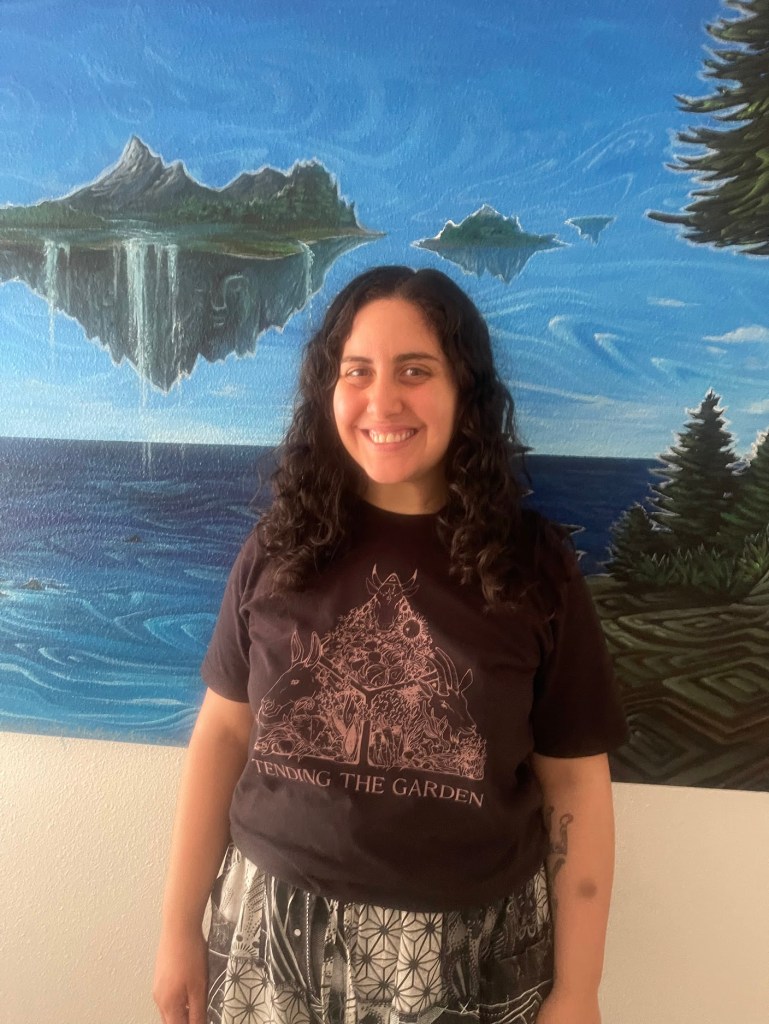
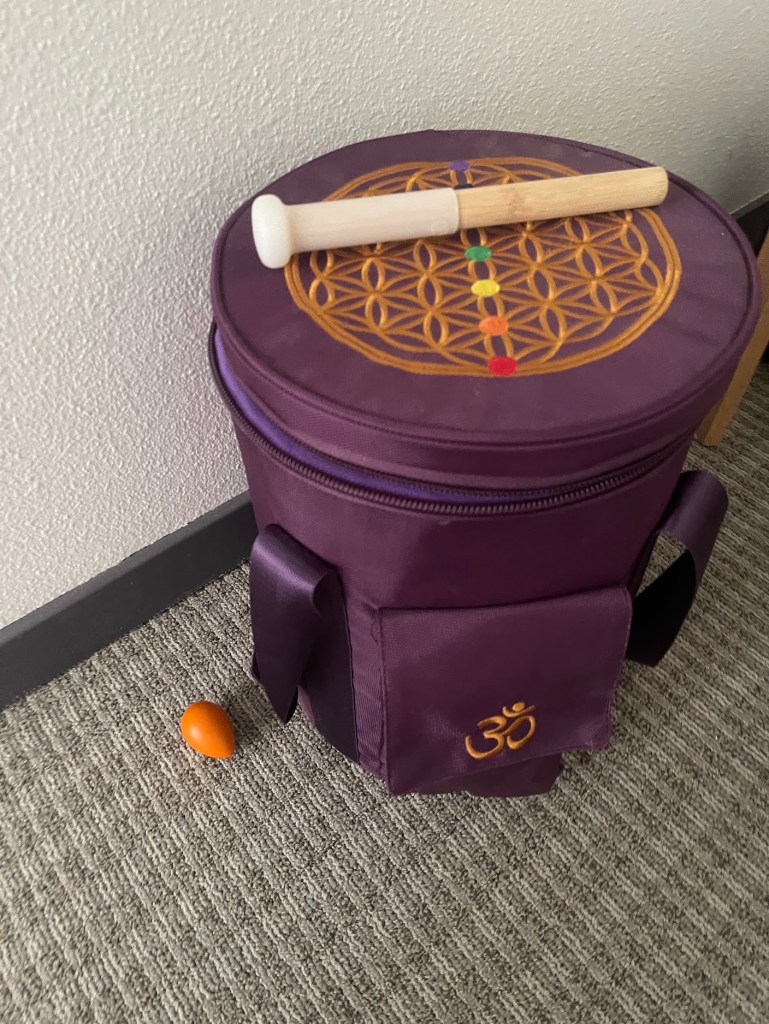
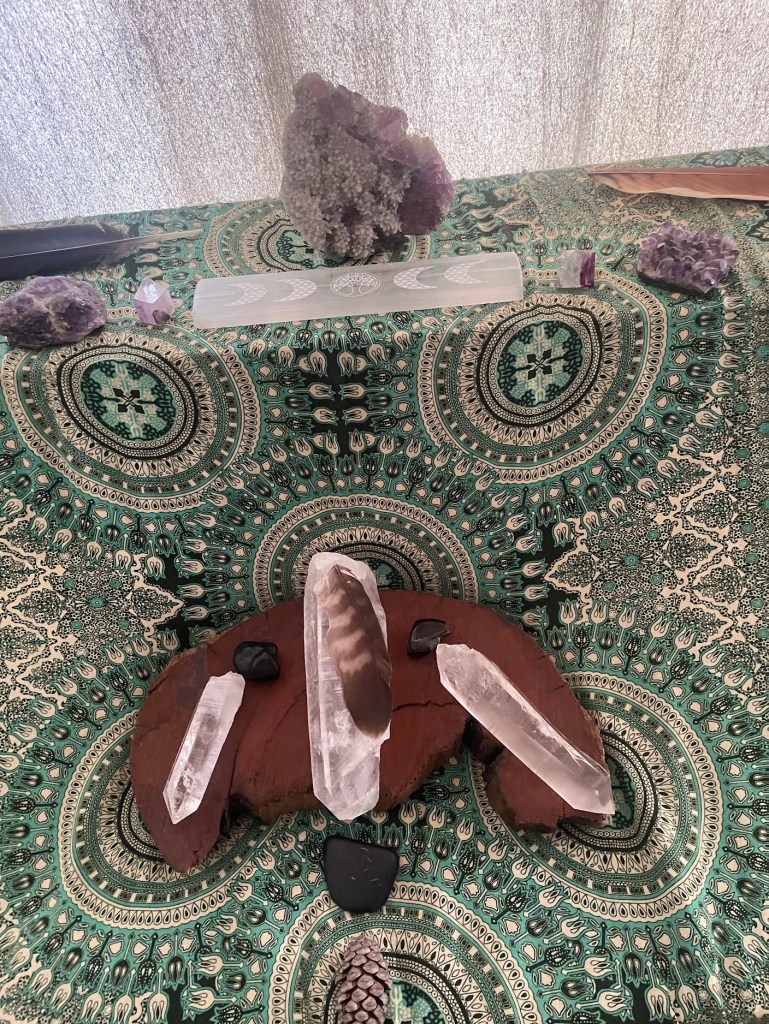
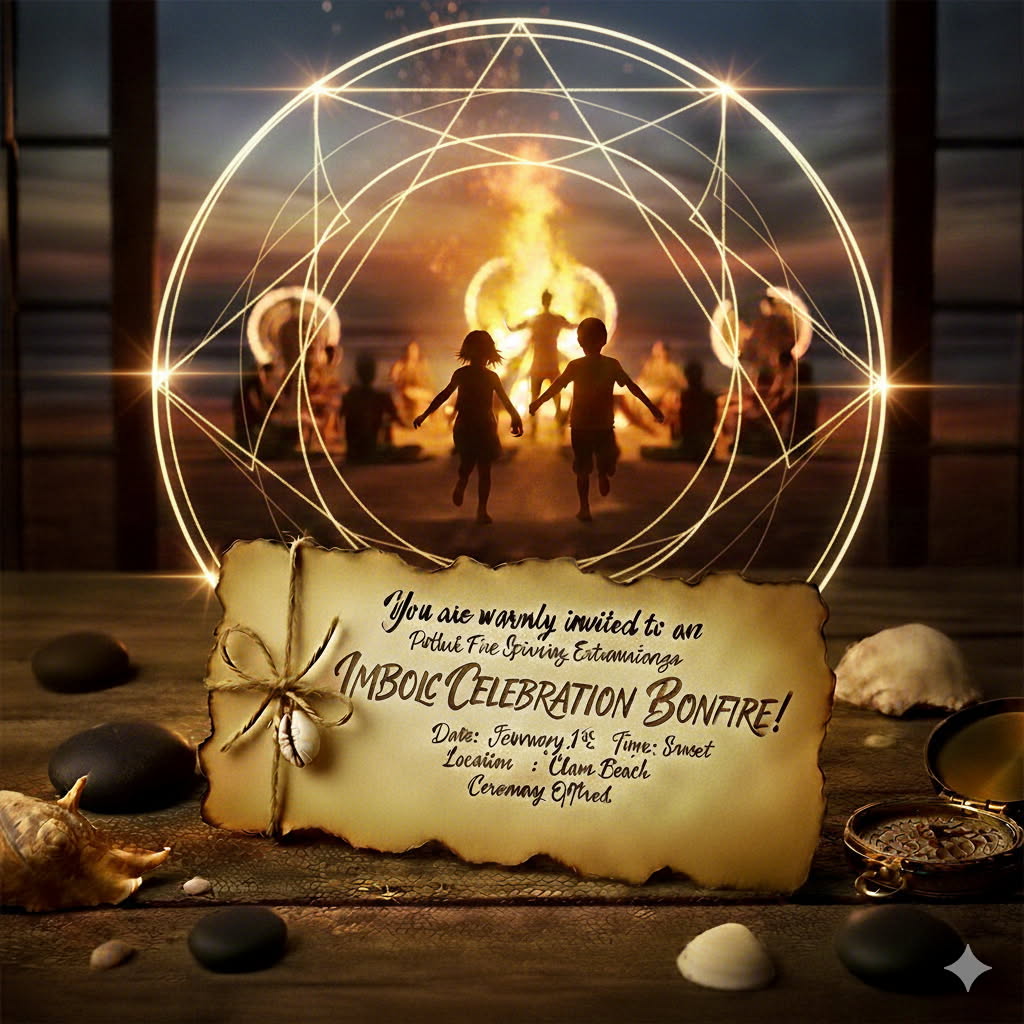

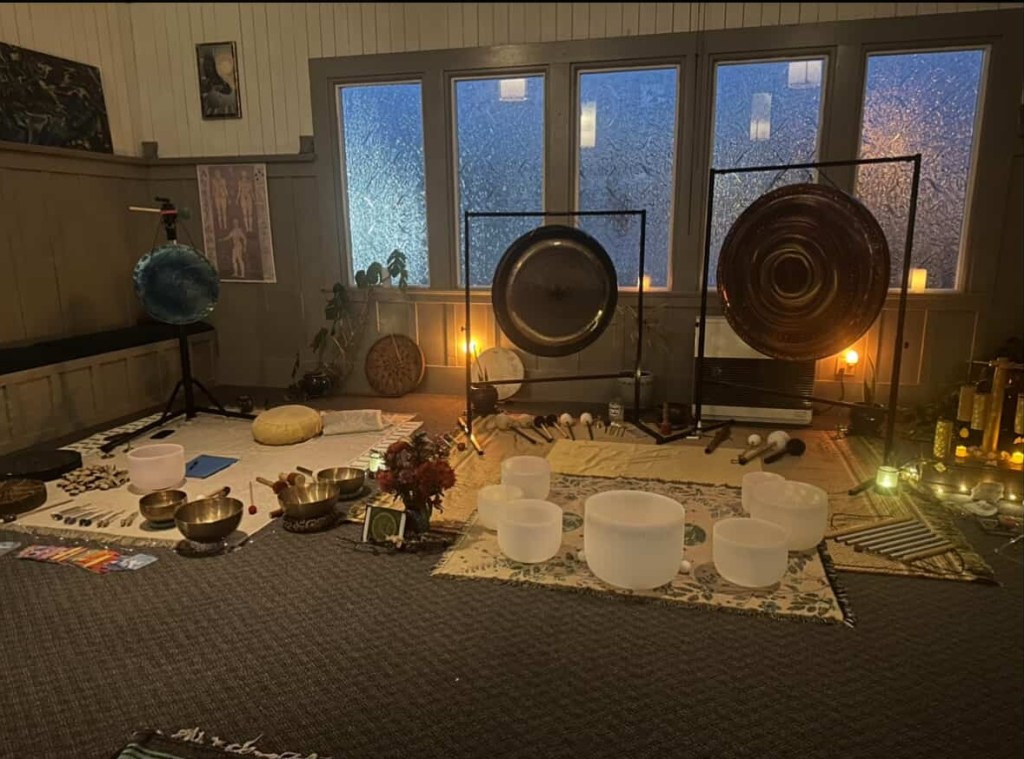
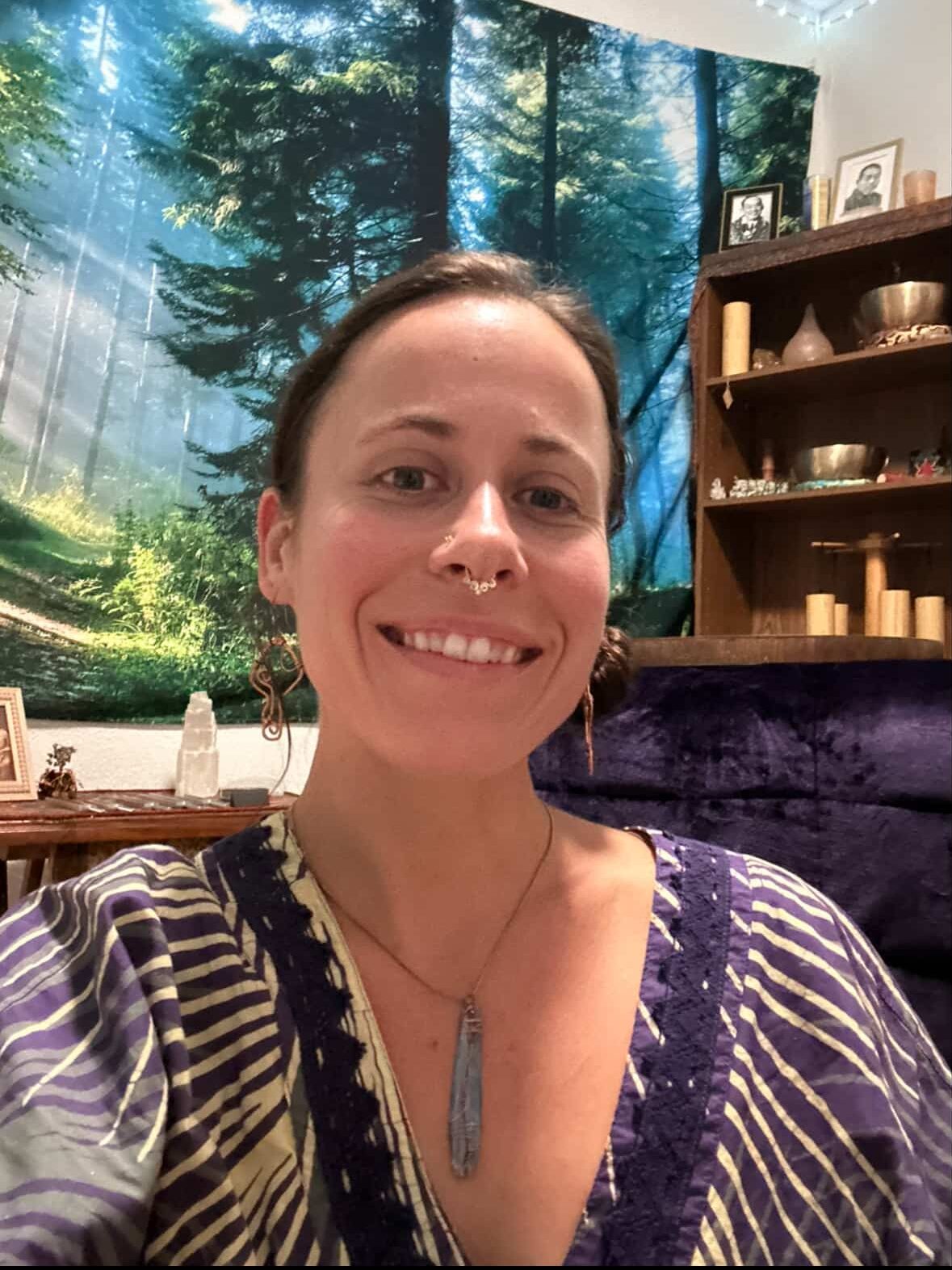
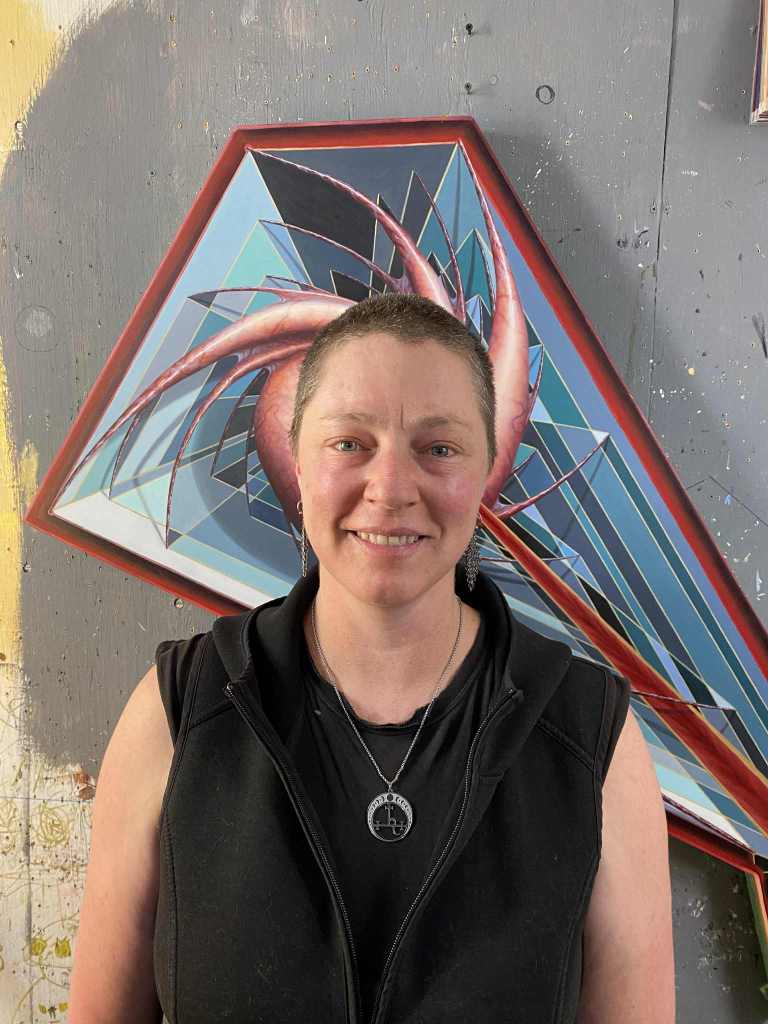

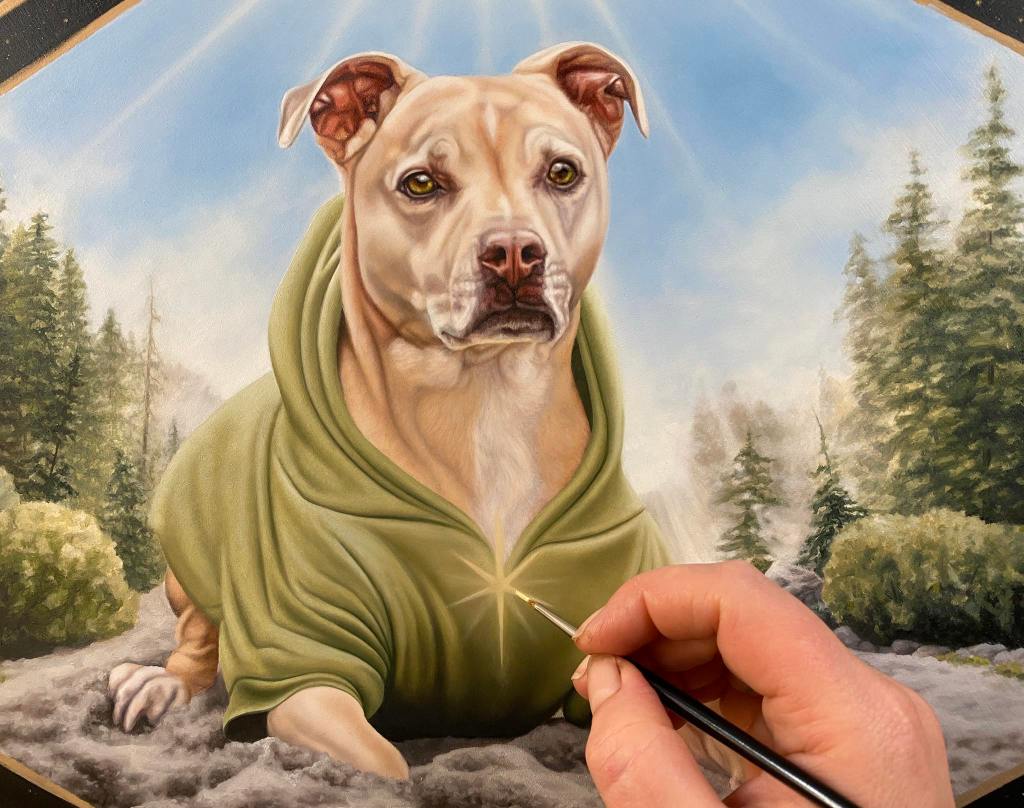


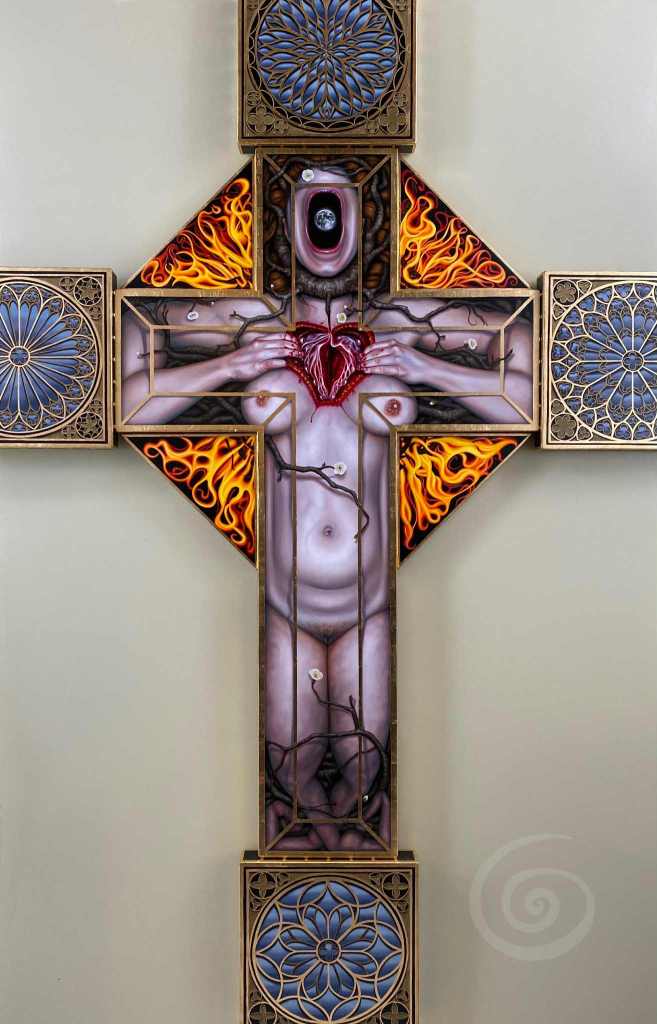
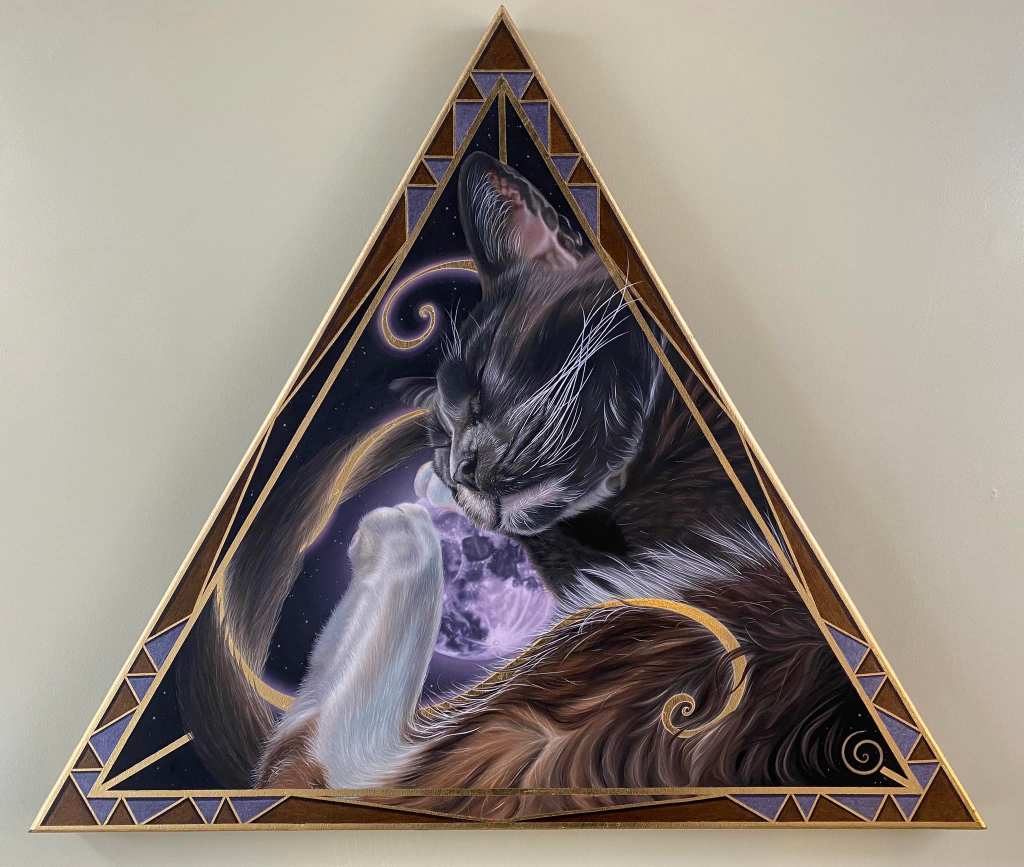

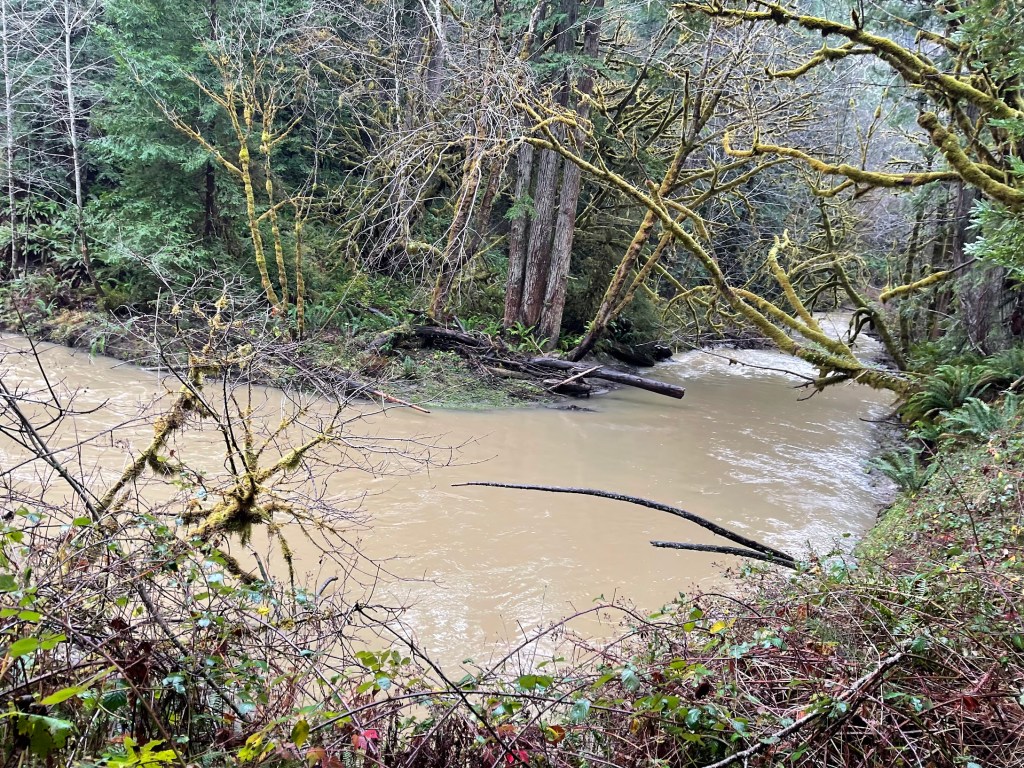

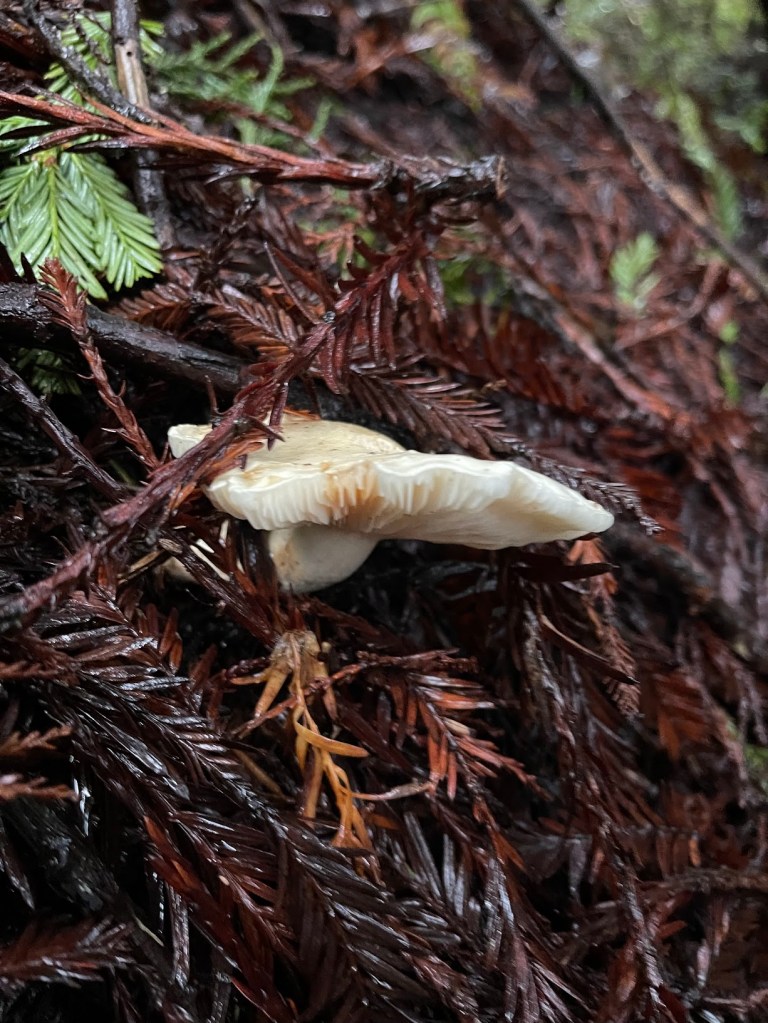
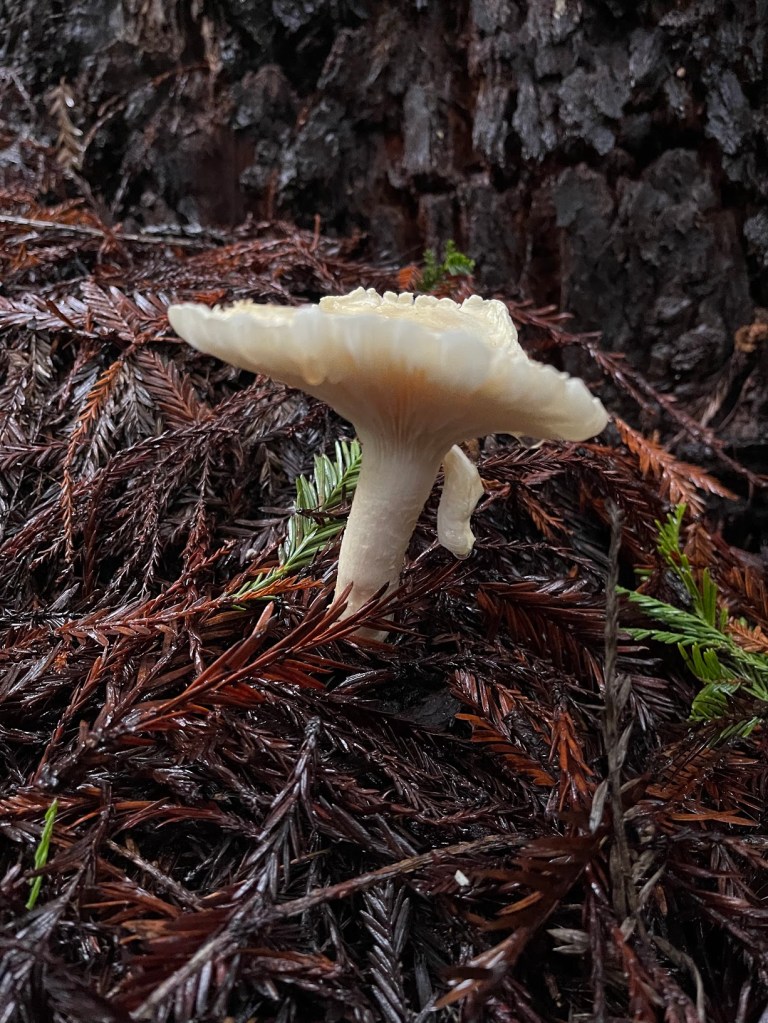


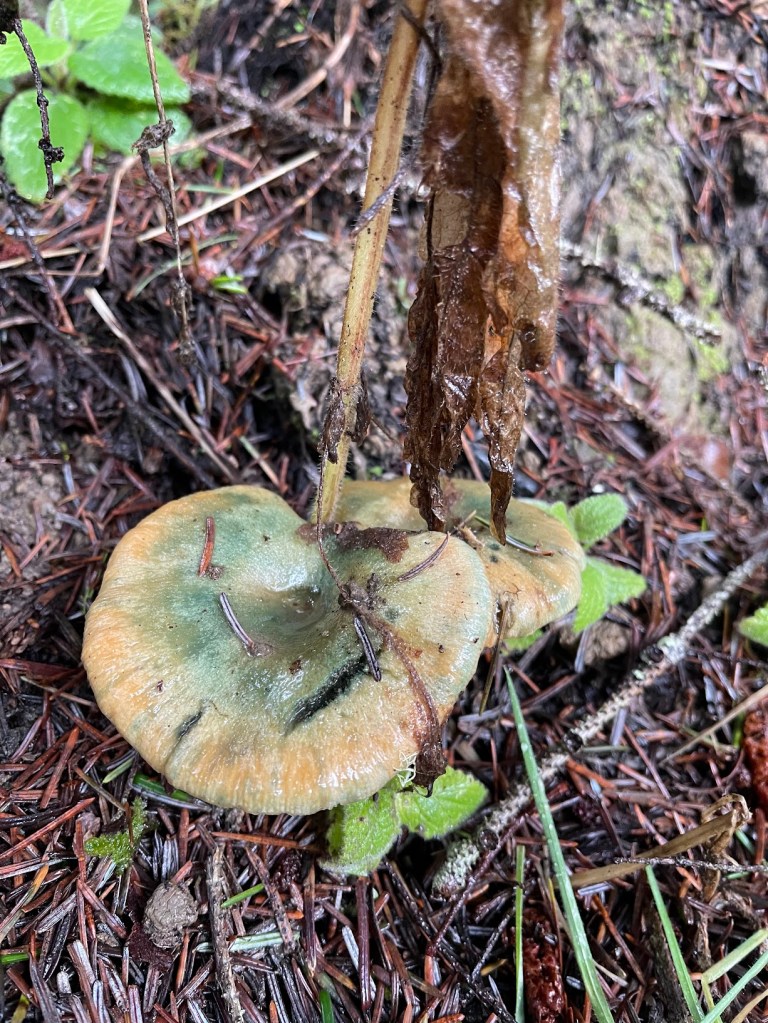
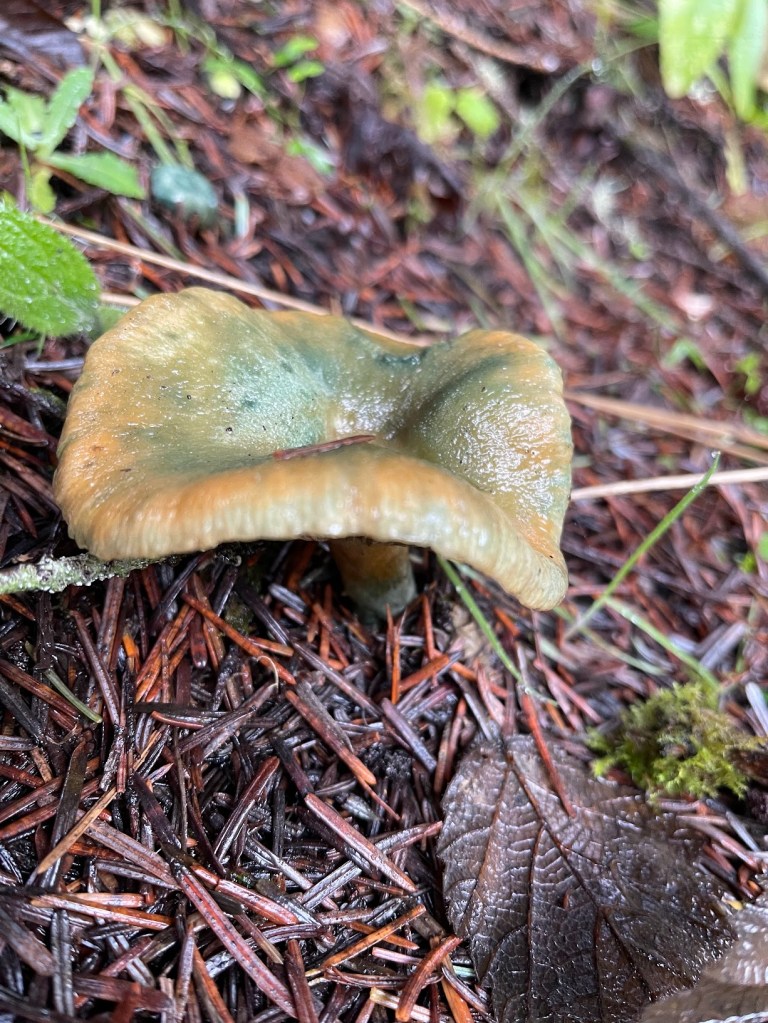
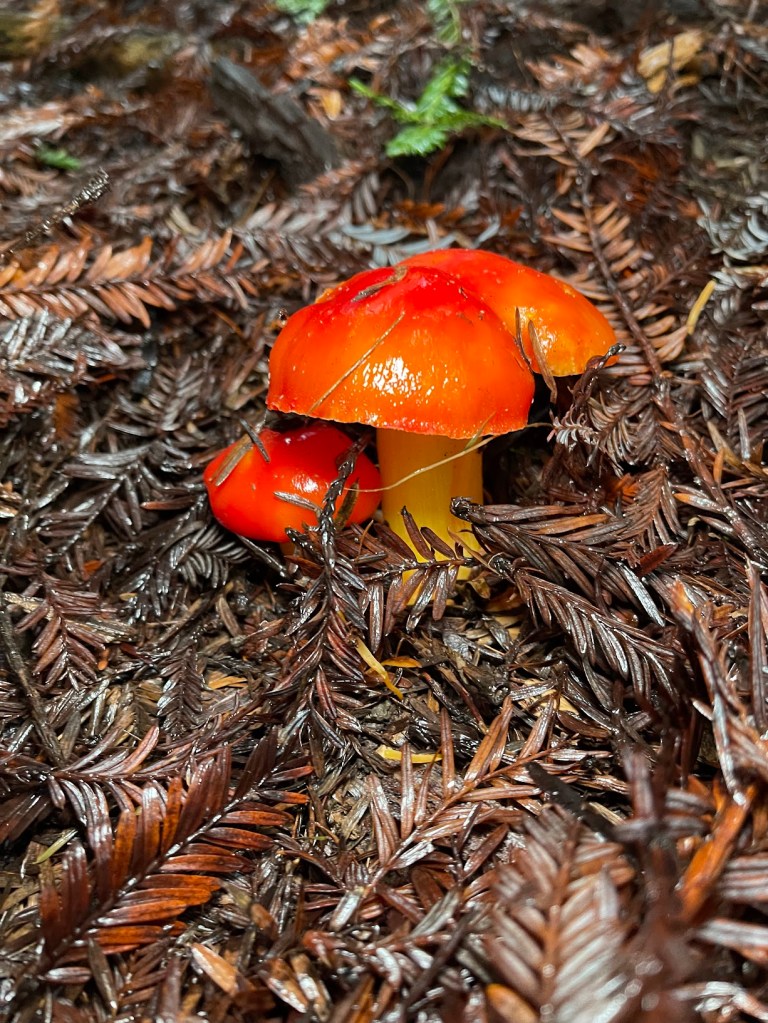
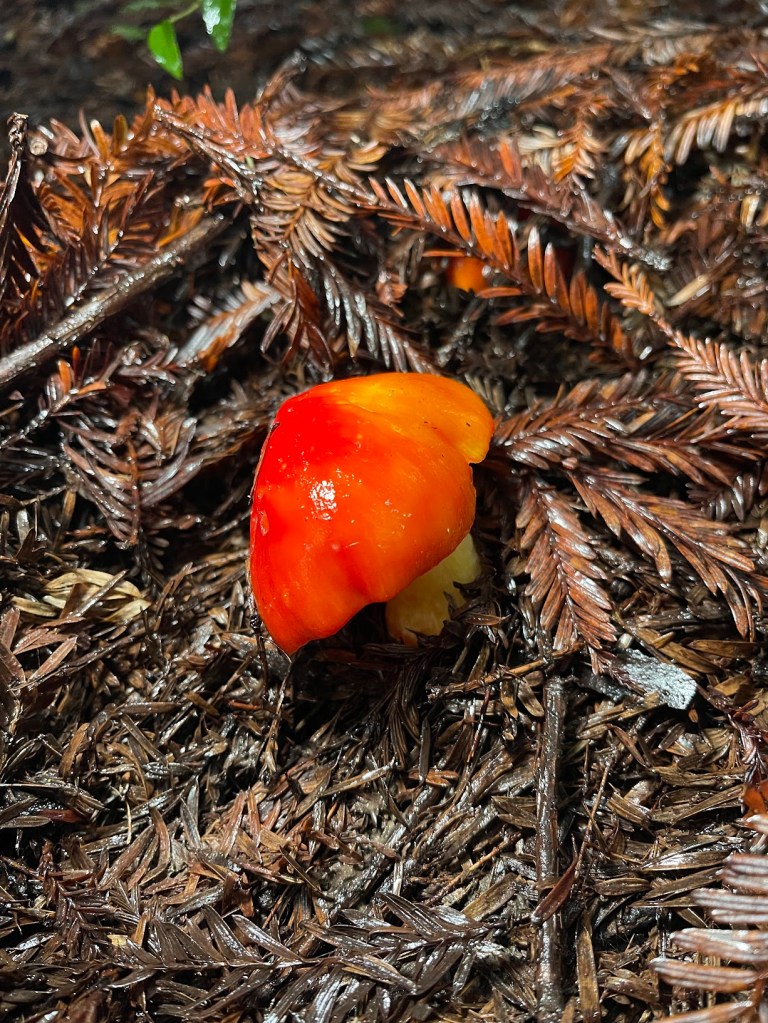
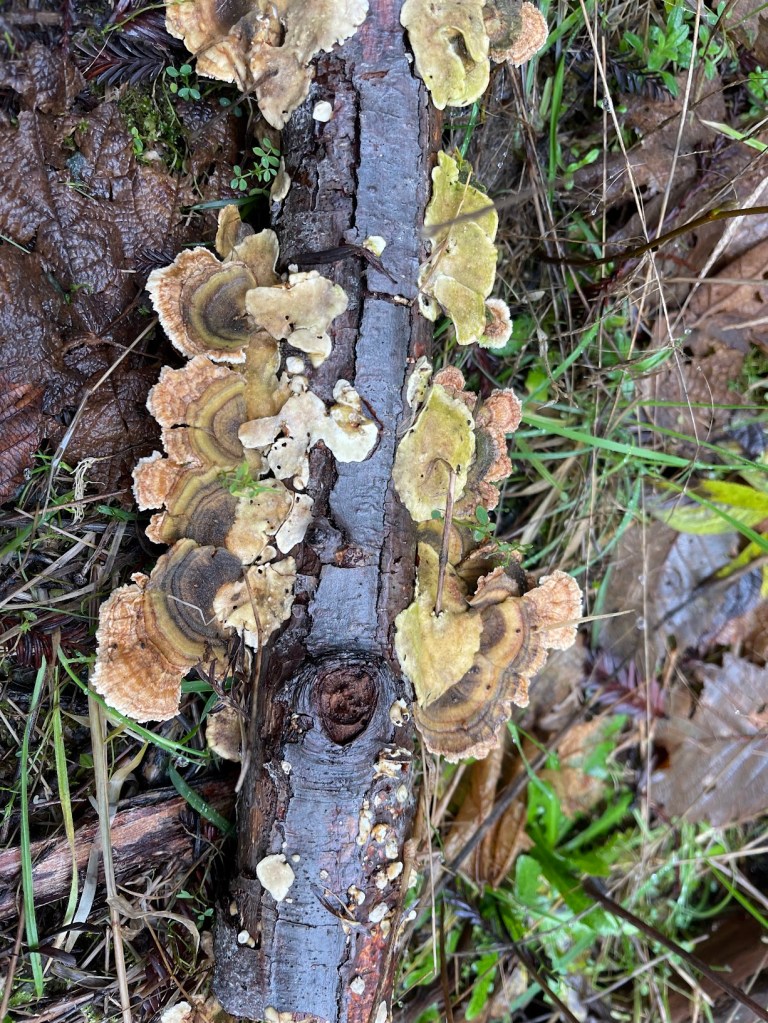


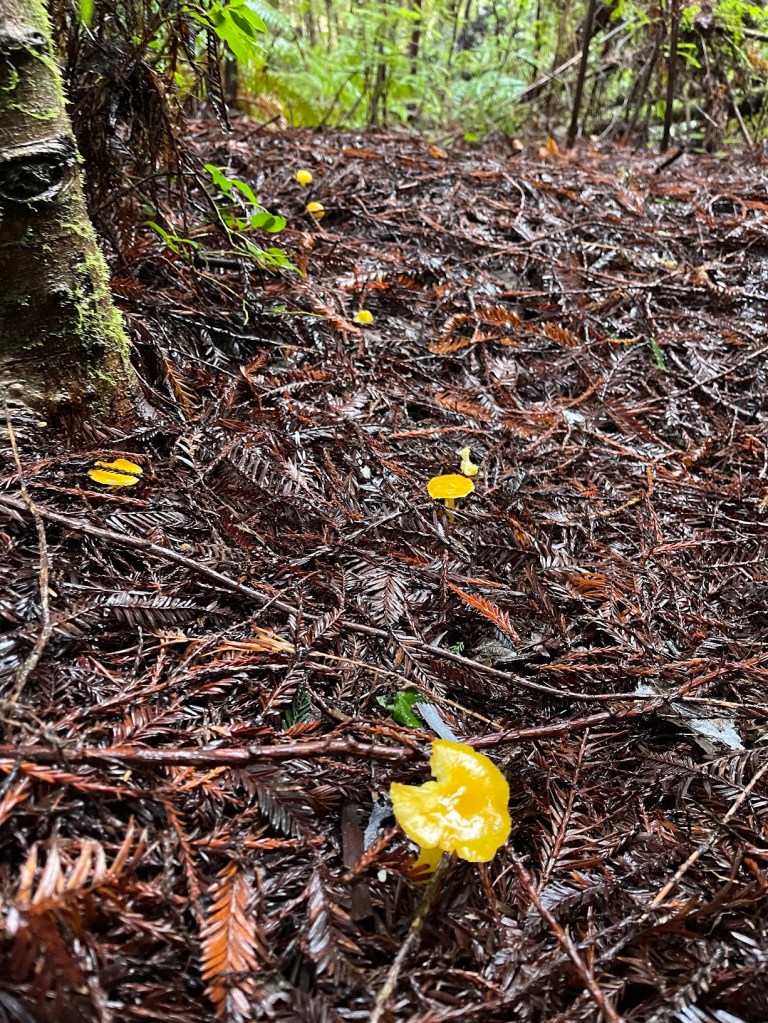
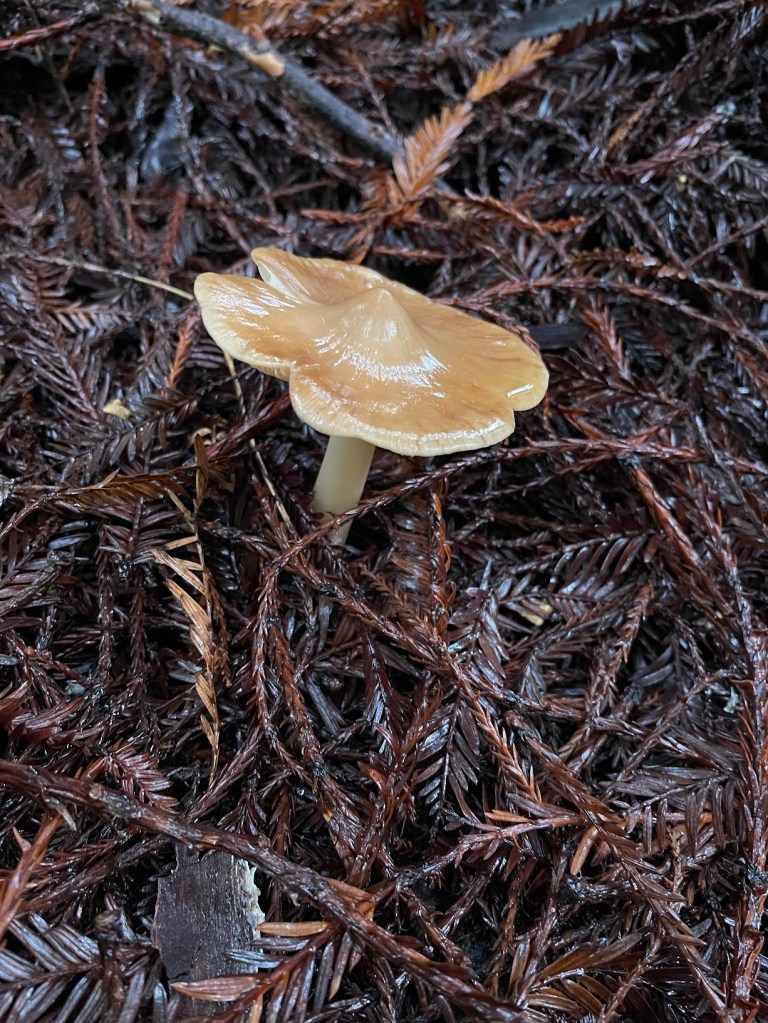


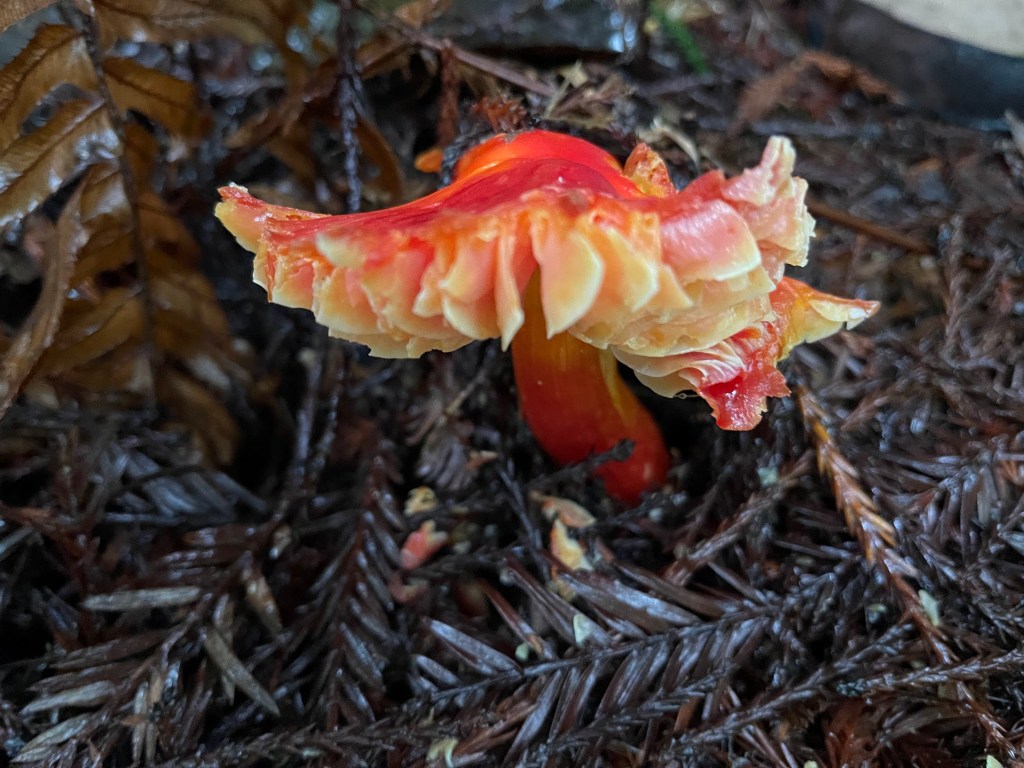


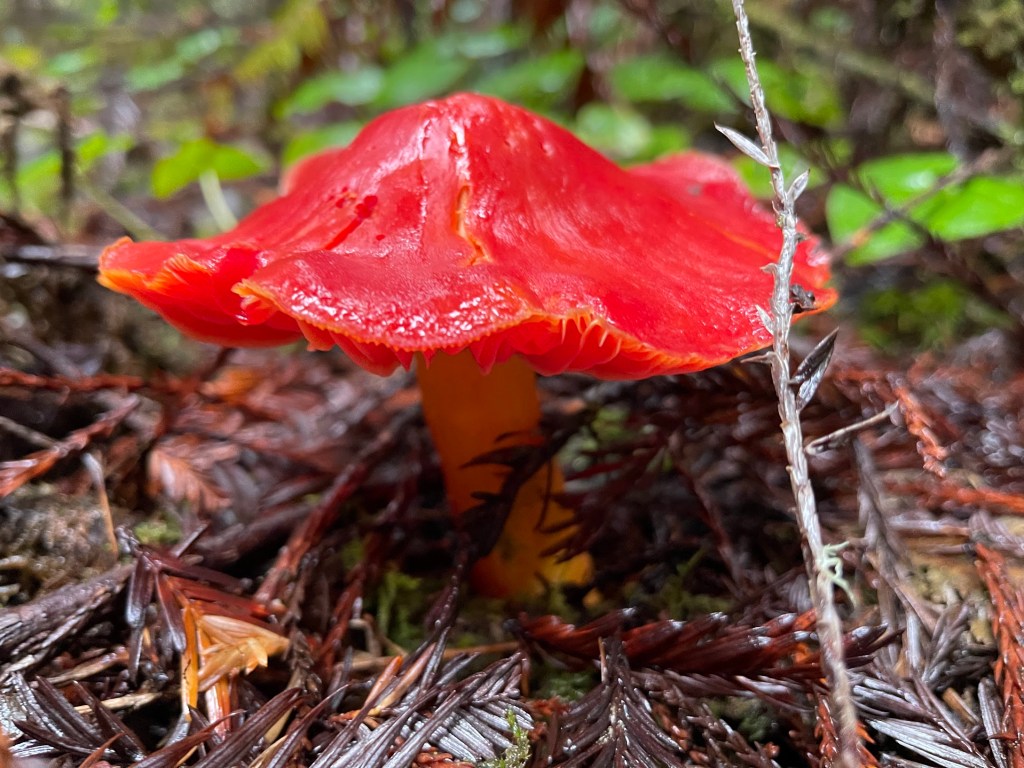
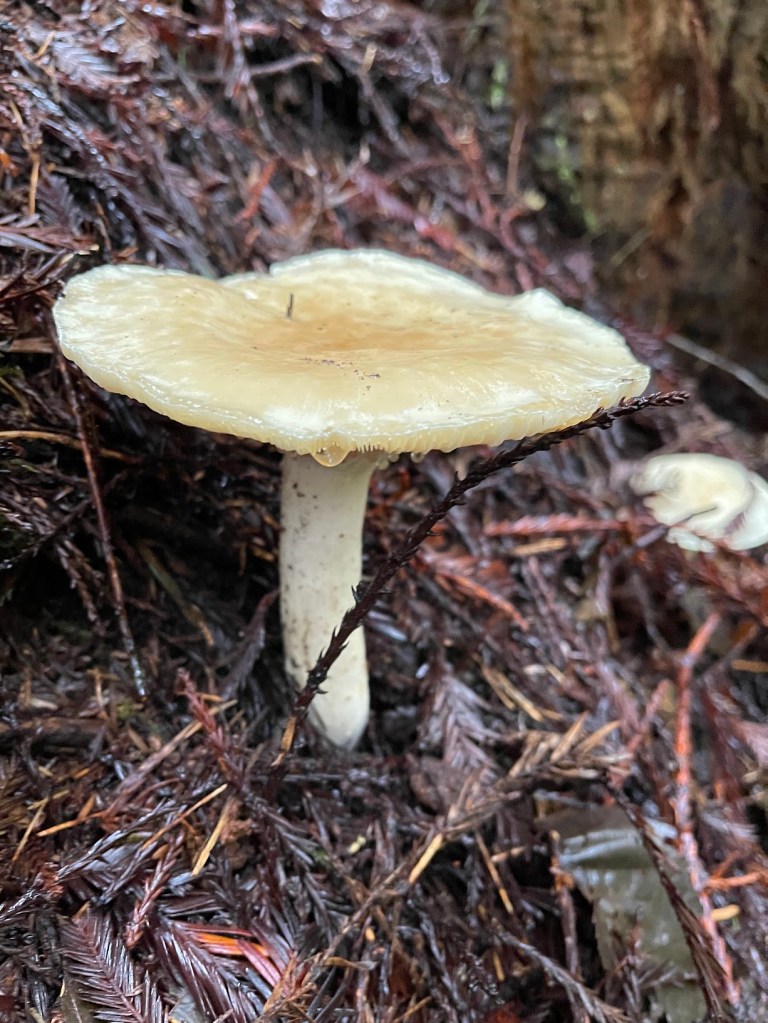


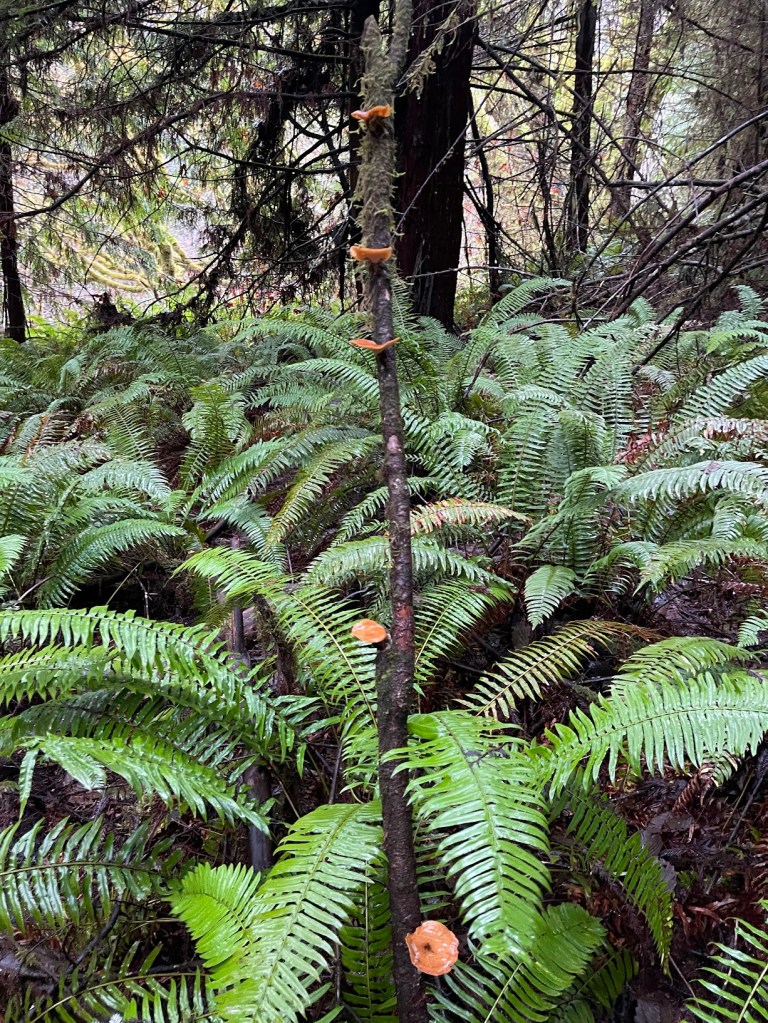

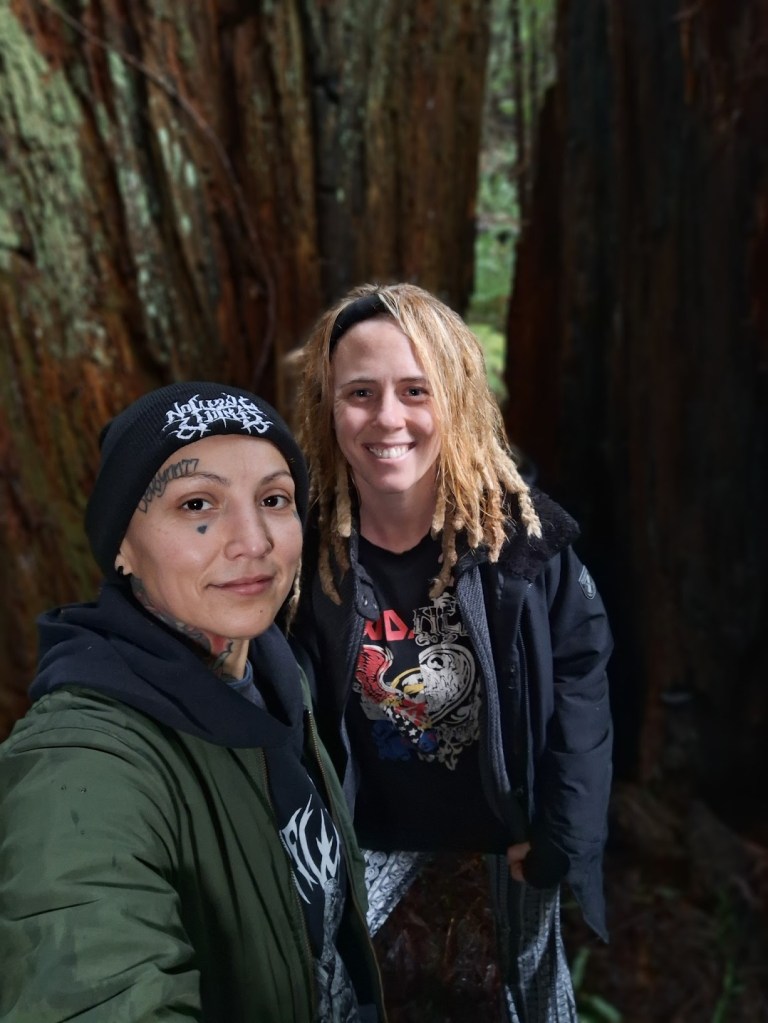
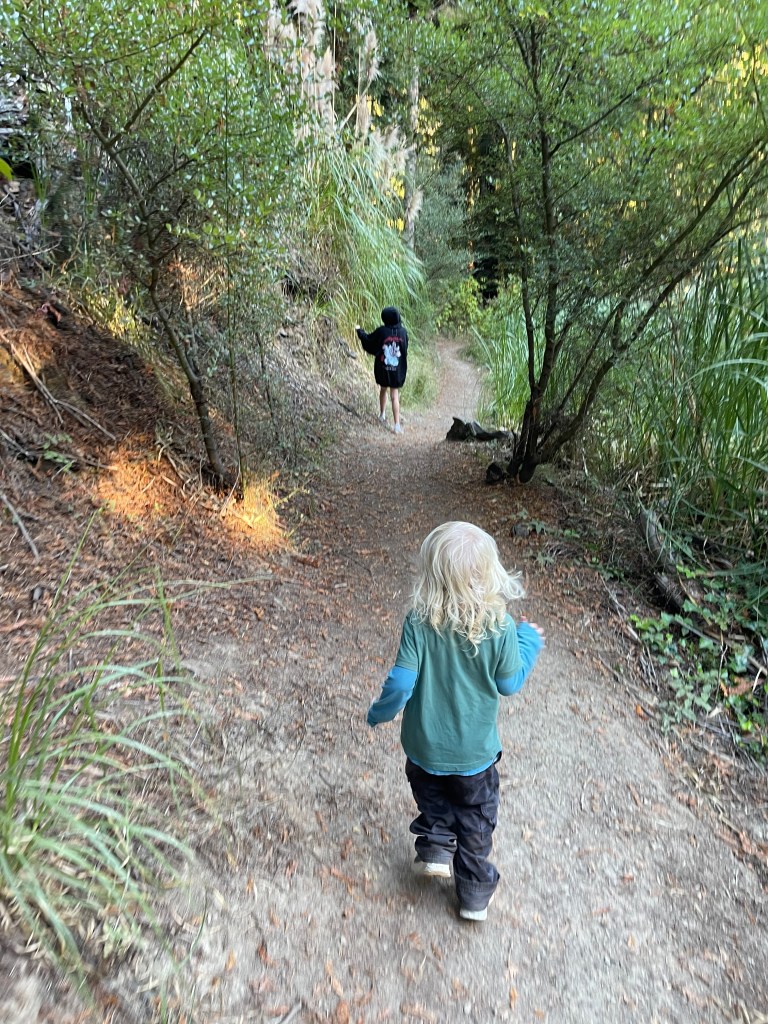

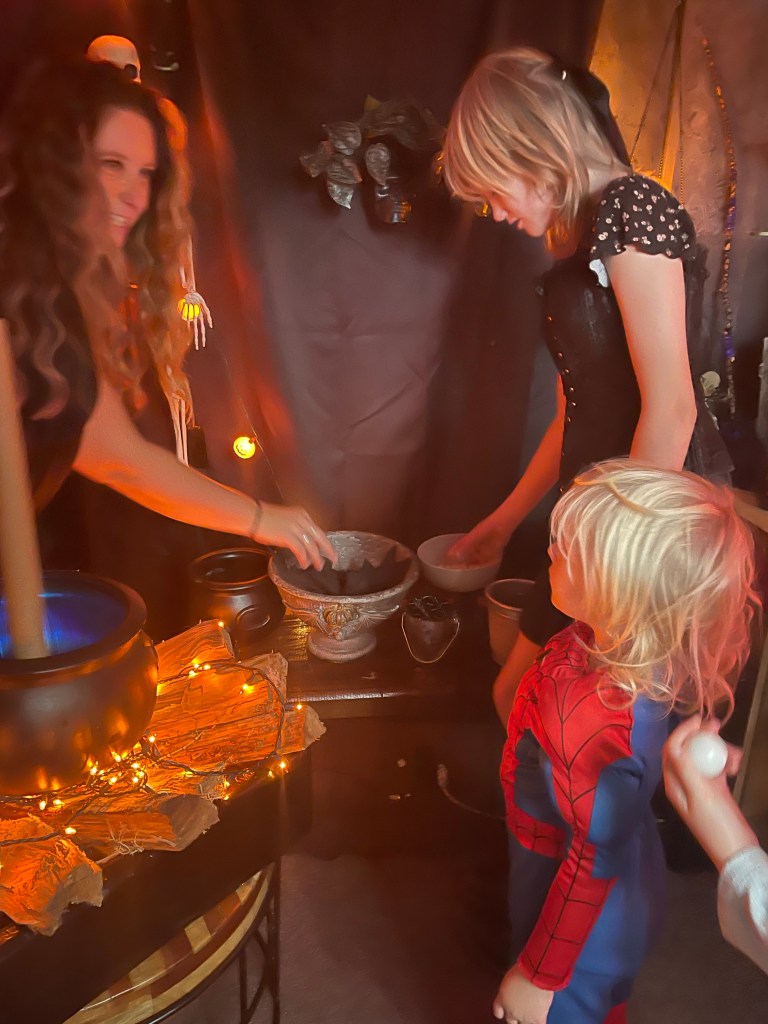
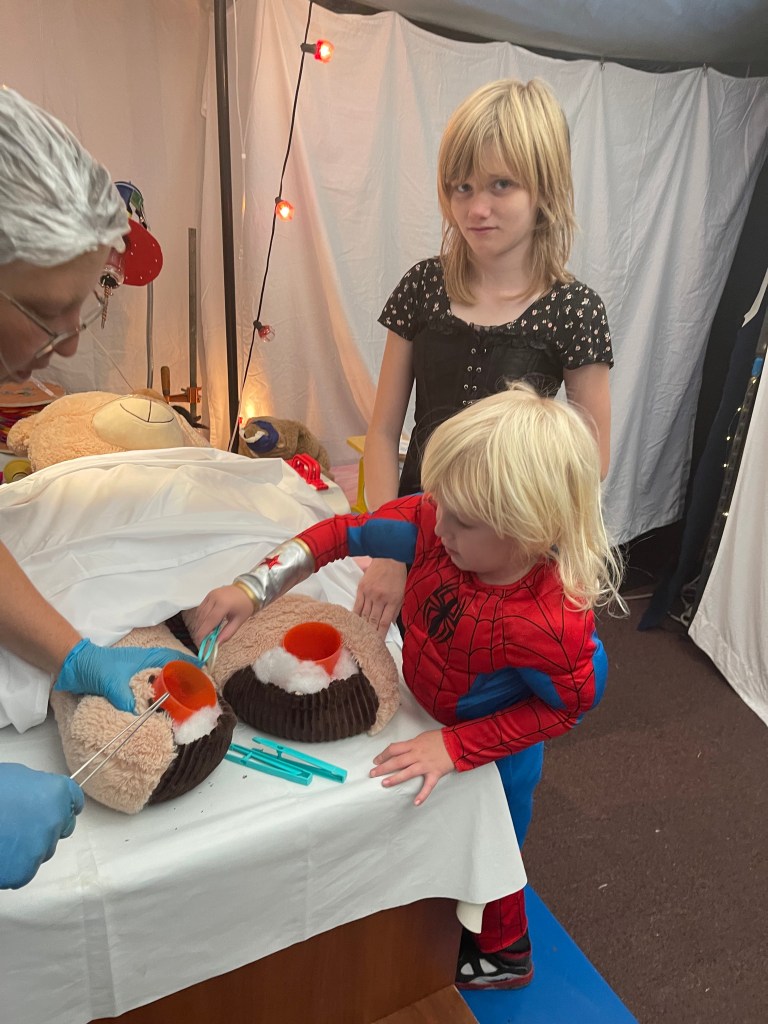



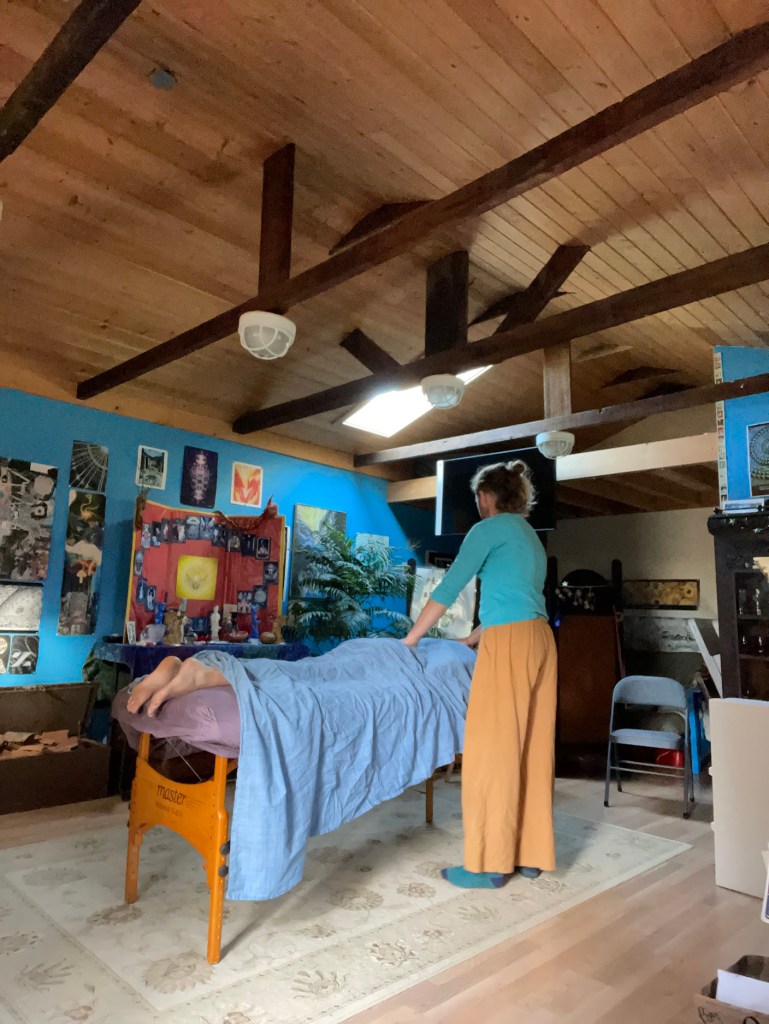
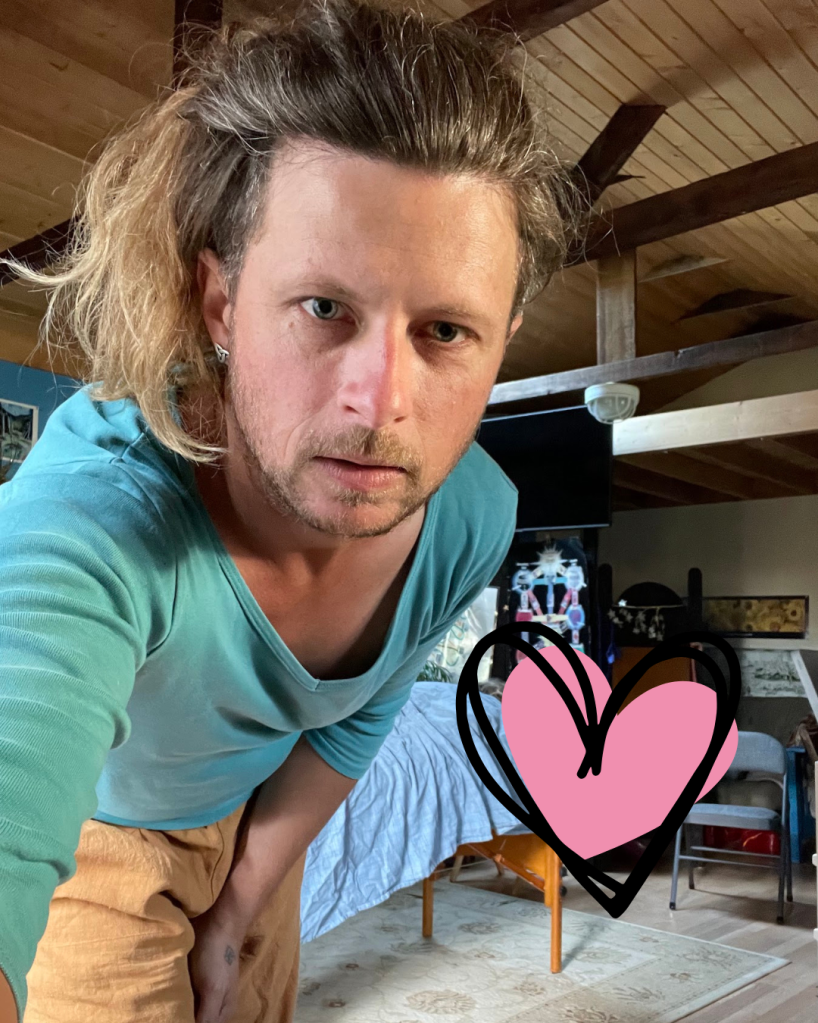

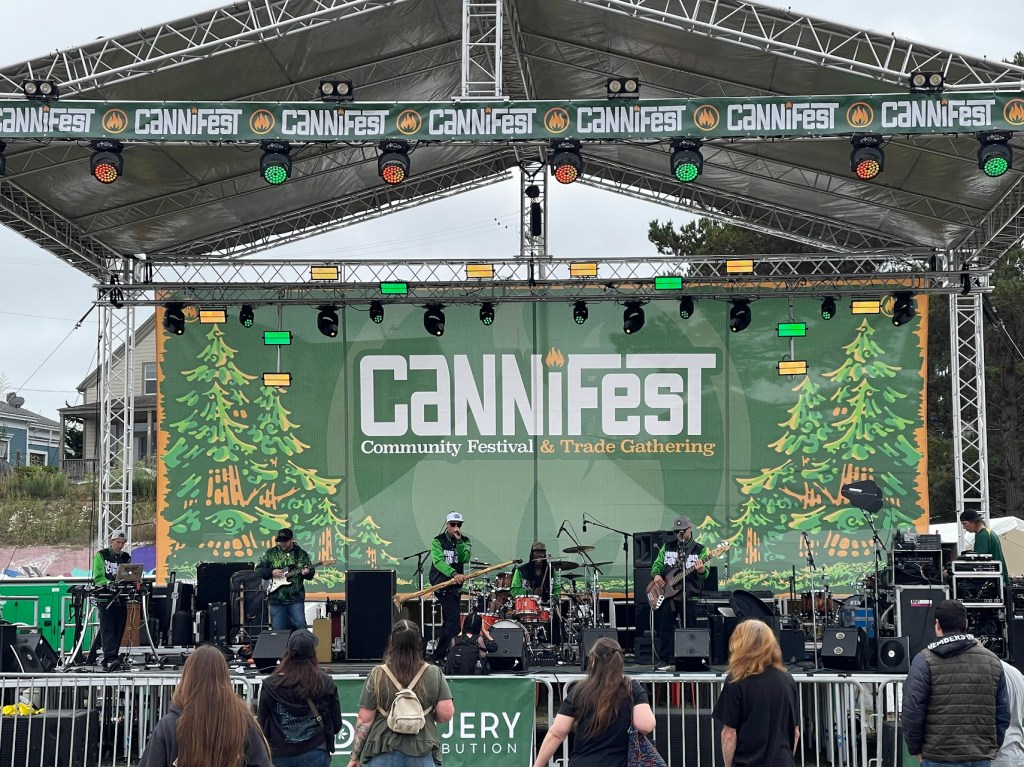


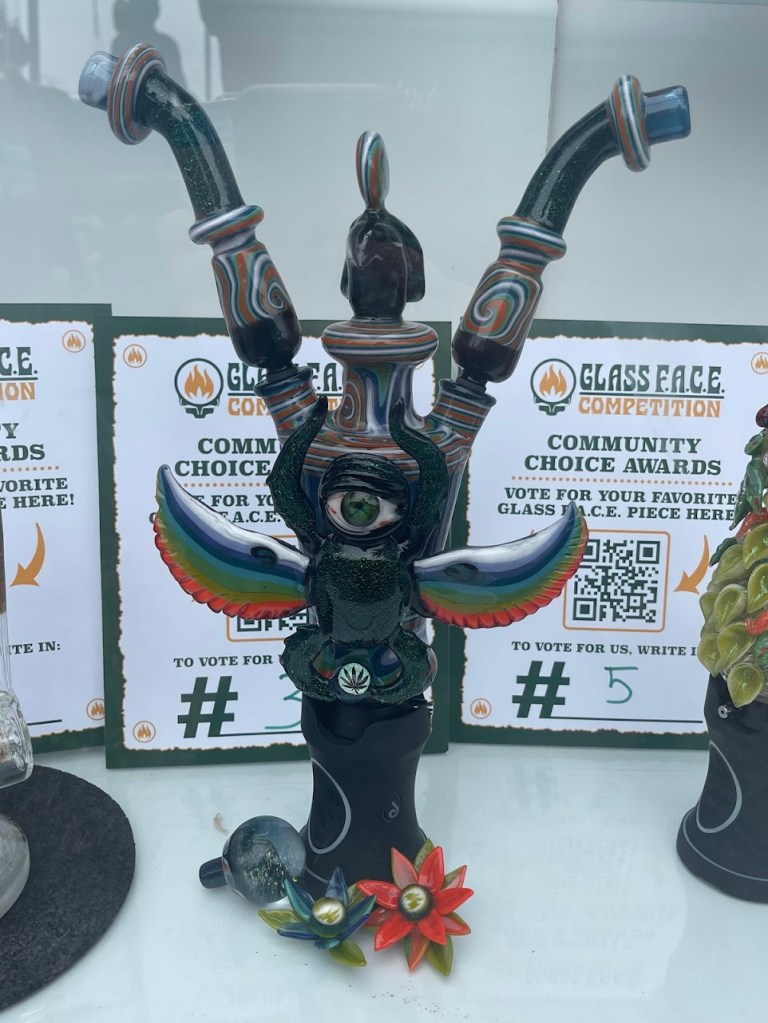

















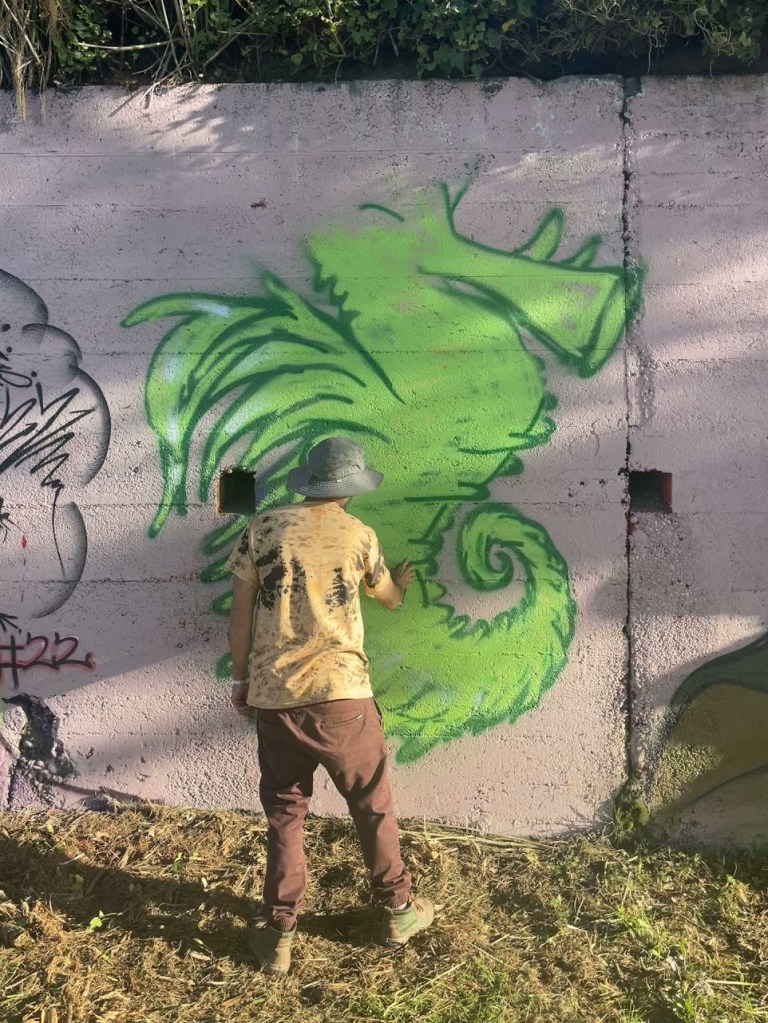


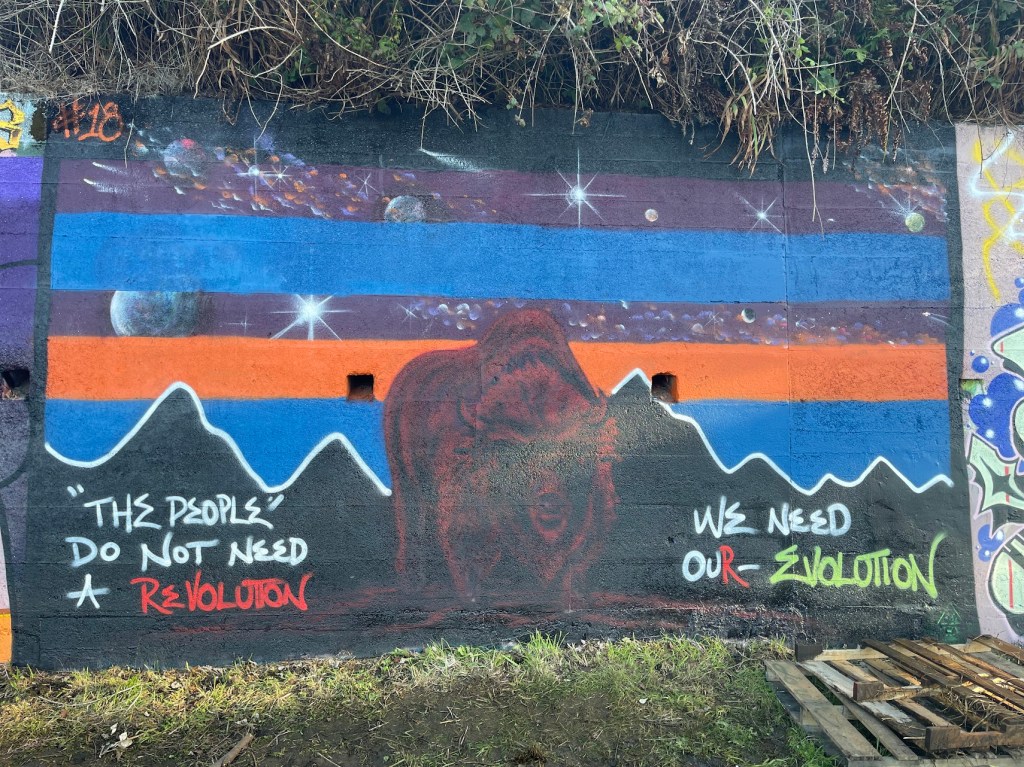
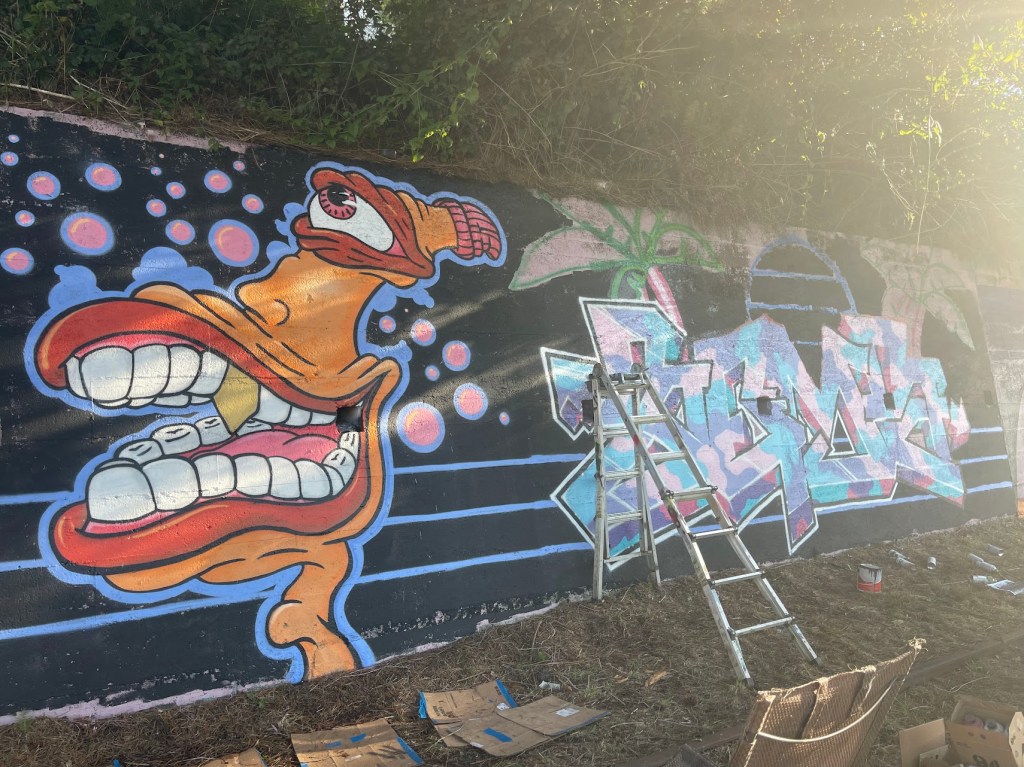
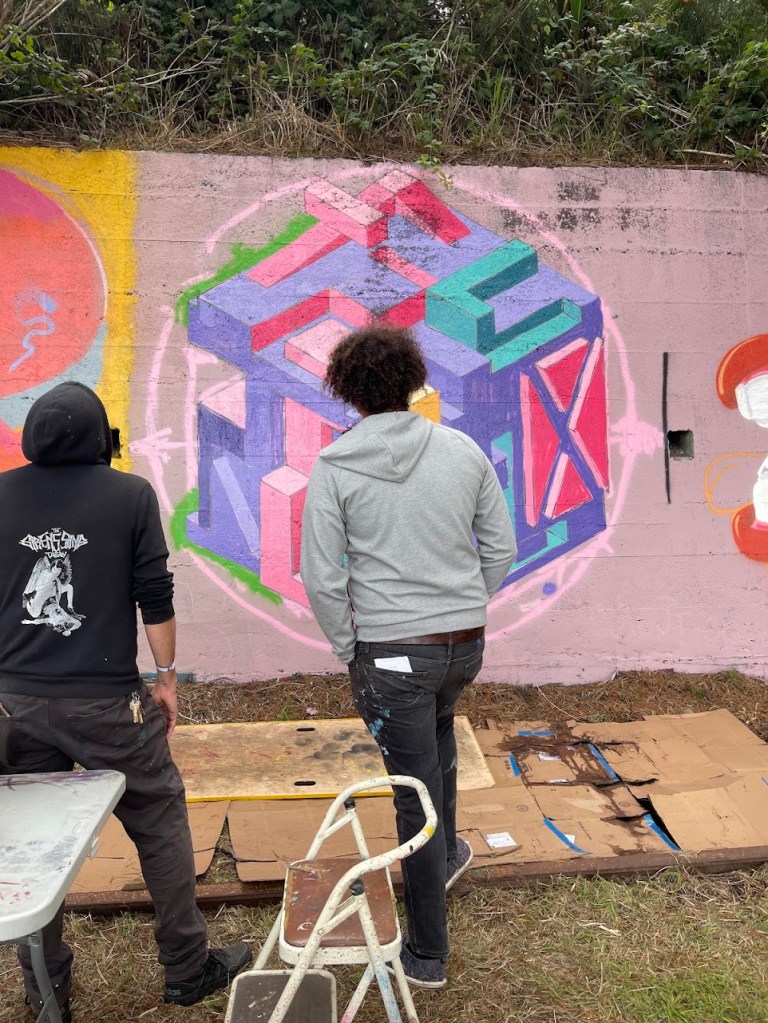





















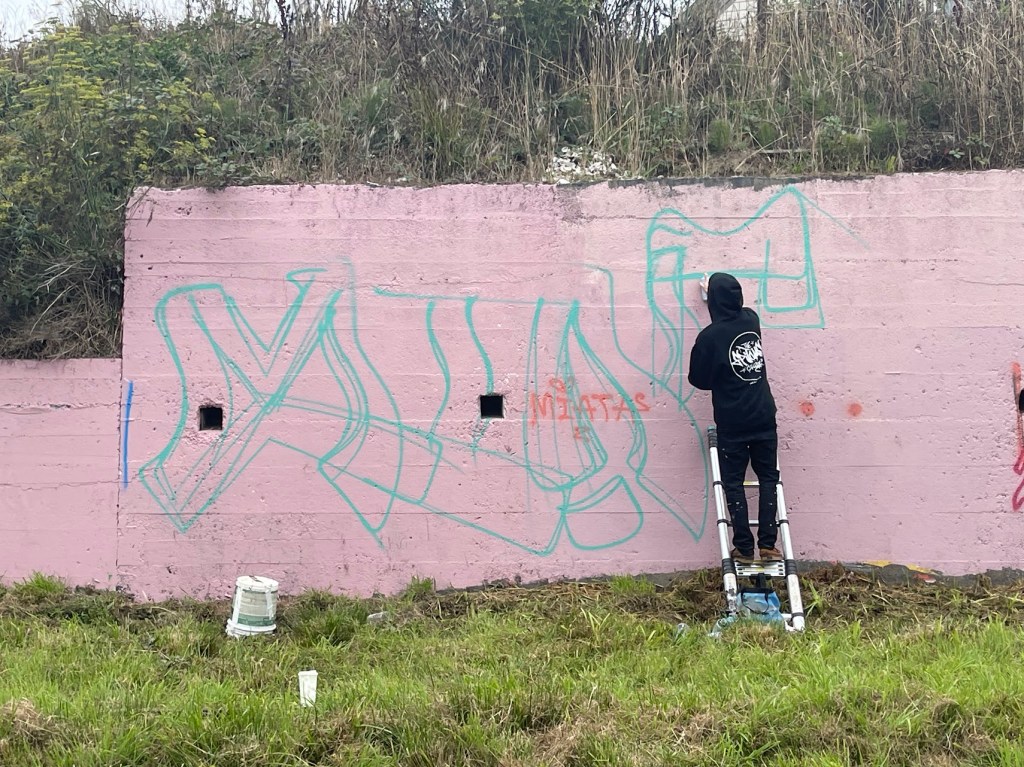
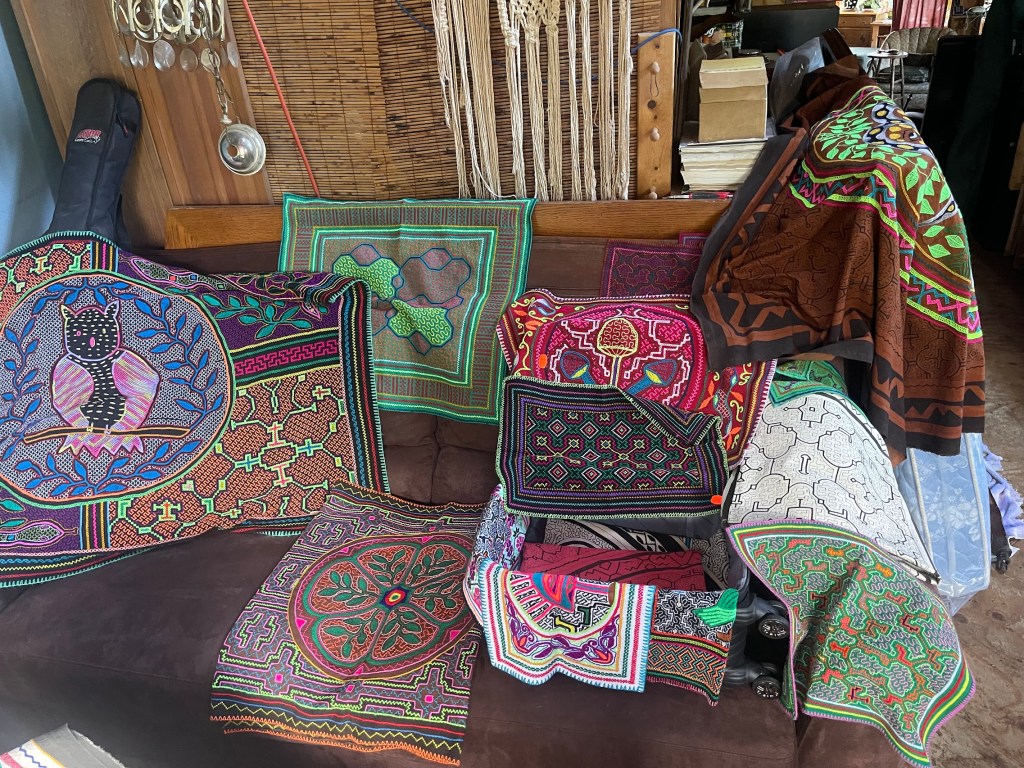


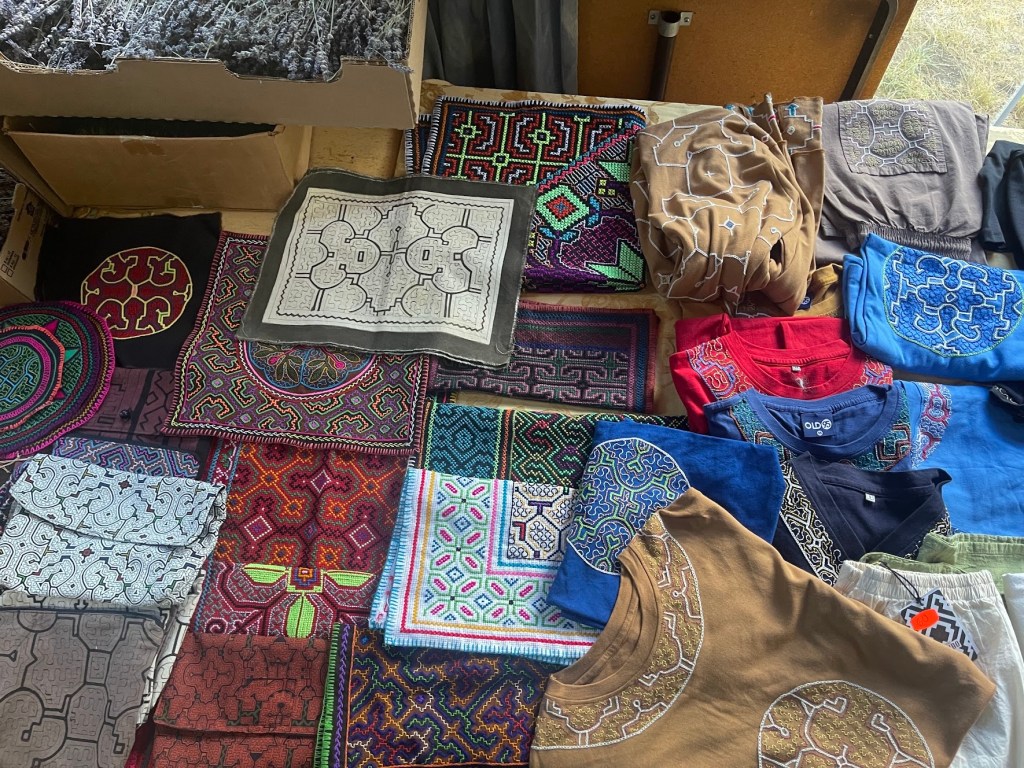


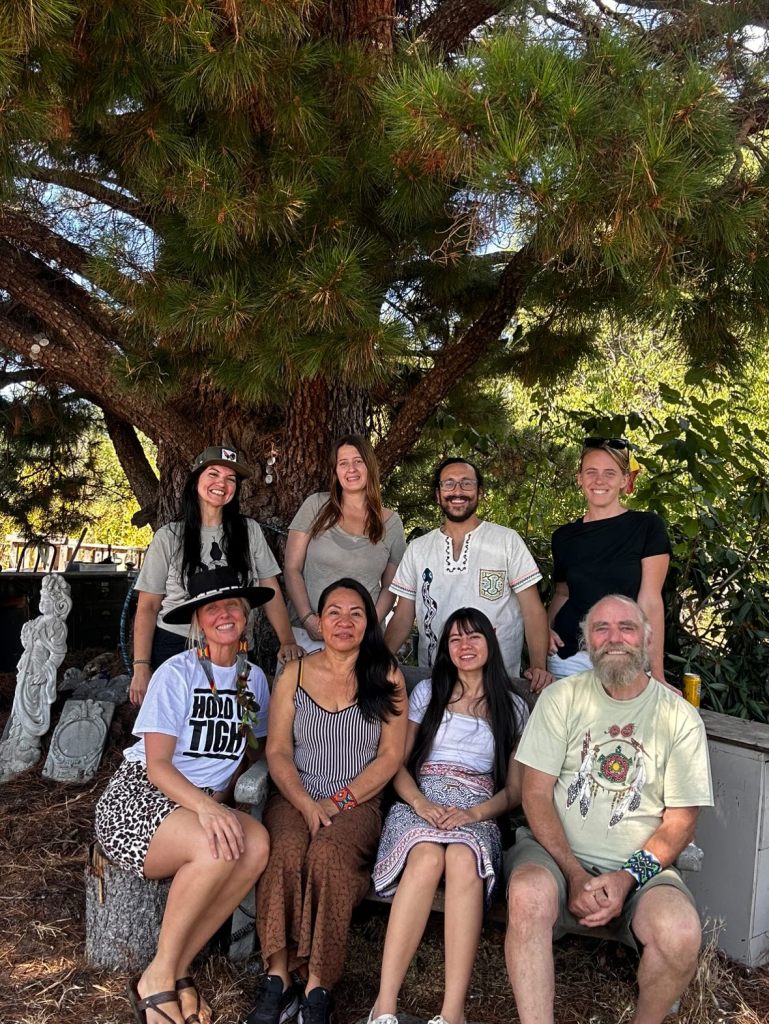
 Little Lost Forest