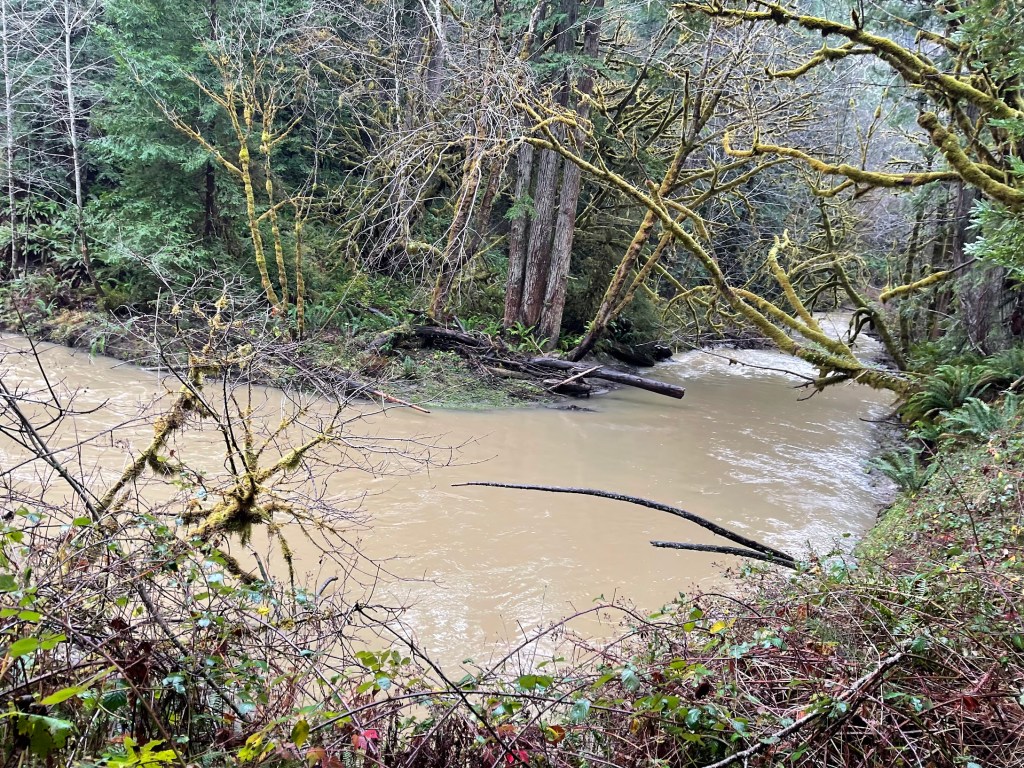
If you’ve been following my blog, you might know that Headwaters, in Eureka, CA, is one of my favorite hiking spots. After a good rain, it transforms into a mushroom paradise, with various types of fungi appearing all along the trail. The Eel River runs through the area, providing a home for anadromous salmon that use this sacred ground as their breeding grounds. The hike is alive with vibrant green vegetation, from towering trees above to the lush undergrowth below. Banana slugs cross your path while small birds flit about, their songs echoing through the ferns and low-hanging branches.
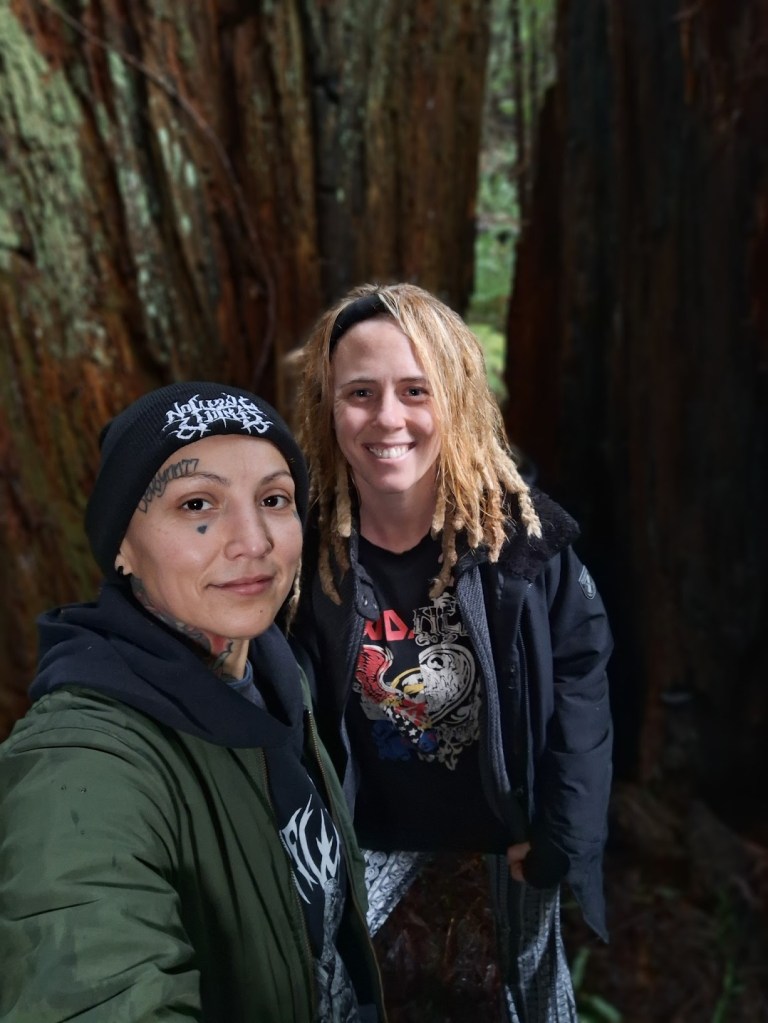
On this hike, I was joined by my friend Sevlynn, a talented photographer who captures stunning images of mushrooms along the West Coast. Everywhere we went, the sound of running water followed us, a calming rush that felt like a peaceful, yet energizing force.
Curious about mushroom exploration? The best part is—this time of year, you can’t miss them. Mushrooms sprout in clusters along the trail, whether you’re heading toward the water or trekking up the mountain. They’re everywhere, no matter which direction you take.
Did we pick them and eat them? Not quite—at least, not yet. We picked a few, touched them, and marveled at their unique qualities. We guessed which ones might be edible, laughed at the oversized ones, and examined the tiny black ones that were so small they were almost a curiosity in themselves. When you pick a mushroom, it releases spores, creating new mushrooms. While you shouldn’t pick every mushroom you see, touching them is an essential part of understanding them—feeling the texture, whether slimy or firm, studying the gills or spines, and noticing the changes in shape or color with age. I watched as Seveylnn carefully uncovered mushrooms hidden under layers of decayed foliage. It’s amazing what can be found beneath the forest’s blanket of leaves and moss.
Mushroom identification can be a fascinating and rewarding experience, but it requires careful attention to detail. When you’re documenting a mushroom, take clear pictures of the cap, gills, and stem to capture its key features. It’s also helpful to note important characteristics like the color and texture of the mushroom, whether it has a skirt or ring, and the type of gills it has—are they attached, free, or decurrent? For a more thorough observation, you can cut the mushroom in half and examine what it looks like inside. These details will help you better understand the mushroom and make identification easier.
Another step in the identification process is collecting spores. This can be done by creating a spore print, which is a simple yet informative method. First, remove the mushroom stem and place the cap, with the gills facing down, on a piece of paper or foil. Add a drop of water to the cap to encourage the spores to fall, then cover it with a glass or a paper cup. Leave it undisturbed for anywhere from one to 24 hours. When you gently lift the cap, you’ll see the spores left behind on the paper or foil. Store the spore print in a cool, dry, and dark place, sealed in a bag to preserve it for future reference. [More experimentation with spore prints will offered in a future post.]
If you’re interested in growing mushrooms at home, spores can also be collected using a spore syringe. This method involves placing your spore print inside a plastic bag, injecting a few drops of sterile water into the bag, and then gently rubbing the print from the outside to release the spores into the water. Once the spores are suspended in the liquid, use a sterile syringe to draw up the spore water. This makes it easy to use the spores for mushroom cultivation.
Whether you’re identifying mushrooms in the wild or collecting spores to grow them at home, safety and cleanliness are essential. Always work in a clean environment to avoid contamination, and take your time to carefully document each step. The process can be both fun and educational, giving you a deeper appreciation for the incredible diversity of mushrooms.
Let’s dive into some mushrooms we encountered.
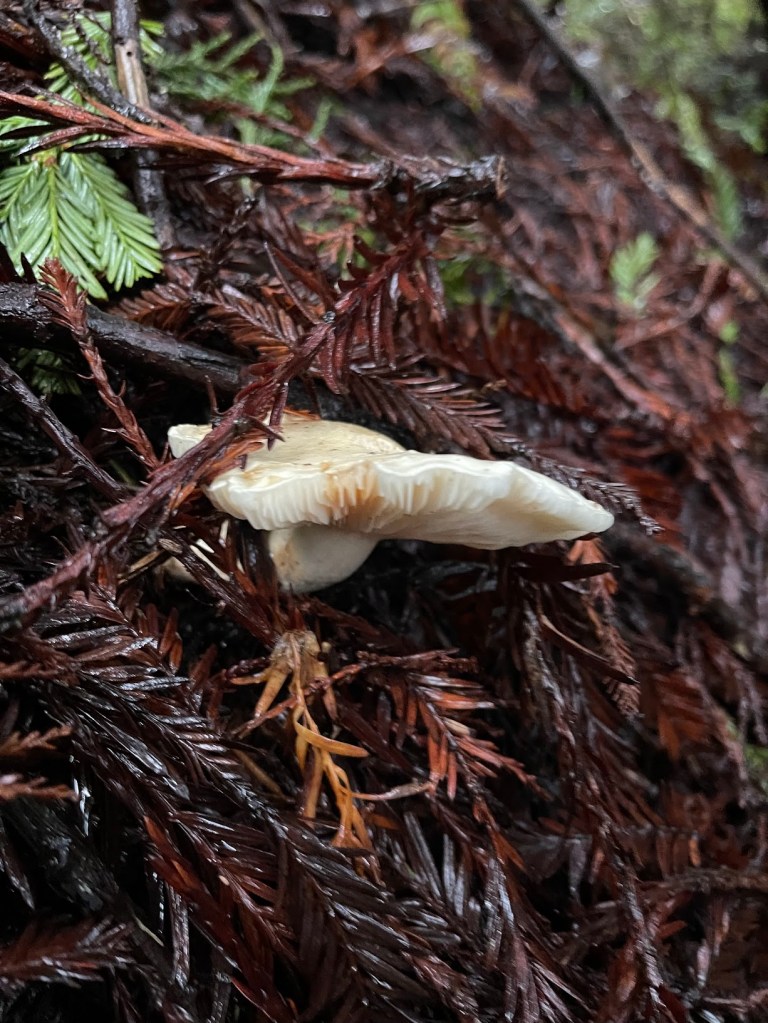
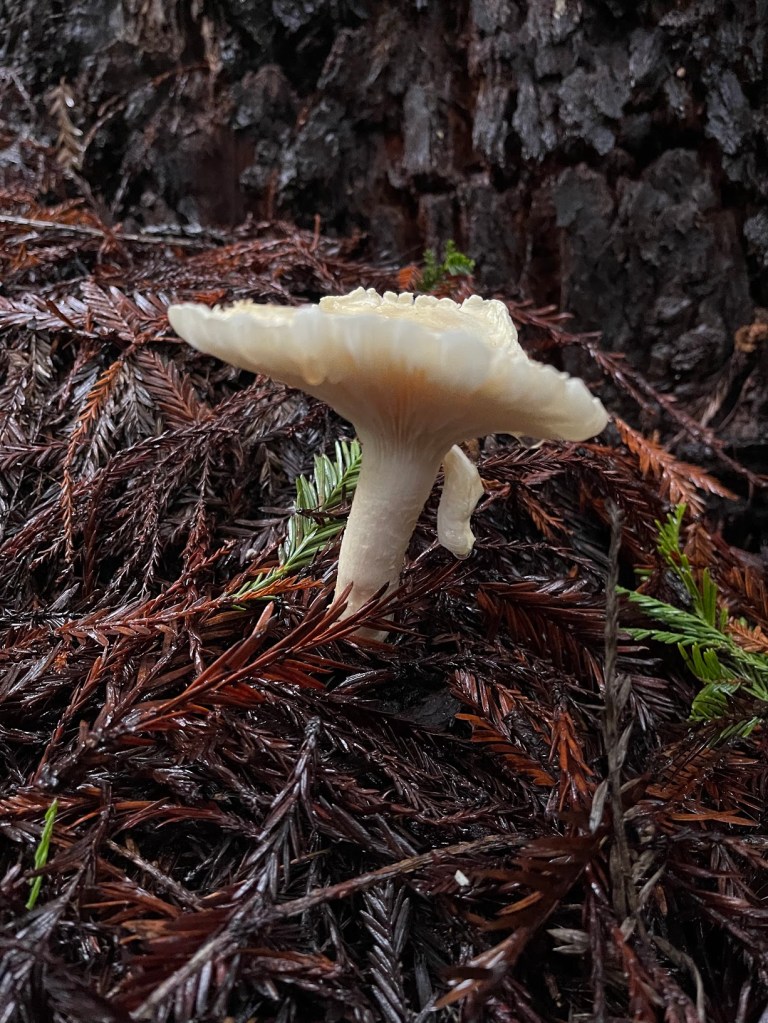
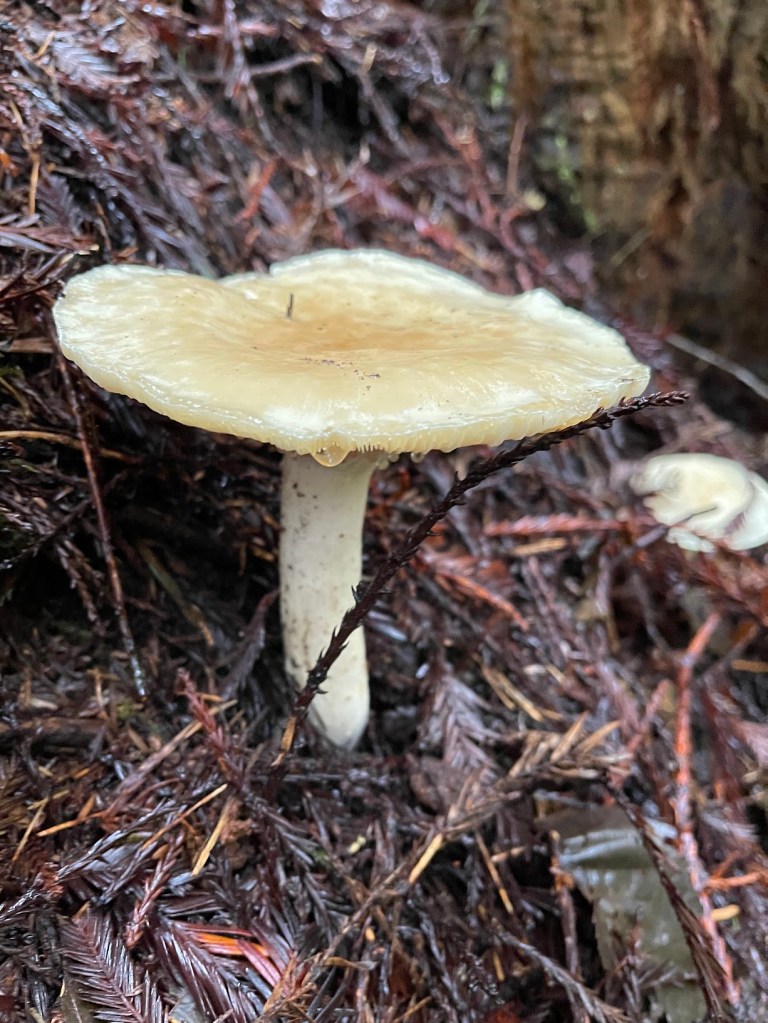
Inocybe geophylla(White Fibrecap) – This poisonous mushroom can be found under both conifer and deciduous trees in summer and autumn. It’s common in North America and Europe, so be cautious when exploring.
Psilocybe cyanescens (Wavy Cap) – Known for its potent psychedelic properties due to psilocybin and psilocin, this mushroom is not considered dangerous in terms of physical harm, though it should be approached with care and knowledge.
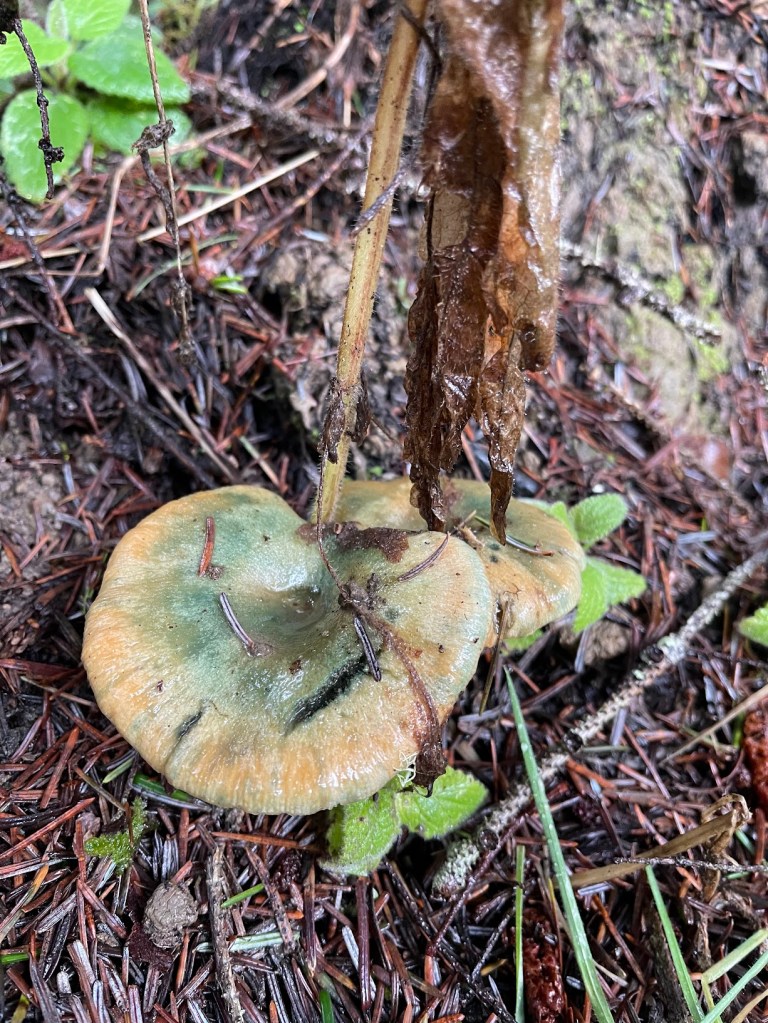
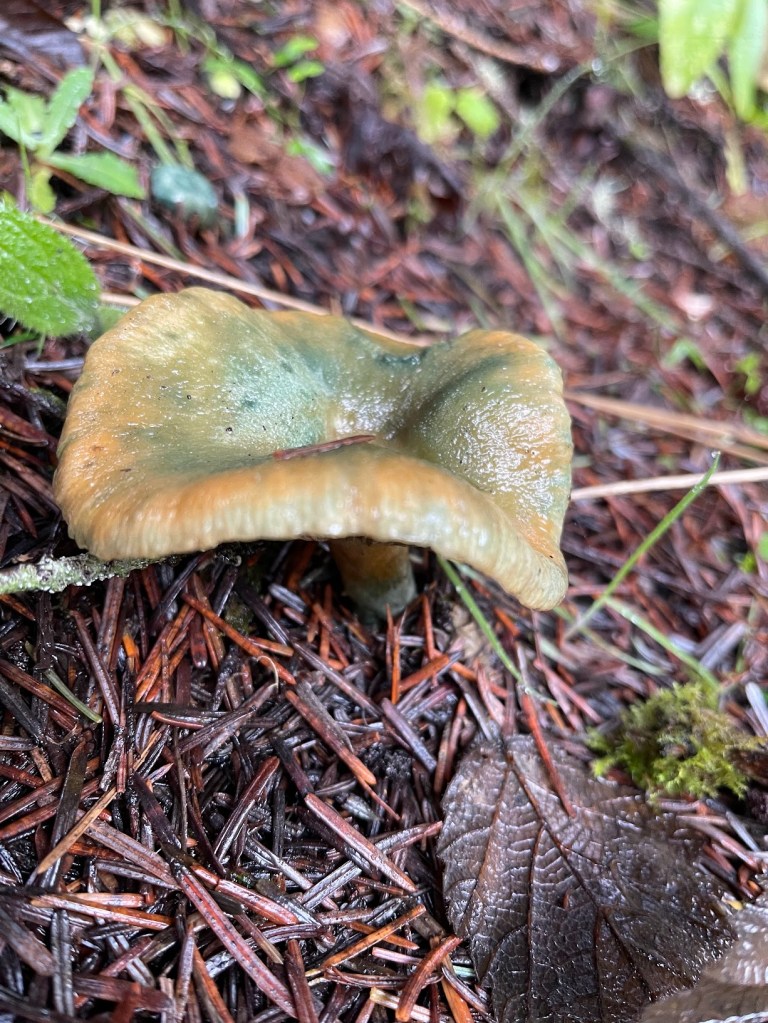
Lactarius deliciosus (Saffron Milk Cap) – Found under pine trees, this mushroom is edible and known for its distinct orange cap and gills that exude a greenish latex.
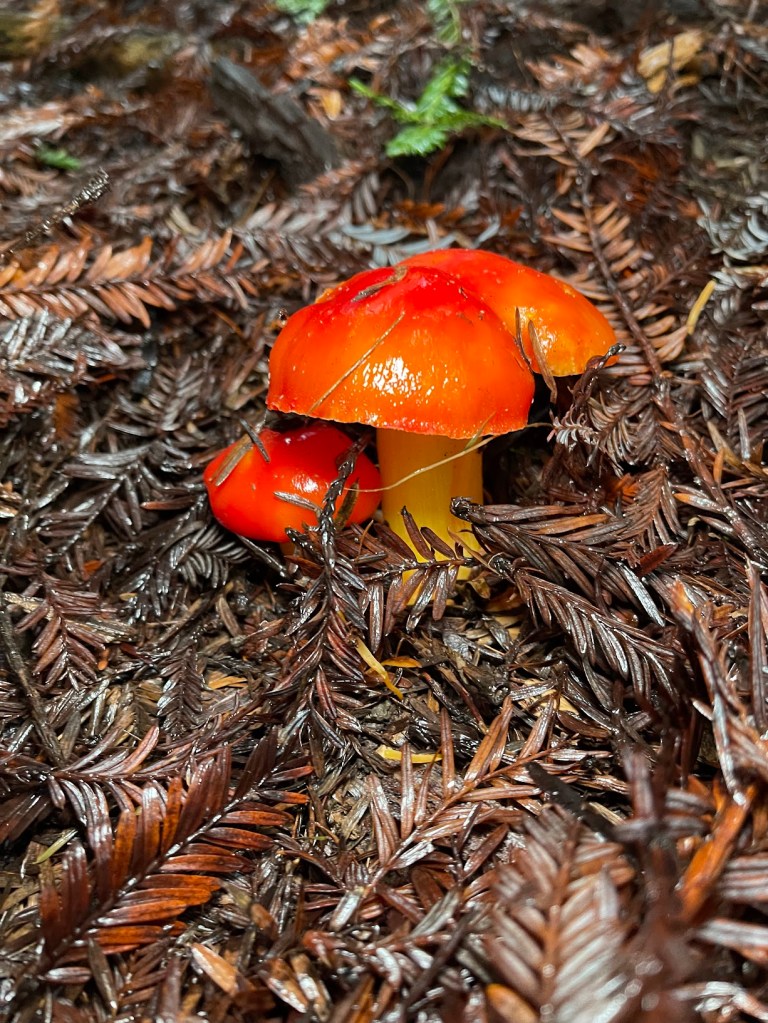
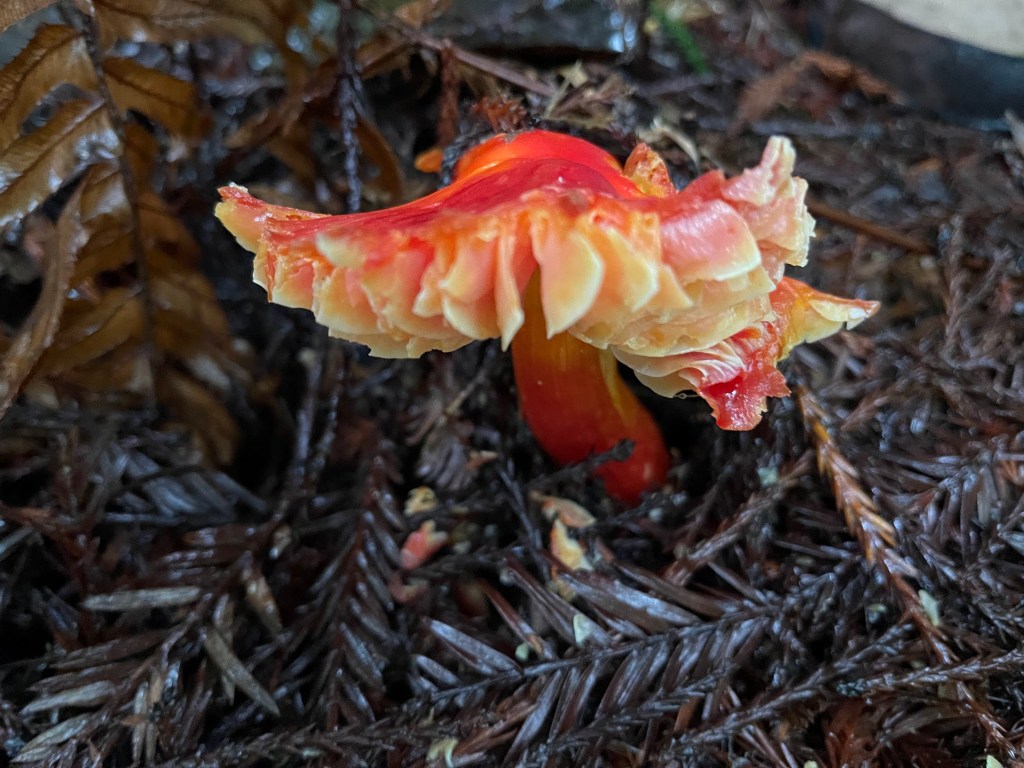
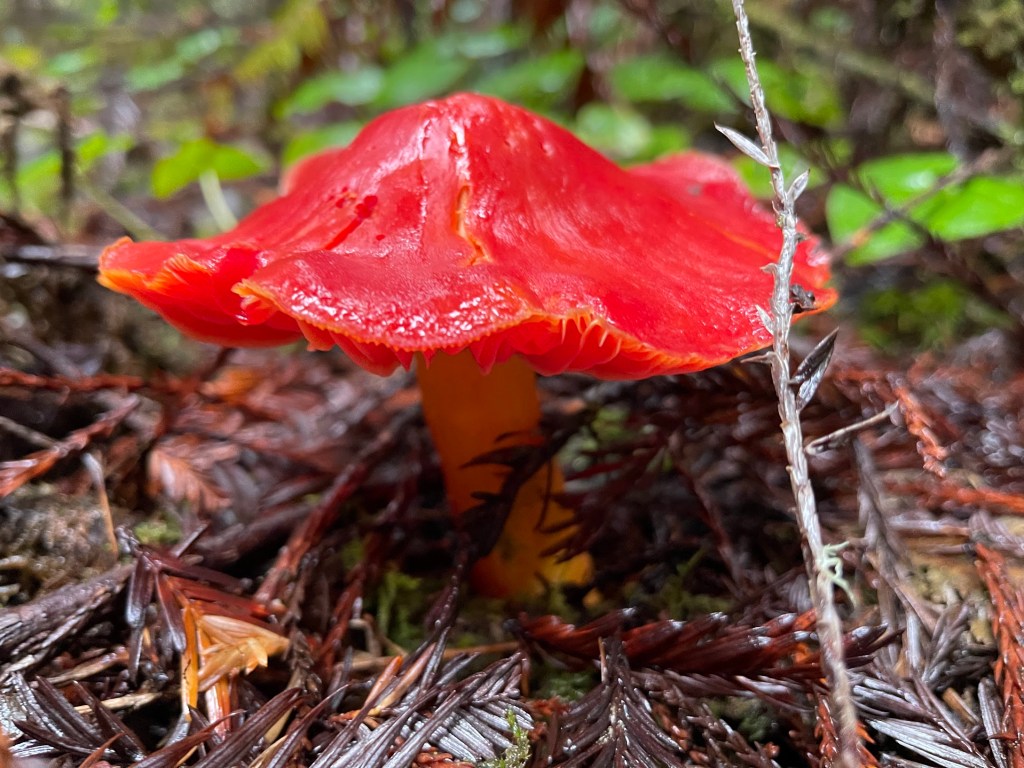
Hygrocybe coccinea (Scarlet Waxy Cap)- If you’ve been following this blog, then the Scarlet Waxy Cap (Hygrocybe coccinea), also known by its former name Hygrophorous coccineus, will likely be familiar to you. This vibrant mushroom stands out in the woods with its striking red appearance, making it a favorite for both mushroom hunters and nature enthusiasts alike.
The Scarlet Waxy Cap has a conical, smooth cap that shines in various shades of scarlet to deep blood red. When fresh, its surface is moist to the touch, giving it a glossy, waxy look that truly lives up to its name. The gills beneath the cap are a brilliant reddish yellow, broad and closely spaced, though they can become almost distant as the mushroom matures. The edges of the gills are delicate and thin, further enhancing the mushroom’s fragile beauty. These gills are attached to the stalk, and the entire structure, though thick, maintains a light and waxy feel.
The stalk of this mushroom is equally captivating—orange-red in color, it gradually becomes lighter towards the base. Its moist texture is consistent with the rest of the mushroom, and like the cap, the stalk is hollow. The spore print is white, and the spores themselves are smooth and elliptical, adding a finishing touch to the Scarlet Waxy Cap’s delicate yet vibrant nature.
This mushroom is typically found growing on the ground in mixed woodlands during the warmer months, from July to October. Its colorful and eye-catching appearance makes it a standout during foraging expeditions. However, while beautiful, this mushroom is not typically sought after for culinary purposes. Its main role in nature is as part of the intricate web of decomposers, helping break down organic matter in its environment.
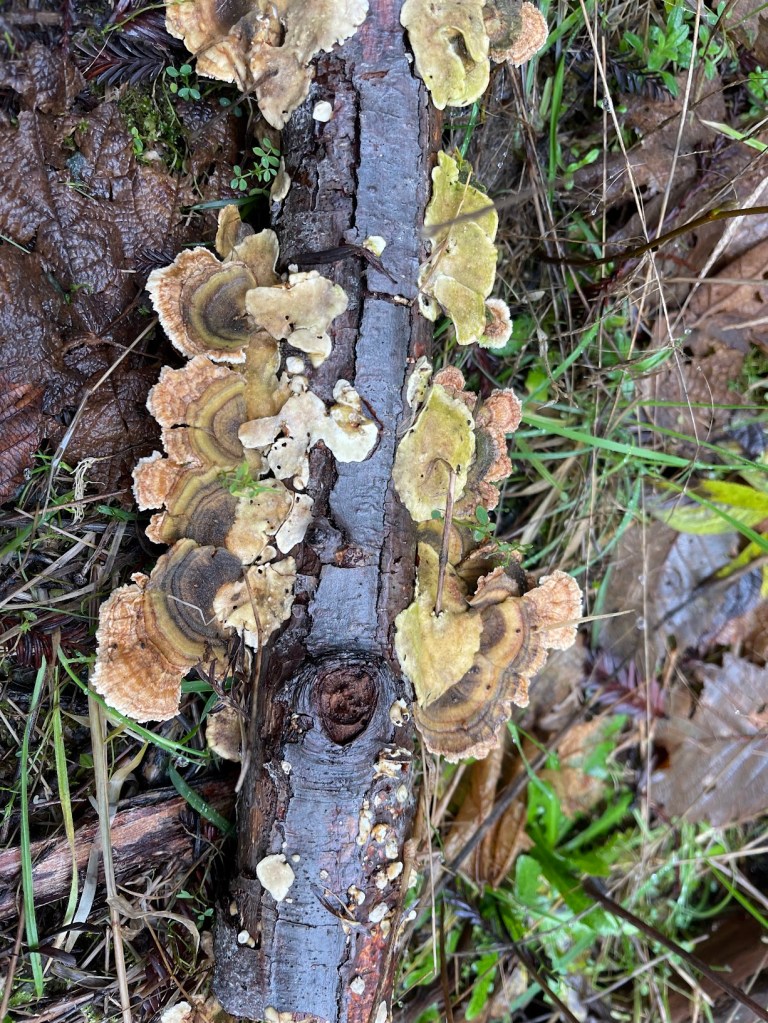
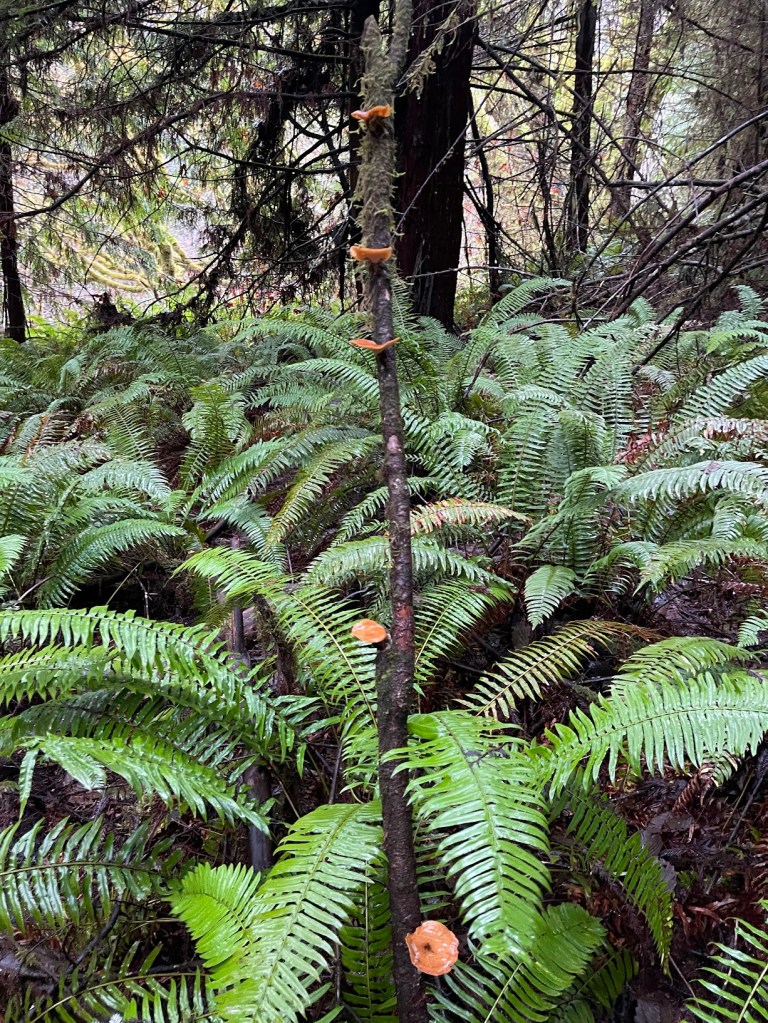
Trametes versicolor(Turkey Tail) – A bracket fungus that grows in concentric rings around tree trunks, Turkey Tail is used in traditional wellness practices and has potential medicinal benefits.
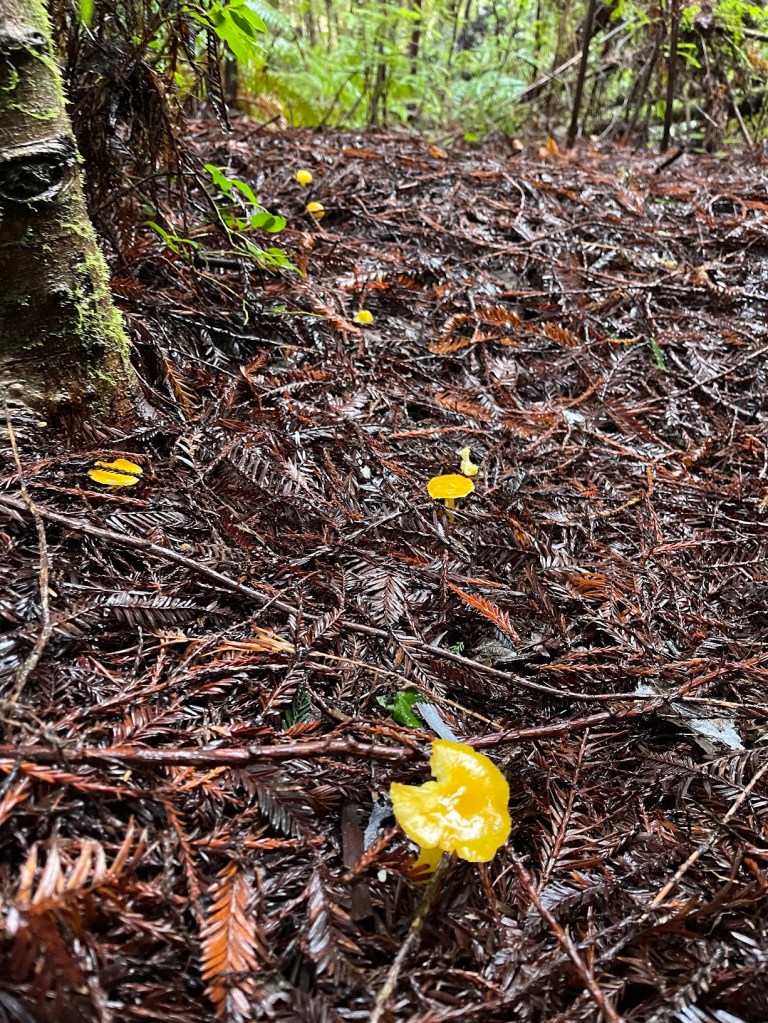
We also spotted (above) Clavulinopsis helvola(Yellow Club), a small, yellow mushroom often found in grasslands or woodland litter, and Bolbitius titubans (Yellow Field Cap), young specimen can be easily distinguished by its yellow, egg shaped cap (below).
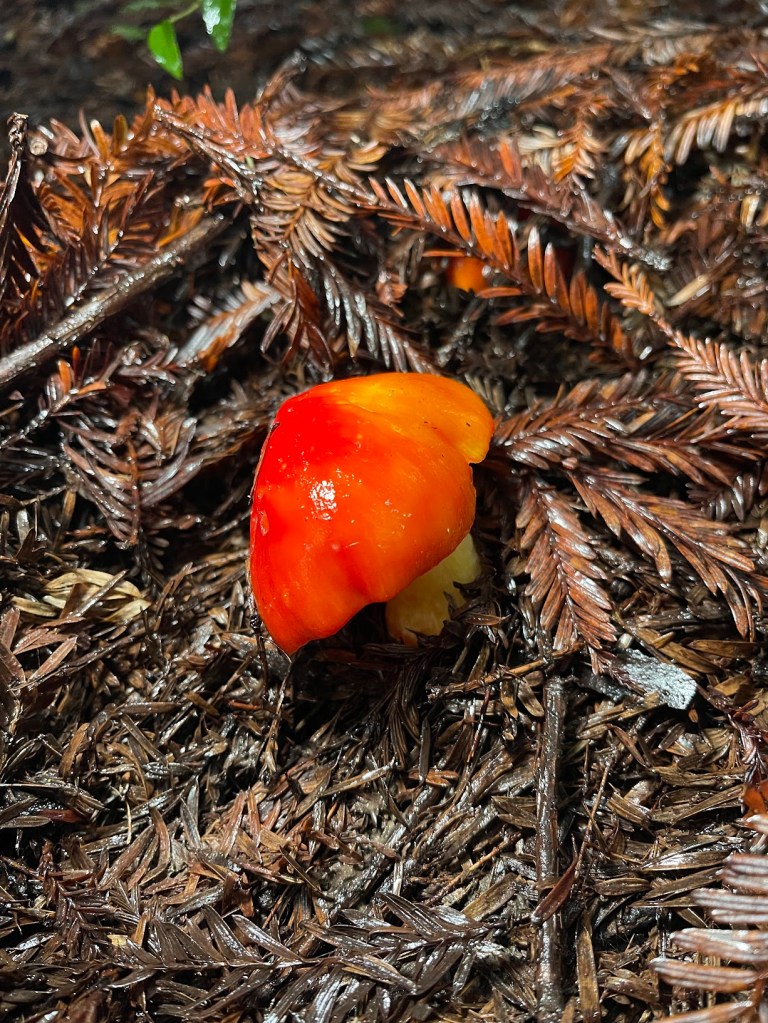
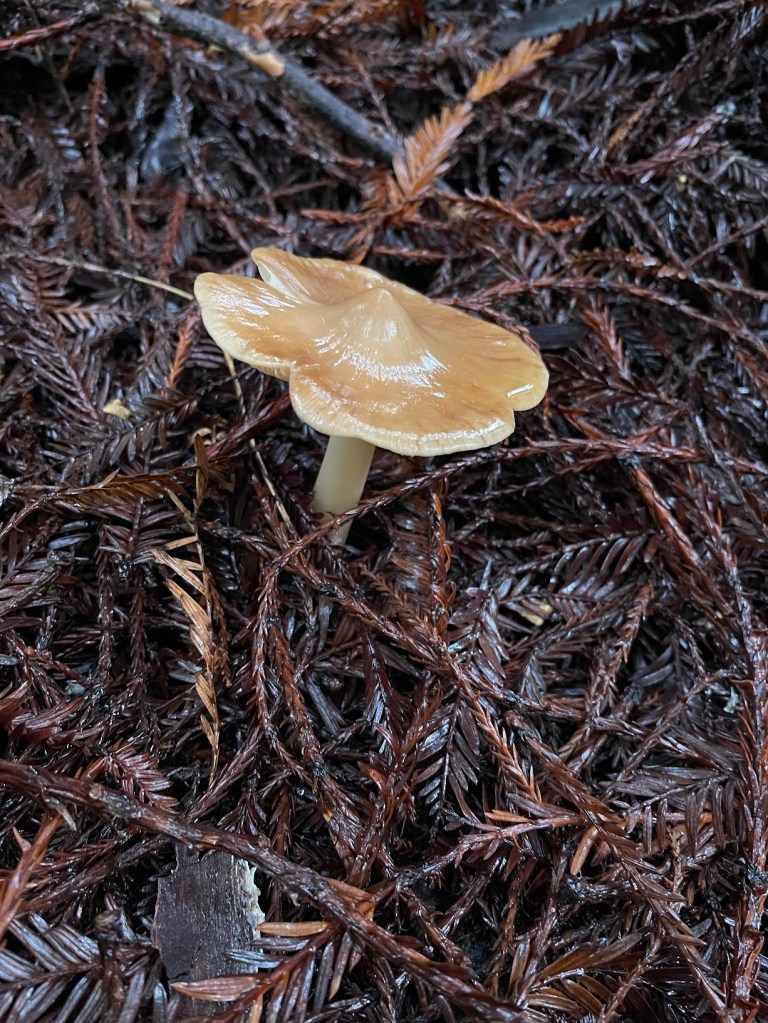
As we continued along the trail, we found more mushrooms like (above) Caulorhiza Umbonata (which you can see from the brown pointed hood) and (below) Hygrocybe punicea (Crimson Waxcap), with its vibrant red cap.
But not all mushrooms are harmless. Amanita ocreata(Death Angel) is one to watch out for. It’s a deadly mushroom that closely resembles edible varieties, making it particularly dangerous. Always be cautious when foraging.
We also discovered Turbinellus floccosus (Scaly Vase), a beautiful chanterelle with orange-red caps and unique ridges on its underside. Its appearance is striking, but it’s a reminder of the diversity found in these magical forests.
Known as the black-footed polypore or black-leg, Picipes badius is a striking mushroom with a deep connection to its environment. Its name derives from the Latin word “badius,” meaning reddish-brown, which aptly describes the dark, earthy tones of its cap. The mushroom’s most notable feature is its dark stipe (or stem), which contrasts with the lighter, brownish cap.
In its early stages, the cap starts out convex before flattening as it matures, often becoming kidney-shaped or lobed with a wavy edge. The cap’s surface begins smooth and glossy but becomes wrinkled with age, typically darker in the center and lighter towards the edges. The stipe, dark brown to black, is velvety and covered in longitudinal wrinkles as it matures.
Although Picipes badius is inedible due to its tough, woody texture, its ecological role is essential. This fungus is a saprobe, meaning it feeds on decaying organic matter, and is particularly fond of hardwoods. It thrives in temperate regions of Asia, Europe, and North America, where it contributes to the breakdown of decaying trees, playing a key part in the natural cycle of forest ecosystems.
Under the microscope, this species reveals a fascinating structure. Its spores are smooth and translucent, while its hyphal construction is dimitic, containing both generative and skeleto-ligative hyphae, which give the mushroom its sturdy texture. These tough tissues reflect the mushroom’s role in decomposing wood, as it slowly breaks down and returns nutrients to the soil.
Coprinellus micaceus, commonly known as the mica cap, is another mushroom with its own set of captivating features. This species was once classified as Coprinus micaceus but was reclassified to Coprinellus in 2001 after phylogenetic studies provided a clearer understanding of its genetic relationships.
The mica cap is a small yet beautiful mushroom, often found in dense clusters. Its cap starts off oval or bell-shaped and expands as it matures, eventually becoming convex. The cap’s surface is initially covered in shimmering, mica-like particles, which give it a glistening appearance. As the mushroom ages, these particles are lost, leaving behind a smooth cap that can range from tan to yellow-brown in color, often darkening toward the center.
What sets Coprinellus micaceus (shiny cap, the mica cap or the glistening inky cap,) apart is its unique process of autodigestion, or deliquescence. After picking, the gills of the mushroom begin to dissolve into a black, inky liquid, a process that allows the spores to spread. This transformation happens rapidly, and the mushroom can be eaten only before the gills begin to blacken. It’s this delicate balance between being edible and quickly deteriorating that makes C. micaceus such a fascinating organism.
This mushroom thrives in environments rich with decaying organic matter, particularly in rotting hardwood stumps and logs. It prefers wood that has already begun to decompose, contributing to the final stages of wood decay. Though it’s an important part of the ecosystem, feeding on the bark and softened wood, it’s also quite adaptable, often growing in disturbed areas like gardens, roadsides, and even indoors in humid conditions.
Despite its small size, C. micaceus has some impressive qualities. It is edible and often used in cooking, particularly in dishes like omelets or as a flavoring for sauces. However, due to its fragile nature and tendency to degrade quickly after picking, it’s important to handle it carefully and cook it promptly. The mushroom’s delicate flavor makes it a treat, though it can be easily overwhelmed by stronger ingredients.
The Importance of Fungi in Ecosystems
Both Picipes badius and Coprinellus micaceus demonstrate the fascinating roles fungi play in our natural world. While Picipes badius might not be edible, its role in breaking down dead wood and returning nutrients to the earth is invaluable. On the other hand, Coprinellus micaceus offers a unique combination of ecological function and culinary delight, with its ability to break down decaying wood and its brief window as an edible mushroom.
These fungi remind us that mushrooms are more than just food; they are vital players in the web of life, contributing to the health of forests and ecosystems across the world. Whether you’re an avid forager or simply a lover of nature’s wonders, the next time you encounter these mushrooms, take a moment to appreciate their beauty and their role in the environment.
The forest at Headwaters is rich with life, from the towering redwoods to the tiny mushrooms underfoot. Every hike offers something new, a deeper connection to nature, and a chance to witness the delicate balance that sustains the ecosystem. Whether you’re a seasoned mushroom hunter or just starting to explore, there’s always more to discover in this lush, thriving world.
Until next time, keep exploring and always tread with care.
Happy mushroom hunting!
Disclaimer: I am not a professional mycologist, and the content on this blog is for informational and educational purposes only. While I strive to provide accurate information about mushrooms, I cannot guarantee the accuracy of mushroom identification or safety.
Harvesting and consuming wild mushrooms can be extremely dangerous and should only be done by individuals with proper training and expertise. Misidentification can result in serious illness or even death. Always consult with a qualified mycologist or local mushroom expert before consuming any wild mushrooms.
By using this blog, you acknowledge and agree that I am not responsible for any harm, injury, or loss that may result from your actions based on the information provided here.
Foraging responsibly means prioritizing safety first!
Is the “Sacred Love Circle” deemed mature content that needs to be monitored in a family-friendly art museum?
As a secretary for the Redwood Art Association, I see art come through our doors trying to convey a message. It may be the common theme of tranquility and nature or an abstract piece with bold lines dancing in splatters across the page. Art is to the eye of the beholder, but the message is conveyed by the artist. Nudity is a common theme in the gallery, and body appreciation art has always been encouraged. A picture has been displayed called “Sacred Love Circle” by Stella Molina. The idea of censoring this piece was brought up by members. This photograph depicts the bottom half of a woman on her blood cycle. This picture is important to me and should be displayed in the art museum for the following reasons.
The women’s cycle should be honored. This should be taught to our children that a girl getting her period is a rite of passage and shouldn’t be considered taboo. By censoring a vagina on its period, we are telling young women that this is something to be ashamed of and that there is no safe place to look at a vagina on its period. It must be condemned, hidden, and labeled mature content. When a girl begins her period, she is not yet old enough for mature content.We should encourage and educate girls to accept their blood cycle instead of treating it with fear. We evoke the fear and inappropriateness of the women’s cycle when we censor this theme in our museum.
No age is too young to admit the women’s cycle is part of our everyday reality. When a woman reaches a certain age, the cycle will begin and later cease. When we can’t communicate these things to our children because we make it taboo, we teach them that the women’s cycle is something to be ashamed of, something we must not talk about, something that will get you shunned from society. When we begin to honor or cycle, young women can welcome their cycle, appreciate their bodies, and be prepared to honor and care for their bodies during the cycle.
This isn’t an issue about censoring nudity at the Redwood Art Association, I believe this is the censorship of the female rite of passage, and this enforced taboo on the menstrual cycle needs to be addressed. The more we talk about these concepts, the more we can educate our children on them, stop self-hate and change the idea of a “curse” of the body to a monthly celebration and rest period. If this piece of art brings up that conversation to the general public, then it should be kept up, and the conversation should be had.
What does “Sacred Love Circle” mean to you? Please comment below!
My name is Natascha with Humboldt counties lifestyle blog, Little Lost Forest. Today I will be talking to Adam Schluter, producer, and photographer of Hello, From a Stranger.
Hi Adam.
Adam: Hey Natascha, thanks for having me.
Natascha: How are you feeling today?
Adam: I’m feeling- I’m feeling pretty good. Honestly, I think you saw I had open heart surgery like two months ago and I just had some weird ups and downs but it’s summertime, it’s wedding season, we’re filming the show, it’s Monday Night Dinners, I’ve just been pushing it too much. I think I’ve just been an introvert crashing, hard but other than that life’s good.
Natascha: You’re looking great and you’re spreading positive energy, you are much appreciated.
Adam: Thanks, Natascha.
Natascha: Where are you talking to us from?
Adam: I’m in Coeur D’Alene, Idaho.
Natascha: Cool. How’s the weather out there?
Adam: It’s magic, perfect. Like 85 sunny but in Coeur D’Alene, Idaho you have like three months of good weather, June, July, August. September, October are usually pretty nice. You never really know. But then you have literal six months of deep pure winter. There’s six hours of sunshine during the day. It’s brutal. This area is perfect.
Natascha: Do you stay in the area year round?
Adam: No, fuck, no. That’s why I photograph weddings during the summer. I make all my income for the whole year in those three months and then I have nine months off, so I like to spend like one month in the winter because, it’s very ideal like a hallmark town. Everything shuts down, you walk everywhere. It’s like ten feet of snow a month. It’s just gorgeous. But you know if I’m not working, and I don’t have routines in place it’s really easy to succumb to seasonal depression and my mental health stuff. So, it allows me that time to travel out into the world and focus on my project which gives me a lot of purpose.
Natascha: I can understand that we have a year around cloud coverage here in Eureka. Winters can be harsh.
Adam: What do you mean year around?
Natascha: We’re right there by the bay. Right there in Eureka, not in southern Humboldt or in Oregon but right where I’m at, clouds accumulated by the water and were stuck with it.
Adam: That’s tough.
Natascha: Can you tell my audience a little about Hello, From a Stranger?
Adam: Six years ago, I lived in Mexico and I wanted to move to a place with more opportunity. I was in a long-term relationship with a girl that I loved like crazy- with all my heart. I thought we were going to get married. So, we got sponsored by this outdoor company to travel the Pacific Coast highway from the southern tip of Mexico to Alaska and pick the best place to live out of the three countries. 22,000 miles, I spent ten months on the PCH, and I chose this town where I’m living now, Coeur D’Alene, Idaho.
We spent ten months together. Every day was bliss. We were on vacation, everything was cool. We were both travelers, so everything was cool. We were running from some demons. She was really running from some demons. She was getting over drugs and alcoholism, and a whole bunch of some darkness we were running from.
So, once we slowed down and we moved into this home that I’m in right now we literally had nothing, we only had enough money for the prorated first month’s rent and the deposit- we had nothing left for groceries, for food, we had no jobs, didn’t know anyone. But we made it work, got jobs, figured it out, obviously. Once we got more comfortable those demons came back and it pulled us apart. It came to a spot where I couldn’t do it anymore and we ended up breaking up. I was in a town where I didn’t know a single person and I was way far away from my family and friends, and I moved here with this girl that I thought I was going to marry and be with for the rest of my life and now she’s gone.
I was living in Mexico for three and a half years and I didn’t have a phone, so I just didn’t know what to do. I didn’t know how to make meaningful relationships without technology in America, especially. It’s easier in third world countries. I finally hit a wall. I was going into the first winter out here and I was suicidal. I was thinking about suicide, I was actually planning it. And one day, I really just didn’t want to do it to my family. So, one day I was just looking at a world map, just kind of dreaming, still very broke, not very much money. I was waiting tables at a restaurant, but I knew I was going to die if I stayed in this house stuck in my thoughts. I just said fuck it I’ll just do what scares me the most. If it confirms my fears that I’m alone and the worlds not there, then I can still commit suicide and give up but maybe it will wake me up and get me out of my head.
I booked the cheapest flight the furthest I could away, which was Copenhagen, Denmark and almost no money left, again. I was homeless in my late twenties. It never bothered me. I’ve always lived a very minimal life guy. I don’t mind being uncomfortable. I was like fuck I need to sleep somewhere, and I need transportation. The trains- the trains are all over Europe. There’s one company, Euro Rail, that does 95% of all trains in Europe. I just started hounding them to sponsor me for it, I didn’t have a big portfolio, it was just an idea, and we went down to Fort Bay to ask the group that sponsored part of the trip. Okay I can sleep on the trains; I can move around on the trains. From there my only plan was to find the beauty in the world and try to wake myself up creatively and do what scared me the most, which was to say hello to people and to interact with people. It’s easy as a photographer to be behind the camera and photograph stuff from a distance. I was trying to wake up. I was really trying to wake myself up. I knew I had to really challenge myself.
I’m an introvert. I’m terrified of rejection. So, I was like what is the scariest thing I can do? It’s like just go say hello to strangers and try to have conversations with them. That was the base of this whole thing. Now we’re twenty-one countries in thousands and thousands of strangers, been published three times by National Geographic, there’s a Ted Talk. There’s a book and we have a second book coming out on it this year. We started filming the show last year. We’ll have a show coming up here too. It’s still a work in progress. Mental health is not like one and done, alright I’ve solved this. No, I need to continue moving this project forward. It’s because give me a lot of purpose and it reminds me of the things I need to do for my own mental health and just keep trying.
Natascha: Your story gives me goosebumps. Congratulations on moving this project forward.
Adam: Thanks, Natascha.
Natascha: Of course. Out of all the creative outlets you could have pursued what influenced you to talk with strangers?
Adam: I think- A) I was incredibly alone. I felt incredibly alone but I was surrounded by people. It was like how the fuck does that make sense- I’m sorry, I guess you can take that out- I’m surrounded by people, I feel completely alone. We have social media and people around us, but there’s no in-person depth of those relationships, and that’s hard. It’s easy to send a text but it’s hard to sit with someone. It can be awkward sometimes. And ask for help, sometimes, and to give help when it is asked of you. They really need to learn this, because the technology, it doesn’t matter how many friends I have on that. It makes me feel worse. It makes me feel more alone. Because it’s not in person. The cool thing about this, I was actually so afraid, the first night I was throwing up in my room. I was deathly terrified. And there was no turning back. I didn’t have the money to go back. So, I put it all on the line and it saved my life, but I made up this script because I thought I better sound cool approaching strangers. I have to sound like I have this all thought out and put together. The script was on approaching and saying hello to strangers all over the world but only if I saw something beautiful and, in this moment, this is so beautiful would you mind if I took your photograph? That sounds aliquant and cool. but what I found was that when I approached these strangers you have a millisecond to earn their trust. You have to decide if they can trust me, if I’m trying to sell you something, see if I’m trying to get something from you and if you think that I’m bullshit then in that millisecond you’ll just walk away. You’ll never stop to talk to me. I found that script was dis-ingenuine. And so, through hundreds of rejections. I was getting rejected 90% plus when I was using the script. I just became more and more vulnerable. I was tired and beat down, I was still trying to figure this out. And the more vulnerable I became- you know I thought as a man it was dangerous to be vulnerable, weak to be vulnerable and foolish, obviously. The more vulnerable I became, everyone started trusting me and everyone started opening up to me. Strangers are crying on my shoulder five minutes after I said hello to them, it’s like what the fuck is going on. I didn’t have to do anything. I’m awkward and goofy. I don’t have the right thing to say, there’s moments when I don’t know what to say but like- it’s read as authentic and that’s all it takes.
Natascha: Cool. How do you choose your subjects? How do you decide that a moment is beautiful?
Adam: Honestly just pure curiosity. I love to pay attention to the world around me. There are absolutely no rules to it. It’s never forced, there’s days where I’m like I should get some stories today and I’ll go out and I just don’t find anything that inspires me that day but it’s just mostly I try to inspire people to put their phones down and notice the world around them and I feel that if people did that- come here [grabs cat]- I feel that if people do that and get off of the technology I think we’ll have a much more realistic, the actual beauty of the world around us, no fluff, no over optimism, reality by itself is pretty fucking beautiful. It’s pretty fucking special. And so, I just go out into the world, I’ll pay attention and I’ll see something that makes me curious. A lot of times it’s like a person reading a book in a park, it’s a person covered in tattoos, some of that sticks out. But I’ll say this, I never approach anybody that is staring at a phone.
Natascha: [laughs]
Adam: I don’t try to be cynical about that, it’s just really there’s nothing interesting about that and I already feel that your head is going to be completely busy if I say hello to you and it’s just not my deal. I prefer people that are doing something else.
Natascha: While abroad how did foreigners view you as an American?
Adam: Yeah, really cool question. The main reason above all why I wanted to do this internationally is that I wanted to do it in places where I didn’t speak the same language, I don’t look the same as the other people that are with me. I’m doing it all in countries that I have never been to. That I don’t know the customs, the rules, the cultures, and what I’m really trying to show above all, now, is the power of vulnerability and the crucial necessity of intuition. Those two things together are enough to open the entire world to help you navigate it.
I found me by being myself, being vulnerable and being curious, it’s also- people like to see curiosity because you can see that I’m excited about something I’m passionate about it. People open up to me with that. I’ve been in some of the most complicated situations in countries around the planet, like the Jamaican story, I did this for six weeks in Jamaica. I would always be the minority. I wanted to be the minority, as a white guy to be the minority- unlike in America where I’m not. I wanted to really stick out, I wanted to earn that respect and not be able to hide at all and that’s a great example of that. We never felt those differences. We never noticed it. We’re sitting there, we’re not talking about things that divide us, we’re not talking about things that are different, we’re not talking about politics or religion, we’re talking about life and humanity and emotions and relationships and stuff that as humans we all share. Whatever the differences are we never notice them because they really don’t matter, we’re talking about real human stuff and in those conversations we both feel very human together. I’ve always been welcomed. I have only had one bad situation ever out of thirty-eight countries I think I’ve been in throughout my life. This is all spontaneous traveling. I only have plans for the first two nights, to get established and then it’s up to me to meet the communities, interact with the world, leave my comfort zone, and let them lead me to where to go next. I am very very vulnerable in these spots. And they do have chances too but I’m intuitive and that’s crucial but I’m also, the world is a pretty damn good place, it really is.
Natascha: You must be pretty street smart as well.
Adam: It comes with experience.
Natascha: If you don’t talk about current affairs, religion, or politics, do you avoid these subjects or does it not come up, does it not cause people pain and other emotions when you approach them?
Adam: I try not to set any rules to it. The problem is if we get into a political conversation accidently let’s say, I’m just very honest. I don’t know enough about politics to have a strong opinion about it and that’s by choice. Also, I’m not saying that everyone should be like that, that’s just how I am. I haven’t owned a TV in ten years. I haven’t watched the news in six months. I just blissfully go out into the world to go see the real story and see what it is for myself. I just don’t know a lot about it. If someone is- the problem with politics or religion- people have already made up their minds. They’ve already created their identities. They already know their speech, they know exactly-there’s no balance to that. Most of the time, like 95% of the time, there’s no doubts to those conversations. It’s I know this, and this is this, and that’s how it’s going to be. There’s nothing for me to learn from in that. I learn a little bit but there’s nothing for them to learn also. Those conversations aren’t very connected. If they do come up, I’ll stop it or I’ll let someone do a rant. If it just continues to not be balanced, I’ll just wish them a nice day and walk away.
Natascha: Are there any common topics or themes that arise in conversations?
Adam: No not at all, honestly. A very broad one, I love to talk about relationships. I love to talk about what inspires people, what they do outside of their jobs that give them inspiration or purpose. I love to talk about families, because I’m really trying to learn about those things. A lot of this is me being curious to help myself learn how to continue growing. I’ve never been married, I don’t have kids, I would love those things. I’ve been through some really tough relationships and I’m trying to learn from other people on how to make sense of that but it’s also a way for me to learn about myself too, in conversation. I’ll tell you this- the secret sauce to this is people know when I’m talking to them that my mind is totally clear. They know that I’m listening. They know that I am genuinely there, present in that conversation and that’s what allows people to open up to me so much because they know that I’m listening. If I had bullet point questions, oh yeah there’s that sound snippet – okay, next! They won’t tell you anything. And that’s fair, I shouldn’t. I’m not really listening. But I really am listening and there’s no format to the conversation and that’s why they go so deep.
Natascha: What are some fears or passions you’ve heard of?
Adam: That’s a great question. Passions are very individual and unique. I’ve just heard millions from juggling to painting to, I hear lots of music, to being a mom. Really beautiful stuff. I just love to hear all the stuff that people are passionate about because it inspires me to continue trying to find them myself. Fear is a lot more- there’s definitely a dread in the entire world right now of fear about life as we know it changing so dramatically so as a global humanity, as a global society, whatever you want to call it, were breaking apart. And so there’s a lot of loneliness that is felt all over the world, everywhere I go. There’s less in third world countries because those are really built on relationships because there’s poverty and poverty doesn’t have much besides the relationships. There’s deep, deep, deep understanding being communicated about technology creating a bit of a chaos that we don’t know what to do about. And the world’s very scared of that. What it’s doing to relationships to communication, friendships to love, and daring. The addiction, people don’t really know what it’s going to continue doing to us. It’s just taking us away from each other in person, so I think we’re going to see a lot of the damage that it causes.
Natascha: Thank you for sharing. Can we talk about your hardware for a second? What is your favorite camera and lens for portrait photography?
Adam: Great question. I always use only one lens ever, for my entire project and it is a Sigma R rig 50 ml 1.4 lens. I’m cheap and I travel light. I just mastered that lens. And I’ve always used ninety-nine cameras. I’ve had a Nikon, D7000, but this project has always been on the D750 and I moved it to the Nikon Z6 last year and it’s made my job incredibly easy. What’s so helpful about having the exact same camera and lens for the entire thing is- I’ve always seen the world in pictures. I’m cursed as a photographer, a lot of us are. I already see the exact picture. I don’t need to take out the camera, I don’t need to take out the lens, I don’t need to look through it. I know the lens so well, it’s like in my eyes so well that it saves me a lot of time and also, I already know exactly what the picture is going to be. If it is something real quick, like holy shit this is an amazing shot, I can get it in to take a picture in two seconds I can get the picture and then we can get into conversation. It helps me a lot.
Natascha: Nifty, cheap and trustworthy.
Adam: Yes.
Natascha: I know we’ve talked about this a bit but what is your stance on the social media dilemma?
Adam: I think that it’s the end of the absolute foundation of relationships that is absolutely critical to us being able to move forward. We’re already seeing it, I mean suicides of despair are down to the age of eight now. There’s eight-year old’s committing suicide. It is so heartbreaking.
An example of that is, I was photographing a wedding and there was this adorable girl, she was eight years old too. She had this little dress her mom gave her and we were all running around. And I said, Hey! Let me get this shoot, it is such a beautiful shot of you. I went to take the pictures and she says, no! Not this side of my face. I only like this side of my face. And I was like, you’re eight years old, where did you get it? She was like, my mom says it all the time. And I see it on TikTok all the time. Children are mimicking what they’re seeing.
I didn’t know when it got cool to be so self-critical. Somehow it got cool for people to feel ugly and talk about themselves poorly. If we don’t have self-confidence then- it’s not ego, it’s self-confidence. It’s like pride in the person that you are. You don’t have to have the best body or be the most beautiful person in the world. Just being okay with who you are. It takes some self-work and that’s a gift we should give ourselves and to the world around us but right now that’s just not the norm. The norm is self-criticism, self-deprecating, belittling ourselves. That’s a bit of cancer to other people around us because then other people around us are like hey that persons beautiful, then I’m ugly. They think they’re ugly then I have to be ugly. There’s no end to that.
So that all being said, with this insane addiction that didn’t exist a few years ago, where people wake up with their phones and they go to bed with their phones, everything in the present moment has been lost. And obviously, the less present we are, the more anxious we are, more depressed we are, the more chaotic we are, we’re not planning on the future, we’re not thinking about people that are right in front of us in that moment everything is expedient, everything needs to be fast. And the most important parts in life are not fast. Love is not fast; relationships are not fast. Like communication is not supposed to be fast. And now I feel like I need to jam in a thirty-minute scheduled time with my friends just to catch up on how life is. We can’t live like that; people are dying because of that and have been. It’s just getting worse and worse every day.
Natascha: Thank you. How do you suggest breaking down barriers within a community?
Adam: I think that’s an easy one, I mean A) barriers are obviously constructed on pride, again, whatever barriers have come in between connections has to come from us swallowing our pride first. And so, the only reason that I wouldn’t go out and try to connect with the community and the people around me is if I was being prideful. Like oh man if they reject me, I’m going to be hurt by it or I’m going to be mad about it, so we think about ourselves so much that we end up not doing what the world needs us to do. To help the world out also, so.
For me, breaking down those barriers is forming relationships and conversations that are vulnerable, authentic, but also not focusing on those things that divide us. I mean, because that is just too easy to do and those are based on identity. Not based on who that person actually is. A lot of people right now with social media, all the stimulus and technology, they don’t really know who they are, they don’t really give themselves the time to find out who they are. They latch on to an identity, this is who I am, this is how I think, this is what’s right, this is what’s wrong. Again, there’s no balance to that. Focus on what’s behind all of that. It’s like who are you really and what do you love? What scares you? What inspires you? And not just question, question, question, because that’s not balanced. It’s like telling them about you also, like really having a balanced conversation. It allows people to have this foundation of trust, that all those barriers just melt away.
Natascha: Good. How do you see conversations with strangers as a healing tool? How can a person overcome their own barriers and talk to a stranger?
Adam: Yup, well however to overcome your own barriers, it’s kind of related to the question before. But again, just try. Like that’s honestly all I can say. What do you have to lose other than your pride? Just try. Hey, I want to talk to that girl. Hi, my name’s Adam. How are you? Hi my name’s Natascha. Nice to meet you. Hey ya’- I’m really busy right now, I can’t really talk. Okay, no worries. And then you learn a little bit. Have a nice day, I just wanted to say hello.
Also, I’d say appear to people without expectations and without an agenda because people can feel an agenda, too. So that’s important, to have an open personality when you approach someone. I think the most healing part of conversations with strangers is this understanding that I saw you. Everybody sees you, and we know that everybody sees us. So rarely do people interact with the world around them that even though everyone sees us, we still feel alone. And so, here’s an idea, I saw you, I said hello to you, and I was vulnerable with you. It’s very scary to do but now I know that you see me. And now we’re going to have a real conversation and we’re both going to walk away from that feeling less alone and more connected to the world around us but also understanding that each and every day we can do that. It might be hard, it might not work, it might be awkward sometimes. But we can do that. So now we have that understanding, we’re back in our home or apartment or whatever and our mental health is having a bad day we know what to do about it. Now if we do it, that is up to us but we at least know something that we can do to help.
Natascha: Do… you believe in BigFoot?
Adam: Oh, that’s a cool question.
Natascha: We are big believers here in Humboldt County.
Adam: I was going to say no. But I’ll just say no because I don’t know enough about it. To not know definitively but know I haven’t researched and don’t know enough about it. I watched I’m All Gas No Breaks on the BigFoot rally, it was pretty revealing but I don’t know enough about it. Do you believe in BigFoot?
Natascha: Yeah, yeah. They are interstellar type of beings that can be- not necessary here all the time, kind of jumps through dimensions type deal. I have another Humboldt County question for you, any stories that relate to pot farms for marijuana enthusiasts.
Adam: Oh man, I can do a whole movie on my time there. I mean the whole thing was so wild. We lived in Clear Lake, but it was off the grid in the wild, this was like twelve years ago. It was like the wild west. Those people are recreational. It was like you can have ninety-nine plants with a doctor’s order, if you had one hundred it was a federal felony so like ninety-nine plants. There were no police because Fish and Game Conservation were the closest thing to police that we had. You’re on your own fucking island. Out in the middle of nowhere. Lots of money in the house, lots of weed plants in the house, you have guns in the house, it was wild. And, toward harvest time there’s like no protection, you know, there’s no regulation. Everyone would do these twelve-hour shifts and there’s people sleeping on patios with shotguns. There were these two sixteen-year-old kids that were out there, and they came out on four wheelers. Not on our farm but the neighboring farms, grabbed a bunch of plants and the people from the farm chased them down and the kids accidently drove off the cliff on the four wheelers and killed both of them. It’s the wild west. There’s a lot of- you probably want more of an optimistic story, but you know.
Natascha: That’s a common story unfortunately.
Adam: Yeah, it is. A lot of boredom really, so fucking boring. You’re trimming ten hours a day, and it was before cell phones were big. You get bored of it. Everybody’s on drugs, a lot of people are on drugs because of the boredom, and I never did drugs. I smoked pot and ate mushrooms. I love those two things, a lot. But I’ve never done hard drugs. And everyone’s on some real hardcore drugs. We had people overdosing. One of our closest friends, out there, OD’d and died. It’s just boredom. People really don’t know what the fuck to do. They’re really just sitting in the house together doing nothing at all. Every once in a while, there will be cool stuff. Like one of the owners of the farm who would never talk to us like the trimmers and the people in it, but he’d come in and he was this very ominous figure. He was nice. He’d go up to the kitchen and sterilize every single thing in the kitchen and nobody was ever allowed to go toward the kitchen. He would put on Grateful Dead, and he would stand there for like twelve hours and he’d just be silent. You know never say a word. We’re all feeling his presence. And then he would walk away without a word, and we’d never see him again. So, there’s just interesting characters.
Natascha: Yeah, yup. My zoom is cutting me short. It says I have three minutes remaining unless I upgrade to pro, which was unexpected. Can you just tell us what you plan on doing next?
Adam: In my personal life I am starting to date for the first time in my life. Really trying to figure out relationships. It’s kind of complicated for me, for the reasons that we talked about before. With my show, my project, we just sold forty percent of it to a major production studio and now we have a major team that is taking, really my team- which is just my director and my camera man, two close friends of mine, and were all merging forces. The next six weeks we are creating our new trailer and we’re taking that too market to sell the show. Which we expect it to sell. Hopefully in the next two to three months we’ll have the show sold and you guys will be able to see what it looks like.
But for my Monday Night Dinners, concept which I do in just Coeur D’Alene, I’m going to be taking it on the road this winter. The idea is to put me in a new city, new country, new place, anywhere in the world. I have two weeks to be there. I have to meet all the strangers but everyone that I meet, every stranger that I met and have a story, I’m going to invite them to have dinner on the end of that trip, two weeks down the line because I always wanted to leave the cities and countries more connected after I leave because, you know, I’m meeting these people and then I just leave. I want to put you all around a table together and I want you to meet each other too. Because of my time there, because of all of our time together, we’re just connecting the world, bringing it a little closer together with every place we visit. Hello, from a Stranger is merging with Monday Night Dinners and that would be the actual show. Some really cool stuff. I’m very excited for them.
Natascha: Alright Adam. Thank you so much for sharing with us. These are some beautiful projects you got going on that are very inspiring and feel good. Looking through your art makes me feel- good.
Adam: Thank you, I appreciate you looking at it and I appreciate this time I really do! It’s an honor and an opportunity. I just want to spread it and remind people that they can do this too. I actually need them to do it because I’m only one person and it’s a big world out there.
Natascha: Thank you, readers, for checking in at Little Lost Forest. Please check out our IG @littlelostforestart. You can find Adam Schluter at hellofromastranger.com and purchase his book at hellofromastranger.com/orderthebook. 100% of all sales go back to the humanitarian mission.












 Little Lost Forest