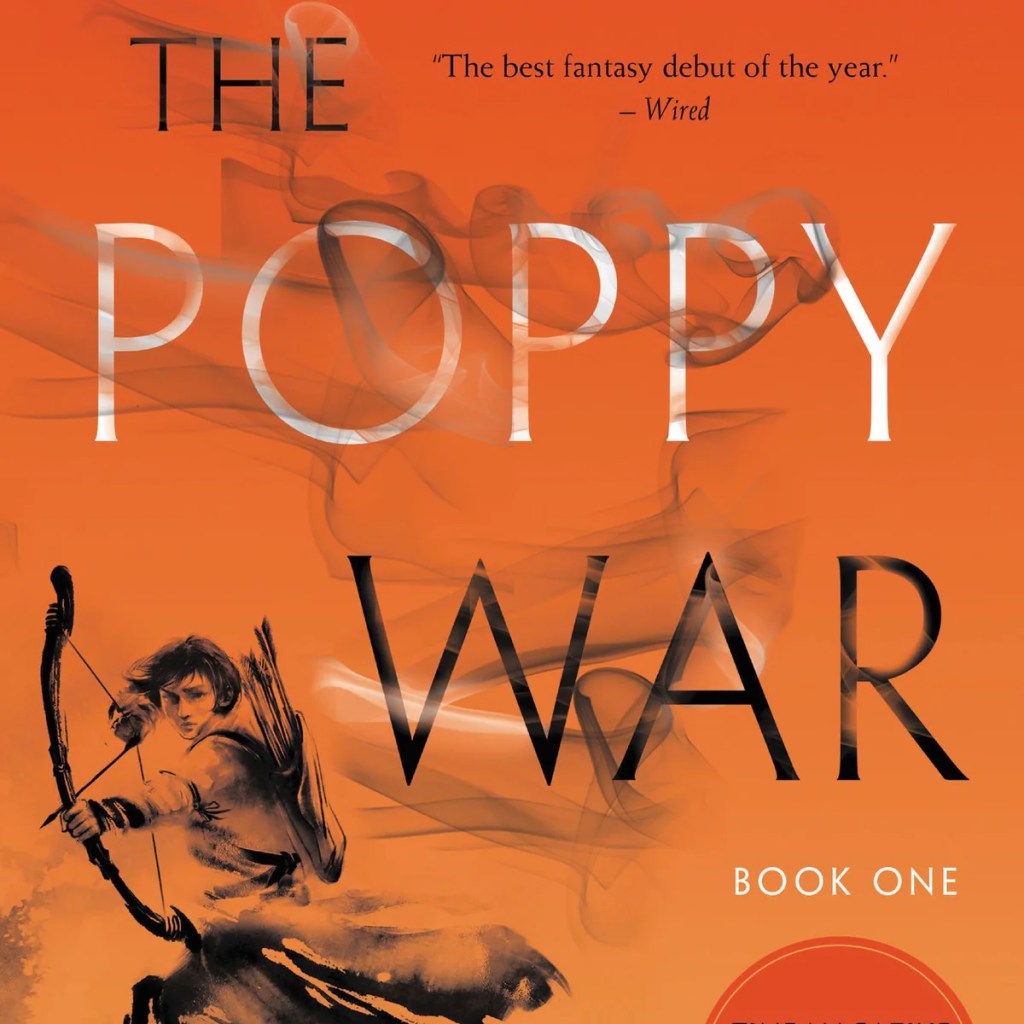
The Poppy War — Opium, War, and the Illusion of Power


Kuang, R. F. The Poppy War. Harper Voyager, 2018.

The Poppy War by R. F. Kuang is a military fantasy novel deeply inspired by the Second Sino-Japanese War, exploring imperialism, genocide, addiction, revenge, and the cyclical nature of violence. Through the journey of Fang Runin (Rin), Kuang examines the devastating cost of power and the illusion that destruction can ever fully solve suffering.

Rin begins as a poor orphan raised by adoptive parents who profit from smuggling poppy products. In order to escape being married off to an older man, she studies obsessively to gain entrance into Sinegard, an elite military academy. Once there, her intelligence does not make up for her lack of combat training, and she is repeatedly targeted for being from the countryside. Alienated from the academy’s traditional paths, she becomes drawn toward Master Jiang and the world of shamanism, opium, and the gods.

Master Jiang explains the spiritual potential of the poppy seeds:

“These seeds are a shaman’s dream… used with the proper mental preparation, give you access to the entire universe contained within your mind” (47).

The poppy becomes more than a narcotic within the novel. It functions simultaneously as a spiritual gateway, a destructive addiction, and a metaphor for war itself.

War as Addiction

One of the strongest literary elements within The Poppy War is metaphor, particularly the relationship between opium and warfare. Throughout the novel, fire, the Phoenix god, and narcotics become emotionally intertwined. Rin gains access to incredible power through shamanism and the Phoenix, but every use of that power consumes her further.

When Rin first unleashes the Phoenix during battle, Kuang describes the fire almost like a drug overtaking the body:

“The fire billowed outward with a vengeance… She controlled the flame no more than the wick of a candle might” (252).

The power is intoxicating, overwhelming, and impossible to fully control. Just as opium offers a temporary escape while destroying the user, war offers the illusion of victory while consuming entire civilizations.

This metaphor becomes even more explicit later in the novel:

“But something so destructive inherently and simultaneously has marvelous potential” (192).

The same logic people use to justify opium is often the logic nations use to justify war: destruction becomes acceptable if it promises power, safety, revenge, or transformation. Yet both ultimately leave devastation behind.

Rin herself fears losing control to the fire in the same way someone fears surrendering themselves to addiction:

“She didn’t want to admit that she was scared. Scared of being in a state where she had little control of herself” (321).

Even Altan, who claims mastery over the Phoenix, eventually reveals himself to be entirely consumed by it. His use of power has become normalized to the point that he no longer recognizes it as a form of dependence. The novel subtly suggests that trauma, violence, and addiction can become inherited cycles passed through generations, particularly through Rin and Altan’s shared history as survivors of Speer.

The Gods Do Not Choose — We Do

The novel’s climax becomes devastating because Rin ultimately chooses annihilation. After witnessing unimaginable violence and genocide, she calls upon the Phoenix and destroys the Mugenese completely, including innocent lives alongside soldiers and political leaders. Before she acts, she is warned:

“To give your soul to the Phoenix is to enter hell” (499).

And afterward comes the novel’s most important line:

“The gods choose nothing. You chose” (502).

That line reframes the entire story. The gods, addiction, war, and fate are not solely responsible for destruction. Human beings still make choices within systems of violence. Power does not remove accountability.

This deeply connects with themes in my own writing in Discordia, particularly those surrounding Eris, the Kalonox, and the golden apple metaphor. Reading The Poppy War helped me think more deeply about autonomy, tyranny, and the illusion of destiny.

In Greek mythology, Eris uses the golden apple to create discord by appealing to vanity and self-interest. Eve’s apple similarly represents knowledge, disobedience, and autonomy. In Discordia, the Kalonox draws inspiration from both symbols. The oppressors pursue power, believing it will give them control over reality itself, while the deeper truth may be that liberation only happens when people stop waiting for gods, rulers, or destiny to save them.

Like The Poppy War, I want the story to suggest that fate is not something handed down by divine power. The gods do not create reality alone—people do. Tyranny survives because people fear standing alone against it. The Kalonox, therefore, becomes less about ultimate power and more about exposing the selfish desires of those who seek it.

What I take from Kuang’s novel for my own writing is the strength of layered metaphor. The fire in The Poppy War is simultaneously war, addiction, trauma, rage, power, divinity, and destruction all at once. The metaphor works because it exists emotionally, politically, spiritually, and personally throughout every layer of the narrative.

Sleeping in Flame — Reincarnation, Manifestation, and Breaking Cycles


Carroll, Jonathan. Sleeping in Flame. Doubleday, 1989.

Sleeping in Flame by Jonathan Carroll is a surreal fantasy novel that reimagines the fairytale of Rumplestiltskin through themes of reincarnation, manifestation, gender roles, generational trauma, and memory. Set largely in Central Europe, the novel follows Wilson, the stolen son of a beautiful woman who once manipulated a magical little man named Breath in order to gain the love of a king. Breath loved Wilson’s mother deeply and willingly used his magic to help her, turning hay into gold so she could rise into royalty. But after gaining power and status, she rejected him completely. In retaliation, Breath claimed her firstborn son and raised him himself.

Unlike the traditional fairytale, however, Breath becomes far more emotionally complicated than a simple villain. He loves Wilson like a son, teaches him magic, and raises him across multiple lifetimes through reincarnation. Yet that love becomes possessive and destructive. Every time Wilson grows old enough to fall in love or begin a life of his own, Breath kills him and reincarnates him again, unable to let him go.

The novel moves fluidly between past, present, and future, slowly revealing how memory and identity bleed into one another across lifetimes. Wilson begins recovering memories of previous lives while becoming aware of the emotional manipulation and loneliness that drive Breath’s actions. To break the cycle, he must eventually remember Breath’s true name. Ironically, Breath had always wanted to be known and understood. The mother never asked for his name, even though he would have given it to her freely.

Manifestation and the Present Moment

One of the strongest themes in this novel is manifestation and the power of focused thought. Breath teaches Wilson that magic depends on specificity and intention. Even the smallest overlooked detail can alter the outcome of a wish. Carroll uses magic less as spectacle and more as an extension of consciousness itself.

A particularly powerful scene takes place during the Nazi occupation of France. A German soldier enters a classroom searching for Jewish children. Although he knows the children are being taken to their deaths, he sees them as innocent and beautiful rather than monstrous. Without realizing it, he unconsciously uses magic to save them:

“Without them doing anything, we watched them fly away over a purple field of lavender” (136).

The moment feels dreamlike and devastating at the same time. It raises difficult questions about free will, morality, obedience, and human choice during times of tyranny. Would people choose compassion over orders if they truly understood the consequences of their actions? The soldier himself does not even fully understand what he has done. When he later asks where the children and teacher disappeared to, another boy responds playfully:

“The boy giggled and threw up his hands as if they were full of confetti” (136).

The scene captures how manifestation in this novel often occurs unconsciously through emotion, desire, or instinct rather than deliberate control. This is deeply connected to themes within my own writing surrounding resistance, moral awakening, and the question: When do we rise against tyranny?

Love, Memory, and Reincarnation

Maris, Wilson’s lover, becomes one of the emotional anchors of the story. As a child, she builds intricate LEGO cities, creating detailed worlds that others dismiss or fail to understand. Building cities becomes her way of grounding herself in the present moment. Later, she creates a detailed image of medieval Vienna for Wilson without realizing its connection to his past lives. Vienna is the city that Breath repeatedly reincarnates him throughout time.

Maris leaves Wilson a note reading “Breathing you,” a phrase that ultimately helps him remember Breath’s name and unravel the cycle controlling his life. Carroll writes:

“When you love someone deeply, you know secrets they haven’t told you yet” (253).

That line beautifully captures the emotional core of the novel. Love becomes tied to memory, intuition, and recognition across lifetimes. The novel suggests that people carry emotional traces of one another through time, even when they cannot consciously explain why.

Generational Trauma and Gender Roles

The story also explores gender roles and inherited emotional wounds. Breath’s obsession with Wilson’s mother stems from rejection and humiliation. Instead of healing from that rejection, he transforms his pain into manipulation and control, continuing to haunt both mother and son across generations. At one point, he says:

“I’d go back to her in her dreams… We’d show her what she was missing” (208).

What begins as heartbreak evolves into possessiveness and emotional cruelty. The cycle of masculine control and manipulation becomes an inheritance, repeated over time. In many ways, the novel mirrors the same themes of generational trauma and gendered violence I saw explored in Grace by Natashia Deón, where harmful gender roles continue echoing through families and relationships across generations.

What I take from this novel for my own writing is the idea that the past, present, and future constantly consume and inform one another. Carroll shows how memory, breath, love, trauma, and identity move through generations almost spiritually. More importantly, the novel suggests that awareness, presence, and emotional honesty may be what finally breaks inherited cycles.