Amrith, Sunil. The Burning Earth: A History. W. W. Norton & Company, 2024.
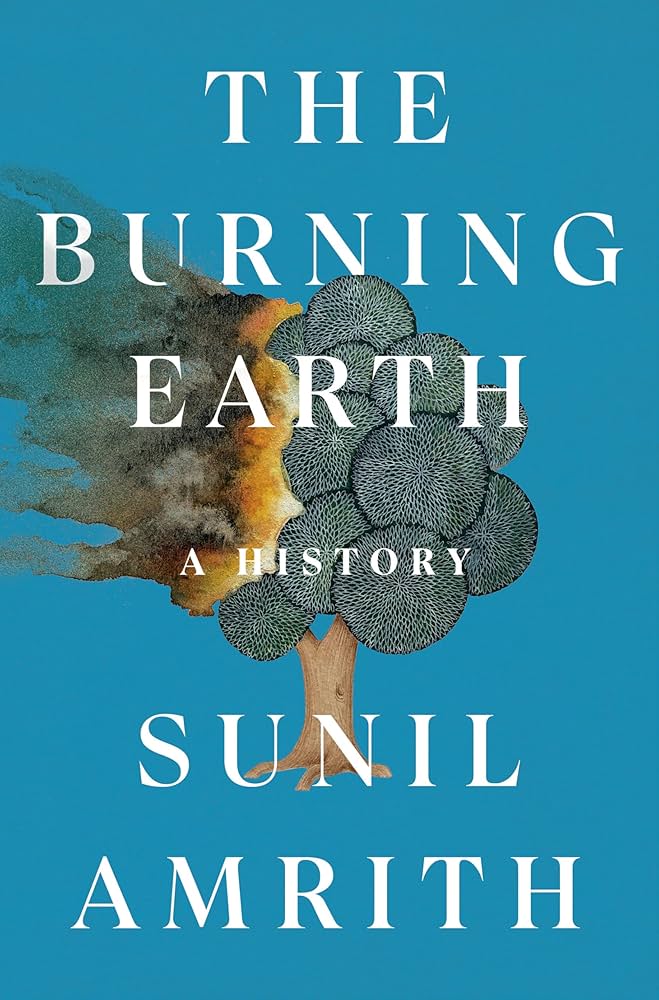
The Burning Earth by Sunil Amrith is a historical examination of climate change, empire, war, and humanity’s relationship with the natural world. The book explores how rising populations, industrialization, greed, and global conflict directly reshape the environment, while environmental collapse simultaneously reshapes the human condition. Throughout the text, Amrith presents history as deeply interconnected with nature rather than separate from it.
One of the most compelling ideas within the book is the danger of believing that technology alone can solve climate collapse. Amrith discusses the concept of the technosphere, humanity’s attempt to “engineer the climate itself” (331), while warning of the consequences that follow: “species loss, the depletion of fresh water, assaults on the forests and the oceans—and reducing the incentive for the wealthy and the powerful to change their behavior in any way” (332). The book repeatedly returns to the idea that those in power often exploit both land and people while avoiding responsibility for the damage left behind.
War Against Nature
A major theme throughout this book is Man vs. Nature, but also the illusion that humanity exists separately from nature. Amrith argues that environmental destruction and human suffering are directly intertwined. Civilization expands, consumes, wages war, and extracts resources while ecosystems collapse alongside it. He writes, quoting Hannah Arendt, that “earthly nature, for all we know, may be unique in the universe in providing human beings with a habitat in which they can move and breathe without effort and without artifice” (252).
This quote deeply resonated with me because it reinforces how fragile and rare our planet truly is. The Earth is not simply a backdrop to human history but the condition that makes human life possible at all. Throughout history, conflict between rulers and the ruled, empires and indigenous peoples, industrialization and sustainability, has repeatedly led to environmental collapse alongside human suffering.
Amrith traces these patterns through multiple eras of history. In 1426, Portuguese colonizers burned the forests of Madeira for sugar plantations, destroying ecosystems alongside local culture and community. During periods of empire and expansion, gold, oil, and resources fueled war while forests, oceans, animals, and entire ways of life were erased in the process. The industrialization of warfare only accelerated this destruction. “War machines were thirsty for oil” (171), Amrith explains, connecting environmental extraction directly to global violence and political ambition.
Discordia and Environmental Tyranny
This book strongly reinforced the central themes within my own novel, Discordia. My thesis asks: How does tyranny affect our environment? And beneath that: When and how do we rise against tyranny?
What The Burning Earth helped crystallize for me is that war, environmental collapse, and the human condition cannot truly be separated from one another. As long as we treat issues like sustainability, politics, war, and social inequality as isolated problems, the destruction continues to spread outward into every part of life.
One of the most haunting passages in the book describes wounded soldiers during World War II, comparing modern warfare to mythological monsters and apocalyptic visions. A Punjabi Rajput soldier wrote, “This is not a war… this is the end of the whole world” (172). That line captures something deeply relevant to our present moment. Environmental destruction is not disconnected from political violence or greed; they are reflections of the same imbalance.
This book ultimately reminded me that humanity behaves as though it stands above nature, when in reality, we are part of a singular living organism. To harm the planet is to harm ourselves. Healing the environment also requires healing the systems of violence, exploitation, and tyranny that continue to consume it.