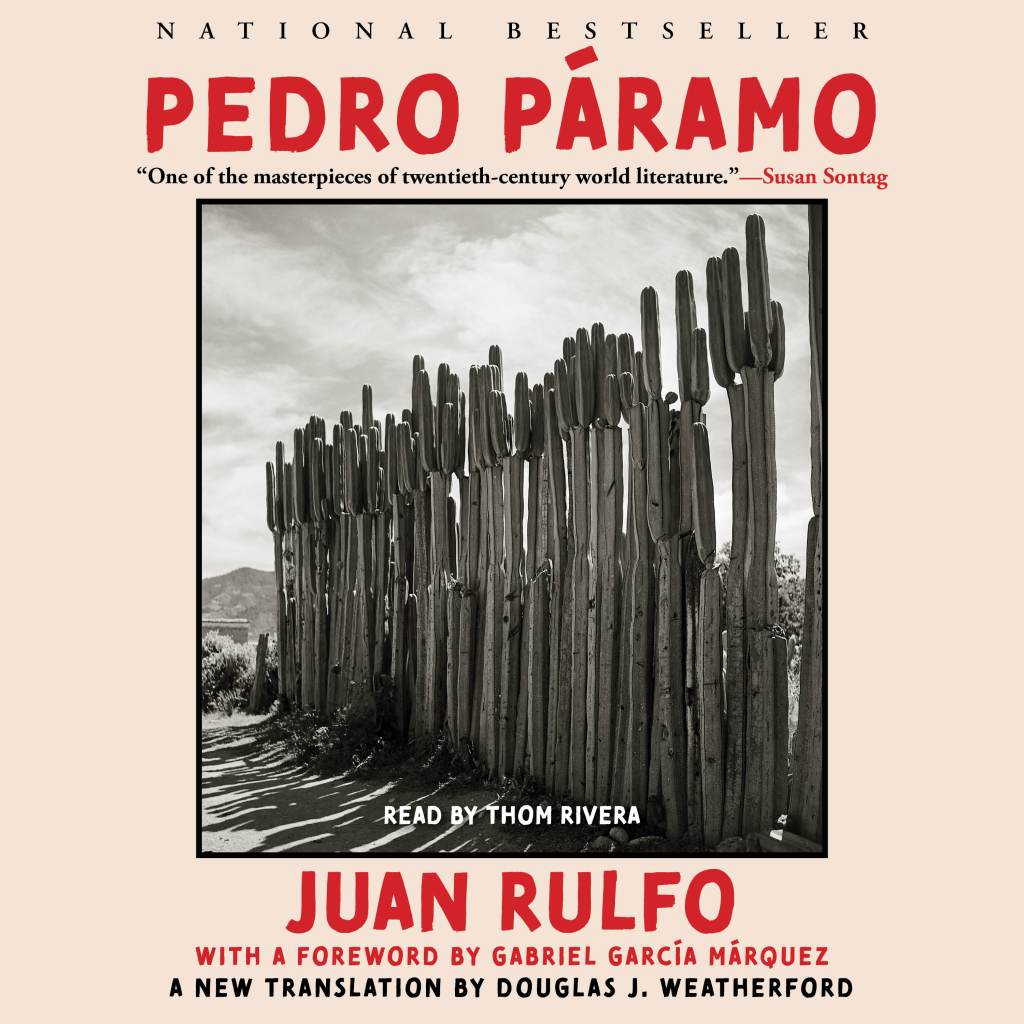
Rulfo, Juan. Pedro Páramo. Translated by Margaret Sayers Peden, Grove Press, 1994.
Pedro Páramo by Juan Rulfo is a ghost novel of magical realism, centered on generational trauma during and after the Mexican Revolution. The story follows Juan Preciado, who travels to the town of Comala after his mother’s death in search of his father, Pedro Páramo. What he expects to find is the beautiful town his mother once described to him: “a beautiful view of a green plain, with a bit of yellow from the ripening corn” (13). Instead, he arrives in a decaying landscape, almost entirely occupied by ghosts.
The guide who first leads Juan into Comala describes the town as “the very mouth of Hell” where the dead return to reclaim their blankets (15). From the beginning, death is normalized within the setting itself. The living and the dead exist together, conversations blur between memory and hallucination, and time moves in fragments rather than straight lines. Juan eventually becomes consumed by the voices and ghosts surrounding him, dying from fear and exhaustion before continuing the story as one of the dead himself.
One of the most striking aspects of this novel is its nonlinear structure and fragmented narration. The story shifts between timelines, memories, conversations, ghosts, and interior thoughts without warning. At times, this can feel disorienting, but it also reflects the emotional collapse of Comala itself. The town is haunted not only by literal ghosts, but by the lingering violence of exploitation, corruption, revolution, and abandonment.
Setting as a Protagonist
What interested me most in this novel was the way Comala itself functions almost like a protagonist. The town is not merely a backdrop to the story; it actively shapes the emotional atmosphere of every scene. Comala represents exploitation, ruined revolution, abandoned women, inherited suffering, and the decay left behind by powerful men like Pedro Páramo.
Throughout the novel, the setting constantly shifts between memory and reality. Damiana Cisneros recalls hearing celebrations and parties in the streets: “There was a time when I could hear the commotion of a party that kept going night after night…” only to discover “Nothing” when she investigates (50). Ghosts roam through the town as though death itself has become part of the landscape: “If only you could see the horde of shadows roam the streets” (60). Yet memories of the past briefly illuminate the darkness through Juan’s recollections of his mother describing carts filled with corn and life moving through the streets (55).
The novel repeatedly contrasts beauty with decay. One moment, the sky is described as bright and full of light, and the next, the physical world becomes suffocating and grotesque:
“The bed was made of otate reeds and covered with burlap sacks that smelled of urine…” (64).
The environment mirrors the emotional and moral collapse of the town itself. Rain, heat, rot, dust, and darkness all become extensions of grief, violence, and abandonment. Later, after Susana San Juan recounts traumatic memories connected to her father, the narration shifts outward:
“Outside it continued to rain. The Indians had left. It was Monday, and the valley surrounding Comala was still drowning in rain” (100).
The environment reflects the narrative’s emotional state. The endless rain feels less like weather and more like accumulated grief soaking into the town itself. In Pedro Páramo, nature and atmosphere become emotional language.
Pedro Páramo and the Corruption of Power
Pedro Páramo’s influence poisons every layer of Comala. Wealth protects him from accountability while everyone beneath him becomes disposable. When a woman comes demanding justice because Pedro’s son murdered her husband, Pedro’s administrator attempts to pay her off with corn rather than acknowledge responsibility:
“I offered her fifty hectoliters of corn if she’d forget the whole thing…” (74).
When Pedro asks who the grieving people were, and his manager responds that he does not know them, Pedro simply replies that they therefore “do not exist.” This moment captures the emotional core of the novel: people without power become invisible. Comala is haunted because suffering was ignored rather than healed.
Susana San Juan becomes one of the most emotionally powerful figures in the story. Her mental instability, trauma, sensuality, and longing are written with poetic intensity. Before her death, she speaks of swimming naked in the ocean and surrendering herself to the sea (105). Water becomes symbolic of purification, release, and returning to something natural beyond suffering.
When Susana dies, the town erupts into celebration:
“They buried Susana San Juan and few in Comala noticed. They were celebrating” (126).
The celebration is not because of Susana’s death itself, but because the town is distracted by festivities while Pedro loses the only person he ever truly loved. Her death marks the emotional collapse of his power. Just as Pedro spent his life taking from others, loss is finally returned to him. After Susana’s death, Comala fully descends into ruin.
What I Take Into My Own Writing
This novel taught me how setting can function as an emotional force within a narrative rather than simply a location. Through memory, atmosphere, ghosts, weather, and fragmented storytelling, Rulfo transforms Comala into a living embodiment of generational trauma.
For my own work in Discordia, I want to explore a similar setting by showing Zetheus before and after societal collapse, using memory, hallucination, storytelling, and environmental shifts to reflect emotional change within the world itself. Pedro Páramo also reminded me to pay close attention to diction, pacing, and the emotional rhythm of sentences. Even in confusion and darkness, the language remains poetic and intentional.
Beneath its ghosts and fractured timelines, the novel ultimately becomes a story about how violence and exploitation echo through generations long after death itself.
Grace by Natashia Deón is a historical horror novel that follows the life and death of a young Black woman named Naomi. Told through a nonlinear narrative, the novel follows Naomi as a ghost after her death, watching over her daughter Josephine while reflecting on the trauma, violence, love, and resilience that shaped her life. The story blends ghost story, historical fiction, and lyrical prose into something emotionally devastating and deeply human.
Gender roles and the brutality of slavery play a major role throughout the novel. Naomi begins as a hidden child, concealed by her mother from Massa, the slave owner who controls their lives. After witnessing abuse and violence against her family, Naomi kills Massa in order to protect herself and avenge her mother. She is then forced into survival alone, wandering through a world where Black women are constantly vulnerable to exploitation and violence.
Throughout the novel, men repeatedly fail the women around them through manipulation, abandonment, rape, cheating, and abuse. Yet alongside this darkness is an equally powerful theme of motherhood and feminine endurance. Naomi’s mother survives by complying outwardly while secretly protecting her children. Hazel, Naomi’s sister, becomes an example of survival and sacrifice. Even when Naomi herself is betrayed by Jeremy—the first man she truly loves—she eventually refuses to remain trapped in abuse. Jeremy attempts to pimp her out, abandons her during pregnancy, and later returns only to shame her. Naomi ultimately walks away, choosing both herself and her child over submission.
Motherhood Beyond Death
Shortly after Josephine’s birth, Naomi is killed by slave catchers. However, death does not end her connection to her daughter. As a ghost, Naomi remains tethered to Josephine, unable to fully let go. Some of the most haunting moments in the novel are not the supernatural ones, but the emotional truths surrounding motherhood, attachment, and grief. Annie tells Naomi’s spirit:
“One day you will leave her, by your choice. It’s what you’re supposed to do. At some point, every mother has to let her child go” (185).
That line stayed with me long after reading the book. It transforms the ghost story into something much larger about the pain of motherhood itself: loving someone enough to eventually release them into the world.
Lyrical Prose and Emotional Rhythm
One of the strongest literary elements in Grace is Deón’s lyrical prose. She slows down intimate moments and emotional observations until they almost feel suspended in time. Her writing often moves with a poetic rhythm that makes even painful scenes feel beautiful and deeply sensory.
“I wish he would smell sweet to me like a man looking for love or seemed soft like a man who could love me silly and forgive me for the thangs he didn’t know about me” (38).
The prose lingers inside physical sensation, emotion, memory, and desire. Rather than rushing through events, Deón allows moments to fully breathe. Her storytelling carries humor, sexuality, tenderness, and humanity even within the horror of slavery and violence.
What I take from this novel for my own writing is the importance of slowing down and honoring the details of life itself. Grace reminded me that storytelling is not only about plot progression but about fully inhabiting emotional moments, relationships, and sensory experience. The novel feels like a ghost story not simply because of Naomi’s spirit, but because it honors the cycle of life, motherhood, trauma, love, and memory itself. It suggests that even after death, the emotional imprint we leave on one another persists.