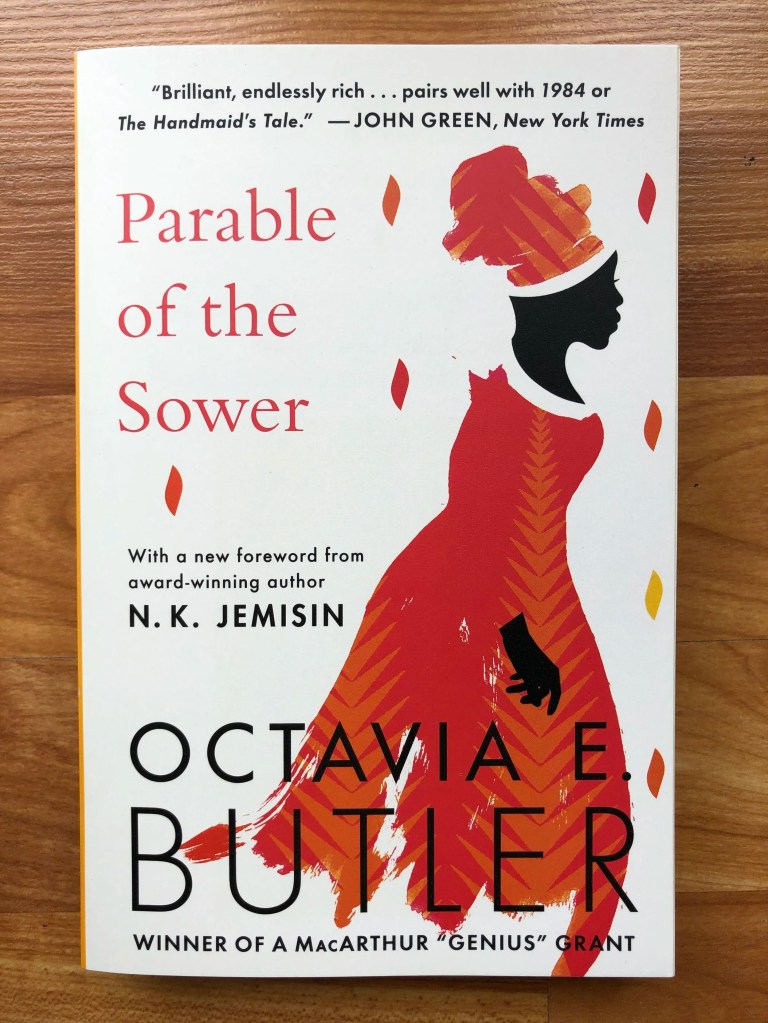
Butler, Octavia E. Parable of the Sower. Grand Central Publishing, 2019.
Parable of the Sower by Octavia E. Butler is a dystopian science fiction novel set in a near-future California, where climate disaster, addiction, violence, poverty, and political corruption are collapsing the state. Told through the diary entries of Lauren Olamina, the story follows a young woman trying not only to survive societal collapse, but to create a new moral philosophy within it. Through Lauren’s belief system, Earthseed, Butler explores religion, adaptability, community, and the human need to create meaning during times of chaos.
The story begins in a gated Los Angeles neighborhood, where Lauren lives with her family. Her father, a Baptist minister and professor, attempts to preserve structure and faith within a rapidly deteriorating world. After his death, the fragile safety of the neighborhood collapses completely. Drug addicts obsessed with fire burn the community to the ground, forcing Lauren to flee northward on foot, disguised as a man. Along the way, she gathers companions, slowly building a community of survivors connected not through blood or traditional religion, but through shared ethics and collective care.
Eventually, Lauren meets Bankole, a doctor who owns land in Northern California. The group travels there hoping to create Earthseed, a sustainable and intentional community built around Lauren’s philosophy that “God is Change.” However, even upon reaching their destination, violence and destruction continue to follow them. The property has already been devastated, and corrupt systems remain close behind. Still, Lauren refuses to abandon her vision.
Religion as Adaptation
One of the strongest themes in the novel is not simply survival, but transformation. Butler presents religion not as rigid doctrine, but as something living and adaptive. Lauren does not inherit her father’s Christianity directly. Instead, she develops her own spiritual philosophy through observation of the natural world, human behavior, and change itself. Earthseed becomes both a religion and a survival strategy.
The world Lauren inhabits is already accustomed to suffering: “Seven of the homeless people sleeping inside on that last night burned with it” (2). Violence has become normalized to the point where people emotionally detach from it. Lauren’s response to this chaos is not despair, but the creation of a moral structure centered around intentional ethics, adaptability, labor, and community responsibility.
What stood out to me most is how Earthseed represents the refusal to blindly follow inherited systems that no longer serve humanity. Lauren creates a belief system aligned with her own understanding of justice and survival rather than simply repeating tradition. The novel asks an important question: how do we build morality in a world where institutions have already failed?
Humboldt County and Returning to the Land
As someone living in Humboldt County, the ending of this novel resonated deeply with me. Butler’s depiction of people migrating north toward the land felt eerily familiar to the history of Humboldt itself. Many people came to these mountains searching for freedom, sustainability, self-governance, and a closer relationship with nature.
I especially connected this to the Green Rush and the migration of cannabis growers into Humboldt County. People originally came to the mountains seeking alternative ways of living outside traditional systems, but over time, corruption, cartel involvement, outside investment, overregulation, and corporate expansion transformed the culture entirely. The same systems people hoped to escape eventually followed them into the mountains.
That connection made Butler’s novel feel less like distant science fiction and more like a warning already unfolding around us. Parable of the Sower suggests that societal collapse is not simply caused by violence or environmental disaster, but by the breakdown of shared ethics and collective care. Lauren’s answer to that collapse is not perfection, but a community rooted in intentional values and cooperation with the earth itself.
What I take from this novel for my own writing is the importance of creating belief systems within stories that shape every layer of the worldbuilding, character decisions, and themes. Butler does not simply tell the reader what Earthseed is—she builds the entire narrative around its philosophy. The story becomes a reflection on how people survive not only physically but also spiritually and ethically during times of collapse.
 Little Lost Forest