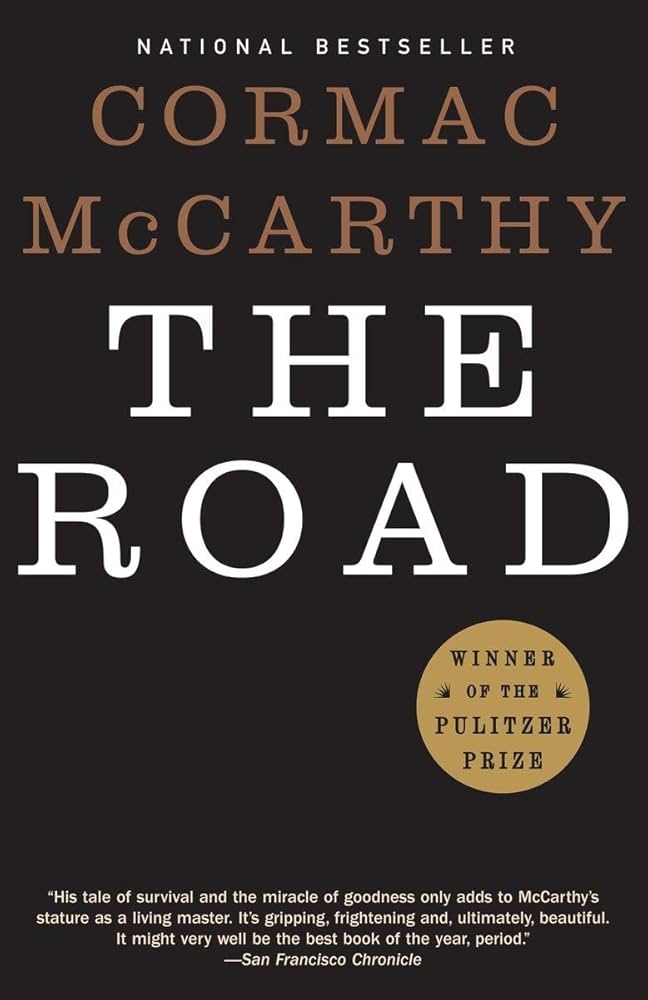
McCarthy, Cormac. The Road. Vintage International, 2007.
The Road by Cormac McCarthy is a dystopian horror novel set in an apocalyptic America where cannibalism has become normalized, and survival itself feels unnatural. The story follows a father and son, referred to only as “the man” and “the boy,” as they travel west toward the coast searching for warmer weather and some remaining fragment of hope. Along the road, they encounter starvation, violence, death, and the constant fear of other survivors.
When they finally reach the coast, however, they discover the same emptiness and danger they faced throughout the journey. At one point, they discover an abandoned ship and recover supplies, including a gun. After the boy accidentally leaves the gun behind, the father injures himself retrieving it, further weakening his already dying body. Eventually, the father dies on the road, leaving the young boy alone in a brutal world. By the end of the novel, another man approaches the child, claiming to have a family, and the two continue down the road together.
Repetition as Atmosphere
One of the most noticeable literary devices in this novel is repetition. Much of the story moves back and forth between short conversations between the father and son. The dialogue often revolves around death, survival, fear, or reassurance. The boy constantly seeks affirmation from his father, asking whether his father is telling the truth or whether things will be okay. McCarthy writes:
“The man was trying to kill us. Wasn’t he. Yes he was. Did you kill him? No. Is that the truth? Yes. Okay. Is that all right? Yes” (270).
The repetition creates a bleak emotional rhythm throughout the novel. The dialogue is stripped down, sparse, and often emotionally restrained. Even moments of tenderness feel muted by exhaustion and by the need to survive.
Another repeated element is the physical movement across the landscape: “They slept… They hiked… they followed” (88–89). The repetition of actions and imagery reinforces the emptiness of the world around them. Town after town, road after road, ash after ash, the setting rarely changes. This creates a suffocating atmosphere where time and geography almost blur together.
Emotional Flatness and Monotony
While I understand that McCarthy intentionally uses repetition to create emotional desolation, I personally struggled to fully enjoy the novel because the dialogue and prose became overly repetitive. Conversations often felt dry or emotionally flat:
“Is it okay? Yeah. It’s okay. Does it hurt? Yes. It hurts” (266).
The characters themselves sometimes felt similarly muted. Most people they encounter blend together under the same grayness of survival, fear, and hopelessness. I also noticed repeated imagery throughout the novel that made the world feel emotionally stagnant: “In the morning they stood in the road, and he and the boy argued about what to give the old man” (173). The landscape, conversations, and interactions often carried the same tone, with little variation.
For my own writing, this book helped me think about balance. Repetition can absolutely be powerful when used intentionally to create mood, rhythm, or emotional weight. However, I also realized how important it is for me, personally, to vary dialogue, imagery, pacing, and character voice to maintain emotional engagement with the reader. Even in bleak or desolate worlds, I am more drawn to stories where moments of tonal variation, personality, or vivid emotional shifts break through the darkness.

