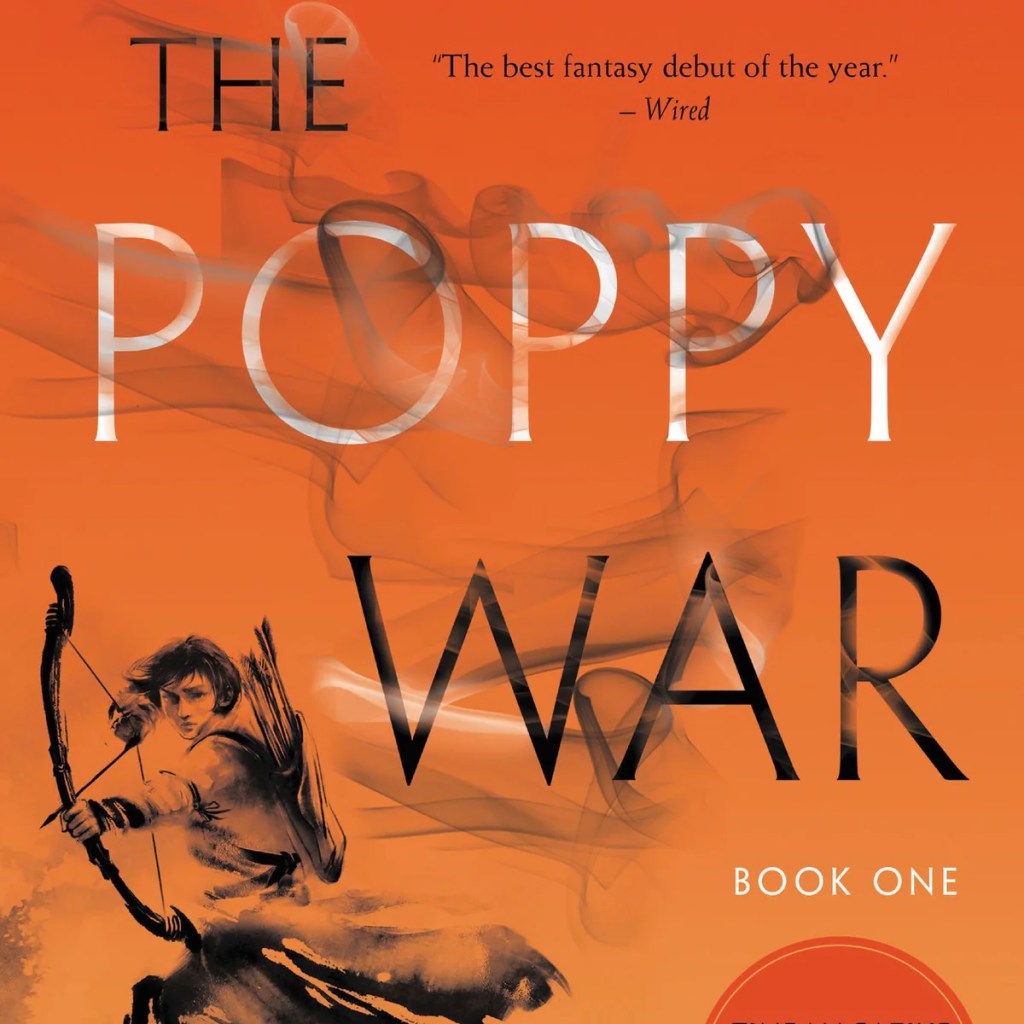
Kuang, R. F. The Poppy War. Harper Voyager, 2018.
The Poppy War by R. F. Kuang is a military fantasy novel deeply inspired by the Second Sino-Japanese War, exploring imperialism, genocide, addiction, revenge, and the cyclical nature of violence. Through the journey of Fang Runin (Rin), Kuang examines the devastating cost of power and the illusion that destruction can ever fully solve suffering.
Rin begins as a poor orphan raised by adoptive parents who profit from smuggling poppy products. In order to escape being married off to an older man, she studies obsessively to gain entrance into Sinegard, an elite military academy. Once there, her intelligence does not make up for her lack of combat training, and she is repeatedly targeted for being from the countryside. Alienated from the academy’s traditional paths, she becomes drawn toward Master Jiang and the world of shamanism, opium, and the gods.
Master Jiang explains the spiritual potential of the poppy seeds:
“These seeds are a shaman’s dream… used with the proper mental preparation, give you access to the entire universe contained within your mind” (47).
The poppy becomes more than a narcotic within the novel. It functions simultaneously as a spiritual gateway, a destructive addiction, and a metaphor for war itself.
War as Addiction
One of the strongest literary elements within The Poppy War is metaphor, particularly the relationship between opium and warfare. Throughout the novel, fire, the Phoenix god, and narcotics become emotionally intertwined. Rin gains access to incredible power through shamanism and the Phoenix, but every use of that power consumes her further.
When Rin first unleashes the Phoenix during battle, Kuang describes the fire almost like a drug overtaking the body:
“The fire billowed outward with a vengeance… She controlled the flame no more than the wick of a candle might” (252).
The power is intoxicating, overwhelming, and impossible to fully control. Just as opium offers a temporary escape while destroying the user, war offers the illusion of victory while consuming entire civilizations.
This metaphor becomes even more explicit later in the novel:
“But something so destructive inherently and simultaneously has marvelous potential” (192).
The same logic people use to justify opium is often the logic nations use to justify war: destruction becomes acceptable if it promises power, safety, revenge, or transformation. Yet both ultimately leave devastation behind.
Rin herself fears losing control to the fire in the same way someone fears surrendering themselves to addiction:
“She didn’t want to admit that she was scared. Scared of being in a state where she had little control of herself” (321).
Even Altan, who claims mastery over the Phoenix, eventually reveals himself to be entirely consumed by it. His use of power has become normalized to the point that he no longer recognizes it as a form of dependence. The novel subtly suggests that trauma, violence, and addiction can become inherited cycles passed through generations, particularly through Rin and Altan’s shared history as survivors of Speer.
The Gods Do Not Choose — We Do
The novel’s climax becomes devastating because Rin ultimately chooses annihilation. After witnessing unimaginable violence and genocide, she calls upon the Phoenix and destroys the Mugenese completely, including innocent lives alongside soldiers and political leaders. Before she acts, she is warned:
“To give your soul to the Phoenix is to enter hell” (499).
And afterward comes the novel’s most important line:
“The gods choose nothing. You chose” (502).
That line reframes the entire story. The gods, addiction, war, and fate are not solely responsible for destruction. Human beings still make choices within systems of violence. Power does not remove accountability.
This deeply connects with themes in my own writing in Discordia, particularly those surrounding Eris, the Kalonox, and the golden apple metaphor. Reading The Poppy War helped me think more deeply about autonomy, tyranny, and the illusion of destiny.
In Greek mythology, Eris uses the golden apple to create discord by appealing to vanity and self-interest. Eve’s apple similarly represents knowledge, disobedience, and autonomy. In Discordia, the Kalonox draws inspiration from both symbols. The oppressors pursue power, believing it will give them control over reality itself, while the deeper truth may be that liberation only happens when people stop waiting for gods, rulers, or destiny to save them.
Like The Poppy War, I want the story to suggest that fate is not something handed down by divine power. The gods do not create reality alone—people do. Tyranny survives because people fear standing alone against it. The Kalonox, therefore, becomes less about ultimate power and more about exposing the selfish desires of those who seek it.
What I take from Kuang’s novel for my own writing is the strength of layered metaphor. The fire in The Poppy War is simultaneously war, addiction, trauma, rage, power, divinity, and destruction all at once. The metaphor works because it exists emotionally, politically, spiritually, and personally throughout every layer of the narrative.