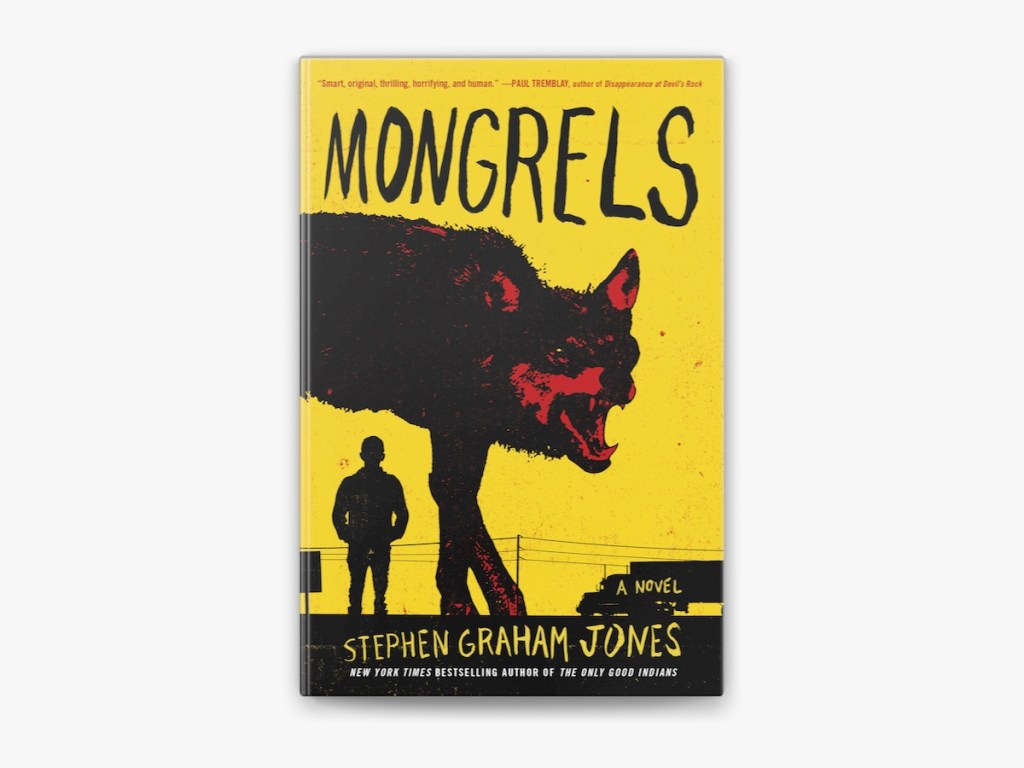
Jones, Stephen Graham. Mongrels: A Novel. HarperCollins/William Morrow, 2016.
Mongrels by Stephen Graham Jones is a coming-of-age horror novel told through the perspective of an unnamed boy growing up in a nomadic family of werewolves. Living alongside his Aunt Libby and Uncle Darren, the nephew struggles to understand who he is as he waits to discover whether he will eventually transform himself. Throughout the novel, Jones uses the werewolf figure not simply as a monster but as a metaphor for poverty, marginalization, generational trauma, displacement, and survival.
The nephew is rarely named directly. Instead, he is often referred to through shifting identities such as “the nephew,” “the vampire,” “the mechanic,” or “the prisoner.” This creates a feeling of instability surrounding identity itself, reflecting the uncertainty of adolescence and self-discovery. Although his experiences are supernatural, the emotional core of the story feels deeply human: the desire to belong somewhere while fearing what you may become.
As the family is forced from town to town, instability becomes their normal way of life. Darren works dangerous and degrading jobs, while Libby repeatedly pulls the family back together whenever things fall apart. Eventually, Darren disappears after falling in love with a woman outside the family, leaving the nephew once again abandoned by a male role model. Shortly before the nephew’s own transformation, Libby promises she will remain beside him:
“I’ll still be here,” the aunt says, reaching her hand across, taking his. “Just like Darren,” the nephew says. “Werewolf promises aren’t any good, don’t you know that one by now?” (296).
That line captures one of the novel’s strongest emotional themes: the fear of abandonment inherited across generations.
Werewolves as Social Outsiders
One of the most powerful aspects of Mongrels is the way Jones compares werewolves to the poor, the criminalized, and the socially unwanted. The nephew grows up believing imprisonment and suffering are inevitable for people like him: “Everybody goes to jail at some point. Werewolves especially” (53). The family survives through scavenging, temporary work, theft, and constant movement. Childhood friendships are temporary because they never last long enough to take root.
The werewolf mythology becomes a framework for exploring inherited trauma. The nephew’s mother became pregnant after an act of violence and died during childbirth. Throughout the novel, there are fragmented stories surrounding her death, some softened or disguised by family storytelling. The grandfather often “humanizes” horrific events through strange, indirect narratives instead of telling the truth directly. One disturbing example involves him describing killing a rabid dog:
“Once I hit her that first time, little pup, I like to have never got that next lick in…” (17).
The story feels awkward, violent, and emotionally detached, especially through the child’s eyes. Later, however, the novel reveals a much darker parallel beneath the story: the brutal death of the nephew’s mother during childbirth while infected with the werewolf condition. The grandfather seems more comfortable transforming trauma into folklore than confronting the real violence directly. In Mongrels, the “humanized” stories often become the fantasy, while the true human experiences underneath remain unbearable to speak aloud.
Memory Through Cars
One literary element that deeply stood out to me was the way cars function throughout the novel. The vehicles are disposable, stolen, temporary, patched together, and constantly changing, much like the family itself. Yet at the same time, the make and model of each car becomes a way of tracking memory, emotion, and periods of life. The cars become emotional landmarks.
Jones repeatedly introduces vehicles with careful specificity:
“Nearly two weeks later, he finally drifted in again. What he drove… was a pretty pristine old Mercury Monterey” (71).
And later:
“The Sabre wasn’t close to street legal anymore…” (71).
The naming of the cars grounds the timeline emotionally. Instead of remembering life through stable homes or permanent places, the family remembers periods of survival through whatever means carried them at the time. The cars become connected to memory, identity, grief, movement, and family history. Each one marks a chapter in the nephew’s life. Because the family is constantly uprooted, the vehicles become one of the only consistent ways to orient time and memory.
This detail resonated with me deeply because it reflects how people living unstable or nomadic lives often attach memory to objects in motion rather than permanent locations. In Mongrels, cars become temporary homes, escape routes, symbols of survival, and emotional timestamps all at once.
Monstrosity and Emotional Truth
What I take from this novel for my own writing is the permission to lean into dramatized or monstrous figures to express emotional truth. By filtering lived experiences through imaginative characters like werewolves, the novel creates a bridge between realism and metaphor, allowing readers to emotionally inhabit difficult truths. The supernatural elements never feel disconnected from humanity. Instead, they intensify it.
Libby’s warning to the nephew echoes throughout the novel:
“Not all kids born to a werewolf are a werewolf” (21).
Beneath the horror and mythology, Mongrels becomes a story about inheritance—what we fear inheriting, what we cannot escape, and the possibility of becoming something different despite where we come from.