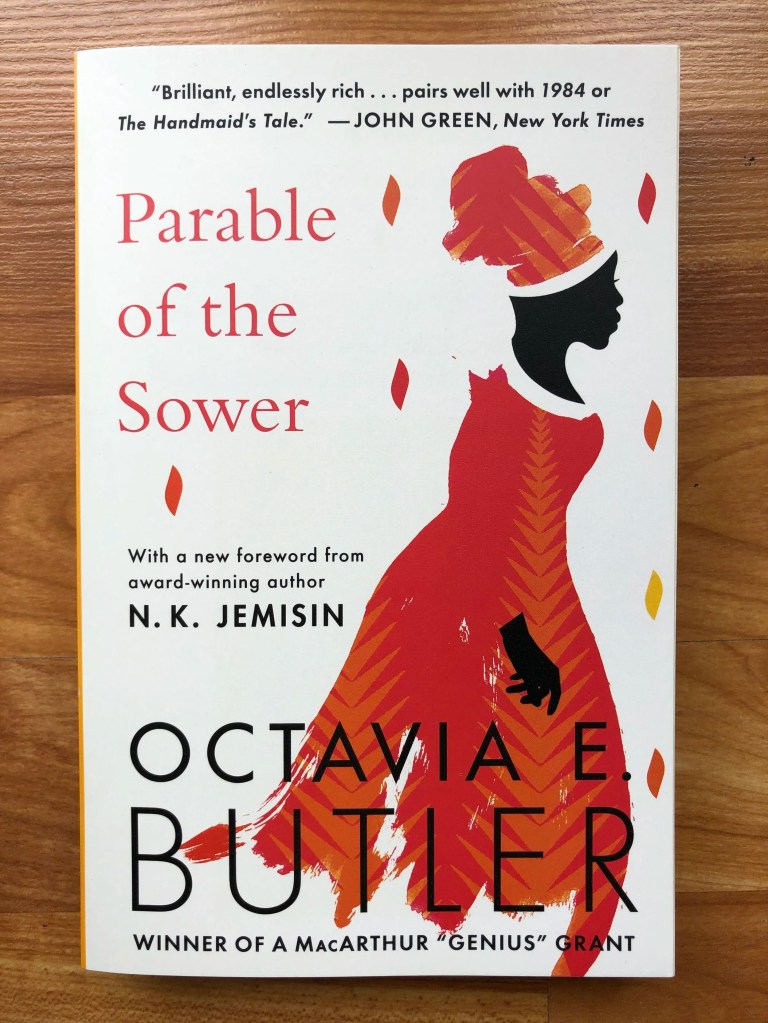
Parable of the Sower — Earthseed, Community, and Moral Reinvention

Butler, Octavia E. Parable of the Sower. Grand Central Publishing, 2019.

Parable of the Sower by Octavia E. Butler is a dystopian science fiction novel set in a near-future California, where climate disaster, addiction, violence, poverty, and political corruption are collapsing the state. Told through the diary entries of Lauren Olamina, the story follows a young woman trying not only to survive societal collapse, but to create a new moral philosophy within it. Through Lauren’s belief system, Earthseed, Butler explores religion, adaptability, community, and the human need to create meaning during times of chaos.

The story begins in a gated Los Angeles neighborhood, where Lauren lives with her family. Her father, a Baptist minister and professor, attempts to preserve structure and faith within a rapidly deteriorating world. After his death, the fragile safety of the neighborhood collapses completely. Drug addicts obsessed with fire burn the community to the ground, forcing Lauren to flee northward on foot, disguised as a man. Along the way, she gathers companions, slowly building a community of survivors connected not through blood or traditional religion, but through shared ethics and collective care.

Eventually, Lauren meets Bankole, a doctor who owns land in Northern California. The group travels there hoping to create Earthseed, a sustainable and intentional community built around Lauren’s philosophy that “God is Change.” However, even upon reaching their destination, violence and destruction continue to follow them. The property has already been devastated, and corrupt systems remain close behind. Still, Lauren refuses to abandon her vision.

Religion as Adaptation

One of the strongest themes in the novel is not simply survival, but transformation. Butler presents religion not as rigid doctrine, but as something living and adaptive. Lauren does not inherit her father’s Christianity directly. Instead, she develops her own spiritual philosophy through observation of the natural world, human behavior, and change itself. Earthseed becomes both a religion and a survival strategy.

The world Lauren inhabits is already accustomed to suffering: “Seven of the homeless people sleeping inside on that last night burned with it” (2). Violence has become normalized to the point where people emotionally detach from it. Lauren’s response to this chaos is not despair, but the creation of a moral structure centered around intentional ethics, adaptability, labor, and community responsibility.

What stood out to me most is how Earthseed represents the refusal to blindly follow inherited systems that no longer serve humanity. Lauren creates a belief system aligned with her own understanding of justice and survival rather than simply repeating tradition. The novel asks an important question: how do we build morality in a world where institutions have already failed?

Humboldt County and Returning to the Land

As someone living in Humboldt County, the ending of this novel resonated deeply with me. Butler’s depiction of people migrating north toward the land felt eerily familiar to the history of Humboldt itself. Many people came to these mountains searching for freedom, sustainability, self-governance, and a closer relationship with nature.

I especially connected this to the Green Rush and the migration of cannabis growers into Humboldt County. People originally came to the mountains seeking alternative ways of living outside traditional systems, but over time, corruption, cartel involvement, outside investment, overregulation, and corporate expansion transformed the culture entirely. The same systems people hoped to escape eventually followed them into the mountains.

That connection made Butler’s novel feel less like distant science fiction and more like a warning already unfolding around us. Parable of the Sower suggests that societal collapse is not simply caused by violence or environmental disaster, but by the breakdown of shared ethics and collective care. Lauren’s answer to that collapse is not perfection, but a community rooted in intentional values and cooperation with the earth itself.

What I take from this novel for my own writing is the importance of creating belief systems within stories that shape every layer of the worldbuilding, character decisions, and themes. Butler does not simply tell the reader what Earthseed is—she builds the entire narrative around its philosophy. The story becomes a reflection on how people survive not only physically but also spiritually and ethically during times of collapse.
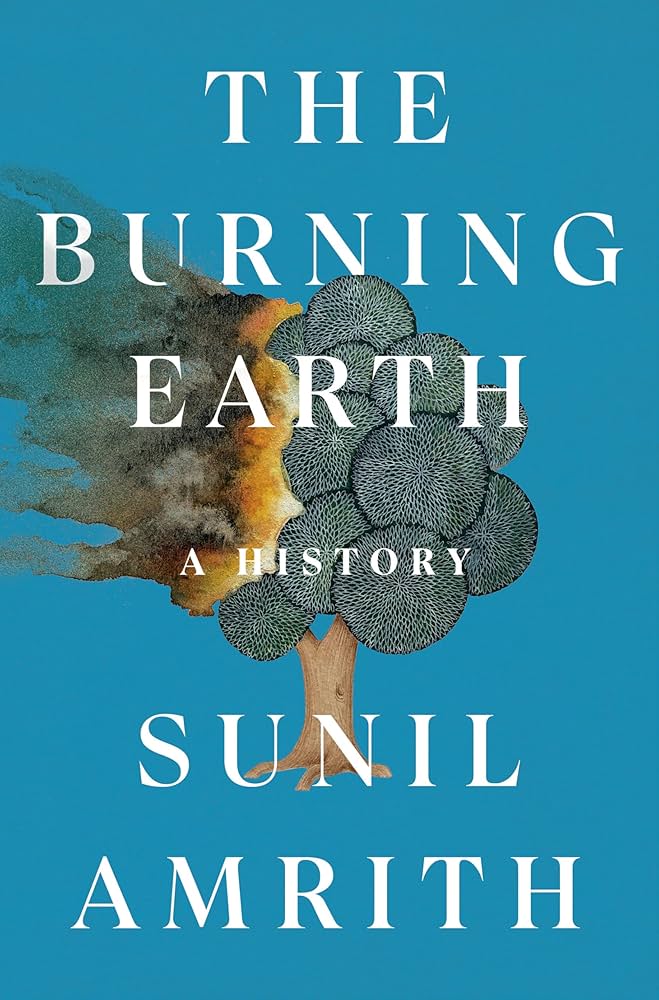
The Burning Earth — Man vs. Nature and the Cost of Empire

Amrith, Sunil. The Burning Earth: A History. W. W. Norton & Company, 2024.

The Burning Earth by Sunil Amrith is a historical examination of climate change, empire, war, and humanity’s relationship with the natural world. The book explores how rising populations, industrialization, greed, and global conflict directly reshape the environment, while environmental collapse simultaneously reshapes the human condition. Throughout the text, Amrith presents history as deeply interconnected with nature rather than separate from it.

One of the most compelling ideas within the book is the danger of believing that technology alone can solve climate collapse. Amrith discusses the concept of the technosphere, humanity’s attempt to “engineer the climate itself” (331), while warning of the consequences that follow: “species loss, the depletion of fresh water, assaults on the forests and the oceans—and reducing the incentive for the wealthy and the powerful to change their behavior in any way” (332). The book repeatedly returns to the idea that those in power often exploit both land and people while avoiding responsibility for the damage left behind.

War Against Nature

A major theme throughout this book is Man vs. Nature, but also the illusion that humanity exists separately from nature. Amrith argues that environmental destruction and human suffering are directly intertwined. Civilization expands, consumes, wages war, and extracts resources while ecosystems collapse alongside it. He writes, quoting Hannah Arendt, that “earthly nature, for all we know, may be unique in the universe in providing human beings with a habitat in which they can move and breathe without effort and without artifice” (252).

This quote deeply resonated with me because it reinforces how fragile and rare our planet truly is. The Earth is not simply a backdrop to human history but the condition that makes human life possible at all. Throughout history, conflict between rulers and the ruled, empires and indigenous peoples, industrialization and sustainability, has repeatedly led to environmental collapse alongside human suffering.

Amrith traces these patterns through multiple eras of history. In 1426, Portuguese colonizers burned the forests of Madeira for sugar plantations, destroying ecosystems alongside local culture and community. During periods of empire and expansion, gold, oil, and resources fueled war while forests, oceans, animals, and entire ways of life were erased in the process. The industrialization of warfare only accelerated this destruction. “War machines were thirsty for oil” (171), Amrith explains, connecting environmental extraction directly to global violence and political ambition.

Discordia and Environmental Tyranny

This book strongly reinforced the central themes within my own novel, Discordia. My thesis asks: How does tyranny affect our environment? And beneath that: When and how do we rise against tyranny?

What The Burning Earth helped crystallize for me is that war, environmental collapse, and the human condition cannot truly be separated from one another. As long as we treat issues like sustainability, politics, war, and social inequality as isolated problems, the destruction continues to spread outward into every part of life.

One of the most haunting passages in the book describes wounded soldiers during World War II, comparing modern warfare to mythological monsters and apocalyptic visions. A Punjabi Rajput soldier wrote, “This is not a war… this is the end of the whole world” (172). That line captures something deeply relevant to our present moment. Environmental destruction is not disconnected from political violence or greed; they are reflections of the same imbalance.

This book ultimately reminded me that humanity behaves as though it stands above nature, when in reality, we are part of a singular living organism. To harm the planet is to harm ourselves. Healing the environment also requires healing the systems of violence, exploitation, and tyranny that continue to consume it.

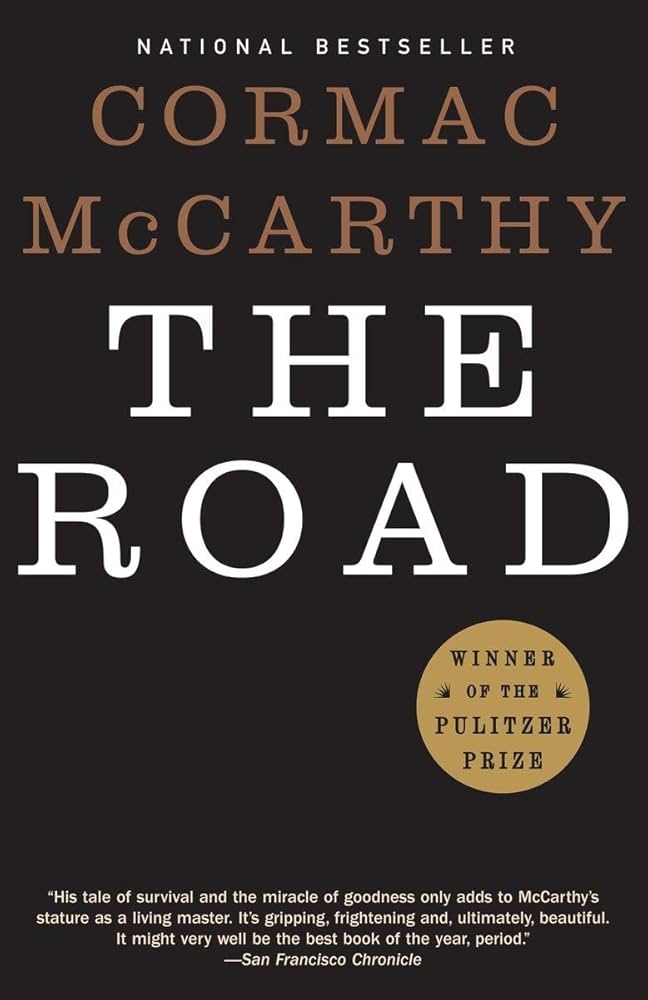
The Road — Repetition and Emotional Desolation

McCarthy, Cormac. The Road. Vintage International, 2007.

The Road by Cormac McCarthy is a dystopian horror novel set in an apocalyptic America where cannibalism has become normalized, and survival itself feels unnatural. The story follows a father and son, referred to only as “the man” and “the boy,” as they travel west toward the coast searching for warmer weather and some remaining fragment of hope. Along the road, they encounter starvation, violence, death, and the constant fear of other survivors.

When they finally reach the coast, however, they discover the same emptiness and danger they faced throughout the journey. At one point, they discover an abandoned ship and recover supplies, including a gun. After the boy accidentally leaves the gun behind, the father injures himself retrieving it, further weakening his already dying body. Eventually, the father dies on the road, leaving the young boy alone in a brutal world. By the end of the novel, another man approaches the child, claiming to have a family, and the two continue down the road together.

Repetition as Atmosphere

One of the most noticeable literary devices in this novel is repetition. Much of the story moves back and forth between short conversations between the father and son. The dialogue often revolves around death, survival, fear, or reassurance. The boy constantly seeks affirmation from his father, asking whether his father is telling the truth or whether things will be okay. McCarthy writes:

“The man was trying to kill us. Wasn’t he. Yes he was. Did you kill him? No. Is that the truth? Yes. Okay. Is that all right? Yes” (270).

The repetition creates a bleak emotional rhythm throughout the novel. The dialogue is stripped down, sparse, and often emotionally restrained. Even moments of tenderness feel muted by exhaustion and by the need to survive.

Another repeated element is the physical movement across the landscape: “They slept… They hiked… they followed” (88–89). The repetition of actions and imagery reinforces the emptiness of the world around them. Town after town, road after road, ash after ash, the setting rarely changes. This creates a suffocating atmosphere where time and geography almost blur together.

Emotional Flatness and Monotony

While I understand that McCarthy intentionally uses repetition to create emotional desolation, I personally struggled to fully enjoy the novel because the dialogue and prose became overly repetitive. Conversations often felt dry or emotionally flat:

“Is it okay? Yeah. It’s okay. Does it hurt? Yes. It hurts” (266).

The characters themselves sometimes felt similarly muted. Most people they encounter blend together under the same grayness of survival, fear, and hopelessness. I also noticed repeated imagery throughout the novel that made the world feel emotionally stagnant: “In the morning they stood in the road, and he and the boy argued about what to give the old man” (173). The landscape, conversations, and interactions often carried the same tone, with little variation.

For my own writing, this book helped me think about balance. Repetition can absolutely be powerful when used intentionally to create mood, rhythm, or emotional weight. However, I also realized how important it is for me, personally, to vary dialogue, imagery, pacing, and character voice to maintain emotional engagement with the reader. Even in bleak or desolate worlds, I am more drawn to stories where moments of tonal variation, personality, or vivid emotional shifts break through the darkness.