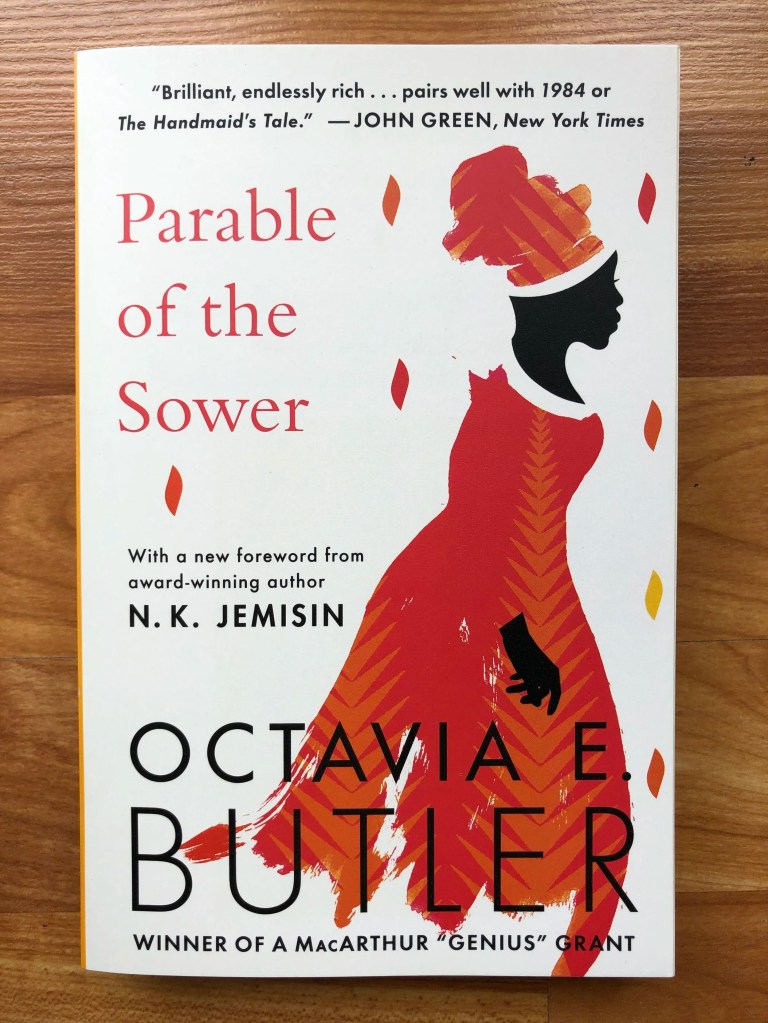
Parable of the Sower — Earthseed, Community, and Moral Reinvention

Butler, Octavia E. Parable of the Sower. Grand Central Publishing, 2019.

Parable of the Sower by Octavia E. Butler is a dystopian science fiction novel set in a near-future California, where climate disaster, addiction, violence, poverty, and political corruption are collapsing the state. Told through the diary entries of Lauren Olamina, the story follows a young woman trying not only to survive societal collapse, but to create a new moral philosophy within it. Through Lauren’s belief system, Earthseed, Butler explores religion, adaptability, community, and the human need to create meaning during times of chaos.

The story begins in a gated Los Angeles neighborhood, where Lauren lives with her family. Her father, a Baptist minister and professor, attempts to preserve structure and faith within a rapidly deteriorating world. After his death, the fragile safety of the neighborhood collapses completely. Drug addicts obsessed with fire burn the community to the ground, forcing Lauren to flee northward on foot, disguised as a man. Along the way, she gathers companions, slowly building a community of survivors connected not through blood or traditional religion, but through shared ethics and collective care.

Eventually, Lauren meets Bankole, a doctor who owns land in Northern California. The group travels there hoping to create Earthseed, a sustainable and intentional community built around Lauren’s philosophy that “God is Change.” However, even upon reaching their destination, violence and destruction continue to follow them. The property has already been devastated, and corrupt systems remain close behind. Still, Lauren refuses to abandon her vision.

Religion as Adaptation

One of the strongest themes in the novel is not simply survival, but transformation. Butler presents religion not as rigid doctrine, but as something living and adaptive. Lauren does not inherit her father’s Christianity directly. Instead, she develops her own spiritual philosophy through observation of the natural world, human behavior, and change itself. Earthseed becomes both a religion and a survival strategy.

The world Lauren inhabits is already accustomed to suffering: “Seven of the homeless people sleeping inside on that last night burned with it” (2). Violence has become normalized to the point where people emotionally detach from it. Lauren’s response to this chaos is not despair, but the creation of a moral structure centered around intentional ethics, adaptability, labor, and community responsibility.

What stood out to me most is how Earthseed represents the refusal to blindly follow inherited systems that no longer serve humanity. Lauren creates a belief system aligned with her own understanding of justice and survival rather than simply repeating tradition. The novel asks an important question: how do we build morality in a world where institutions have already failed?

Humboldt County and Returning to the Land

As someone living in Humboldt County, the ending of this novel resonated deeply with me. Butler’s depiction of people migrating north toward the land felt eerily familiar to the history of Humboldt itself. Many people came to these mountains searching for freedom, sustainability, self-governance, and a closer relationship with nature.

I especially connected this to the Green Rush and the migration of cannabis growers into Humboldt County. People originally came to the mountains seeking alternative ways of living outside traditional systems, but over time, corruption, cartel involvement, outside investment, overregulation, and corporate expansion transformed the culture entirely. The same systems people hoped to escape eventually followed them into the mountains.

That connection made Butler’s novel feel less like distant science fiction and more like a warning already unfolding around us. Parable of the Sower suggests that societal collapse is not simply caused by violence or environmental disaster, but by the breakdown of shared ethics and collective care. Lauren’s answer to that collapse is not perfection, but a community rooted in intentional values and cooperation with the earth itself.

What I take from this novel for my own writing is the importance of creating belief systems within stories that shape every layer of the worldbuilding, character decisions, and themes. Butler does not simply tell the reader what Earthseed is—she builds the entire narrative around its philosophy. The story becomes a reflection on how people survive not only physically but also spiritually and ethically during times of collapse.

Mongrels — Generational Trauma, Monstrosity, and Memory Through Motion

NIG72LPZIJNTESAFAXFLXQKGDA


Jones, Stephen Graham. Mongrels: A Novel. HarperCollins/William Morrow, 2016.

Mongrels by Stephen Graham Jones is a coming-of-age horror novel told through the perspective of an unnamed boy growing up in a nomadic family of werewolves. Living alongside his Aunt Libby and Uncle Darren, the nephew struggles to understand who he is as he waits to discover whether he will eventually transform himself. Throughout the novel, Jones uses the werewolf figure not simply as a monster but as a metaphor for poverty, marginalization, generational trauma, displacement, and survival.

The nephew is rarely named directly. Instead, he is often referred to through shifting identities such as “the nephew,” “the vampire,” “the mechanic,” or “the prisoner.” This creates a feeling of instability surrounding identity itself, reflecting the uncertainty of adolescence and self-discovery. Although his experiences are supernatural, the emotional core of the story feels deeply human: the desire to belong somewhere while fearing what you may become.

As the family is forced from town to town, instability becomes their normal way of life. Darren works dangerous and degrading jobs, while Libby repeatedly pulls the family back together whenever things fall apart. Eventually, Darren disappears after falling in love with a woman outside the family, leaving the nephew once again abandoned by a male role model. Shortly before the nephew’s own transformation, Libby promises she will remain beside him:

“I’ll still be here,” the aunt says, reaching her hand across, taking his.
“Just like Darren,” the nephew says. “Werewolf promises aren’t any good, don’t you know that one by now?” (296).

That line captures one of the novel’s strongest emotional themes: the fear of abandonment inherited across generations.

Werewolves as Social Outsiders

One of the most powerful aspects of Mongrels is the way Jones compares werewolves to the poor, the criminalized, and the socially unwanted. The nephew grows up believing imprisonment and suffering are inevitable for people like him: “Everybody goes to jail at some point. Werewolves especially” (53). The family survives through scavenging, temporary work, theft, and constant movement. Childhood friendships are temporary because they never last long enough to take root.

The werewolf mythology becomes a framework for exploring inherited trauma. The nephew’s mother became pregnant after an act of violence and died during childbirth. Throughout the novel, there are fragmented stories surrounding her death, some softened or disguised by family storytelling. The grandfather often “humanizes” horrific events through strange, indirect narratives instead of telling the truth directly. One disturbing example involves him describing killing a rabid dog:

“Once I hit her that first time, little pup, I like to have never got that next lick in…” (17).

The story feels awkward, violent, and emotionally detached, especially through the child’s eyes. Later, however, the novel reveals a much darker parallel beneath the story: the brutal death of the nephew’s mother during childbirth while infected with the werewolf condition. The grandfather seems more comfortable transforming trauma into folklore than confronting the real violence directly. In Mongrels, the “humanized” stories often become the fantasy, while the true human experiences underneath remain unbearable to speak aloud.

Memory Through Cars

One literary element that deeply stood out to me was the way cars function throughout the novel. The vehicles are disposable, stolen, temporary, patched together, and constantly changing, much like the family itself. Yet at the same time, the make and model of each car becomes a way of tracking memory, emotion, and periods of life. The cars become emotional landmarks.

Jones repeatedly introduces vehicles with careful specificity:

“Nearly two weeks later, he finally drifted in again. What he drove… was a pretty pristine old Mercury Monterey” (71).

And later:

“The Sabre wasn’t close to street legal anymore…” (71).

The naming of the cars grounds the timeline emotionally. Instead of remembering life through stable homes or permanent places, the family remembers periods of survival through whatever means carried them at the time. The cars become connected to memory, identity, grief, movement, and family history. Each one marks a chapter in the nephew’s life. Because the family is constantly uprooted, the vehicles become one of the only consistent ways to orient time and memory.

This detail resonated with me deeply because it reflects how people living unstable or nomadic lives often attach memory to objects in motion rather than permanent locations. In Mongrels, cars become temporary homes, escape routes, symbols of survival, and emotional timestamps all at once.

Monstrosity and Emotional Truth

What I take from this novel for my own writing is the permission to lean into dramatized or monstrous figures to express emotional truth. By filtering lived experiences through imaginative characters like werewolves, the novel creates a bridge between realism and metaphor, allowing readers to emotionally inhabit difficult truths. The supernatural elements never feel disconnected from humanity. Instead, they intensify it.

Libby’s warning to the nephew echoes throughout the novel:

“Not all kids born to a werewolf are a werewolf” (21).

Beneath the horror and mythology, Mongrels becomes a story about inheritance—what we fear inheriting, what we cannot escape, and the possibility of becoming something different despite where we come from.

Grace — Motherhood, Survival, and Lyricaly Haunting


Deón, Natashia. Grace. Counterpoint, 2016.

Grace by Natashia Deón is a historical horror novel that follows the life and death of a young Black woman named Naomi. Told through a nonlinear narrative, the novel follows Naomi as a ghost after her death, watching over her daughter Josephine while reflecting on the trauma, violence, love, and resilience that shaped her life. The story blends ghost story, historical fiction, and lyrical prose into something emotionally devastating and deeply human.

Gender roles and the brutality of slavery play a major role throughout the novel. Naomi begins as a hidden child, concealed by her mother from Massa, the slave owner who controls their lives. After witnessing abuse and violence against her family, Naomi kills Massa in order to protect herself and avenge her mother. She is then forced into survival alone, wandering through a world where Black women are constantly vulnerable to exploitation and violence.

Throughout the novel, men repeatedly fail the women around them through manipulation, abandonment, rape, cheating, and abuse. Yet alongside this darkness is an equally powerful theme of motherhood and feminine endurance. Naomi’s mother survives by complying outwardly while secretly protecting her children. Hazel, Naomi’s sister, becomes an example of survival and sacrifice. Even when Naomi herself is betrayed by Jeremy—the first man she truly loves—she eventually refuses to remain trapped in abuse. Jeremy attempts to pimp her out, abandons her during pregnancy, and later returns only to shame her. Naomi ultimately walks away, choosing both herself and her child over submission.

Motherhood Beyond Death

Shortly after Josephine’s birth, Naomi is killed by slave catchers. However, death does not end her connection to her daughter. As a ghost, Naomi remains tethered to Josephine, unable to fully let go. Some of the most haunting moments in the novel are not the supernatural ones, but the emotional truths surrounding motherhood, attachment, and grief. Annie tells Naomi’s spirit:

“One day you will leave her, by your choice. It’s what you’re supposed to do. At some point, every mother has to let her child go” (185).

That line stayed with me long after reading the book. It transforms the ghost story into something much larger about the pain of motherhood itself: loving someone enough to eventually release them into the world.

Lyrical Prose and Emotional Rhythm

One of the strongest literary elements in Grace is Deón’s lyrical prose. She slows down intimate moments and emotional observations until they almost feel suspended in time. Her writing often moves with a poetic rhythm that makes even painful scenes feel beautiful and deeply sensory.

“I wish he would smell sweet to me like a man looking for love or seemed soft like a man who could love me silly and forgive me for the thangs he didn’t know about me” (38).

The prose lingers inside physical sensation, emotion, memory, and desire. Rather than rushing through events, Deón allows moments to fully breathe. Her storytelling carries humor, sexuality, tenderness, and humanity even within the horror of slavery and violence.

What I take from this novel for my own writing is the importance of slowing down and honoring the details of life itself. Grace reminded me that storytelling is not only about plot progression but about fully inhabiting emotional moments, relationships, and sensory experience. The novel feels like a ghost story not simply because of Naomi’s spirit, but because it honors the cycle of life, motherhood, trauma, love, and memory itself. It suggests that even after death, the emotional imprint we leave on one another persists.