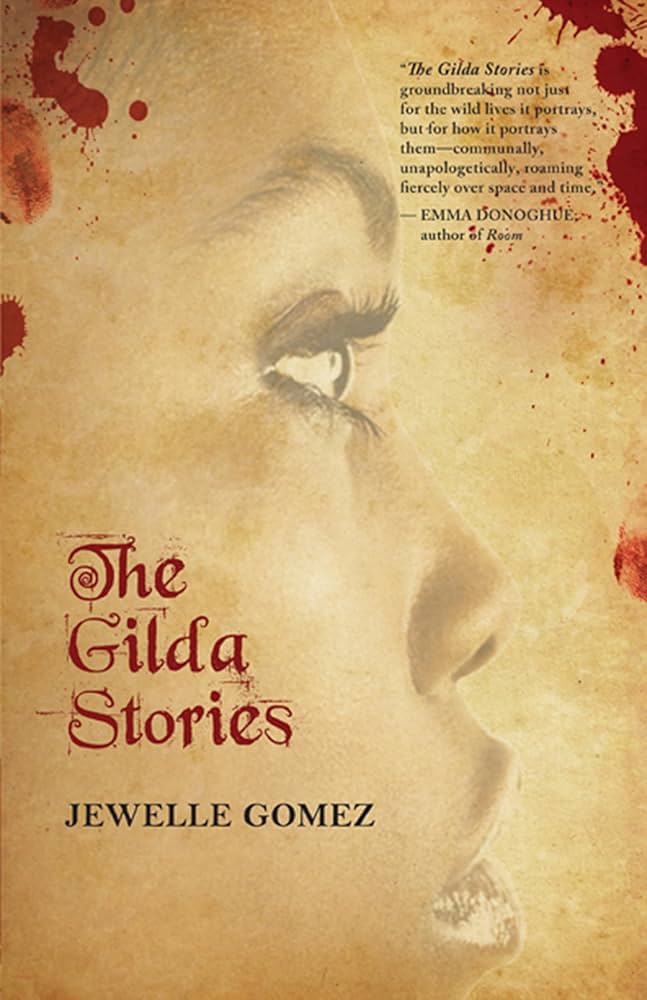
Gomez, Jewelle. The Gilda Stories. Beacon Press, 2023.
The Gilda Stories by Jewelle Gomez is a vampire novel that explores racism, queer love, slavery, chosen family, and survival across generations. More than simply a vampire story, the novel examines what it means to belong to one another in a world built on violence and displacement. The story begins with a frightened young woman escaping slavery and finding refuge in Gilda’s brothel, where she is introduced to compassion, education, and community in a way she has never experienced before.
“The gambling, musical divertissements, and the private rooms were all well attended. Gilda employed eight girls, none yet twenty…” (14). From the beginning, Gomez creates a setting that feels alive with intimacy and emotional texture. The young woman remains fearful of white men and the possibility of being dragged back into slavery: “Any of these men could capture her and take her back to the plantation” (29). Yet within Gilda and Bird’s household, she witnesses something entirely different from the cruelty she has known. The women are intelligent, capable, compassionate, and empowered: “They all had manners of ladies, could read, write, and shoot” (24).
Eventually, the young woman learns that Gilda and Bird are vampires, though Gomez reimagines vampirism as something rooted in connection rather than violence. “It is through our connection with life, not death, that we live” (43). The vampires in this world do not exist purely as predators. Instead, they exchange energy, dreams, and emotional understanding with humanity. Gomez writes, “We draw life into ourselves, yet we give life as well… It’s a fair exchange in a world full of cheaters” (43).
Chosen Family and Queer Love
One of the strongest elements in this novel is its exploration of chosen family. The emotional architecture of the relationships feels deeply intentional, especially the connection between Gilda and Bird. Their love is romantic, nurturing, and spiritual all at once. When Gilda prepares to die, she asks the young woman to remain with Bird, believing she belongs among them. Eventually, the young woman takes on the name Gilda herself, continuing the family’s lineage and identity she has entered.
Throughout the novel, Gomez repeatedly returns to the idea that family is not solely determined by blood, but by loyalty, protection, understanding, and mutual care. Eleanor later says, “…to choose someone for your family is a great responsibility. It must be done not simply out of your own need or desire but rather because of a mutual need” (63). That line felt especially powerful to me because it defines family as a responsibility rather than ownership.
The language surrounding community and belonging throughout the novel is often breathtakingly beautiful: “Those of us who can withstand that uneasy pulling of the sea’s waters swirling about the bay feel firmly rooted here and protective of each other” (71). Gomez creates an emotional atmosphere where intimacy and survival become deeply intertwined.
Resistance Against Exploitation
The antagonist, Fox, represents exploitation, cruelty, and domination. Unlike Gilda’s compassionate philosophy, Fox treats working women as disposable and slave-like. Because Gilda herself escaped plantation slavery, her conflict with Fox becomes deeply personal and symbolic. As the story unfolds over time, Gilda also becomes involved in activist movements such as Greenpeace and the Black Panther Party, continuing the novel’s larger themes of justice, resistance, and collective care.
One thing I struggled with personally was pacing. I found myself wishing Fox had been introduced earlier within the story, possibly within the first sixty pages, to create a stronger central tension sooner. I also wanted the novel to slow down more often and remain longer inside the emotional and sensual details of each scene. The relationships, touches, environments, and emotional moments were among the novel’s strongest parts, and I often found myself wanting more time to fully inhabit them before the story moved forward. By the end, the pacing felt rushed to me compared to the emotional depth established earlier in the novel.
Still, what stayed with me most was the novel’s belief in companionship and healing across time. Even after centuries, distance, grief, and transformation, the characters continue searching for connection with one another. The story ultimately suggests that survival alone is not enough; people also need intimacy, community, and love in order to remain whole.
 Little Lost Forest